
Live high train low cycling: practical LHTL protocol for maximum performance
Published 20 February 2026 · 6 min read
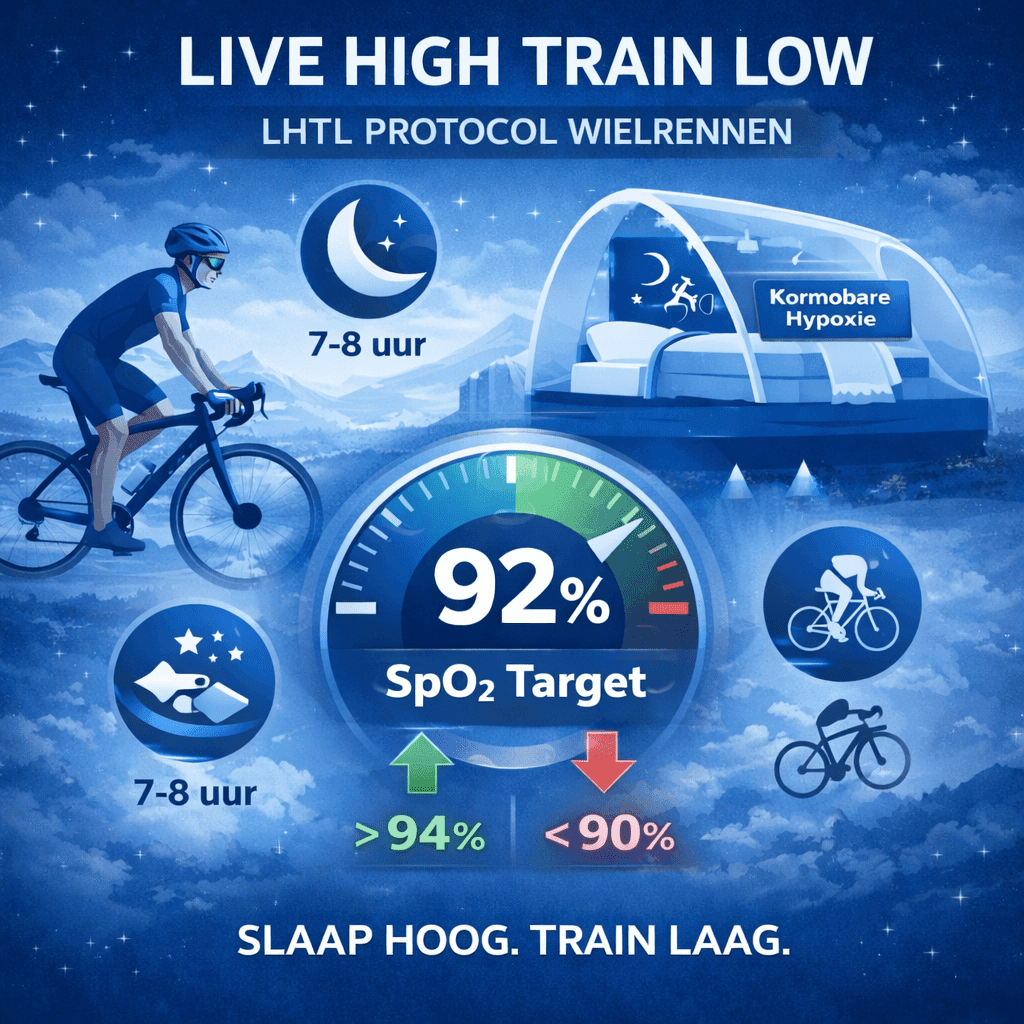
Live high train low cycling is a smart way to improve your oxygen transport without slumping your training quality. You create the adaptation stimulus during sleep, but save your intensive training for lowland. For cyclists peaking purposefully towards a time trial, course block or granfondo, a well-executed LHTL protocol can give just that few percent extra.
In this article, you get a concrete roadmap that fits the practice of cycling. You will learn how to build up altitude step by step, how to monitor objectively, and how to adjust with a clear SpO2 target zone. Everything is measurable, plannable and focused on performance.
The essentials in 30 seconds
- With LHTL, you sleep high (normobare hypoxia) and train low (maintain quality).
- The main stimulus comes from sleep, not from extra-heavy workouts.
- Adjust your altitude based on morning SpO2 trend, with a guide value around 92%.
- Do not increase until 94% or higher and reduce at 90% or lower, assessed over several days.
What does live high train low mean for cycling?
Live high train low cycling means you expose the body to lower oxygen availability during rest and sleep, while continuing to do the intensive training stimuli at sea level. Instead of travelling to the mountains, simulate altitude via an altitude tent or similar sleeping solution.
Important: this is done with normobaric hypoxia. The air pressure remains the same, but the oxygen percentage is reduced. This creates a controlled stimulus that you can build up step by step and monitor accurately.
Want the basics around this principle first? Then read sleep high train low or the wide intro altitude training.
Why this is often misunderstood
Many riders automatically associate altitude training with “as high as possible” and “as hard as possible”. This is exactly where it goes wrong. Sleeping too high too soon increases the risk of poor sleep, fatigue and loss of training quality.
At LHTL, you win precisely through control:
- You keep your intensive blocks sharp, because you run those low.
- You gradually build up the hypoxic stimulus via sleep.
- You adjust via data, especially via SpO2 trends and sleep quality.
The haematological stimulus is related to EPO response and adjustments in oxygen transport, among other things. Find out more in How altitude training increases your EPO levels.
When is live high train low interesting for cyclists?
Live high train low cycling fits especially well in these situations:
- You plan a peak period of 3 to 6 weeks towards important competitions.
- You want to improve your aerobic base and recovery capacity without losing intensity.
- You have a structured training schedule and can consistently sleep in the tent.
- You want to plan preparation around work, family and training.
💡 LHTL is often most valuable when your training quality is already high. That's when marginal gains really become apparent.
The practical LHTL protocol for cycling
The structure below is designed for cyclists who train intensively and focus on the sleep stimulus. The protocol assumes a controlled altitude zone and SpO2 controlled adjustment.
Phase 1 - Introduction and familiarisation (week 1)
- Start at 2000m simulation altitude.
- Sleep 6 to 7 hours a night in the tent.
- Measure SpO2 every morning at a set time.
- Leave your workouts content unchanged, focus on sleep quality.
Goal: get used to normobaric hypoxia without fragmenting your sleep. In this week, “sleeping well” is more important than “sleeping high”.
Phase 2 - Adaptation and real incentive (weeks 2 and 3)
- Build up to 2200 to 2500 metres if your data support it.
- Aim for 7 to 8 hours of sleep per night.
- Minimum 14 nights of exposure at this stage.
- Intensive interval training remains low key.
- Adjust altitude based on SpO2 target zone around 92%.
This is usually where core adaptation occurs, provided your sleep remains stable. For more context on suitable altitude zones: optimal height at LHTL.
Phase 3 - Stabilise and optimise (week 4)
- Stable altitude 2300 to 2500 metres, controlled by your SpO2 trend and sleep.
- Training volume remains similar, but monitor recovery tighter.
- Plan 1 extra quiet day if sleep quality declines.
Goal: keep the stimulus stable and prevent fatigue from creeping into your intensive sessions.
This is how you monitor this lens
Live high train low cycling works best when you make it measurable. You don't steer by feel alone, but by trends in a small number of parameters.
1. SpO2 trend (morning measurement)
Measure every morning immediately after waking up, still lying in bed. Always use the same time of measurement and the same device. Look at trends over at least 5 to 7 days.
Target value: morning SpO2 around 92%.
- Remains your morning value 94% or higher over several days? If so, the stimulus may be too low and you can increase the simulation height by 100 to 200 metres increase.
- Does your morning value fall towards 90% or lower? Then the load may be too high and temporarily lower the height by 200 metres.
Interpretation is always based on trend, never on a single isolated measurement. More background: oxygen saturation at altitude.
2. Sleep quality
Monitor sleep on two levels:
- Subjective: Do you feel rested, clear and stable during the day?
- Objective: Nocturnal awakenings, sleep-in time and total sleep duration.
⚠️ If sleep quality deteriorates for more than 4 to 5 days, lower your altitude by 200 metres and stabilise first.
3. Recovery feeling and RPE in fixed training
Choose 1 to 2 fixed training moments per week as a reference, for example a steady endurance ride or a subthreshold block. Record power output, heart rate and your RPE. If the same power output suddenly feels much heavier, this is often a signal that recovery is lagging behind.
Decision rule: Target your morning SpO2 around 92%. Increase only at 94% or higher and decrease at 90% or lower. Always assess over several days and in combination with sleep quality.
Common mistakes at LHTL in cycling
- Too fast too high: directly to 2800 to 3200 metres without habituation.
- SpO2 as a separate measurement: Deciding on one number instead of trend.
- Underestimate sleep: less than 6 hours of sleep and still continue to build.
- No nutrition or iron check: suboptimal status inhibits adaptation.
Power supply and iron are often a silent limiter. See iron and nutrition during altitude training.
When do you see effect and how long does it last?
Many cyclists notice improvement in recovery and aerobic “ease” between day 10 and day 21. You often see the maximum effect around weeks 3 to 5, depending on consistency, sleep and total load.
After stopping, the effect can continue for 4 to 4 weeks on average. Therefore, many riders plan the end of the protocol 7 to 14 days before a major goal, depending on their response pattern.
Decision aid: is LHTL a good choice for you?
Use this short checklist:
- Can you sleep in the tent for at least 5 nights a week?
- Do you have a stable training schedule and recovery routine?
- Are you willing to steer by data rather than ego?
- Do you have a clear peak period in the next 4-8 weeks?
💡 If you answer “yes” to all questions, live high train low cycling is usually a good fit for your approach.
Start your live high train low route for cycling
Want to apply live high train low cycling professionally, with a setup that is quiet, works practically at home and guidance that helps you steer on SpO2 and sleep? Check out our cycling packages and the experiences of other riders.


