
Height training
Published 15 August 2012 · 3 min read
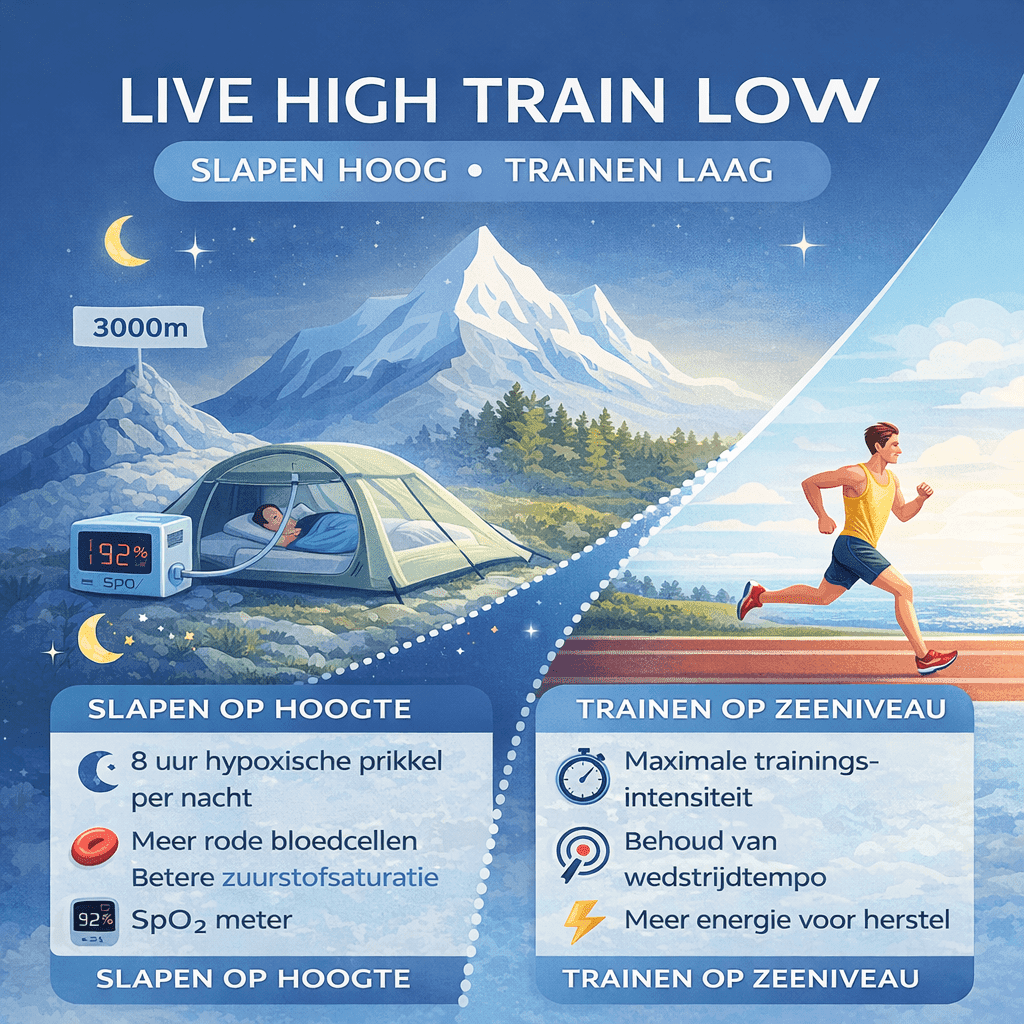
Altitude training is often seen as the way to improve performance at sea level. Yet in practice, it turns out that not every altitude training has the same effect. So what determines whether altitude training actually works? And why does Live High Train Low often deliver better results than traditional altitude training?
The essentials in 30 seconds
Conclusion: For performance improvement at sea level, Live High Train Low is usually more effective than Live High Train High.
Nuance: Traditional altitude training can be valuable, provided preparation, periodisation and load control are optimal.
Practical lead: If you want to exploit the altitude stimulus without losing training quality, sleeping at altitude and training low is usually the most controlled strategy.
Why altitude training works - and why it sometimes backfires
At its core, altitude training revolves around controlled exposure to hypoxia. Lower oxygen availability increases erythropoietin production, which ultimately leads to an increase in red blood cells. This improves oxygen transport to the muscles.
Yet more oxygen transport does not automatically mean better performance. On the contrary, when the hypoxic load becomes too high, recovery can slow down. Therefore, dosage is crucial.
For a comprehensive physiological underpinning read also the physiological benefits of altitude training.
⚠️ Reality check
Although training at altitude feels heavy, heavy is not the same as effective. When intensity drops structurally, the performance effect can actually decrease.
Traditional altitude training: what really happens?
In classic altitude training, the athlete stays and trains at altitude. In theory, you thus combine the hypoxic stimulus with training load. In practice, however, several shifts occur.
Physiological changes
- Heart rate increases with equal load
- Training speed drops for the same effort
- Sleep may temporarily deteriorate
- Hydration needs increase
As a result, the absolute training intensity often decreases, while the perceived load increases. Moreover, the body requires additional recovery capacity.
📊 Research shows
A review in the Journal of Applied Physiology shows that Live High Train Low produces, on average, greater performance improvements than Live High Train High. In particular, maintaining high training intensity proves decisive.
Preparation determines effect
Before starting altitude training, the basics need to be right. Without preparation, the effect remains limited.
- Measure ferritin at least four weeks in advance
- Correct iron deficiency if needed
- Analyse resting heart rate trend
- Evaluate training load of last six weeks
- Schedule an important match 8 to 14 days after return
- Book at least 48 hours of post-trip recovery
In addition, nutrition plays a key role. Read more at iron and nutrition during altitude training.
💡 Did you know?
When ferritin is below the optimal zone, the increased erythropoietin production may not be sufficiently utilised. Therefore, measurement is more important than standard supplementation.
Live High Train Low: why this strategy often works better
Unlike the traditional approach, with Live High Train Low you sleep in a hypoxic environment while performing intensive workouts at sea level. As a result, you combine adaptation with maintaining training quality.
Read also Live High Train Low explained and Sleep High Train Low.
The benefits at a glance
- Prolonged hypoxic stimulus during sleep
- Maintaining maximum training intensity
- Less disruption of technology and speed
- Lower cumulative stress
🧭 In practice
Many athletes adjust the altitude so that nighttime oxygen saturation is around a working zone, say around 92 per cent. Thereby, the trend over several days is leading, not one single measurement.
This is how you monitor altitude training objectively
Effective altitude training requires data-driven guidance. Feeling alone is insufficient.
- SpO2 trend: Does it stabilise or fall over several nights?
- Sleep quality: number of interruptions and feeling rested
- Recovery feeling: muscle fatigue and training output
Decision rule: When SpO2 drops below the target zone for several nights AND sleep deteriorates, the altitude should be adjusted.
You can read more about oxygen monitoring at oxygen saturation at altitude.
When to continue, adjust or stop
Continue
- Stable SpO2 trend
- Normal sleep duration
- Maintaining training quality
Adjust
- Sleep deteriorates several nights
- Morning fatigue increases
- Training intensity drops
Stop
- Persistent headache
- Nausea or dizziness
- Obvious performance deterioration
For alarm symptoms, stopping and descending is always the primary intervention.
Summary
While traditional altitude training can be effective, this approach requires perfect timing and load control. In contrast, Live High Train Low often offers more control over adaptation as well as training quality. This creates a more stable and predictable performance effect.
Want to take a personal and data-driven approach to this? Then feel free to take contact on for tailored guidance.


