
Altitude training for athletes: altitude training for cyclists, protocol and intensity
Published 9 February 2026 · 4 min read
Many cyclists use altitude training to improve their endurance, but get stuck on the same questions: how much altitude makes sense, how hard can you train and when does the stimulus become too great? This article is relevant for cyclists and triathletes who want to improve their athletic performance via altitude training without unnecessary recovery loss or performance degradation.
The essentials in 30 seconds
Conclusion: Altitude training can demonstrably help cyclists improve their aerobic capacity, if altitude, duration and intensity are carefully matched.
Nuance: Training more height or harder does not automatically produce more effect and actually increases the risk of overtraining.
Practical lead: Use altitude as a controlled stimulus, keep intensity low and adjust for recovery feeling and SpO₂ tendencies.
Why altitude training for cyclists is often misunderstood
Altitude training is often seen in cycling as a magic accelerator of performance. Those who sleep or train higher would automatically come back stronger. In practice, this is precisely where confusion arises. Cyclists combine altitude with heavy training blocks, long hours and high power, while at the same time the body has to get used to less oxygen.
As a result, fatigue is confused with training stimulus. Performance loss is seen as a necessary evil, while it is often a signal of imbalance.
💡 Did you know?
A drop in your normal training ability at altitude is not a sign of weakness, but a logical physiological consequence of reduced oxygen availability. Those who ignore this are missing the very adaptation that altitude training is all about.
What happens physiologically during altitude training
At altitude, oxygen pressure is lower, so less oxygen is available to your muscles. The body responds with a series of adaptations. Breathing speeds up, heart rate increases and, in the longer term, red blood cell production is stimulated.
For cyclists, aerobic efficiency is particularly relevant. The body learns to use oxygen more economically, which can translate into higher sustained power output after returning to sea level.
📊 Research shows
Studies show that well-dosed altitude training can contribute to improvements in VO₂max and power output in endurance athletes, provided recovery and intensity are strictly monitored.
Altitude, duration and intensity balanced
The effectiveness of altitude training for cyclists depends on three variables: altitude, exposure duration and training intensity. These factors reinforce each other, but can also undermine each other.
What height makes sense?
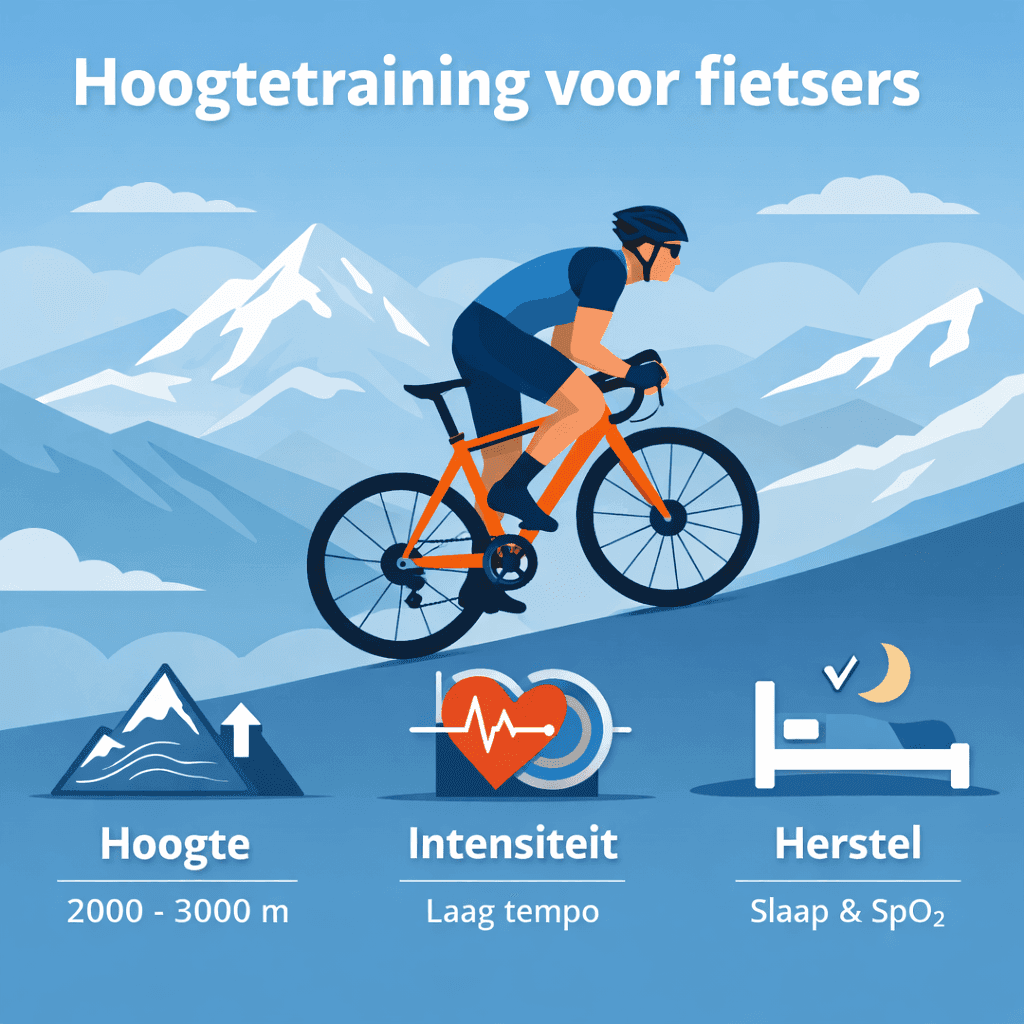
For most cyclists, the effective zone is between 2000 and 3000 metres equivalent altitude. Higher is possible, but greatly increases the load with no guarantee of additional effect.
How long do you need to be exposed?
Adaptation takes time. Short exposure of a few nights has little effect. Usually at least two to three weeks are needed to achieve structural adaptation.
How hard can you train?
At altitude, the focus shifts to size and technique, not intensity. Heavy intervals are limited or even temporarily avoided. The incentive lies in the combination of hypoxia and controlled loading.
⚠️ Reality check
Those who want to ride the same power outputs at altitude as at sea level do not train more effectively but pile on stress. Altitude training only works if you accept that intensity is temporarily lower.
Subjective feeling versus objective data
Cyclists are used to steering by wattages, heart rates and training schedules. At altitude, that is not enough. The subjective sense of recovery becomes at least as important.
Poor sleep, increased resting heart rate or falling SpO₂ in the morning are signals that the workload is too high. Ignoring these signals rarely leads to better performance.
🧭 In practice
Successful altitude training in cyclists combines data with feeling. Power tells what you can deliver, sleep quality and recovery tell what you can sustain.
Decision moments during altitude training
During an altitude training programme, there are clear moments when you need to make adjustments.
- Continuing: stable sleep, gradual adjustment of heart rate and slightly increasing SpO₂ trend.
- Adjust: persistent fatigue, restless sleep or marked decline in performance.
- Slow down or stop: headache, nausea, structurally poor sleep or falling saturation despite rest.
Altitude tent and pre-acclimatisation for cyclists
For cyclists who cannot spend long periods of time at altitude, pre-acclimatisation can be a valuable preparation. This involves using normobaric hypoxia, where the oxygen percentage is reduced without a change in air pressure.
The primary stimulus occurs during sleep. This is the time when the body is exposed to hypoxia for a long time and without training stress.
From protocol to trust
Altitude training for cyclists is not a set recipe, but a process of observation, adaptation and learning. Those who understand and respect the stimulus can benefit structurally.
For athletes who need guidance, customisation and data-driven adjustment, professional support can help them get the most out of altitude training without unnecessary risk.
If you want to know how your training situation translates into an appropriate altitude training programme, personal coaching can help you make the right choices. Take contact with us.
❓ Mini-FAQ
When do I see effect of altitude training?
Usually only after returning to sea level, when the body fully utilises the accumulated adaptations.


