
Height tent ’course protocol’ for spring races
Published 26 February 2026 · 3 min read
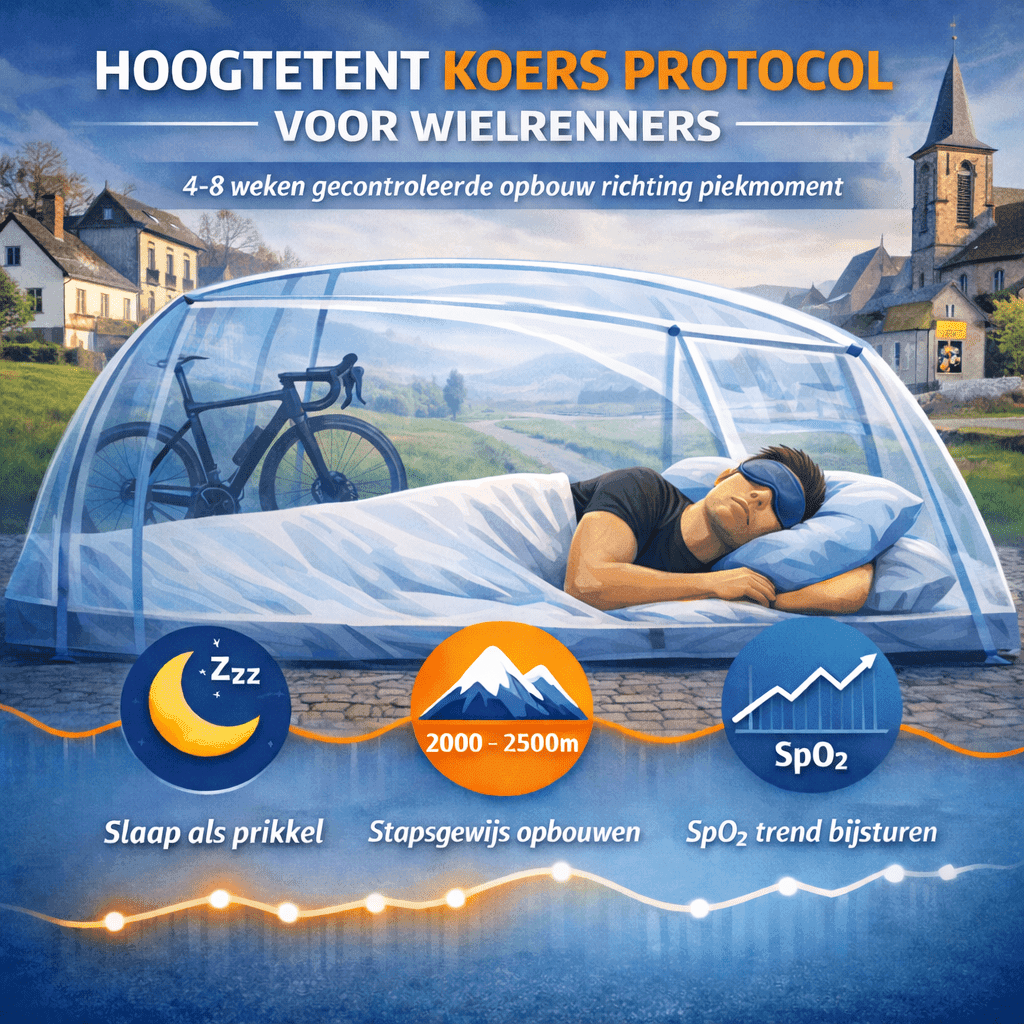
The right height tent ‘course protocol’ can make the difference between “good” and “decisively strong” in the weeks before spring races. Cyclists look for ways to optimise their oxygen transport, recovery capacity and endurance capacity every year. An altitude tent, properly deployed via normobaric hypoxia, can add that physiological stimulus in a controlled and plannable way. Not as a panacea, but as a strategic extra layer of training.
This article tells you exactly how to deploy an altitude tent towards classics, what the optimal timing is, how to trend SpO2 and when to make adjustments. Including concrete decision rules.
What is the purpose of an altitude tent course protocol?
Spring races require a unique combination of aerobic capacity, repeated anaerobic efforts and recovery capacity between accelerations. The goal of an altitude cycling protocol is not simply “more red blood cells”. It is about:
- Improving oxygen transport
- More efficient oxygen utilisation
- Enhanced recovery between intense efforts
- More stable energy management in long races
An altitude tent works through normobaric hypoxia. The oxygen percentage is reduced while the air pressure remains the same. Sleep is the primary stimulus in this process. During the day, you train at sea level, which matches the Sleep High Train Low principle.
Why many cyclists get it wrong
The biggest mistake is starting too late. Adaptation takes time. EPO rises relatively quickly, but functional enhancement of oxygen transport and buffering takes weeks.
In addition, we often see:
- Too aggressive take-off height
- No SpO2 monitoring
- No consideration of training load
- Insufficient iron status
Those who start without a plan run the risk of disturbed sleep and reduced training quality. An altitude tent is no substitute for acclimatisation, but it will significantly reduce the risk of negative altitude effects if you build up the process in a controlled way.
Step by step altitude course protocol towards spring races
Phase 1 - Start 6 to 8 weeks before first peak moment
- Starting altitude: 2000 metres
- 8 to 9 hours of sleep per night
- Minimum 5 nights per week
- Morning SpO2 as trend measurement
This height matches the ideal LHTL zone from 2000 to 2500 metres.
Phase 2 - Progressive build-up after 10 to 14 days
- Increase to 2200 to 2400 metres
- Increase only when stable SpO2 trend above 94 per cent
- Reduce when repeatedly 90 per cent or lower
The morning value is not an absolute truth. It is about the trend over several days.
Phase 3 - Stabilisation 3 to 4 weeks
This is where the real adaptation takes place. The combination of qualitative intervals during the day and nocturnal hypoxia produces the desired effect.
Train intensively at sea level. Read more about physiological mechanisms in how altitude training works.
Phase 4 - Taper and phase-out
Stop 5 to 7 days before your main course. This maintains your adaptation while letting fatigue subside.
This is how you monitor this lens
A professional height tent ‘course protocol’ is always measurable.
1. SpO2 trend
Measure every morning right after waking up. Look at trends over 5 days. A downward trend with fatigue symptoms means adjusting.
2. Sleep quality
Use subjective score or wearable data. Fragmentation and restless sleep are signals that you are rising too fast.
3. Recovery feeling
Watch heart rate at submaximal effort. A sudden higher heart rate at fixed wattages is a warning.
Decision rule: Falls SpO2 trend 3 days below 90 per cent and drops sleep quality, lower 200 metres immediately.
Importance of iron and nutrition
Increasing EPO production needs sufficient iron. Have ferritin checked before start. Guide value for male cyclists is often above 50 micrograms per litre. See also iron and nutrition during altitude training.
What can you realistically expect?
No magic power jump. Well:
- Improved endurance
- Faster recovery between efforts
- Better stability in long courses
The combination of planned hypoxia, training quality and monitoring makes the difference.
Is this suitable for every cyclist?
A high-altitude course protocol is especially useful for competitive riders who can plan several weeks before peak performance. For recreational riders without clear periodisation, the effect is more limited.
Conclusion
An altitude ‘course protocol’ for spring races requires 4-8 weeks of preparation, step-by-step build-up, SpO2 trend monitoring and correct tapering. The power is not in altitude per se, but in control. Those who work systematically increase their physiological margin without sacrificing training quality.
Ready to strategically optimise your spring form?
Check out our cycling package and find out how to do controlled work with normobaric hypoxia.
Or learn the altitude tent experiences of other riders


