Sleep high train low: how to use it smartly and measurably
Published 23 August 2025 · 12 min read
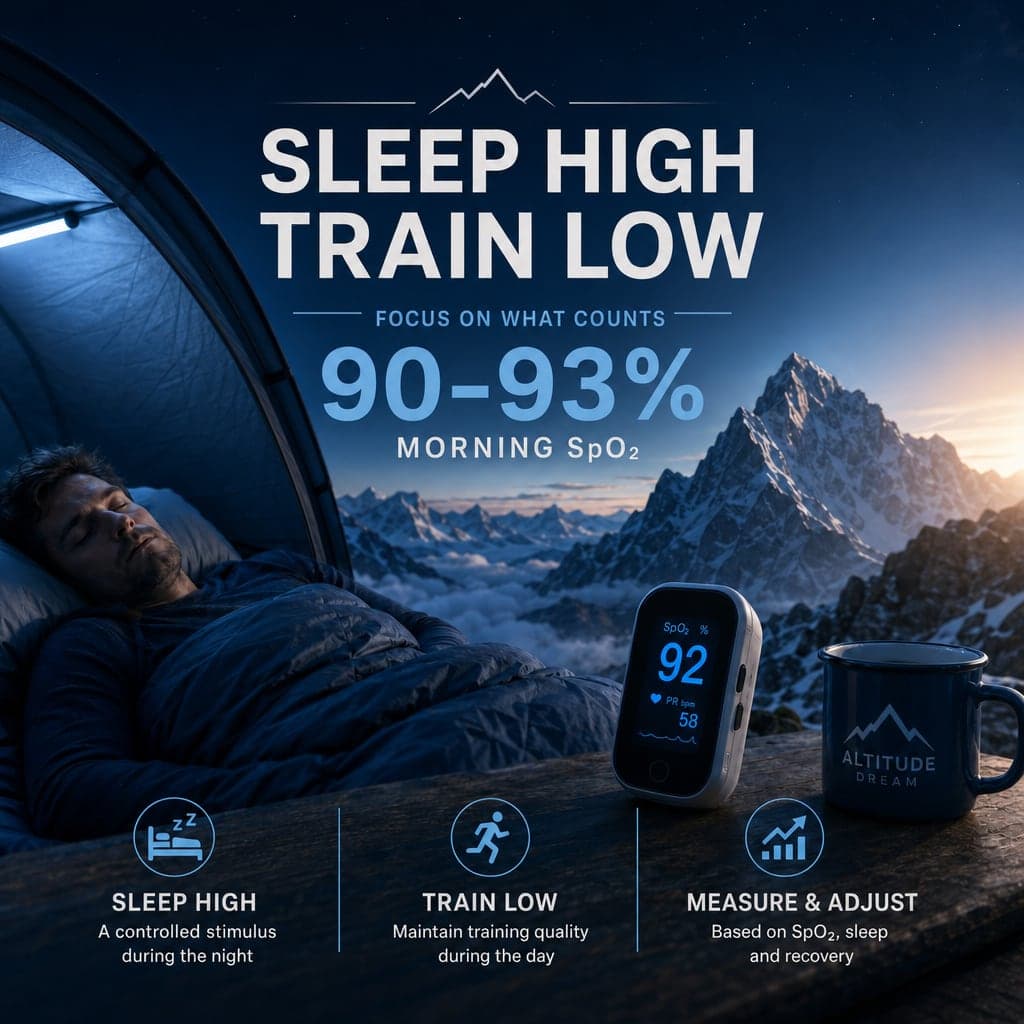
Sleep high, train low means you sleep in an environment with less oxygen, while training normally during the day. The aim is not to sleep as high as possible. The aim is to provide just enough hypoxic stimulus, without unnecessarily compromising sleep, recovery, or training quality.
That’s why the ‘sleep high, train low’ approach works best when you don’t just stick to a fixed altitude, but base it on your morning readings, sleep quality and recovery. For many users, the ideal morning SpO2 during the build-up phase is roughly between 90% and 93%. This is a practical adaptation zone: enough stimulation, but usually still manageable. Those who prefer the broader basis of altitude training understands, this method can be applied much more precisely.
Short answer: ‘Sleep high, train low’ works best when you sleep for 7 to 9 hours a night in normobaric hypoxia, train normally during the day, and gradually build up your altitude based on your morning SpO2, sleep and recovery. A morning SpO2 reading of 90% to 93% is often the most useful target range.
Conclusion: sleep high train low is especially effective if the altitude stimulus remains dosed and measurable.
Nuance: Higher is not automatically better, as too much hypoxia can disrupt sleep and recovery.
Practical hook: Send your morning SpO2 trend, not a single measurement.
Sleep high, train low
Sleep high train low, often abbreviated as LHTL, is a high-altitude training method where your body is exposed to less oxygen during sleep. During the day, you train in normal oxygen conditions. This way, you combine two advantages: an altitude stimulus at rest and the maintenance of training quality during intensive sessions.
In practice, this can occur at natural altitudes, for example, during a high-altitude training camp. It can also be done at home with an altitude tent. In that case, it concerns normobaric hypoxia. The air pressure remains normal, but the oxygen percentage in the inhaled air is reduced. This simulates altitude without having to be physically on a mountain.
This makes the method interesting for endurance athletes, mountaineers and ambitious recreational athletes. However, the core principle is always the same: the sleep phase is used as a controlled stimulus. The training itself remains low, so that pace, power, technique and quality do not drop unnecessarily.
In practice: Sleep high, train low is not extra training that you need to force. It is a recovery-related stimulus. If the stimulus becomes too intense, you will often notice it first through poorer sleep, a lower morning SpO2, increased fatigue, or less desire to train.
Why high train low works better with steering
When it comes to altitude training, many athletes immediately think of a fixed altitude, such as 2,000 or 2,500 metres. That’s understandable, but not always ideal. Two people can react completely differently at the same set altitude. One athlete sleeps soundly with an SpO2 of 93%. The other drops to 88% and wakes up feeling tired.
This is why "sleep high, train low" is particularly valuable when you dose the stimulus personally. The set altitude is merely the means. Your body's reaction determines whether that setting is appropriate at that moment.
A good protocol therefore looks at three questions. Are you getting enough oxygen stimulus? Are you recovering well? Does your daytime training remain qualitatively strong? Only when those three points align are you likely in the right zone.
Sleep high, train low and saturation: guidelines for the morning
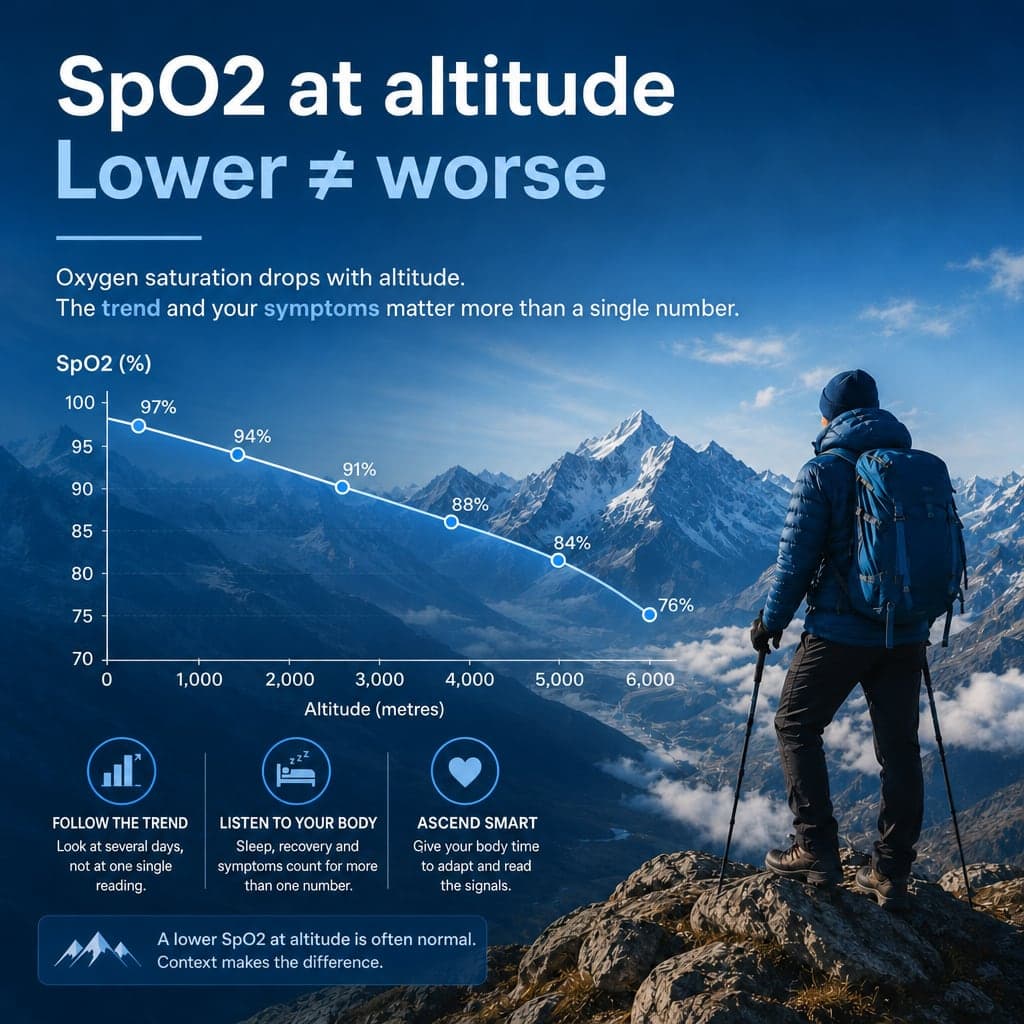
The morning SpO2 is one of the most practical control values for sleep high, train low. Preferably measure it shortly after waking, while sitting, at rest, and always in approximately the same way. The individual value is less important than the trend over several days.
The guidelines below support a calm, measurable progression. They are intended as a practical framework and not as a medical diagnosis. In cases of doubt, complaints, or pre-existing medical conditions, professional advice remains important.
| Morning SpO2 | Action | Explanation |
|---|---|---|
| ≥ 94% | Increase height cautiously | The stimulus might still be too light, provided sleep and recovery remain good. |
| 90% to 93% | Maintain altitude | This is often the optimal adaptation zone for a controlled build-up. |
| ≤ 89% | Lower height | The burden is likely too heavy. Prioritise recovery and sleep. |
Action: Increase height carefully.
Explanation the stimulus may still be too light, provided sleep and recovery remain good.
Action: Maintain height.
Explanation This is often the optimal adaptation zone for controlled build-up.
Action: lower height.
Explanation The burden is likely too heavy. Prioritise recovery and sleep.
These zones are particularly useful when you combine them with how you feel. An athlete with a 91% SpO2 reading, good sleep and normal training quality is likely to be doing well. Someone with a 91% reading, a headache, restless sleep and heavy legs may be overtraining.
Further insight into measuring and interpreting can be found in our guide on saturation in an altitude tent.
How to build up sleep high train low
A good build-up starts conservatively. The first few nights are meant to let your body get used to it. So you don't have to go to a high setting right away. Indeed, increasing too quickly is one of the most common mistakes.
The best approach is simple: start light, measure consistently, and only increase if the trend indicates it. It's important not to unnecessarily increase the intensity of your training in the first week. Your body already receives a new stimulus during the night.
Example protocol for the first 21 days
Day 1 to 3: Start gently. Aim to get used to it, not to maximise stimulation. A morning SpO2 reading of around 93% to 94% is fine.
Day 4 to 7: Build up gradually towards the target range of 90% to 93%, as long as your sleep and recovery remain good.
Days 8 to 14: Stabilise. This is usually the most important adaptation phase. Avoid large jumps.
Days 15 to 21: Optimise. Increase only with structurally high SpO2, good sleep, and normal training quality.
Do you use a altitude tent, and you can accurately dose that build-up. That is the practical advantage of working with normobaric hypoxia at home. You are not dependent on the altitude of a location. You adapt the stimulus based on your response.
How many hours of sleep do you need?
When it comes to altitude training, it’s not just about the set altitude. Total exposure also counts. Those who sleep in hypoxia for only a few hours a night often receive too little stimulus. Conversely, those who go too long or too high may even lose recovery benefits.
For most athletes, 7 to 9 hours per night is a sensible range. Consistency is important here. A consistent series of nights works better than the occasional very intensive hypoxia night.
Practical sleep check
- Ideally, aim for 7 to 9 hours of sleep per night in the tent.
- Keep bedtime and wake-up times as stable as possible.
- Measure the SpO2 in the morning in the same way.
- Record sleep quality, fatigue, and any complaints.
- Lower the height if sleep clearly deteriorates for multiple nights.
For some athletes, one extra hour of sleep compared to normal is sensible. Not because hypoxia should feel dangerous, but because adaptation requires energy. Especially in the first week, extra sleep can make the difference between adapting well and becoming unnecessarily fatigued.
What do you do with your training during the day?
The second part of "sleep high, train low" is at least as important: train low. You therefore train in normal oxygen conditions during the day. This allows you to better maintain pace, power, technique, and strength.
For endurance athletes, this means that intensive intervals, threshold training, and race-specific sessions will mostly remain in normal air. The hypoxic stimulus should primarily be overnight. This way, you prevent every training session from feeling harder than necessary.
For cyclists, runners and triathletes, this is particularly relevant during blocks of high training intensity. A good LHTL (Low Heart Rate Training Long) protocol supports training but should not dominate it. If your power drops, your heart rate remains unusually high, or your recovery deteriorates, it is wiser to adjust than to push through.
To do and not to do
Do: Use the altitude stimulus during sleep, perform training as normal and calmly assess trends.
Don't: increase the height every day, ignore complaints, or make intensive training extra difficult due to oxygen deficiency.
How to monitor this objectively
Objective monitoring makes "sleep high train low" much safer and more effective. It prevents you from increasing too quickly based on intuition. At the same time, you'll see more quickly when the stimulus remains too light.
Use a minimum of four control values: morning SpO2 trend, sleep quality, recovery feeling, and symptoms. For athletes, you can optionally add HRV, resting heart rate, power, pace, or training RPE. More on effect measurement can be found in our guide on measuring altitude training effect.
| Measuring point | What are you paying attention to? | Practical interpretation |
|---|---|---|
| SpO2 trend | Morning value over several days | Values from 90% to 93% are often appropriate. Values below 89% usually require a reduction. |
| Sleep | Time to fall asleep, waking up, sleep depth | Poorer sleep is often the first sign that the stimulus is too much. |
| Recovery | Fatigue, resting heart rate, HRV, muscle soreness | Do not increase if the recovery trend is declining, even if SpO2 is higher. |
| Symptoms | Headache, nausea, dizziness, tightness in the chest | If symptoms are clear, reduce or pause and ask for advice if in doubt. |
What are you paying attention to? Overnight value over multiple days.
Interpretation: Values from 90% to 93% are often appropriate. Values below 89% usually require a reduction.
What are you paying attention to? Sleep duration, waking up, and sleep depth.
Interpretation: Poorer sleep is often the first sign that the stimulus is too intense.
What are you paying attention to? Fatigue, resting heart rate, HRV, and muscle sensation.
Interpretation: Do not increase during a declining recovery trend, even with higher SpO2.
What are you paying attention to? headache, nausea, dizziness, and shortness of breath.
Interpretation: With clear complaints, reduce or pause, and seek advice if in doubt.
Important: SpO2 is always a trend value. A single measurement may deviate due to cold fingers, movement, measurement error, or restless breathing. Therefore, observe the pattern over several mornings.
Common misconceptions about "sleep high, train low"
The first misconception is that higher is always better. That's not true. A higher setting can provide more stimulation, but also more stress. If sleep quality declines, you might lose more than you gain.
The second misconception is that a low SpO2 reading is automatically a good thing. In fact, a reading that is too low in the morning may actually mean that your body is not recovering sufficiently. That is why the target range of 90% to 93% is practical: it provides guidance without being overly aggressive.
The third misconception is that train high, train low is separate from nutrition. Iron status, energy intake, and recovery capacity, among other factors, are important for adaptation. Especially during serious training blocks, it is advisable to have your ferritin and blood values checked in good time. For further reading on this, see our in-depth article on Iron and ferritin.
The fourth misconception is that a high-altitude tent completely replaces proper acclimatisation. It does not. A high-altitude tent primarily makes the process controlled, measurable and predictable. It can significantly reduce the risk of altitude-related symptoms, but does not offer a 100% guarantee.
When should you adjust or reduce?
Adjusting is part of a good protocol. It's not a sign that it's not working. Precisely because sleep high train low differs individually, adjustment is part of the method.
Increase the height only if
- your morning SpO2 remains at 94% or higher for several days;
- your sleep quality remains stable;
- you recover normally feel;
- Your daytime training isn't clearly deteriorating.
Lower the height if
- your morning SpO2 drops to 89% or below;
- you have had restless nights;
- you experience headaches, nausea, or dizziness;
- your training quality drops without a clear reason.
A small reduction is often enough. You don't need to stop straight away. The goal is to return to a stimulus your body can handle.
Sleep high train low is particularly interesting for:
Sleep high train low is particularly interesting for athletes who want to maintain training quality while adding an altitude stimulus. Think of runners, cyclists, triathletes, speed skaters, and other endurance athletes. Mountaineers can also benefit from the method, especially when they want to acclimatise their bodies in a controlled manner to lower oxygen levels beforehand.
The method is less suitable when your sleep is already structurally poor, when you are not recovering sufficiently, or when medical factors are involved that need to be assessed first. For asthma, COPD, heart problems, pregnancy or if in doubt, professional advice beforehand is sensible.
For healthy athletes with a clear goal, the biggest gains are often not found in complicated methods. The gains are actually in simplicity: building up gradually, measuring well and not pushing yourself too hard.
Would you like to start with a controlled LHTL protocol?
A good start begins with the right build-up, clear saturation guidelines and a protocol that suits your goal. Use the altitude tent as a measurable sleep stimulus, not as a competition against altitude.
Conclusion: sleep high train low is about dosing
Sleep high train low is valuable because it combines two worlds. You sleep in lower oxygen levels to stimulate adaptation. At the same time, you train normally during the day, so intensity and technique are maintained.
The key lies in dosage. It is not the highest setting that determines success, but the optimal individual stimulus. For many users, during the build-up phase, this corresponds to a morning SpO2 reading of approximately 90% to 93%, provided that sleep, recovery and training quality remain good.
Therefore, use a protocol. Measure your morning SpO2 as a trend. Look at sleep and recovery. Only increase when your body shows it can. Decrease as soon as the stimulus becomes too heavy. This way, you make sleep high train low calm, rational, and effective.
FAQ about sleep: train high, sleep low
Sleep high, train low
Sleep high train low means sleeping in a lower oxygen environment and training in normal air during the day. This way, you combine a 'high-altitude' stimulus with maintaining training quality.
What morning SpO2 is ideal for sleep high, train low?
For many users, the practical target range is between 90% and 93%. Always take into account the trend, sleep quality, recovery and any symptoms.
Do I need to increase the height for the 94% SpO2?
Only if you record a reading of 94% or higher for several days running and your sleep and recovery remain good. Always increase in small increments.
What should I do if the SpO2 reading is 89% or lower?
Lower the height, assess your sleep, and pay attention to any complaints. Professional advice is advisable in case of clear symptoms or doubt.
Does sleep high train low mean the same as altitude training?
No. With sleep high, train low you sleep high and train low. This usually helps to maintain the quality of intensive training sessions.