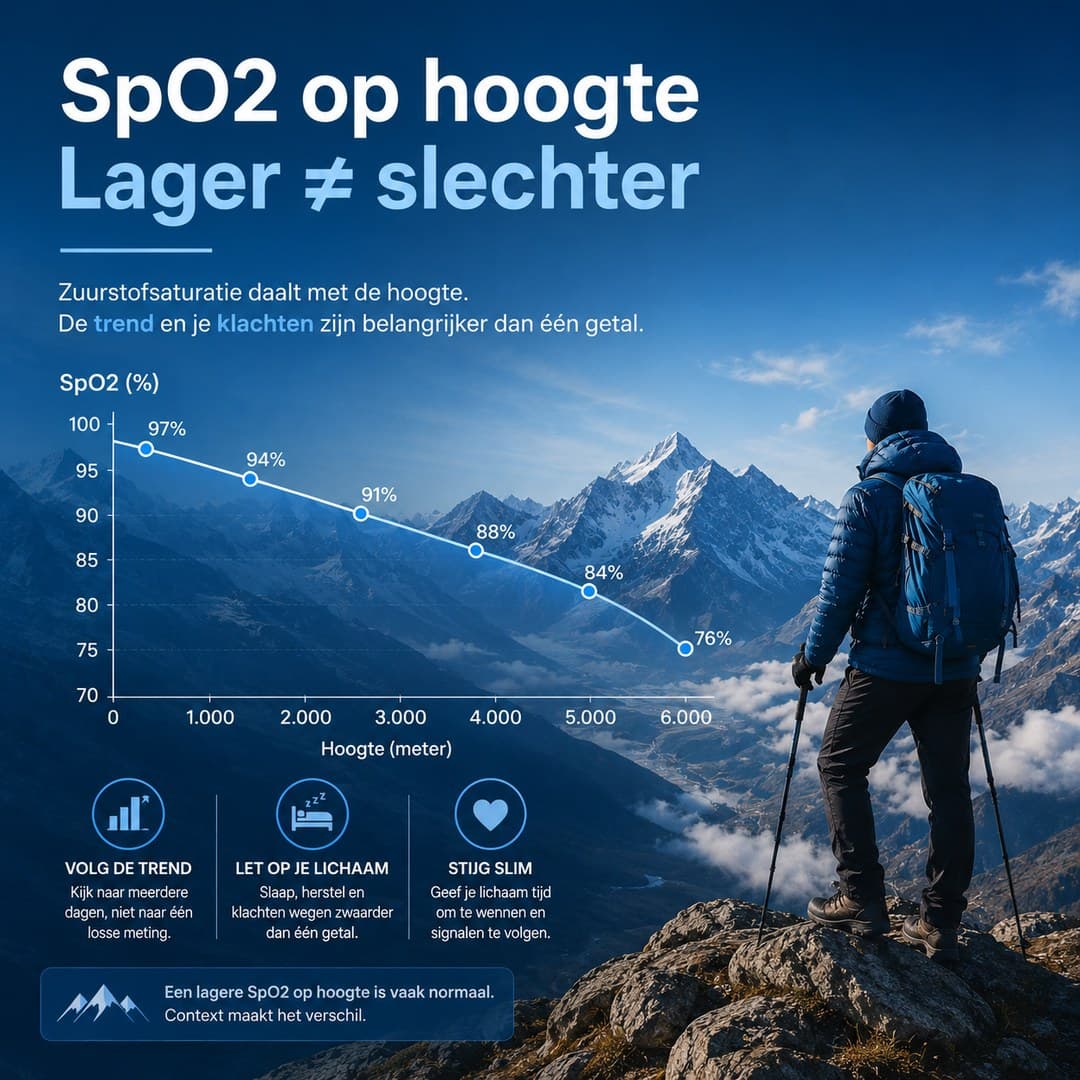
Altitude tent setup schedule: safe setup with saturation
Published 19 January 2026 · 12 min read
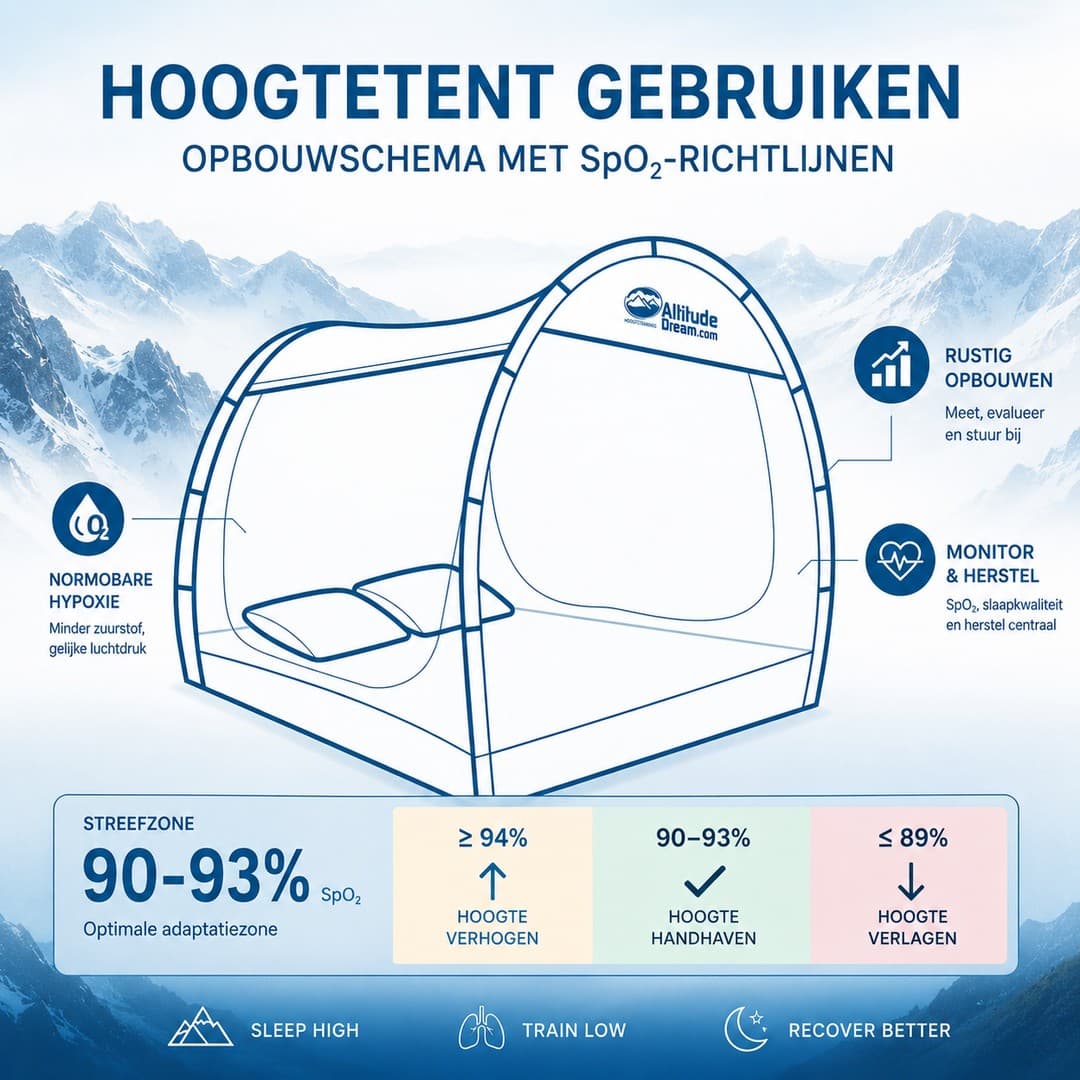
Using a high altitude tent It involves more than simply setting a level and going to sleep. The best way to build up gradually is to get used to it gently, measure your morning readings and make adjustments step by step. The most important indicator is your oxygen saturation in the morning. For most users, the ideal morning SpO₂ during the ramp-up phase is roughly between 90% and 93%.
This means: sufficient hypoxic stimulus, without unnecessarily overtaxing your body. That's why we advise against using a height tent based on feel, but rather with a simple protocol. Measure, look at the trend, and only adjust when the pattern is clear. Whoever first masters the basics of to use a height tent Understands, usually gets more out of the build-up phase.
Short answer: The best way to use an altitude tent is to build up gradually. Start conservatively, measure your SpO2, sleep quality and sense of recovery every morning, and only increase the altitude if your morning readings consistently remain too high. A morning SpO2 reading of 90% to 93% is usually the optimal adaptation zone.
Conclusion: Using an altitude tent works best with an SpO2-guided acclimatisation schedule.
Nuance: Saturation is a trend value and not an isolated absolute truth.
Practical hook: Continue building as long as sleep, recovery and symptoms remain stable.
Why use a height tent for a gradual build-up?
A height tent simulates altitude by reducing the oxygen percentage in inhaled air. We call this normobaric hypoxia. The air pressure therefore remains the same, but the oxygen availability decreases. As a result, your body receives a controlled stimulus that is similar to sleeping at altitude.
The stimulus can be useful for athletes, trekkers and mountain climbers. However, it only works well if the load matches your recovery capacity. Setting it too low provides little stimulus. Building up too aggressively can disrupt your sleep, suppress your recovery and trigger complaints. That's why a schedule is not a formality. It's the way you dose the stimulus.
The most common misunderstanding is that higher is always better. In practice, this rarely works. The best setting is the one where you get enough oxygen stimulus, but can still sleep well and recover with enough freshness. That's why we always combine a build-up schedule with monitoring.
In practice: View the altitude tent as a sleep stimulus, not as extra training. During the day, you train normally at low altitude. At night, you give your body a controlled stimulus. This fits the principle of sleep high train low.
Using a height tent in brief
A strong plan usually starts gently. Then you only increase the simulated altitude when your body reacts stably. The exact steps differ per person, goal and period. Nevertheless, the underlying logic is the same: tolerance first, then stimulus, then refinement.
Use the first few nights primarily to acclimatise. You want to know how you react to less oxygen during sleep. Only after that does the build-up become more interesting. If your morning SpO2 remains high, your sleep is stable, and you don't experience any clear complaints, you can usually increase cautiously.
Practical basic protocol
- Start with a conservative setting.
- Measure your SpO2 every morning immediately after waking up.
- Also note sleep quality, feeling of rest, and any complaints.
- Increase only if your SpO2 remains too high for several mornings.
- If your SpO2 is too low or your recovery clearly deteriorates, reduce.
Using a height tent per phase
The diagram below is intended as a practical guideline. It does not replace personal guidance, but helps to understand the logic behind the structure. The central question is always: does this setting provide enough stimulation without compromising recovery and sleep?
| Phase | Target | Practical interpretation | Adjust |
|---|---|---|---|
| Phase 1 | Getting used to the stimuli | Your body learns to sleep with less oxygen. | Don't increase too quickly. |
| Phase 2 | Encouraging adaptation | You are looking for the zone where SpO2, sleep and recovery remain balanced. | Increase with structurally high SpO2. |
| Phase 3 | Stabilise | You keep the setting if the values respond well. | Do not continue to increase if it is working well. |
| Phase 4 | Refine towards goal | You steer towards travel goals, sports goals, sleep quality and trend values. | Switch back if experiencing complaints or poor sleep. |
Objective: Getting used to the stimulus.
Interpretation: Your body learns to sleep with less oxygen.
Adjustment: Don't increase too quickly.
Objective: Facilitate adaptation.
Interpretation: You are looking for balance between SpO2, sleep and recovery.
Adjustment: Increase with structurally high SpO2.
Objective: Stabilising.
Interpretation: You keep the setting if the values respond well.
Adjustment: Do not continue to increase if it is working well.
Objective: Refine towards goal.
Interpretation: You steer towards travel goals, sports goals, sleep quality and trend values.
Adjustment: Switch back if experiencing complaints or poor sleep.
Using saturation guidelines with a height tent
The saturation guidelines form the heart of this article. Ideally, measure in the morning, immediately after waking up. This will give you a useful indication of how your body has processed the nocturnal hypoxia. Do not measure obsessively every hour. Primarily look at the trend over several days.
For most users, a morning SpO2 reading between 90% and 93% is a practical target range. If you are consistently above this range, the intensity may be too low. If you are clearly below it, the workload may be too heavy. In both cases, you should look not only at the number, but also at your sleep, recovery and any symptoms.
| Morning SpO2 | Action | Explanation |
|---|---|---|
| ≥ 94% | Increase height | Probably insufficient stimulation. |
| 90% to 93% | Maintain altitude | Usually optimal adaptation zone. |
| ≤ 89% | Lower height | Possible overload. Recovery is needed. |
Action: Increase height.
Explanation Probably insufficient stimulation.
Action: Maintain altitude.
Explanation Usually optimal adaptation zone.
Action: Lower height.
Explanation Possible overload. Recovery is needed.
These guidelines align with how we practically interpret saturation when using altitude tents. Anyone who wants to delve deeper into values, measurement errors, and interpretation can read further about saturation in an altitude tent.
This is how you monitor this lens
Monitoring doesn't have to be complicated. In fact, a simple measurement ritual often works better than a dashboard full of data. Choose a set time, use the same finger, measure calmly, and above all, note the trend. A single measurement can deviate due to cold hands, movement, poor sensor placement, or slight breathing fluctuations.
Daily check
- SpO2 trend: Meet every morning and look at 2 to 3 days together.
- Sleep quality: assess whether you sleep soundly and wake up feeling refreshed.
- Recovery: Note your resting heart rate, HRV if available, and training feel.
- Symptoms: note headache, nausea, chest tightness, or unusual fatigue.
- Training quality: During the day, your normal training shouldn't structurally deteriorate.
So SpO2 is important, but it isn’t the be-all and end-all. A reading of 91% accompanied by a good night’s sleep and normal recovery is different from a reading of 91% accompanied by a headache, restless sleep and heavy legs. That’s why you should always consider your oxygen saturation alongside how you feel.
For athletes, HRV can be particularly useful. If HRV drops for several days, your resting heart rate increases, and training feels harder, then that's a signal not to increase the intensity further. In such cases, maintaining or temporarily reducing intensity is often smarter than pushing through.
Om de fysiologische achtergrond beter te begrijpen, is de uitleg van de Cleveland Clinic over zuurstofsaturatie a useful external resource.
When do you increase the height?
You should increase the level particularly when the stimulus seems too mild. You can usually tell this is the case if your morning SpO2 is 94% or higher over several days, whilst you are sleeping well and have no symptoms. In that case, your body can probably tolerate a greater hypoxic stimulus.
Do not increase after a single isolated high reading. Nor because your schedule says you must. The body does not always react linearly. Sometimes, after a heavy training session, alcohol, stress or a short night, you already have enough load. Then, additional altitude is not advisable, even if it seemed logical on paper.
Increasing is logical if
- your morning SpO2 has been at or above 94% for several days;
- your sleep quality remains stable;
- you recover normally during the day;
- You do not experience any clear height complaints;
- My training quality is not visibly under pressure.
When do you maintain the height?
Maintaining the status quo is often the most underestimated choice. Many users want to keep pushing higher and higher, because that feels like progress. Yet sometimes the best progress is actually stability. If your morning SpO2 is between 90% and 93% and you’re functioning well, you’re usually in a strong zone.
In this zone, your body receives sufficient stimulus. At the same time, the load usually remains manageable. This allows you to build adaptation without unnecessarily disrupting your sleep. Especially in multi-week programmes, this is often more effective than scaling up too quickly.
Stability is also valuable when preparing for a mountain trek. An altitude tent makes acclimatisation controlled, measurable and predictable. This can significantly reduce the risk of altitude-related problems. However, it is by no means a 100% guarantee, nor is it a complete substitute for genuine acclimatisation whilst on the trek.
When do you lower the height?
Lowering the target is not a failure. On the contrary, it is a sign that you are taking the protocol seriously. If your morning SpO2 is at or below 89%, the dose may be too high. This is particularly true if it is accompanied by poor sleep, headaches, nausea or unusually severe fatigue.
You also reduce training if you recover poorly for several days. For example, when your resting heart rate rises, your HRV drops, and your training feels more strenuous during the day. In that case, the body is likely already sufficiently stressed. Extra hypoxia then adds little.
Reality check: Setting the right level can actually lead to better adaptation. Sleep is not a minor detail, but a prerequisite. If the altitude tent structurally disrupts your sleep, the stimulus becomes less effective. Stabilise recovery first, then build up again.
How many hours do you sleep when using a high-altitude tent?
The number of hours counts. A high setting with insufficient or poor sleep is rarely optimal. For most users, consistent sleep is more important than aggressive settings. More hours in a well-tolerated zone often yield more than fewer hours on a too-high setting.
In practice, we often advise aiming for sufficient night's sleep and preferably taking a little more sleeping space than usual. A altitude tent requires adaptation. Your body processes a stimulus during the night. Therefore, recovery capacity is not a minor detail.
Those who wish to fine-tune this further can delve into How many hours to sleep in a high-altitude tent. That subject is important because duration and intensity together determine how strenuous the stimulus becomes.
Common mistakes when using an altitude tent
The biggest mistake is wanting to go too fast. This often happens with motivated athletes and mountaineers. The intention is good, but the body doesn't adapt based on motivation. It adapts based on stimulus, recovery, and repetition.
To do and not to do
- Well: taking measurements at a fixed moment. Not: het getal overinterpreteren.
- Well: increase with stable high values. Not: increase after one good night.
- Well: Take sleep quality seriously. Not: Ignore poor sleep.
- Well: Record complaints. Not: Dismiss headaches as normal.
- Well: Adjusting the plan to your body. Not: Forcing your body into the schedule.
A second mistake is only looking at the height setting. The real question isn't what height is displayed. The real question is what that setting does for you. Two people can react very differently to the same setting. That's why measuring is more important than comparing.
A third mistake is paying too little attention to training and recovery during the day. Athletes in particular must monitor their overall load. A tough training week, little sleep, and a higher tent setting can become too much. In that case, it is advisable to stabilise temporarily.
Practical decision-making rules for everyday use
Use the decision rules below as a simple day-to-day approach. They make the protocol concrete, without getting lost in details.
| Situation | Interpretation | Action |
|---|---|---|
| SpO2 ≥ 94% | Stimulus possibly too mild. | Carefully increase if sleep and recovery are good. |
| SpO2 90 to 93% | Usually good adaptation zone. | Maintain setting. |
| SpO2 ≤ 89% | Stimulus perhaps too heavy. | Reduce setting and monitor recovery. |
| Poor sleep | Recovery is under pressure. | Do not increase. If symptoms persist, reduce. |
| Complaints | Possible overload. | Change gear and seek medical advice if in doubt. |
Interpretation: Stimulus possibly too mild.
Action: Carefully increase if sleep and recovery are good.
Interpretation: Usually good adaptation zone.
Action: Maintain setting.
Interpretation: Stimulus perhaps too heavy.
Action: Reduce setting and monitor recovery.
Interpretation: Recovery is under pressure.
Action: Do not increase. If symptoms persist, reduce.
Interpretation: Possible overload.
Action: Change gear and seek medical advice if in doubt.
Hoogtetenten zijn vooral relevant voor atleten, backpackers, reizigers die bergbeklimmingen maken, en iedereen die kampeert in dunne lucht en de nadelige gevolgen van hoogteziekte wil vermijden.
Using an altitude tent is particularly relevant for people who want to acclimatise to less oxygen in a controlled way at home. This includes mountaineers, trekkers, trail runners, cyclists, triathletes, and other endurance athletes. However, the application differs depending on the objective.
An athlete often uses a high-altitude tent to combine a physiological stimulus with normal daytime training. A mountaineer more frequently uses the tent in preparation for rapid ascent, limited acclimatisation time, or a high travel destination. In both cases, the core remains the same: build up slowly, measure, and adjust.
When undertaking mountain expeditions, timing is also a factor. Don't start too late. A high-altitude tent works best if you have enough nights to build up acclimatisation. Those preparing for an expedition can read further about acclimatising at home for mountain expeditions.
FAQ on using a height tent
What is a good morning SpO2 when using a height tent?
For many users, a practical target range lies between 90% and 93%. Consider this as a trend value. Always take the measurement in conjunction with sleep quality, recovery and symptoms.
When should I increase the height?
Only increase the level if your morning SpO2 has been at or above 94% for several days and you are sleeping well. Do not increase the level based on a single measurement.
When should I lower the height?
Reduce the dose if your morning SpO2 is at or below 89%, or if your sleep, recovery or symptoms clearly worsen.
Is using an altitude tent the same as real altitude?
No. An altitude tent works via normobaric hypoxia. The air pressure remains the same, but the oxygen percentage decreases. It makes acclimatisation controlled and measurable, but doesn't fully replace real acclimatisation.
Do I have to sleep in the altitude tent every night?
Consistency helps. However, recovery is more important than pushing yourself. In cases of poor sleep, illness, or clear complaints, temporarily stabilising or reducing can be wiser.
Do you want to make sure you get off to a good start?
Using a height tent works best with a gradual acclimatisation, clear measurement points, and realistic adjustments. Therefore, use a practical check beforehand so you know what to pay attention to during the first few nights.
Conclusion: Use a height tent with caution.
Using an altitude tent is not a competition for the highest setting. It is a controlled way to get your body used to less oxygen. Morning SpO2 helps with this, but only if you put the value in context.
Use 90% to 93% as a practical adjustment range. Only increase the setting if values are consistently high. Reduce the setting if values are too low, if you are having trouble sleeping, or if you experience obvious symptoms. This ensures that the stimulation remains targeted, measurable and more tolerable.
This way, the altitude tent is not a gamble but a planable preparation. That is precisely what pre-acclimatisation is all about: sufficient stimulus, sufficient recovery, and enough control to make timely adjustments.