Whoop vs Garmin altitude tent: which data is actually useful?
Published 20 May 2026 · 13 min read
Whoop vs Garmin in a hypobaric chamber is a smart comparison for anyone who not only wants to sleep with less oxygen but also wants to understand what is happening in their body. Both devices show a lot of data. Yet they don't help in the same way. Sleeping in a altitude tent is mainly about recovery, HRV, resting heart rate, sleep quality, respiration and saturation.
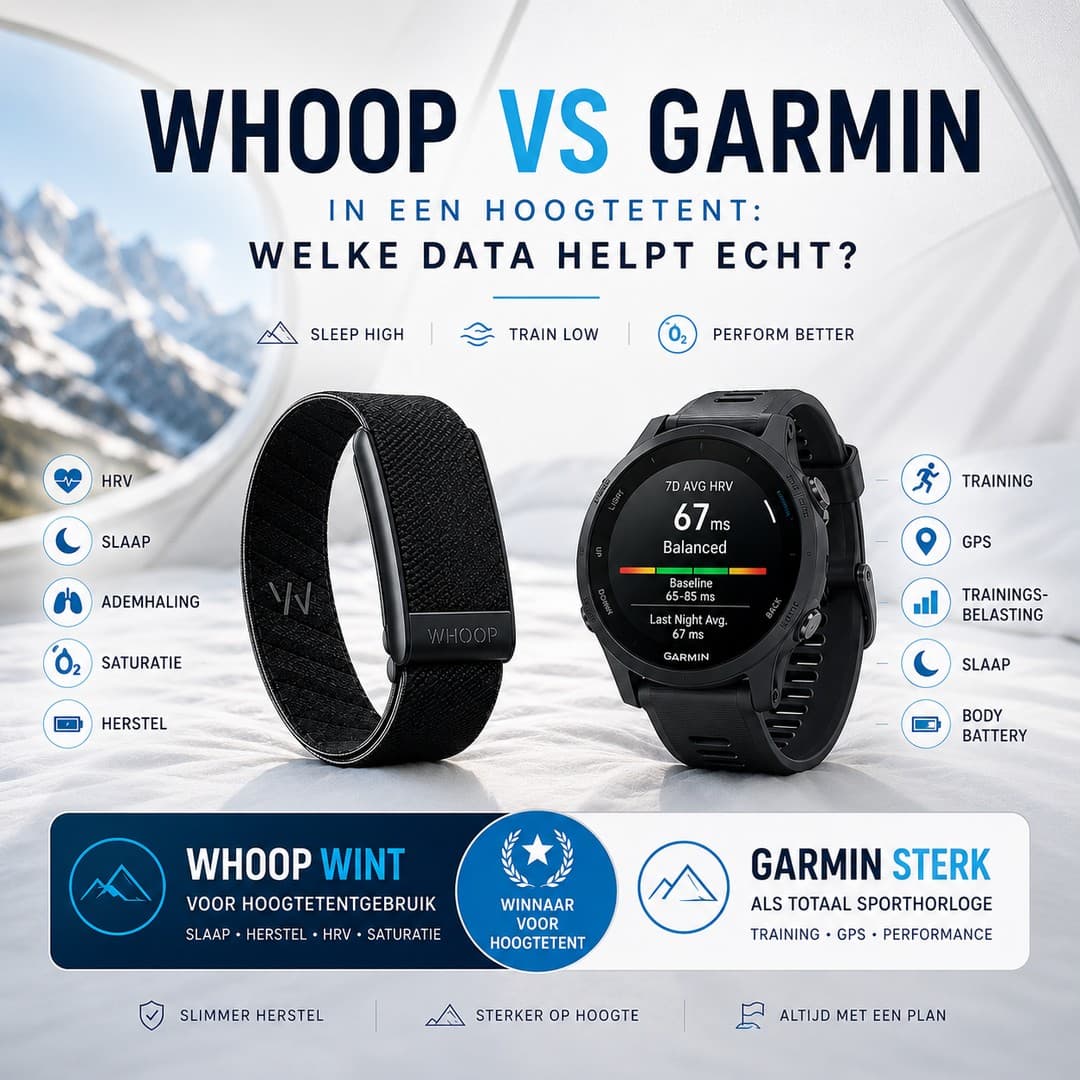
The winner for pure altitude tent use is clear: Whoop. Not because Garmin is bad, but because Whoop is a better fit for the nocturnal context of a sleep tent. The system is built around sleep, recovery, and body strain. Garmin remains stronger as an all-round watch for training, GPS, routes, sports profiles, and daily sports data.
Short answer: Choose Whoop if you primarily want to know how your body reacts to sleeping in a altitude tent. Choose Garmin if you want one device for training, GPS, routes and sports load. For altitude tent use, Whoop wins. For all-round sports use, Garmin wins.
Conclusion: Whoop is the best choice if you specifically want to use wearable data for sleeping in a altitude tent.
Nuance: Garmin remains very strong for athletes who want to combine training, GPS and recovery in one ecosystem.
Practical hook: Never look at a single score, but at trends over at least three to five nights.
Wearable data is interesting in a height tent because it can provide valuable insights into how an individual's body responds to simulated high-altitude conditions. This data can include: * **Physiological responses:** Heart rate, heart rate variability, blood oxygen saturation (SpO2), respiration rate, and sleep patterns can all be affected by reduced oxygen levels. Wearables can continuously monitor these metrics, allowing for a detailed understanding of physiological adaptation and potential stress. * **Performance tracking:** For athletes training in a height tent, wearables can track training intensity, recovery, and progress. This helps coaches and athletes optimise training regimes and identify any adverse effects of the simulated altitude. * **Individualised assessment:** People respond differently to altitude. Wearable data allows for personalised monitoring and assessment, identifying individual tolerances and responses, which can be crucial for developing tailored training or acclimatisation strategies. * **Research and development:** In research settings, wearables can collect large amounts of continuous, objective data on how people react to different simulated altitudes, contributing to a better understanding of altitude sickness, acclimatisation processes, and the effects on various bodily systems. * **Sleep quality:** Sleep is often disrupted at altitude. Wearables can track sleep stages, duration, and disruptions, providing data on how the simulated altitude impacts rest and recovery. * **Activity levels:** Monitoring general activity levels can help determine if a person is still able to perform at expected levels or if the altitude is causing significant fatigue or impact on physical activity. In essence, wearables transform a height tent from a static environment into a dynamic one, providing a wealth of real-time, personalised data that can be used for training optimisation, medical research, and a deeper understanding of human physiology under hypoxic conditions.
A height tent lowers the oxygen percentage in the air you breathe. The air pressure remains normal. This is called normobaric hypoxia. As a result, your body receives a controlled stimulus during sleep that mimics being at altitude.
This makes an altitude tent interesting for athletes and mountaineers who want to make their preparation more measurable. You don't have to go to the mountains straight away to get your body used to less oxygen. At home, you can gradually build up, monitor your reaction, and adjust in good time.
Wearables can make this development more insightful. They show how your body reacts to the hypoxic sleep stimulus. Consider changes in HRV, resting heart rate, sleep quality, breathing frequency, and saturation. The trend is particularly important. One noticeable night means little. A pattern over several nights tells much more.
Who high-altitude tent used, Therefore, you don't want data stress. You want data that helps. Not data that makes you doubt unnecessarily.
The winner: Whoop is stronger for altitude tent use
For someone who specifically has to choose between Whoop and Garmin in conjunction with a sleep tent, Whoop the clear winner. The reason is simple: an altitude tent works mainly during the night. This is precisely where Whoop excels.
Whoop focuses on sleep, recovery, HRV, resting heart rate, and daily load. As a result, the system fits well with the question you want to answer during altitude tent use: is my body processing this stimulus well?
Garmin also provides valuable data, but the platform is broader. It's designed as a sports watch, training computer, and outdoor tool. That's fantastic for runners, cyclists, triathletes, and mountaineers. Nevertheless, that broad focus makes Garmin slightly less precise as a pure recovery compass for sleeping in a high-altitude tent.
Practice interpretation: Don't use Whoop to nervously check one recovery score every morning. Use it as a trend tool. HRV, resting heart rate, sleep quality and respiratory rate together give much more context than one green, yellow, or red score.
Whoop vs Garmin: The Altitude Tent Comparison
A typical wearable review often looks at the screen, battery, apps, GPS, notifications, and sports functions. For high-altitude tent use, other questions are more important. Are you sleeping well? Are you recovering sufficiently? Is your HRV dropping temporarily or structurally? Is your resting heart rate increasing too much? Does your saturation match the set stimulus?
| Section | Whoop | Garmin | Winner |
|---|---|---|---|
| Sleep focus | Very strong. Whoop is built around sleep, recovery and recuperation. | Strong, but sleep is part of a wider sports platform. | Whoop |
| HRV | Very useful in a daily recovery context. | Very useful, especially with sufficient baseline. | Whoop |
| Resting heart rate | Clearly linked to recovery load. | Strongly available and easy to follow. | Draw |
| Saturation | Useful as supplementary trend data. | Pulse Ox is available on many models, but sensitive to measurement position. | Slight advantage Whoop |
| Training | Good for strain and recovery, less strong as a sports watch. | Very strong with GPS, routes, sport profiles and training load. | Garmin |
| Night comfort | Light, no screen, made for continuous wear. | Depending on the model. Some watches feel larger during sleep. | Whoop |
| Decision value | Strong for recovery interpretation during altitude tent use. | Strong for sports context and total training load. | Whoop for height tent |
Whoop: Very strong. Built around sleep, recovery and recuperation.
Garmin: Strong, but sleep is part of a wider sports platform.
Winner Whoop.
Whoop: Very useful in a daily recovery context.
Garmin: Very useful, especially with sufficient baseline.
Winner Whoop.
Whoop: Clearly linked to recovery load.
Garmin: Strongly available and easy to follow.
Winner Draw.
Whoop: Useful as supplementary trend data.
Garmin: Pulse Ox is available on many models, but sensitive to measurement position.
Winner Slight advantage Whoop.
Whoop: Good for strain and recovery, less strong as a sports watch.
Garmin: Very strong with GPS, routes, sport profiles and training load.
Winner Garmin.
Whoop: Light, no screen, made for continuous wear.
Garmin: Depending on the model. Some watches feel larger during sleep.
Winner Whoop.
Whoop: Strong for recovery interpretation during altitude tent use.
Garmin: Strong for sports context and total training load.
Winner Go us for the altitude tent.
Why Whoop is better suited for sleeping in a height tent
Whoop feels almost made for this context. You wear it continuously, it doesn't get in the way, and the system places a lot of emphasis on nightly recovery data. This makes it a good fit for a protocol where sleep is the most important stimulus.
In the first few nights of using a high-altitude tent, your body may react with a lower HRV, higher resting heart rate, or more restless sleep. This is not necessarily a bad sign. It can mean your body is processing the new stimulus. The main question is whether this reaction stabilises.
Whoop helps with this because it consolidates nightly data in a compact way. You can see more quickly whether your body is adapting, or if the stimulus is becoming too much. This is appealing to young athletes, biohackers, and data-driven users. You don't get a scattered pile of numbers, but clear recovery direction.
Practical Whoop Protocol for Altitude Tent Use
- First, build a baseline. Wear Whoop for at least 7 to 14 nights before starting.
- Start with a mild setting. Let your body slowly get used to less oxygen.
- Look at three to five nights. One bad night is not a trend.
- Combine signals. HRV, resting heart rate, sleep quality and feeling should be read together.
- Send a little bit. Stabilize or reduce the stimulus if recovery is clearly under pressure.
Where Garmin is still very strong
Garmin is the better choice if you're looking for one device for sport, training and outdoors. The watch provides a lot of context around training load, routes, GPS, pace, power, heart rate zones and recovery. This is hugely valuable for runners, cyclists, triathletes and mountaineers alike.
Garmin can also be useful when using a sleep tent. You can track HRV Status, sleep score, resting heart rate, Body Battery, and optionally Pulse Ox. Especially if you've been using Garmin for years, the system has a strong personal baseline.
However, Garmin requires a bit more interpretation. You have to filter for yourself which data really says something about the altitude tent. A low nocturnal Pulse Ox measurement can be consistent with hypoxic exposure, but can also be influenced by wrist position, strap tension or sleeping position. Therefore, a separate fingertip saturation meter remains advisable.
Clear choice: If you already have a good Garmin, you don't necessarily need to switch. If you're specifically buying a device for altitude tent use now, then Whoop is more logical. Garmin is broader. Whoop is sharper for recovery.
Which data really counts in the altitude tent?
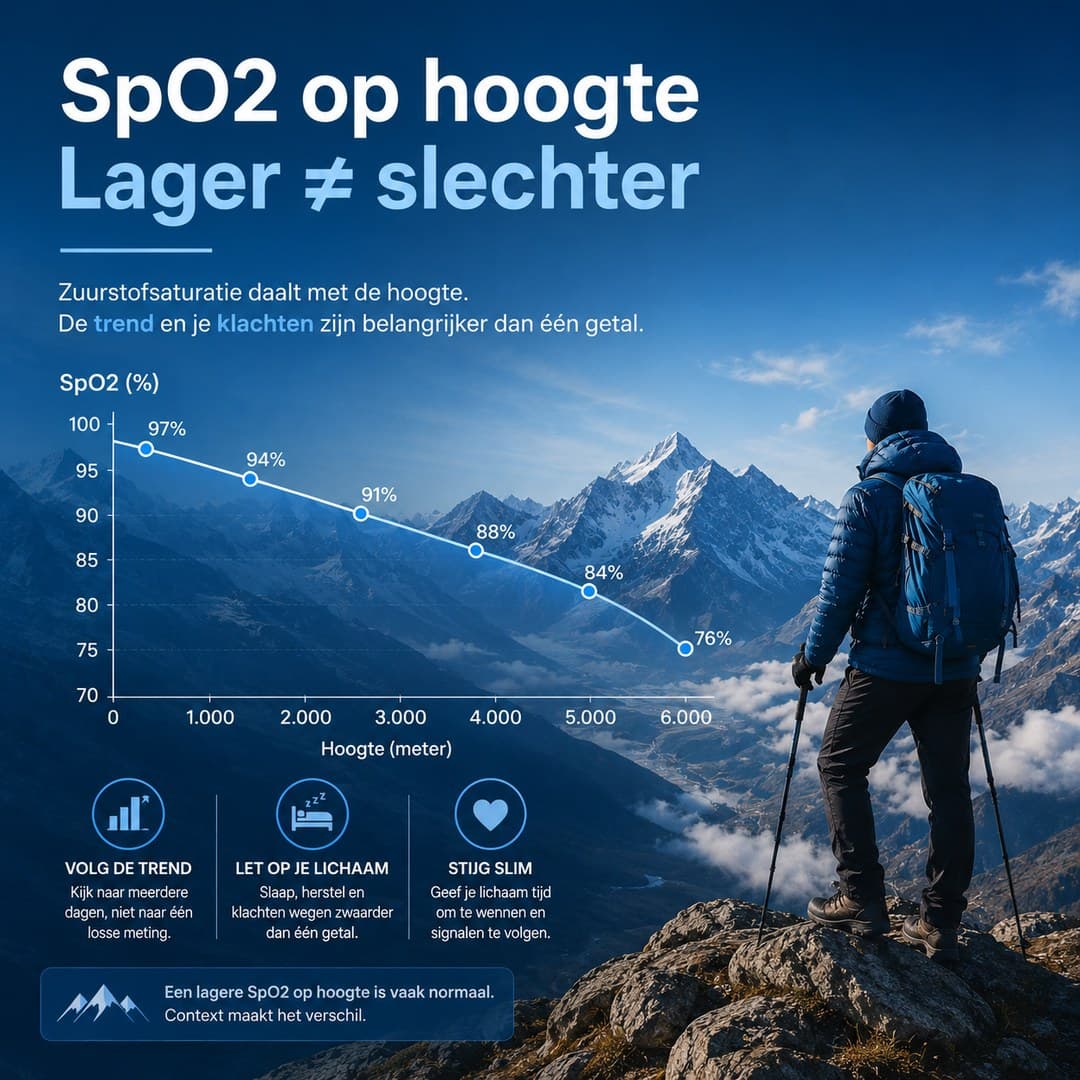
The most important data isn't the score at the top of the app. It's about the underlying trend. A green score can be misleading if you're sleeping poorly. A red score isn't immediately a problem if your body is just processing a new stimulus.
When using a hypoxic tent, you primarily look at the combination of SpO2, HRV, resting heart rate, sleep quality, breathing, and subjective recovery. This also aligns with how you saturation in the altitude tent interprets it best: as a trend, not as an isolated truth.
| Data point | What does it mean? | How do you use it? |
|---|---|---|
| HRV | Show how recovery and autonomous load change. | Look at multiple nights. A temporary drop is normal. |
| Resting heart rate | Can rise as the hypoxic stimulus becomes heavier. | Pay particular attention to a continuously rising trend. |
| SpO2 | Directs oxygenation during sleep. | Use a trend and optionally compare with a fingertip pulse oximeter. |
| Sleep quality | Show whether the stimulus disrupts your recovery. | Several bad nights call for adjustments. |
| Feeling | Subjective recovery remains important. | Note refreshment, headache, energy, and training feeling. |
Significance: Show how recovery and autonomous taxation change.
Use: Look at multiple nights. A temporary drop is normal.
Significance: Can rise as the hypoxic stimulus becomes heavier.
Use: Pay particular attention to a continuously rising trend.
Significance: Directs oxygenation during sleep.
Use: Use a trend and optionally compare with a fingertip pulse oximeter.
Significance: Show whether the stimulus disrupts your recovery.
Use: Several bad nights call for adjustments.
Significance: Subjective recovery remains important.
Use: Note refreshment, headache, energy, and training feeling.
This is how you monitor this lens
A smart altitude tent setup doesn't feel like gambling. You use a calm protocol and look for the same signals every morning. This way, you prevent panic due to one outlier score.
Preferably measure shortly after waking up. First, see how you feel. Then, measure your saturation with a fingertip meter. Only after that should you open your Whoop or Garmin. This way, you prevent the wearable's score from unduly influencing your feelings.
Daily check-in in the altitude tent
- SpO2 trend: Look at the pattern, not at a single measurement.
- HRV Please note: overnight recovery.
- Resting heart rate: A slight rise may be normal, a persistent rise requires attention.
- Sleep quality: napping and waking up refreshed count.
- Symptoms: Please note headache, nausea, shortness of breath, or unusual tiredness.
- Training: do not simultaneously increase both height and training intensity.
An altitude tent can significantly reduce the risk of altitude-related problems by allowing your body to get used to lower oxygen levels whilst you’re still at home. Nevertheless, it remains important to be realistic. An altitude tent does not offer a 100% guarantee and does not fully replace acclimatisation on site. It does, however, make the process much more controlled, measurable and predictable.
Decision rule: which device should you choose?
The choice becomes easy when you look at your true goal. Do you primarily want to know how your body reacts to sleeping in a wysokości tent? Then choose Whoop. Do you want one robust sports watch for training, GPS, routes, races and recovery? Then choose Garmin.
Choose Whoop as…
- if you want to seriously monitor your altitude tent usage;
- you particularly look at sleep, HRV and recovery;
- you prefer a screenless light device;
- you have less need for GPS and sports watch features;
- you can quickly see if your body is processing the hypoxic stimulus well.
Choose Garmin if…
- you want one device for sport and recovery;
- if you train a lot with GPS, routes, power or sport profiles;
- you already have a long Garmin-baseline;
- you want to link your altitude tent usage to training load;
- you are mainly looking for an all-round sports watch.
Common mistakes with wearable data
The first mistake is reacting too quickly. A bad night doesn't mean the altitude tent is set up incorrectly. Your body needs to get used to the stimulus.
A second pitfall is blind trust in a single readiness score. Whoop and Garmin both provide summaries. These are useful, but they don't replace interpretation.
Oxygen saturation also requires nuance. A wearable measures through the skin and can be affected by position, movement, temperature, and band tightness. Therefore, it's preferable to use a separate saturation meter alongside your wearable.
Finally, many people build up too quickly. A higher setting is not automatically better. The best stimulus is the highest stimulus your body can still process well.
FAQ about Whoop, Garmin and altitude tent use
Is Whoop better than Garmin in a hyperbaric chamber?
Yes, for specific high-altitude tent use, Whoop is usually better. The system is more strongly focused on sleep, HRV, resting heart rate, and recovery trend.
Is Garmin then not a good choice?
Garmin is indeed a good choice if you want one device for training, GPS, sport profiles and recovery. For pure altitude tent use, Whoop is more focused.
Should I set up my altitude tent based on Whoop or Garmin?
No, not solely on that. Use wearable data as additional trend information alongside SpO2, sleep quality, recovery feeling, and any symptoms.
Which data is most important?
The combination of HRV, resting heart rate, SpO2 trend, sleep quality, and subjective recovery is most important. A single score is insufficient.
Can my recovery temporarily worsen in a height tent?
Yes. In the first few nights, your body might react to the new stimulus. This doesn't have to be a problem if the trend then stabilises.
Do you want to set up your altitude tent smartly?
With a height tent, you make acclimatisation controlled, measurable, and plannable. Combine the correct setup with objective monitoring, so your body can gently adapt to less oxygen.
Conclusion: Whoop wins for the altitude tent, Garmin wins as a sports watch
For use in a height tent, it all comes down to overnight recovery data. You want to know if your body is processing the hypoxic sleep stimulus well. That's why Whoop is the best choice for anyone specifically looking for a wearable for altitude tent use.
Garmin remains stronger as an all-round sports watch. It is ideal for training, GPS, routes, sports profiles, and broader performance context. Those already fully integrated into the Garmin ecosystem can work well with it.
Still, the final conclusion is clear. Are you buying a device specifically for sleeping in a hypobaric chamber? Choose Whoop. Are you already using Garmin and primarily want to combine your training with hypobaric chamber data? Then you can continue using Garmin, as long as you interpret the data as a trend and not as absolute truth.