Measuring oxygen saturation at altitude: interpretation, normal values and pitfalls
Published 9 January 2026 · 5 min read
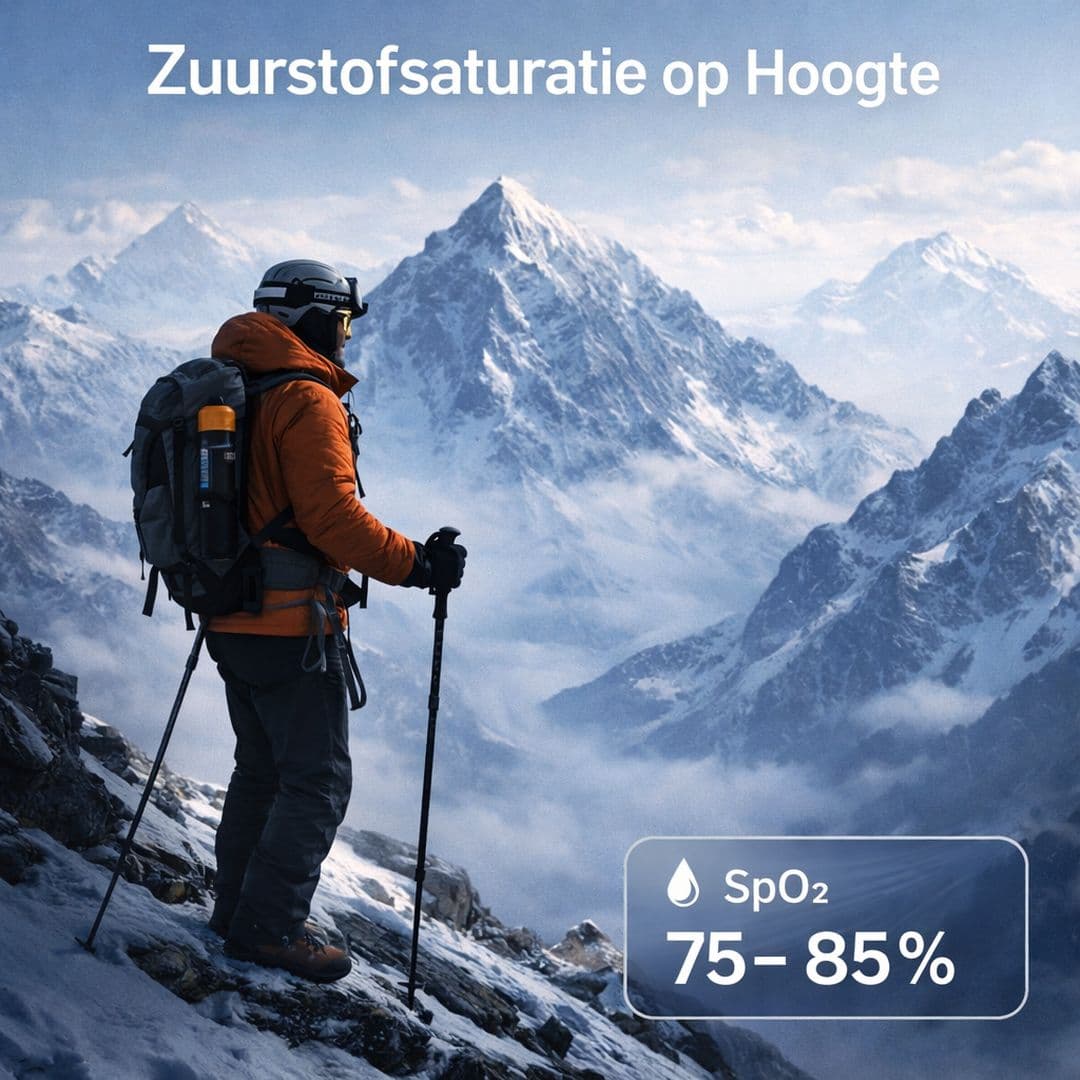
Oxygen saturation at altitude for many mountain hikers, expeditioners and athletes is one of the first metrics looked at when acclimatising and preventing altitude sickness. A simple measurement with a saturation meter seems to provide clarity, but the reality is more complex. A low SpO2 does not automatically mean danger, and an apparently normal value does not rule out problems.
In this article you will learn what oxygen saturation (SpO2) does and does not say at altitude, which values are normal per altitude zone, which measurement errors are common and how to use SpO2 responsibly in combination with complaints and decision moments. This will help you interpret signals better and make informed choices during altitude training, trekking or expeditions.
What is oxygen saturation (SpO2)?
Oxygen saturation, commonly abbreviated as SpO2, indicates the percentage of haemoglobin in the blood saturated with oxygen. Haemoglobin is the protein in red blood cells that transports oxygen from the lungs to tissues.
An SpO2 of 98 per cent means that 98 per cent of the available haemoglobin molecules carry oxygen. The measurement is usually done with a pulse oximeter on the finger, earlobe or sometimes the toe.
What SpO2 does show
- How efficiently oxygen is absorbed into the blood at that time.
- How the body responds to reduced oxygen pressure at altitude.
- Trends over time, e.g. decline or recovery during acclimatisation.
What SpO2 does not show
- How much oxygen actually reaches the muscles and brain.
- How well someone functions or feels.
- Whether altitude sickness will develop.
SpO2 is thus a tool, not a diagnostic tool.
Why does oxygen saturation fall at altitude?
At altitude, air pressure decreases. This decreases the partial pressure of oxygen in the inhaled air. Although the oxygen percentage in the air remains the same, less oxygen is available for absorption into the blood per breath.
The body responds by, among other things:
- Faster and deeper breathing.
- Increased heart rate.
- After a few days to weeks: production of extra red blood cells.
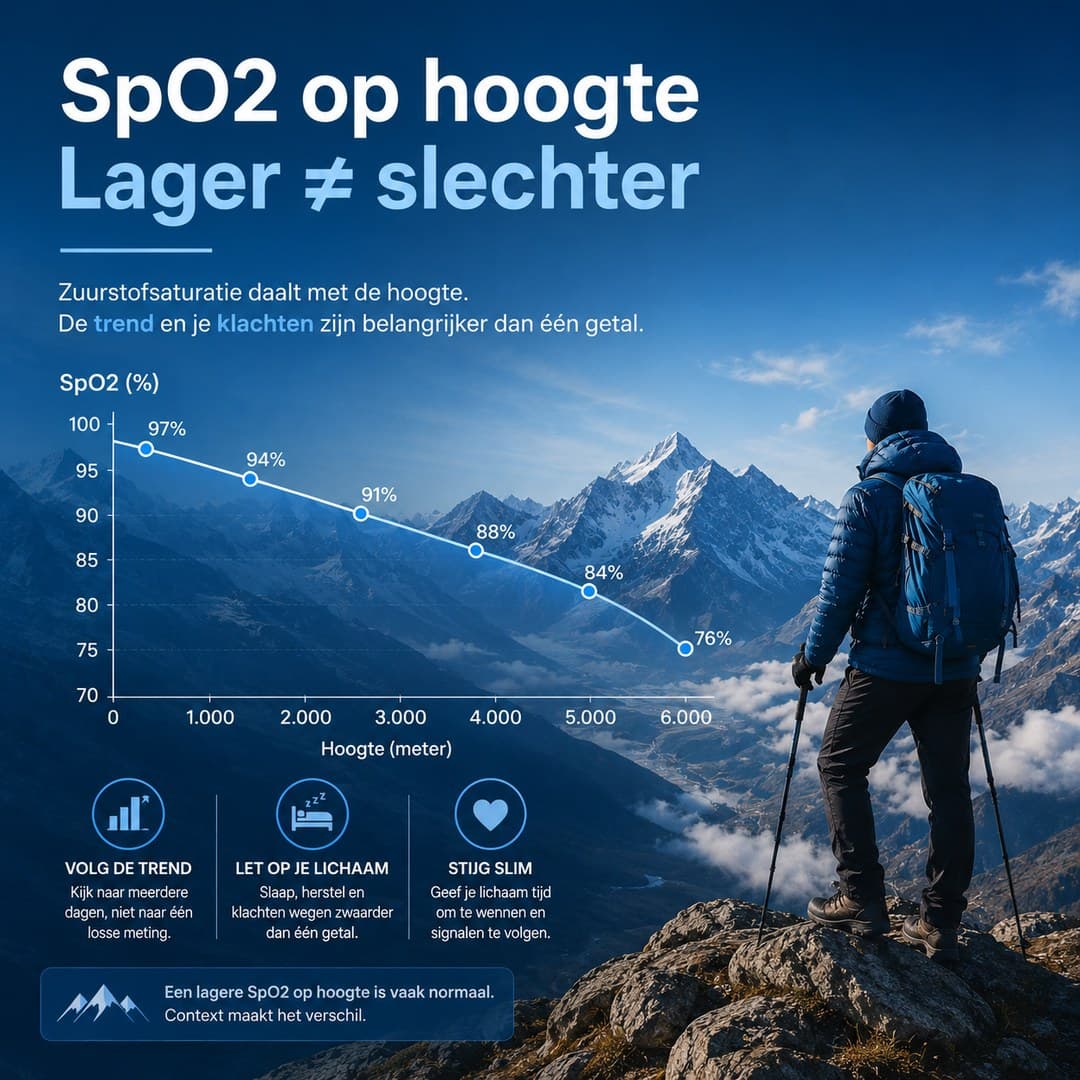
Despite these adjustments, SpO2 almost always drops the higher you go. This is normal and in itself no cause for concern.
Normal oxygen saturation by altitude zone
The values below are indicative and apply to healthy adults at rest. Individual differences are large.
Sea level (0 to 500 metres)
| Situation | SpO2 (%) |
|---|---|
| Healthy, at rest | 96 to 99 |
Values below 94 per cent at sea level are unusual and deserve attention.
Around 2,500 metres
| Situation | SpO2 (%) |
|---|---|
| Unacclimatised | 90 to 94 |
| Acclimatised | 92 to 95 |
Many people first notice mild effects here, such as being out of breath faster or less deep sleep.
Around 4000 metres
| Situation | SpO2 (%) |
|---|---|
| Unacclimatised | 80 to 85 |
| Acclimatised | 85 to 90 |
This is an altitude zone where the risk of altitude sickness increases markedly, especially with rapid ascent.
Around 5000 metres
| Situation | SpO2 (%) |
|---|---|
| Acclimatised | 70 to 80 |
Values below 70 per cent occur, but require careful interpretation in combination with complaints and attrition.
For a full overview by altitude and context, please refer to the altitude-to-oxygen-table.
Common measurement errors and pitfalls
Cold hands or poor circulation
At altitude and in cold conditions, blood vessels in fingers contract. This can lead to incorrectly low measurements. Warm hands and measure several times.
Exercise and stress
Moving, talking or agitation during measurement disturbs the sensor. Always measure at rest, preferably while seated.
Poor saturation meter placement
Nail polish, dirty sensors or loose positioning can affect the measurement. Always check positioning.
Blind reliance on one measurement
A single low or high value says little. Trends over several days are much more relevant.
Relationship between SpO2 and altitude sickness
A common misconception is that low SpO2 automatically means someone has altitude sickness. In reality, the relationship is complex.
What research shows
Studies show that there is a correlation between lower SpO2 values and an increased risk of acute mountain sickness (AMS), but the predictive value is limited. Some people with low values feel fine, while others with relatively high values develop obvious symptoms.
Altitude sickness is diagnosed primarily on the basis of symptoms, not a number.
Important complaints to take seriously
- Persistent headache that does not respond to rest or pain relief.
- Nausea, vomiting or loss of appetite.
- Dizziness or coordination problems.
- Severe fatigue or confusion.
Read more about signals and prevention in the article preventing altitude sickness.
Decision moments: when to intervene?
SpO2 can help with decisions, if used correctly.
Situations where extra caution is needed
- Rapid decline in SpO2 over several days.
- Low SpO2 combined with increasing symptoms.
- No recovery of SpO2 after rest or additional acclimatisation days.
Possible actions
- Insert extra rest day or acclimatisation day.
- Do not rise further until symptoms subside.
- Consider descending in case of deterioration.
A number alone should never be the deciding factor, but it can support the clinical picture.
Using SpO2 in altitude training and pre-acclimatisation
In structured altitude training and pre-acclimatisation, SpO2 is mainly used to track adaptation over time. These are not absolute values, but trends.
At Altitude Dream, for example, SpO2 is used to:
- Individual response to simulated altitude to be monitored.
- To determine whether the chosen height is appropriate.
- Identify overload or insufficient recovery early.
When combined with subjective complaints, sleep quality and training load, a more complete picture emerges. Read more in measuring effect during altitude training.
For those who want to prepare properly for altitude, pre-acclimatisation with an altitude tent can play a role. In that case, the guideline is a minimum of 4 weeks and a maximum of 6 weeks, depending on goal and starting level.
Summary and nuance
Measuring oxygen saturation at altitude can provide valuable insights, provided the measurement is done correctly and interpreted correctly. A lower SpO2 is normal at altitude and by itself says little about functioning or risk. Only when values are linked to complaints, trends and context does useful information emerge.
Use SpO2 as a tool, not a decision-maker. Listening to the body, taking sufficient time for acclimatisation and knowledge of warning signals always remain leading.