When is low saturation dangerous: guideline values
Published 7 April 2026 · 10 min read
When is low saturation dangerous? It depends on three things: where you are, how you feel and whether the reading fits a clear trend. At sea level, a low SpO2 is usually worrying faster than at altitude. In the mountains, lower values are often partly normal, but a deviation that is clearly worse than expected, especially in combination with tightness of breath, headaches or performance loss, deserves immediate attention. In this article you will read which guide values are useful, when to repeat and observe above all, and when to seriously consider medical help or descent. For broader context about oxygen saturation at altitude it is important to always read absolute figures together with complaints and height profile.
At sea level, an SpO2 of 95 to 100 per cent is reassuring in most healthy adults. A value of 93 or 94 per cent requires repeated measurement and interpretation in context. A value of 92 per cent or lower at sea level is cause for urgent assessment, especially in cases of shortness of breath, chest pain, drowsiness or rapid deterioration.
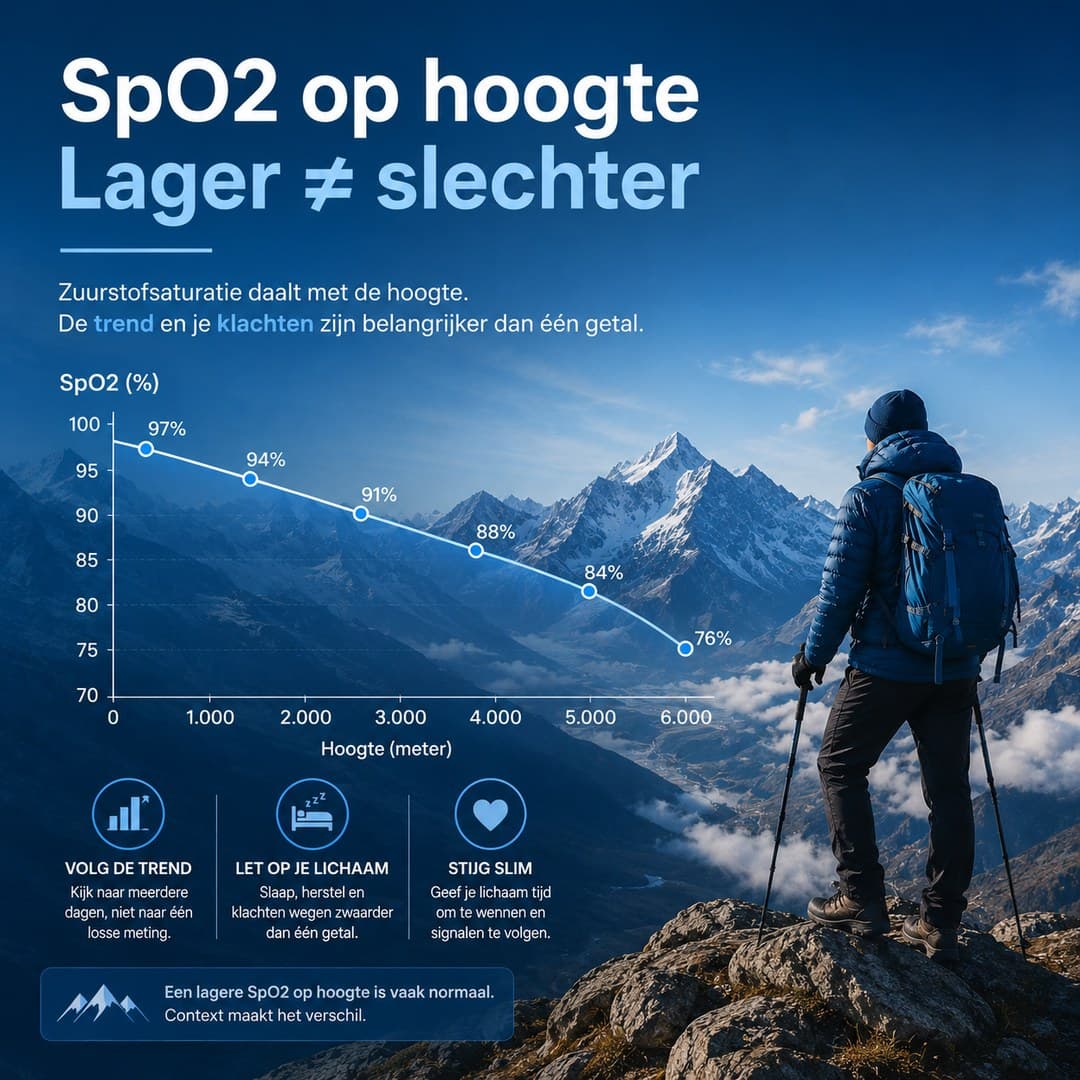
At altitude, the situation is different. There, saturation drops even in healthy people. This is precisely why not one single value is decisive, but the combination of trend, symptoms, exercise tolerance and comparison with what is normal at that altitude.
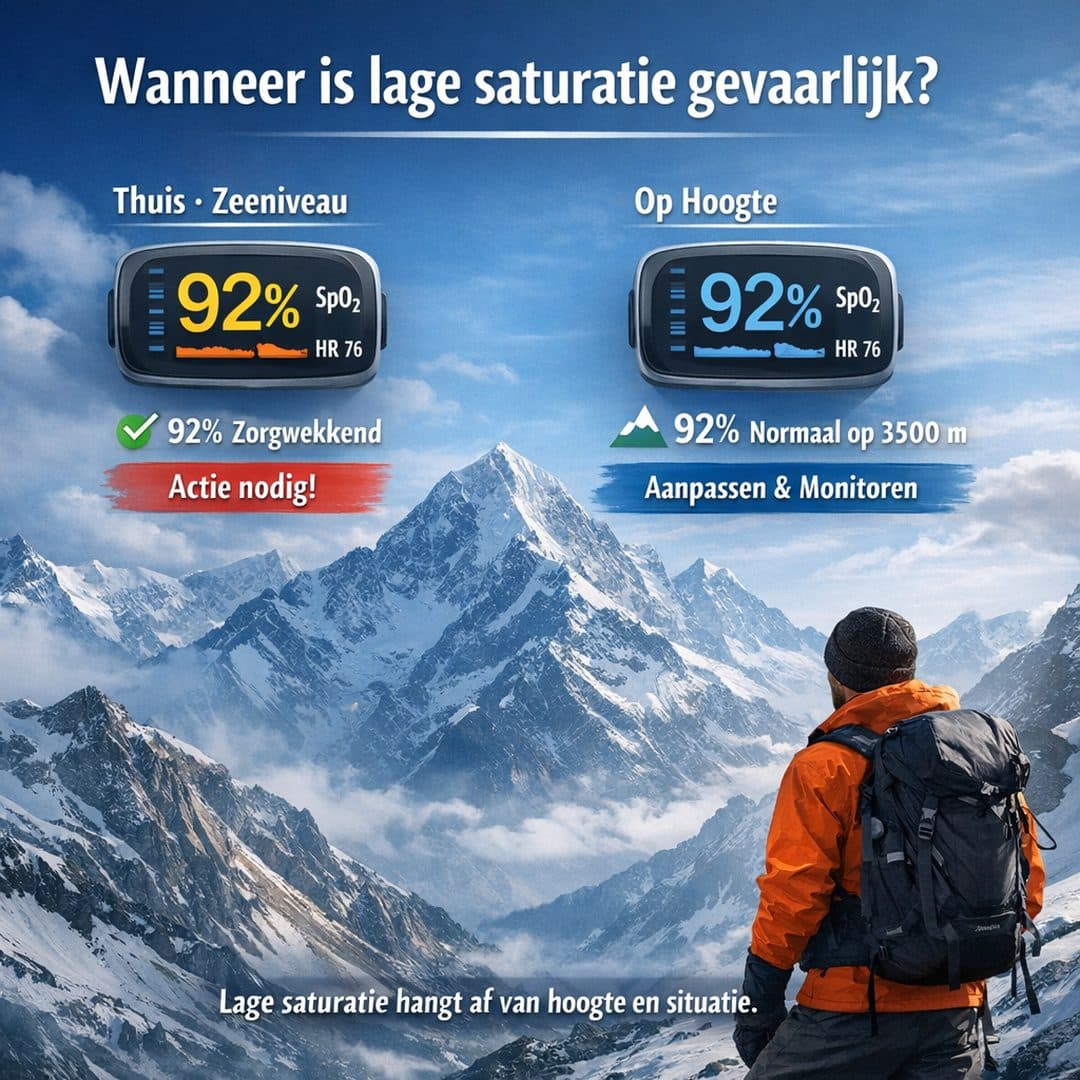
Conclusion: Low saturation is especially dangerous when the value does not match the environment and is accompanied by symptoms or rapid decline.
Nuance: At 3500 metres, a lower SpO2 may still be physiologically explainable, while the same value at home is clearly abnormal.
Practical hook: Therefore, always assess SpO2 as a trend, not as an isolated number.
When is low saturation dangerous at sea level?
For healthy adults at sea level, an SpO2 of 95 to 100 per cent is usually normal. If a value drops to 93 or 94 per cent, it is not yet an automatic emergency, but it is a signal to measure again at rest and look closely at symptoms. At 92 per cent or below, things become more serious. Then prompt medical assessment is much more appropriate than waiting, especially if chest tightness, drowsiness, confusion or chest pain are added.
Use these guideline values as practical guidance at sea level. The combination of value, complaints and trend always remains leading.
| SpO2 at sea level | Interpretation | Practical action |
|---|---|---|
| 95 - 100% | Mostly reassuring in healthy adults at rest. | No acute action needed. Focus on symptoms and your normal baseline. |
| 93 - 94% | Border area. Not immediate panic, but reassess. | Measure again after 5 to 10 minutes of rest. Check cold hands, movement, nail polish and symptoms. |
| 92% or lower | Urgent anomaly at sea level. | Seek medical attention the same day, and in case of obvious symptoms immediately. |
| Declining trend | Often more important than one single measurement. | Take a falling trend seriously, even if the absolute value does not yet seem extremely low. |
95 - 100%
Interpretation: usually reassuring in healthy adults at rest.
Practical action: no acute action needed. Above all, look at symptoms and your normal baseline.
93 - 94%
Interpretation: border area. Not immediate panic, but reassess.
Practical action: Measure again after 5 to 10 minutes of rest. Check cold hands, movement, nail polish and symptoms.
92% or lower
Interpretation: urgent deviation at sea level.
Practical action: seek medical attention the same day, and in case of obvious symptoms immediately.
Declining trend
Interpretation: often more important than one single measurement.
Practical action: take a clear drop seriously, even if the absolute value does not yet seem extremely low.
There is an important nuance here. For some people with chronic lung disease, target values are different. In that group, a doctor may deliberately accept a lower saturation range. This does not mean that low saturation is suddenly harmless, but rather that you need to know your own medical context. Those with no known lung disease would be wise not to downplay an obviously low reading at home.
⚠️ Reality check
A pulse oximeter is a tool, not a diagnosis in itself. Severe shortness of breath, blue lips, confusion or chest pain remain alarm signals, even if saturation unexpectedly still seems reasonable.
When is low saturation dangerous at altitude?
At altitude, the playing field shifts. Air pressure drops, available oxygen per breath decreases and, as a result, SpO2 also drops. That means you can't just use the same limits as at home. Anyone preparing for trekking or expedition therefore needs to know what is normal per altitude zone, instead of immediately seeing any lower value as pathological.
A useful starting point is that healthy people can average lower ranges 24 to 48 hours after arriving at altitude. That range varies from person to person, due to ventilatory response, acclimatisation and susceptibility to hypoxia. Therefore, comparison with other team members is sometimes useful, but only if you also consider rate of ascent, symptoms and recovery.
At altitude, no single alarm limit is leading. Always compare your value with the expected zone at that altitude, plus your symptoms and recovery.
| Height | Expected resting SpO2 in healthy people | How to read this |
|---|---|---|
| Sea level | >96% | Normal home or lowland reference. |
| 1500 metres | 93 - 97% | Slight decline may be normal. |
| 2,500 metres | 90 - 95% | This is where real altitude physiology starts to become noticeable. |
| 3500 metres | 82 - 88% | Clearly lower, but not automatically dangerous. |
| 4500 metres | 75 - 85% | Only interpret along with symptoms, pace and recovery. |
| 5500 metres | 70 - 80% | Very low values may still occur physiologically, but abnormality and symptoms weigh heavily. |
Sea level
Expected resting SpO2: >96%
Lecture: normal home or lowland reference.
1500 metres
Expected resting SpO2: 93 - 97%
Lecture: slight decrease may be normal.
2,500 metres
Expected resting SpO2: 90 - 95%
Lecture: This is where real altitude physiology starts to become noticeable.
3500 metres
Expected resting SpO2: 82 - 88%
Lecture: clearly lower, but not automatically dangerous.
4500 metres
Expected resting SpO2: 75 - 85%
Lecture: only interpret along with symptoms, pace and recovery.
5500 metres
Expected resting SpO2: 70 - 80%
Lecture: very low values may still occur physiologically, but abnormality and symptoms weigh heavily.
The mistake many mountain athletes make is to look for one absolute alarm limit for all conditions. There is no such thing. An SpO2 of 84 per cent may still fit an otherwise stable situation at 3,500 metres. That same 84 per cent at home on the couch is an entirely different story. Therefore, always look together at altitude, symptoms and the overall picture of physical reactions to oxygen deprivation.
Not automatically dangerous: lower SpO2 at altitude without obvious symptoms, with stable trend and reasonable recovery.
Worrying, though: SpO2 significantly lower than expected for that altitude, especially if you simultaneously walk less, sleep worse, get more headaches or become inexplicably stuffy.
When low saturation at altitude is indeed an alarm
At altitude, low saturation becomes especially dangerous when the value is out of sync. Think of someone who is 8-10 points lower than teammates at the same altitude, or rapidly deteriorating in combination with shortness of breath at rest, wet cough, extreme fatigue, ataxia or confusion. Then the question shifts from “is this still normal?” to “should I stop, descend or treat?” That interpretation includes symptoms and risks of altitude sickness.
Probably observe and reassess: mild headache, stable SpO2, normal appetite, reasonable sleep and no obvious deterioration.
Probably taking pace back: lower SpO2 than expected plus headache, nausea, poor sleep or noticeable performance loss.
Not rising through: Declining SpO2 trend combined with symptoms getting worse.
Instant alert: tightness at rest, blue lips, confusion, walking unsteadily, inability to speak in full sentences or marked deterioration within hours.
The latter is exactly why saturation only makes sense as part of a system. Those who measure a number but do not consider breathing work, running pace, nighttime recovery and neurological symptoms often miss the real risk. Conversely, the same applies: you can't see every headache at 3,000 metres as a danger if everything else is stable.
This is how you monitor this lens
The most useful way to track saturation is systematically. Not ten consecutive measurements until you see a nice number, but one standardised measurement at a fixed time. Especially when pre-acclimatisation or staying in an altitude tent, a trend is much more valuable than single peaks or valleys. The same applies if you want to assess at home when low saturation becomes a medical signal.
- Measure at rest, preferably seated, after sitting still for at least five minutes.
- Use warm hands and remove nail polish or artificial nails.
- Wait for the value to stabilise and note not only SpO2, but also heart rate and symptoms.
- Compare with your previous measurements at the same time and under similar conditions.
In addition, always use four observation points in addition to SpO2:
- SpO2 trend: does your saturation stay stable, does it rise gradually or does it drop day by day?
- Sleep quality: do you sleep more restfully or more restlessly than the days before?
- Recovery: Do you feel functional or empty and rushed in the morning?
- Symptoms: Do headaches, shortness of breath, nausea or coordination problems increase?
This approach avoids two classic mistakes. The first is underreaction: dismissing a falling trend because one isolated value does not yet look extreme. The second is overreaction: being startled by a single low reading that is mainly due to cold hands or a poorly positioned sensor.
💡 Did you know?
In pulse oximetry, relative change is often more valuable than a single absolute figure. This is especially relevant at altitude, where normal values vary more widely than at sea level.
Common misconceptions about low saturation
A low SpO2 is always immediately dangerous
No. At sea level, a marked drop is more quickly worrisome. At altitude, a lower value may still be within physiology. Danger arises mainly when the value is out of context or accompanied by alarm symptoms.
A normal SpO2 rules out a serious problem
That, too, is incorrect. A person may be clinically clearly distressed or have neurological symptoms while the oximeter does not yet show a dramatic abnormality. Measurements support assessment but do not replace it.
Each oximeter value is exact
A pulse oximeter has limitations. Cold hands, movement, nail polish, poor circulation and skin characteristics can affect the measurement. Therefore, neat measurement is not a detail, but a prerequisite.
- Always rate SpO2 as a trend.
- Measure only after rest.
- Check that your hands are warm.
- Also note heart rate and symptoms.
- Use height as a context factor.
- Let complaints outweigh the prettiest number on the screen.
Want to learn to better read saturation readings at altitude?
So use our in-depth guide explaining normal values, interpretation by altitude zone and practical context for mountaineering and pre-acclimatisation.
Conclusion
When is low saturation dangerous? At sea level, an SpO2 of 92 per cent or lower is a clear warning, especially in case of symptoms. At altitude, you cannot apply that same limit blindly. There, low saturation is especially dangerous when the value is clearly worse than expected, keeps falling or coincides with worsening symptoms. This is precisely why a trend-based approach works better than a single absolute number.
So those who want to act safely never just look at the screen. The best interpretation combines altitude, symptoms, recovery, sleep and measurement trend. That makes your assessment calmer, more accurate and ultimately safer.
FAQ
Is 94 per cent saturation dangerous?
At sea level, 94 per cent is not an immediate emergency, but it is a value you should check again at rest and read in context. At altitude, 94 per cent can actually be quite normal.
Is 92 per cent saturation always cause for urgency?
At sea level, 92 per cent or lower is cause for urgent medical assessment, especially in case of complaints. At high altitude, the interpretation is different and symptoms and trend count more heavily.
What saturation is normal at 3500 metres?
In healthy people, the expected resting SpO2 at 3,500 metres is often roughly around 82 to 88 per cent. So that is significantly lower than at home, without automatically being dangerous.
Can you have altitude sickness with a reasonable-looking SpO2?
Yes. Saturation helps, but does not rule out altitude sickness. Headache, nausea, ataxia and shortness of breath remain leading alarm signals.
How often should you measure saturation?
Rather once or twice a day at fixed times and under similar conditions than constantly separate measurements without context. That way, the trend becomes actionable.