Altitude to oxygen table (O2 percentage per altitude)
Published 28 September 2019 · 10 min read
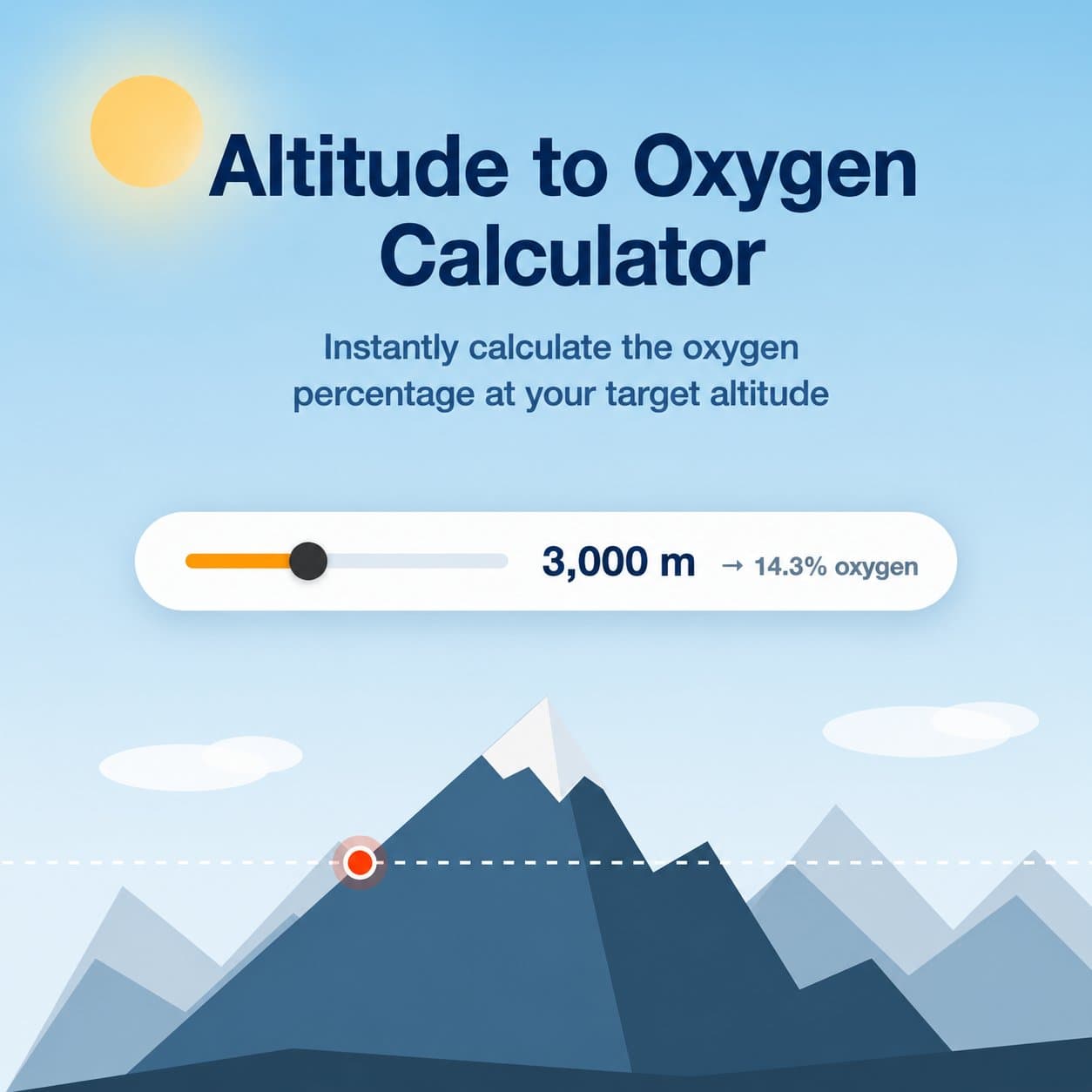
With this Altitude to Oxygen Calculator you can see at a glance how much effective oxygen is available at your target altitude. This helps you better understand what a climb, trek, altitude stay, or simulated altitude training demands of your body.
Enter your target altitude below or choose a well-known mountain. You will see the effective oxygen percentage, air pressure, temperature, comparable locations, and practical preparation advice for sport, trekking or expedition.
Short answer: At high altitudes, the oxygen percentage in the outside air remains at around 20.9%, but due to the lower air pressure, your body takes in less oxygen with each breath. That is why we use ‘effective oxygen’ as a practical measure. At 3,000 metres, the available oxygen feels roughly equivalent to 14 to 15% at sea level.
Conclusion: The higher you go, the lower the effective oxygen availability per breath.
Nuance: The calculator provides a guideline value, not a prediction of your personal reaction to altitude.
Practical hook: Use the outcome to better plan your acclimatisation, altitude training or expedition preparation.
Last updated: 18 June 2026
How to use the altitude to oxygen calculator
The calculator is intended as a practical starting point. Therefore, you don't need to compare tables or manually convert air pressure first. Choose your altitude, view the effective oxygen value, and then use the explanation below the calculator to interpret the result correctly.
- Step 1: Slide or type your target height in metres or feet.
- Step 2: Choose a famous mountain or location as a reference, if applicable.
- Step 3: Examine the effective oxygen percentage and pressure loading.
- Step 4: Use the preparation advice to better plan your acclimatisation or altitude training.
Would you like to understand exactly how oxygen works at altitude? Then also check out the in-depth explanation about the oxygen levels per altitude. This page explains why the air at high altitudes does not contain less oxygen, but rather provides lower oxygen pressure.
Height to oxygen table
The table below provides a quick indication of the effective oxygen availability per altitude zone. Use these values as a guide. Your personal reaction will depend on factors including rate of ascent, sleeping altitude, fitness, previous altitude experience, hydration, recovery, and individual sensitivity.
| Height | Effective oxygen | Zone | Practical significance |
|---|---|---|---|
| 0 m | 20,9% | Sea level | Normal oxygen availability. |
| 1,000 metres | 18,6% | Slight elevation | Usually minimally noticeable, especially with intense exertion. |
| 2,000 metres | 16,4% | Training altitude | Breathing and heart rate can react more clearly. |
| 2,500 metres | 15,3% | Acclimatisation zone | From here, the risk of altitude sickness increases with rapid ascent. |
| 3,000 metres | 14,3% | Obvious hypoxic stimulus | Exertion feels heavier. Sleep and recovery can change. |
| 3,500 metres | 13,3% | Serious height load | A steady increase and good monitoring are becoming more important. |
| 4,000 metres | 12,3% | Expedition preparation | Altitude sickness is more common with insufficient acclimatisation. |
| 4,500 metres | 11,4% | High tax | Recovery often slows. Sleep quality and rest days become crucial. |
| 5,000 metres | 10,9% | Heavy height | Preparation and acclimatisation make a big difference. |
| 5,500 metres | 10,5% | Everest Base Camp level | Taxes are high. Rising too quickly increases the risk significantly. |
| 6,000 metres | 9,9% | Very heavy altitude | Only responsible with adequate acclimatisation and conservative progression. |
| 7,000 m | 8,9% | Extreme height | Every effort requires a lot. Margins are narrowing. |
| 8,000 m | 7,9% | Death zone | Long-term stays are extremely burdensome and risky. |
| 8,800 metres | 6,9% | Mount Everest level | Almost maximum terrestrial height load. |
Effective oxygen: 20,9%
Zone Sea level
Significance: Normal oxygen availability.
Effective oxygen: 18,6%
Zone Slight elevation
Significance: Usually minimally noticeable, especially with intense exertion.
Effective oxygen: 16,4%
Zone Training altitude
Significance: Breathing and heart rate can react more clearly.
Effective oxygen: 15,3%
Zone Acclimatisation zone
Significance: From here, the risk of altitude sickness increases with rapid ascent.
Effective oxygen: 14,3%
Zone Obvious hypoxic stimulus
Significance: Exertion feels heavier. Sleep and recovery can change.
Effective oxygen: 13,3%
Zone Serious height load
Significance: A steady increase and good monitoring are becoming more important.
Effective oxygen: 12,3%
Zone Expedition preparation
Significance: Altitude sickness is more common with insufficient acclimatisation.
Effective oxygen: 11,4%
Zone High tax
Significance: Recovery often slows. Sleep quality and rest days become crucial.
Effective oxygen: 10,9%
Zone Heavy height
Significance: Preparation and acclimatisation make a big difference.
Effective oxygen: 10,5%
Zone Everest Base Camp level
Significance: Taxes are high. Rising too quickly increases the risk significantly.
Effective oxygen: 9,9%
Zone Very heavy altitude
Significance: Only responsible with adequate acclimatisation and conservative progression.
Effective oxygen: 8,9%
Zone Extreme height
Significance: Every effort requires a lot. Margins are narrowing.
Effective oxygen: 7,9%
Zone Death zone
Significance: Long-term stays are extremely burdensome and risky.
Effective oxygen: 6,9%
Zone Mount Everest level
Significance: Almost maximum terrestrial height load.
Important: This table provides guideline values. It helps to understand load bearing, but does not precisely predict how your body will react. Therefore, always use trends, symptoms and recovery as additional information.
Wat betekent effectieve zuurstof op hoogte?
The percentage of oxygen in the air is roughly the same at sea level and at high altitudes: around 20.9%. Yet breathing at high altitudes feels more laboured. This is because air pressure decreases. As a result, for every litre of air you breathe in, fewer oxygen molecules are available to your lungs and blood.
The calculator converts that difference into an effective oxygen percentage. This makes altitude easier to understand. A value of approximately 14.3% at 3,000 metres does not, therefore, mean that the air there literally contains only 14.3% of oxygen. It means that the amount of oxygen available to your body is comparable to breathing air containing approximately 14.3% of oxygen at sea level.
At high altitudes, we speak of hypobaric hypoxia: the air pressure is lower. With an altitude tent or hypoxic training at home, the air pressure remains the same, but the percentage of oxygen in the inhaled air is reduced. This is called normobaric hypoxia. In both cases, your body receives a controlled oxygen stimulus, but the conditions are not exactly the same.
Do you want to link these values with measurements during a trip or expedition? Then the page about oxygen saturation at altitude a logical next step.
Altitude to oxygen for sports, trekking and expeditions
The same altitude can have a different meaning for different purposes. An athlete often uses altitude as a training stimulus. A trekker primarily wants to prevent ailments. An expedition climber must prepare their body for multiple days or weeks at higher altitudes.
For athletes
For endurance athletes, many relevant altitude stimuli lie between approximately 2,000 and 3,000 metres. The aim is not to sleep as high as possible, but to find a stimulus that is strong enough and at the same time remains recoverable.
For tractors
For trekkers, the combination of ascent rate, sleeping altitude and rest days becomes important from around 2,500 metres. A fit hiker can still experience symptoms if the schedule is too rapid.
For expedition climbers
For journeys towards 4,000, 5,000 or 6,000 metres, preparation becomes increasingly important. The oxygen value helps to estimate how strenuous the exertion will be, but the acclimatisation schedule often makes the difference.
When preparing for a mountain trip, you can combine the calculator with a plan for acclimatising at altitude. This translates the outcome not only into a number, but into a practical schedule.
When does altitude require preparation?
Not every altitude requires the same approach. Up to around 2,000 metres, you'll mainly notice a difference during exertion. From 2,500 metres onwards, acclimatisation becomes more relevant. Above 3,500 metres, the margin narrows, especially if you ascend quickly or sleep poorly.
Use these decision rules as a starting point
- Up to 2,000 metres: mostly limited impact, particularly noticeable with strenuous exertion.
- 2,000 to 2,500 metres slight to moderate height stimulus. Sleep and recovery can change.
- 2,500 to 3,500 metres clear acclimatisation zone. A gentle ascent will be important.
- 3,500 to 5,500 metres Serious altitude exposure. Preparation and monitoring are highly recommended.
- Above 5,500 metres: heavy to extreme altitude. Only with thorough acclimatisation and ample safety margins.
A height tent can help to make this process controlled, measurable, and plannable. It is not a substitute for proper acclimatisation, but can significantly reduce the chance of altitude sickness when set up sensibly. More practical explanations can be found in the guide on to use a height tent.
This is how you monitor this lens
The calculator provides a useful estimate, but your body ultimately determines how well you process the altitude. Therefore, monitoring is more important than a single value. Pay particular attention to trends over several days.
| Signal | What you are following | Practical interpretation |
|---|---|---|
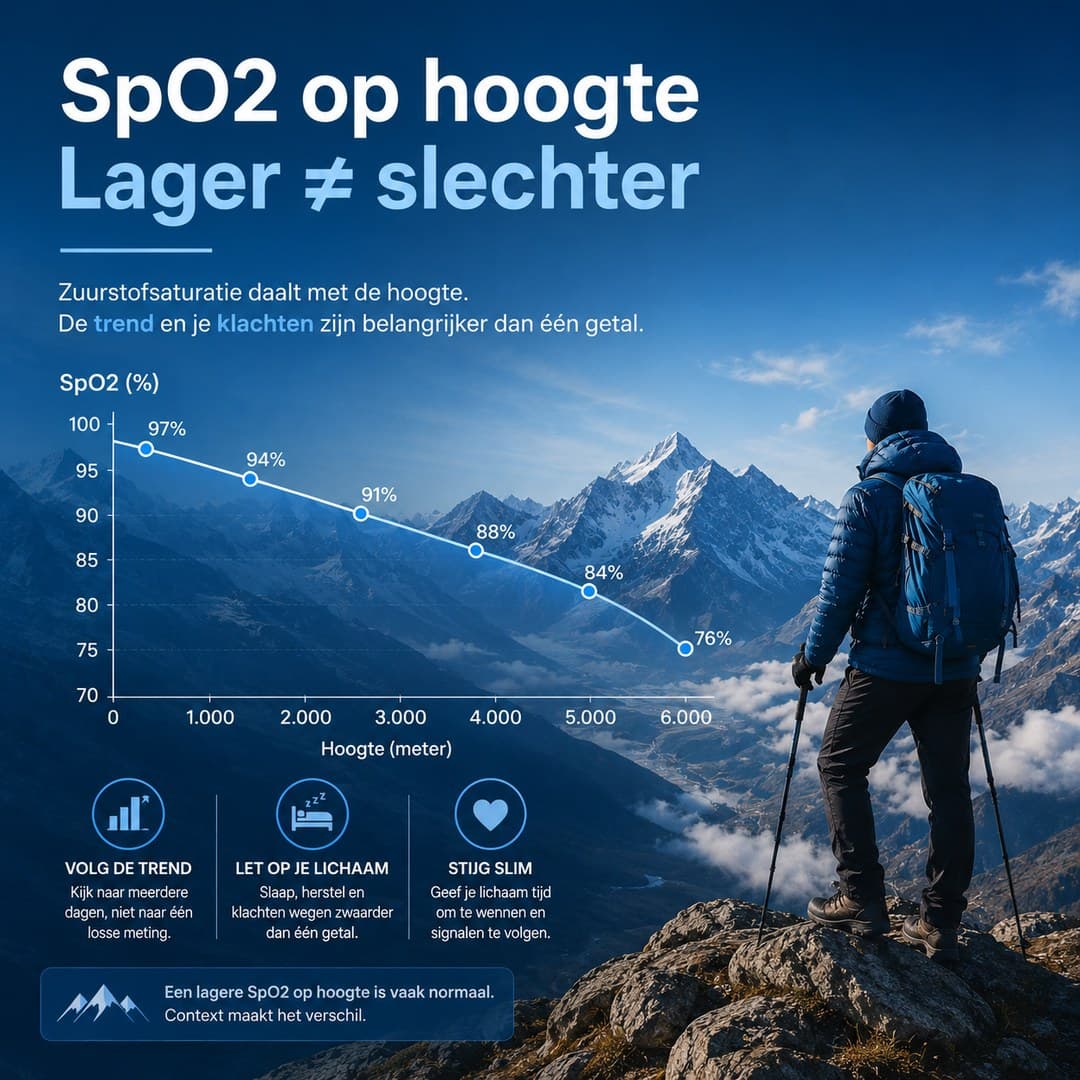
| SpO2 | Trend in oxygen saturation, especially in the morning | A drop in itself is not always problematic. The trend in combination with complaints counts. |
| Sleep | Sleep duration, restlessness, waking up, feeling of recovery | Poorer sleep can mean the stimulus is too heavy or you're ascending too quickly. |
| Recovery | Heart rate, HRV, muscle feeling, energy level | Persistent poorer recovery is a signal to build up more gradually. |
| Symptoms | Headache, nausea, dizziness, loss of appetite | Complaints are more important than the calculator value. With clear complaints, you must make adjustments. |
What you're following: trend in oxygen saturation, particularly in the morning.
Interpretation: A drop on its own is not always problematic. The trend combined with symptoms is what counts.
What you're following: Sleep duration, restlessness, waking up, and feeling of recovery.
Interpretation: Poorer sleep can mean the stimulus is too heavy or that you are ascending too quickly.
What you're following: Heart rate, HRV, muscle sensation, and energy level.
Interpretation: Sustained poorer recovery is a signal to build back up more gradually.
What you're following: headache, nausea, dizziness and loss of appetite.
Interpretation: Complaints are more important than the calculator value. With clear complaints, you need to make adjustments.
Always use SpO2 as a trend. A single low or high reading tells you little without context. Combine saturation with sleep quality, recovery, symptoms, and the pace at which you build altitude.
Common misconceptions about altitude and oxygen
Misunderstanding 1: At higher altitudes, there is less oxygen in the air. In reality, the percentage of oxygen remains about the same, but the air pressure decreases.
Misunderstanding 2: A calculator predicts exactly whether you will get altitude sickness. That's impossible. Individual sensitivity and rate of ascent remain decisive.
Misunderstanding 3: The higher you sleep, the better it always is. Sleeping too high can actually disrupt recovery and sleep quality.
Misunderstanding 4: Simulated altitude is exactly the same as real altitude. It is a powerful tool, but the conditions are not physiologically identical.
Frequently asked questions about altitude and oxygen
How much oxygen is there at an altitude of 3,000 metres?
At 3,000 metres, the effective oxygen availability is approximately 14 to 15%. The outside air still contains around 20.9% of oxygen, but due to lower air pressure, you take in less oxygen with each breath.
At what altitude do you notice less oxygen?
Many people notice the difference from around 2,000 to 2,500 metres, especially during exertion and sleep. Above 3,000 metres, the effects usually become more pronounced.
Is the altitude to oxygen calculator exact?
No. The calculator provides a practical benchmark. Your personal response will depend on ascent rate, acclimatisation, sleep, recovery, hydration and individual sensitivity.
Why does the oxygen level remain at 20.9%, yet it still feels lower?
This is because air pressure decreases the higher you go. As a result, each breath contains fewer oxygen molecules, despite the same percentage of oxygen in the outside air.
Can I use this value for a height tent?
Yes, as a practical reference. An altitude tent works on the principle of normobaric hypoxia: the air pressure remains the same, but the oxygen concentration is reduced to create a similar oxygen stimulus.
Prepare your target height in a controlled manner
The calculator shows how physically demanding your target altitude might feel. If you want to prepare better for that altitude, start with a plan that suits your trip, sporting goal or expedition.
Conclusion
The altitude to oxygen calculator shows what altitude does to your body. Not as a medical judgment, but as a practical translation of air pressure, effective oxygen, and altitude stress. This allows you to better estimate when acclimatisation becomes important and how to build your preparation more effectively.
Therefore, do not use the calculator as a standalone figure, but as a starting point. Combine the outcome with your target altitude, sleep altitude, ascent rate, SpO2 trend, symptoms, and recovery. This way, altitude becomes not an abstract risk, but a factor you can prepare for in a targeted manner.