
How does altitude training naturally increase your EPO levels?
Published 29 June 2025 · 4 min read
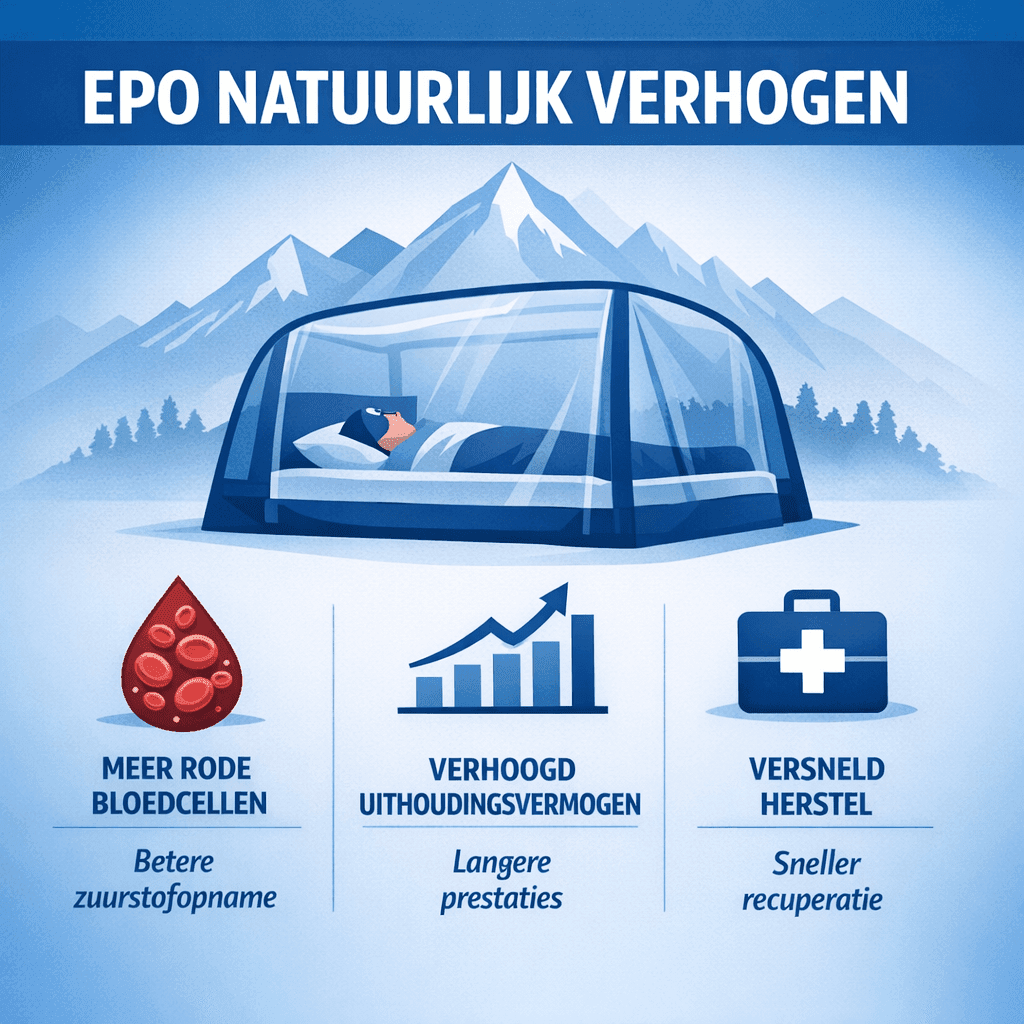
Those looking for a natural way to boost their EPO levels quickly turn to altitude training. Yet EPO is often misunderstood. It is not a magic performance button, but a physiological response to oxygen deprivation. If you understand that mechanism correctly, you also understand why sleeping at altitude can be such a powerful stimulus for endurance athletes and mountain travellers.
The essentials in 30 seconds
Conclusion: High altitude training increases your EPO levels as your body responds to oxygen deprivation, leading to additional red blood cell production.
Nuance: More EPO does not automatically mean better performance. Timing, duration and individual response determine the effect.
Practical lead: Build height incrementally and adjust on SpO2 trend and sleep quality, not on one single measurement.
What is EPO and why is it so important?
Erythropoietin, EPO for short, is a hormone produced in the kidneys. It stimulates the bone marrow to produce red blood cells. More red blood cells means higher oxygen transport capacity, and thus potentially higher aerobic power.
If you want to understand more deeply how this works physiologically, read also How high training naturally increases your EPO levels.
For endurance athletes, this is essential. Oxygen is the limiting factor in prolonged exercise. The more efficiently your body can absorb and transport oxygen, the greater your endurance.
💡 Did you know? The Epo peak often occurs as early as 24 to 48 hours after exposure to hypoxia. The increase in red blood cells follows later. The hormone responds quickly, but the structural adjustment of your blood takes time and consistency.
Why does altitude stimulate EPO production?
At altitude, air pressure is lower, causing the partial pressure of oxygen to drop. Your body experiences this as hypoxia. The kidneys register this lack of oxygen and increase EPO production.
This mechanism makes evolutionary sense. At higher altitudes, the body needs to use oxygen more efficiently. What was originally a survival mechanism is now used strategically for sports performance.
More background on this mechanism can be found in the physiological benefits of altitude training.
⚠️ Reality check Many athletes think that higher is always better. This is not true. Too much hypoxia disrupts sleep and recovery, which can make the net effect negative. Adaptation requires the right dose, not maximum altitude.
Natural height versus artificial height
Traditionally, athletes travelled to mountain areas. Nowadays, they often opt for Sleep High Train Low strategies involving sleeping at altitude and training at lower intensity.
With an altitude tent, normobare hypoxia is applied. This means that it is not the air pressure that changes, but the oxygen percentage in the air that is reduced.
An altitude tent is no substitute for acclimatisation, but it will significantly reduce the risk of altitude sickness when it comes to expedition preparation.
Step by step: here's how to increase your EPO in a controlled way
- Start with an altitude equivalent around 2000 to 2200 metres.
- Sleep at least 7 to 8 hours per night in hypoxic environment.
- Monitor your SpO2 trend for the first 72 hours.
- Increase height only when sleep remains stable.
- Aim for an SpO2 working zone around about 92 per cent during sleep.
- Plan a 3-5-week cycle for structural adaptation.
📊 Research shows A publication in the Journal of Applied Physiology shows that sleeping for 2-3 weeks at altitude leads to significant increases in haemoglobin and performance improvement at sea level.
The most common fallacy about EPO
The biggest misconception is that EPO equals immediate performance enhancement. In reality, EPO is only the beginning of a cascade. Without sufficient iron status, recovery and training structure, the effect remains limited.
Therefore, also read about iron and nutrition during altitude training.
This is how you monitor this lens
A single SpO2 measurement says little. Trends provide insight.
- SpO2 trend: does it drop slightly in the first few days and then stabilise? That is normal.
- Sleep quality: sleeping through without frequent interruptions.
- Recovery feeling: Subjective freshness and training response.
Decision rule: If SpO2 remains below 88 per cent for several nights or sleep structurally deteriorates, then altitude is set too aggressively.
🧭 In practice We usually adjust altitude such that SpO2 remains around a stable working zone during sleep. Not as low as possible, but low enough to encourage adaptation without disrupting recovery.
When to continue, adjust or stop?
When to continue
Stable sleep, mild fatigue in week 1, gradual normalisation of resting heart rate.
When to adapt
Restless sleep, persistent headache, declining exercise quality. Lower altitude temporarily.
When to stop
Severe symptoms such as nausea, coordination problems or persistent shortness of breath. Stopping and descending is the primary intervention.
Read more about alarm symptoms at altitude sickness symptoms and risks.
For whom is this relevant?
Endurance athletes in particular benefit from increased oxygen transport capacity:
- Runners from 800 metres to marathon
- Triathletes
- Cyclists
- Mountain climbers
In expedition preparation, it is used as pre-acclimatisation. See acclimatising at home for mountain expeditions.
❓ Mini-FAQ How quickly do you notice effects?
Often within 2 to 3 weeks in performance. The hormonal response starts earlier, but structural adaptation takes time.
❓ Mini-FAQ Is higher always better?
No. Excessive hypoxia can disrupt sleep and recovery, making net effect negative.
❓ Mini-FAQ Is this safe?
Yes, if built up incrementally and monitored via SpO2 trend and symptoms.
Guidance makes the difference
The difference between gaming and targeted work is in data and interpretation. At Altitude Dream, we guide athletes and mountain travellers through SpO2-driven schedules, sleep monitoring and personal tuning.
Want to know more? Feel free to contact us at https://altitudedream.com/contact/ for a personally tailored course of action.
Main choice for athletes
For endurance athletes looking to increase their aerobic capacity, a structured high-altitude cycle of 4-5 weeks is often ideal.
Running-specific coaching:
View the running altitude programme
Not as hype. Not as a shortcut. But as a controlled physiological strategy.


