Can altitude training improve your VO2 max? What the research says
Published 13 November 2026 · 10 min read
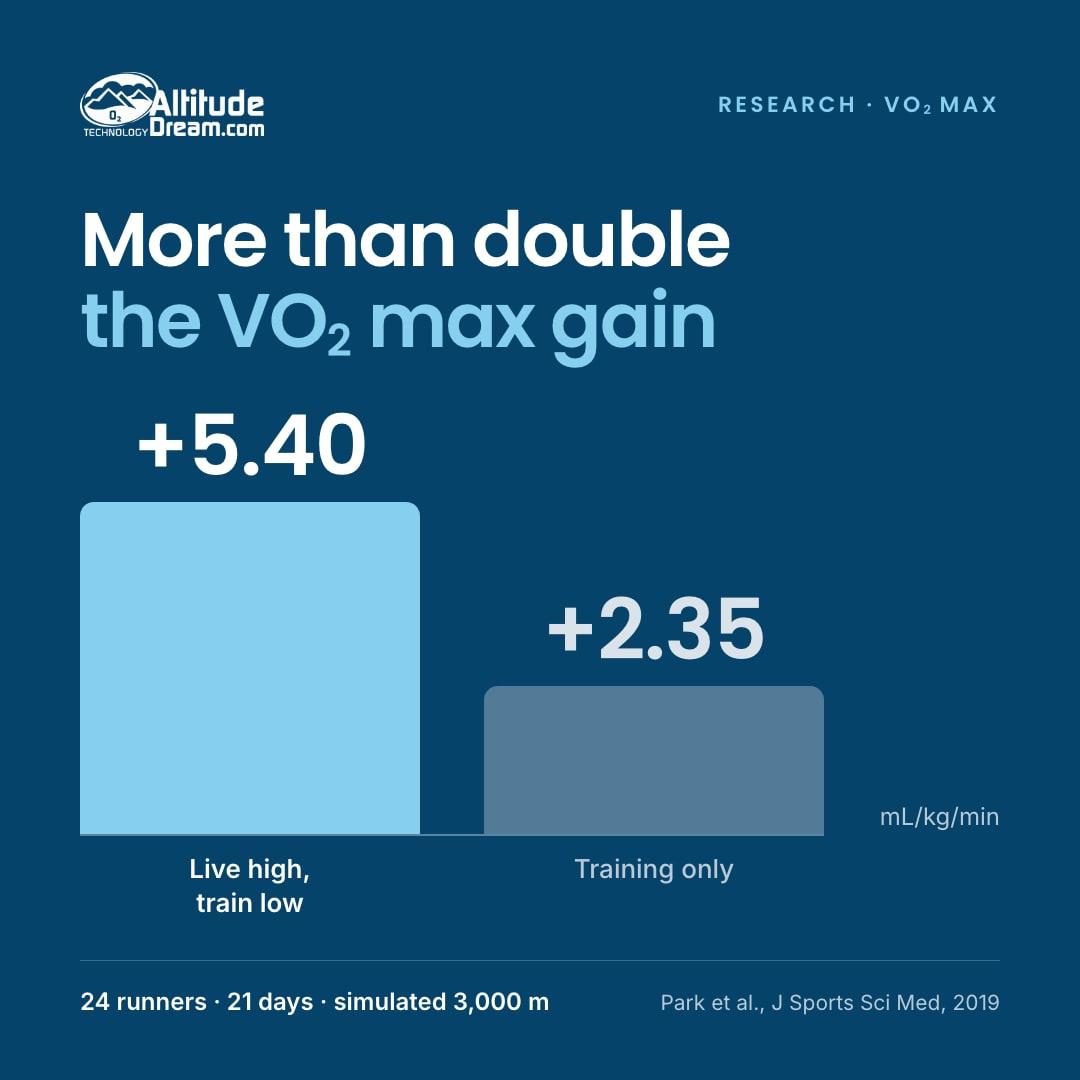
The short answer: yes, it can, but it does not always happen. In one controlled study with simulated altitude, the VO2 max of runners who lived high and trained low rose more than twice as much as in the control group. In a double-blind study, also with simulated altitude, VO2 max stayed the same.
Both outcomes belong in an honest picture. We read five widely cited publications and set out for each study what was measured, in whom, for how long, and what that says about sleeping in an altitude tent at home.
The essentials in 30 seconds
- Runners who lived high and trained low for 21 days gained 5.40 mL/kg/min of VO2 max, against 2.35 in the control group.
- In a double-blind study in cyclists (4 weeks), VO2 max, haemoglobin mass and time trial power did not change.
- An analysis of 59 studies ranks live high, train low first for VO2 max, with simulated altitude too.
- Haemoglobin mass is estimated to grow by about 1.1% per 100 hours at altitude. It is the hours that count.
- Your personal gain cannot be predicted in advance. What you do control: enough hours, a build-up that suits your body and the right timing.
What is VO2 max, and why does everyone look at it?
VO2 max is the most oxygen your body can use per minute during hard exercise, expressed in millilitres per kilogram of body weight. Think of it as the engine size of an endurance athlete: the higher it is, the more pace you can sustain on oxygen.
You train your VO2 max with intervals and volume. But anyone who has trained for years knows how stubborn that number becomes. That is why endurance athletes look at altitude: a stimulus you cannot copy with one more session.
The five studies at a glance
A higher VO2 max, a higher haemoglobin mass and a faster race time are three different outcomes. That is why each study lists exactly what was measured.
| Study | Design | Measured | Outcome |
|---|---|---|---|
| Park, 2019 | Simulated 3,000 m. 24 competitive runners, 21 days, more than 12 hours a day | VO2 max and 3,000 m time trial | Both improved more than with training alone |
| Siebenmann, 2012 | Simulated 3,000 m, double-blind. 16 endurance cyclists, 4 weeks, 16 hours a day | VO2 max, haemoglobin mass and time trial power | No change |
| Feng, 2023 | Real and simulated altitude. 59 studies, 1,821 athletes | VO2 max | Live high, train low ranks first |
| Saunders, 2013 | Various altitude studies. 145 elite endurance athletes | Link between haemoglobin mass and VO2 max | VO2 max rises by more than half of the haemoglobin mass |
| Gore, 2013 | Altitude camps and live high, train low. 17 studies | Haemoglobin mass | About 1.1% per 100 hours |
Simulated altitude, 21 days: more than double the gain
South Korean researchers randomly assigned 24 competitive runners to two groups. Both groups followed the same training programme at sea level for 21 days, six days a week. The only difference: one group also spent more than 12 hours a day in a room at a simulated 3,000 metres (14.5% oxygen), while the other group simply lived at sea level.
| After 21 days | Live high, train low | Training only |
|---|---|---|
| VO2 max | +5.40 mL/kg/min | +2.35 mL/kg/min |
| 3,000 m time trial | 34.0 seconds faster | 19.5 seconds faster |
Both differences were statistically significant. The runners started with an average VO2 max of 55.6 mL/kg/min and a time of about 9 minutes and 44 seconds over 3,000 metres.
One striking detail: after three weeks the blood values did not differ significantly between the groups. In this study the gain came from a more economical body. At the same effort the altitude group needed less oxygen and fewer heartbeats, and the heart pumped more blood per beat.
What does this say about an altitude tent? The setup resembles sleeping in a tent at home: simulated altitude, training at sea level. The difference is in the hours. The runners reached more than 12 hours a day; in a night in the tent you reach about 8. The control group also simply lived at sea level and so knew it was not sleeping at altitude; a placebo effect cannot be ruled out here.
Source: Park, Park and Lim, Journal of Sports Science and Medicine, 2019.
Double-blind, 4 weeks: no difference
That placebo effect is exactly what Siebenmann and colleagues wanted to rule out. Sixteen endurance cyclists trained for eight weeks at low altitude. For four weeks they spent 16 hours a day in rooms with either normal air (6 riders) or low-oxygen air corresponding to 3,000 metres (10 riders). Nobody was told which group they were in, and questionnaires showed that the riders really did not know.
The outcome: haemoglobin mass, VO2 max and mean power in a time trial of just over 26 kilometres stayed the same in both groups.
What does this say about an altitude tent? This too is simulated altitude with training at low altitude, and at 16 hours a day well above a night in a tent. The study shows that a gain does not come by itself, not even with many hours. It is one study with 16 riders, but the only double-blind one in this list.
Source: Siebenmann and colleagues, Journal of Applied Physiology, 2012.
59 studies together: live high, train low on top
Two studies that contradict each other call for a broader view. The 2023 network meta-analysis by Feng and colleagues gives one: 59 randomised studies with 1,821 athletes in total, comparing the forms of altitude training with each other and with normal training.
The outcome: live high, train low, a classic altitude camp and training in low-oxygen air each improved VO2 max more than normal training. In the ranking (a score from 0 to 1, higher is better) live high, train low comes first:
| Variant | Score |
|---|---|
| Living at real altitude, training at 1,000 to 1,500 m | 0.92 |
| Living at simulated altitude, training at 1,000 to 1,500 m | 0.86 |
| Living at simulated altitude, training at sea level | 0.56 |
What does this say about an altitude tent? If you live near sea level, the third row is the one that applies: sleeping at simulated altitude and training at sea level. That combination ranked below the variants with training at low altitude, but on average still did significantly better than normal training. The researchers note that its effect was similar to that of a classic altitude camp, where you live and train at altitude.
Source: Feng and colleagues, Frontiers in Physiology, 2023. Read more about the protocol itself in sleep high, train low.
The mechanism: haemoglobin
Why would less oxygen give you more oxygen? In low-oxygen air your body produces more EPO, the hormone that drives the production of red blood cells. More red blood cells means more haemoglobin, the protein that carries oxygen to your muscles. How that works is explained in how altitude training raises your EPO.
Saunders and colleagues put the data of 145 elite endurance athletes from various altitude studies side by side. In the altitude groups, each 1% of extra haemoglobin mass went with roughly 0.57 to 0.72% of extra VO2 max. Their conclusion: VO2 max rises by more than half of the rise in haemoglobin mass.
They add at once that a race is more than VO2 max alone. Running economy and lactate threshold can improve through altitude as well. Exactly what the Park study showed.
What does this say about an altitude tent? This study did not measure a tent but the mechanism: if your haemoglobin mass rises, your VO2 max rises with it on average. Whether and how much your haemoglobin mass rises is the question of the next study.
Source: Saunders and colleagues, British Journal of Sports Medicine, 2013.
It is the hours that count
How much haemoglobin you gain depends mainly on one thing: how many hours you spend at altitude. Gore and colleagues analysed the raw data of 17 altitude studies and estimated the increase at about 1.1% per 100 hours, both for classic altitude camps (above 2,100 m) and for live high, train low (around 3,000 m).
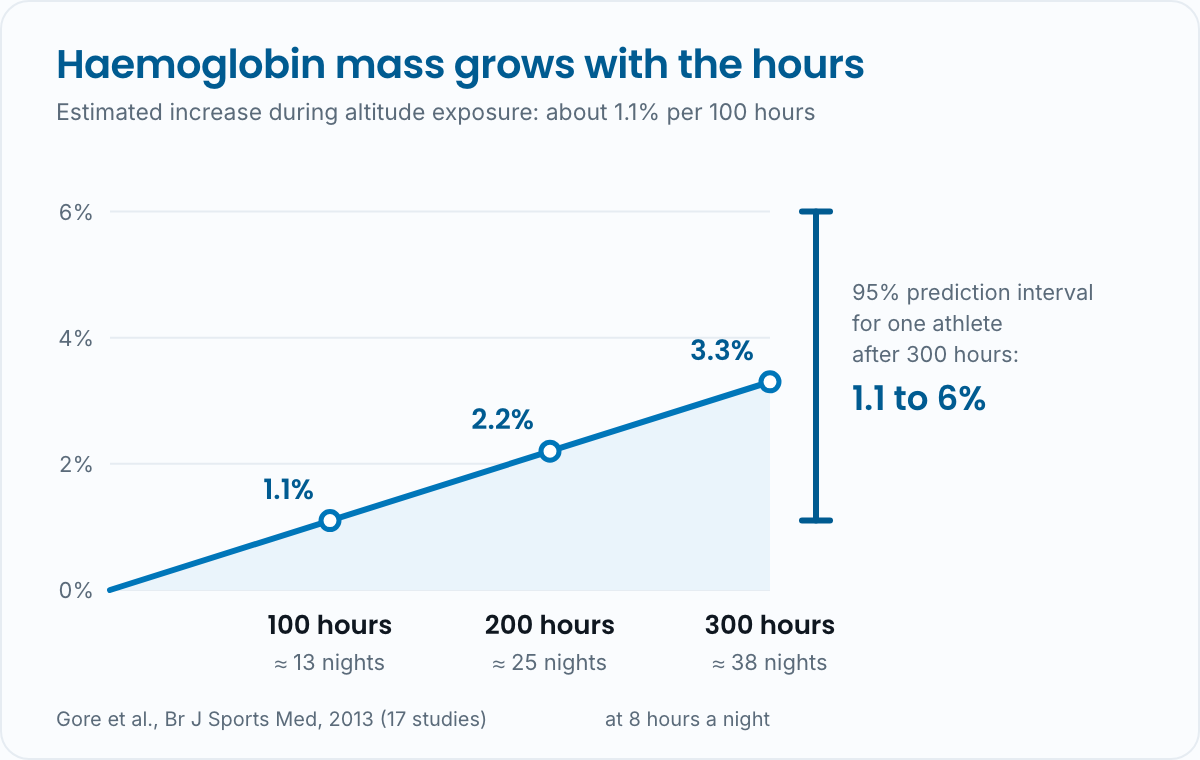
After 300 hours the 95% prediction interval for one athlete runs from 1.1 to 6%. In other words: almost everyone gains something, but how much differs widely from person to person. Afterwards, haemoglobin mass stayed on average 3.3% higher than before for up to 20 days. What happens after that is covered in how long your altitude effect lasts.
What does this say about an altitude tent? Translate it to your bedroom. In the live high, train low studies athletes usually spent 14 hours a day or more in low-oxygen air. If you only sleep in an altitude tent at night, you reach about 8 hours a night. Then 300 hours equals about 38 nights: five to six weeks. Every hour you add per night shortens that period.
Source: Gore and colleagues, British Journal of Sports Medicine, 2013.
What the studies do not promise
Put the five studies side by side and the picture is mixed: on average live high, train low works, but not in every study and not in every athlete. The Feng analysis also describes an inverted U: more is not always better, and too heavy a dose works against you.
- The studies above were carried out in research chambers and at real altitude, not with the systems of Altitude Dream.
- The participants were trained to elite athletes, often with more hours a day in low-oxygen air than you reach at home in one night.
- Individual responses vary widely. A performance gain is never guaranteed.
How do you apply this at home?
With an altitude tent you sleep at simulated altitude at home, in your own bed, and you keep training in your own environment. You do not have to plan an altitude camp for it.
What the studies do teach is what it comes down to: enough hours, an altitude that suits your body and the right timing. That is where the guidance of Altitude Dream comes in:
- Timing. You give your race date, we count back to your first night and match your rental period to it.
- Build-up. You build up the altitude based on your own morning oxygen saturation, not on a fixed schedule. In My Altitude you note your saturation every morning and see which setting you sleep at the next night.
- Hours. You also note your hours in the tent, so you see where you are in your programme. If you like, your coach can follow along.
- Convenience. In the Netherlands, Belgium and Luxembourg we deliver and install the altitude tent at your home and explain everything. Elsewhere in Europe we ship the system by courier, with a manual.
How the protocol works in practice is explained on Sleep High, Train Low.
Count back from your race
The studies do not only say whether altitude can work, but also what it costs: time. Three things follow from that.
- Start in time. You build haemoglobin per hundred hours, not per weekend. If you start two weeks before the race, you will not catch up on those hours.
- Count back. Athletes usually stop 7 to 10 days before their peak race. Add your weeks at altitude and you know when your first night has to fall.
- Make your nights long. Every extra hour in the tent counts towards the same dose.
An example. Is your race on Sunday 11 April 2027? Then you stop around 1 April. With four to six weeks at altitude, your first night falls between mid-February and early March. The hours you miss then do not come back.
Further reading
Working towards a race?
Choose your sport and race date to see which programme we advise.
Sleeping high and training low improved endurance performance, even in elite runners.
Sources
- Park HY, Park W, Lim K (2019). Living high-training low for 21 days enhances exercise economy, hemodynamic function, and exercise performance of competitive runners. J Sports Sci Med 18(3):427-437.
- Siebenmann C, Robach P, Jacobs RA, Rasmussen P, Nordsborg N, Diaz V, Christ A, Olsen NV, Maggiorini M, Lundby C (2012). "Live high-train low" using normobaric hypoxia: a double-blinded, placebo-controlled study. J Appl Physiol 112(1):106-117.
- Feng X, Zhao L, Chen Y, Wang Z, Lu H, Wang C (2023). Optimal type and dose of hypoxic training for improving maximal aerobic capacity in athletes: a systematic review and Bayesian model-based network meta-analysis. Front Physiol 14:1223037.
- Saunders PU, Garvican-Lewis LA, Schmidt WF, Gore CJ (2013). Relationship between changes in haemoglobin mass and maximal oxygen uptake after hypoxic exposure. Br J Sports Med 47(Suppl 1):i26-i30.
- Gore CJ, Sharpe K, Garvican-Lewis LA, Saunders PU, Humberstone CE, Robertson EY, Wachsmuth NB, Clark SA, McLean BD, Friedmann-Bette B, Neya M, Pottgiesser T, Schumacher YO, Schmidt WF (2013). Altitude training and haemoglobin mass from the optimised carbon monoxide rebreathing method determined by a meta-analysis. Br J Sports Med 47(Suppl 1):i31-i39.