HRV-controlled altitude training: when to build up and when to rest.
Published 10 May 2026 · 14 min read

HRV-controlled altitude training helps you use an altitude tent smarter. Not by blindly tracking one number every morning, but by reading HRV, resting heart rate, SpO2 trend, sleep quality and complaints together. This is especially valuable with Live High Train Low: you sleep in normobare hypoxia, but train low enough during the day to maintain training quality.
So the practical question is not just, “What height should I set?” The better question is: “Can my body handle the current hypoxic stimulus properly?” If the answer is yes, you can build up in a controlled way. If the answer is no, rest or a lower setting is often stronger than forcing.
Short answer: increase the altitude setting only when your HRV trend is stable or recovering, your resting heart rate does not remain markedly elevated, your SpO2 trend matches the set altitude and your sleep quality is acceptable. Lower the altitude or take rest when HRV drops for several days, your resting heart rate rises, your sleep gets worse or you experience symptoms such as headache, restlessness, nausea or noticeable fatigue.
Conclusion: HRV-driven altitude training works best as a tutoring system, not as an absolute traffic light.
Nuance: HRV also responds to stress, alcohol, heat, travel load, illness and training load.
Practical hook: Always combine HRV with SpO2 trend, sleep, resting heart rate and symptoms.
This article is deliberately different from a general article on HRV and recovery monitoring. The focus here is on one specific application: Live High Train Low with an altitude tent. In other words, how do you use HRV data to determine whether to raise the tent higher, lower it or keep it temporarily level?
Why HRV-driven altitude training is different from ordinary recovery monitoring
In regular recovery monitoring, you often look at whether you can train hard today. With HRV-controlled altitude training, an extra layer is added. You don't just train. You also add an overnight oxygen stimulus.
An altitude tent lowers the oxygen percentage in the air. The air pressure remains the same. This is called normobaric hypoxia. Your body therefore experiences less available oxygen per breath during sleep. This can be a useful stimulus, but it is still a stimulus.
Therefore, you should not think of the altitude tent as a passive sleep environment. You use sleep as a training stimulus. That requires dosage. Too low may give too little stimulus. Too high can disrupt sleep, recovery and training quality.
In practice: a lower setting that you process well is often more valuable than a high setting that breaks your sleep. Especially in the first few weeks, consistency counts more heavily than heroic highs.
HRV can help monitor that balance. A falling HRV does not automatically mean the marquee is too high. But a falling HRV combined with higher resting heart rate, poorer sleep and falling SpO2 trend is a clear signal. Then building up is usually not wise.
What HRV does and does not say in HRV-controlled altitude training
HRV stands for heart rate variability, or heart rate variability. It reflects how much variation there is between consecutive heartbeats. In sports context, RMSSD is mainly used because it is sensitive to parasympathetic activity and recovery status.
With a properly recovering body, you often see a stable or rising HRV trend. With heavy load, stress, illness, alcohol, sleep deprivation or insufficient recovery, HRV may drop. Still, one single measurement is rarely enough. The trend over several days is especially important.
This is even more true in altitude training. The first nights in hypoxia may temporarily stress your autonomic nervous system. Your breathing may change slightly, your heart rate may rise and your sleep may become lighter. This need not be wrong. It can also be part of the adjustment.
So the trick is not to avoid every drop. The trick is to recognise when a normal adaptive response turns into too much strain.
HRV as a signal versus HRV as a decision
Not strong: “My HRV is lower today, so I have to stop.”
Stronger: “My HRV is down three mornings, my resting heart rate is elevated, my sleep is worse and I have a headache. I lower the tent or have a rest night.”
Therefore, it makes sense to link HRV to the way you set your altitude. Those without a basis for that yet can first delve into setting the correct height before HRV is added as an additional layer of control.
The decision logic: when to increase, keep the same or decrease
A good altitude programme usually proceeds in steps. You don't start at maximum. You build up. Then you check whether your body is processing the stimulus. HRV especially helps with the timing of that next step.
In practice, there are three decisions: increase, keep the same or decrease. Increase you do only when signals are stable. Keeping it the same is done at normal adjustment. Decrease you do in case of accumulating load.
| Signal image | Interpretation | Action for the high altitude tent |
|---|---|---|
| Green HRV stable, resting heart rate normal, sleep reasonable, no complaints | The current incentive is being handled well. | You can gently increase or confirm for another 1-2 nights. |
| Yellow HRV slightly lower, sleep slightly more restless, SpO2 trend lower but symptom-free | Normal adjustment is possible, but the system works harder. | Keep the height the same. Do not raise. |
| Orange HRV several days lower, resting heart rate higher, sleep markedly worse | The total load increases. | Lower the tent or plan a recovery block. |
| Red Headache, nausea, dizziness, tightness in the chest or conspicuous exhaustion | Complaints are more important than data. | Stop or reduce immediately and medically assess where necessary. |
Signal image: HRV stable, resting heart rate normal, sleep reasonable, no complaints.
Interpretation: the current stimulus is well processed.
Action: Gently increase or confirm for another 1-2 nights.
Signal image: HRV slightly lower, sleep slightly more restless, SpO2 trend lower but symptom-free.
Interpretation: normal adjustment is possible, but the system works harder.
Action: keep height the same. Do not increase.
Signal image: HRV several days lower, resting heart rate higher, sleep markedly worse.
Interpretation: the total load increases.
Action: lower tent or schedule a recovery block.
Signal image: headache, nausea, dizziness, tightness in the chest or conspicuous exhaustion.
Interpretation: complaints are more important than data.
Action: stop or reduce immediately and medically assess where necessary.
This decision logic avoids two mistakes. The first mistake is increasing too fast because the programme on paper says so. The second mistake is stopping too quickly because one HRV measurement is disappointing. It is precisely the combination of signals that makes the decision stronger.
A practical protocol for HRV-controlled altitude training
The protocol below is intended as a practical line of thought. It does not replace individual guidance, but it does help to use the altitude tent in a measurable and planable way.
Protocol in 4 stages
Phase 1: Determine your baseline without an altitude tent. Measure at least 5 to 7 mornings HRV, resting heart rate, sleep quality and general fatigue.
Phase 2: start conservatively. Choose a setting that does not immediately disrupt your sleep. First nights are meant for reading response, not gaining altitude.
Phase 3: Increase only when trends are stable. Do not use a fixed calendar as the only guide. Look at HRV, resting heart rate, SpO2 trend and symptoms.
Phase 4: stabilise before the peak period. In the final phase, sleeping well is often more important than one more step up.
| Phase | Target | HRV interpretation | Elevation tent action |
|---|---|---|---|
| Baseline | Personal normalcy determination. | Use 5 to 7 days as a reference. | Not yet increasing based on loose dates. |
| Start | Getting used to hypoxia. | Slight decline may be normal. | Keep height the same until sleep is stable. |
| Construction | Prick controlled increase. | Increase only when the trend is stable or recovering. | Small step up, then observe for 2-3 nights. |
| Stabilisation | Monitor recovery and consistency. | Downward trend outweighs ambition. | Keep equal or lower if sleep deteriorates. |
Objective: determine personal normalcy.
HRV interpretation: use 5 to 7 days as a reference.
Action: not yet increase based on loose dates.
Objective: Getting used to hypoxia.
HRV interpretation: slight decrease may be normal.
Action: keep height the same until sleep is stable.
Objective: increase incentive controlled.
HRV interpretation: Increase only when trend is stable or recovering.
Action: small step up, then observe for 2-3 nights.
Objective: monitor recovery and consistency.
HRV interpretation: Downward trend outweighs ambition.
Action: Keep equal or lower if sleep deteriorates.
For athletes, this is especially relevant when they want to maintain training quality. For mountain athletes, it is especially relevant because sleep, recovery and acclimatisation preparation are not separate. In both cases, the best stimulus is the one your body can process.
This is how you monitor this lens
Objective monitoring starts with repeatability. Preferably measure every day at the same time, under similar conditions and with the same device. Do not use HRV in isolation, but as part of a compact dashboard for yourself.
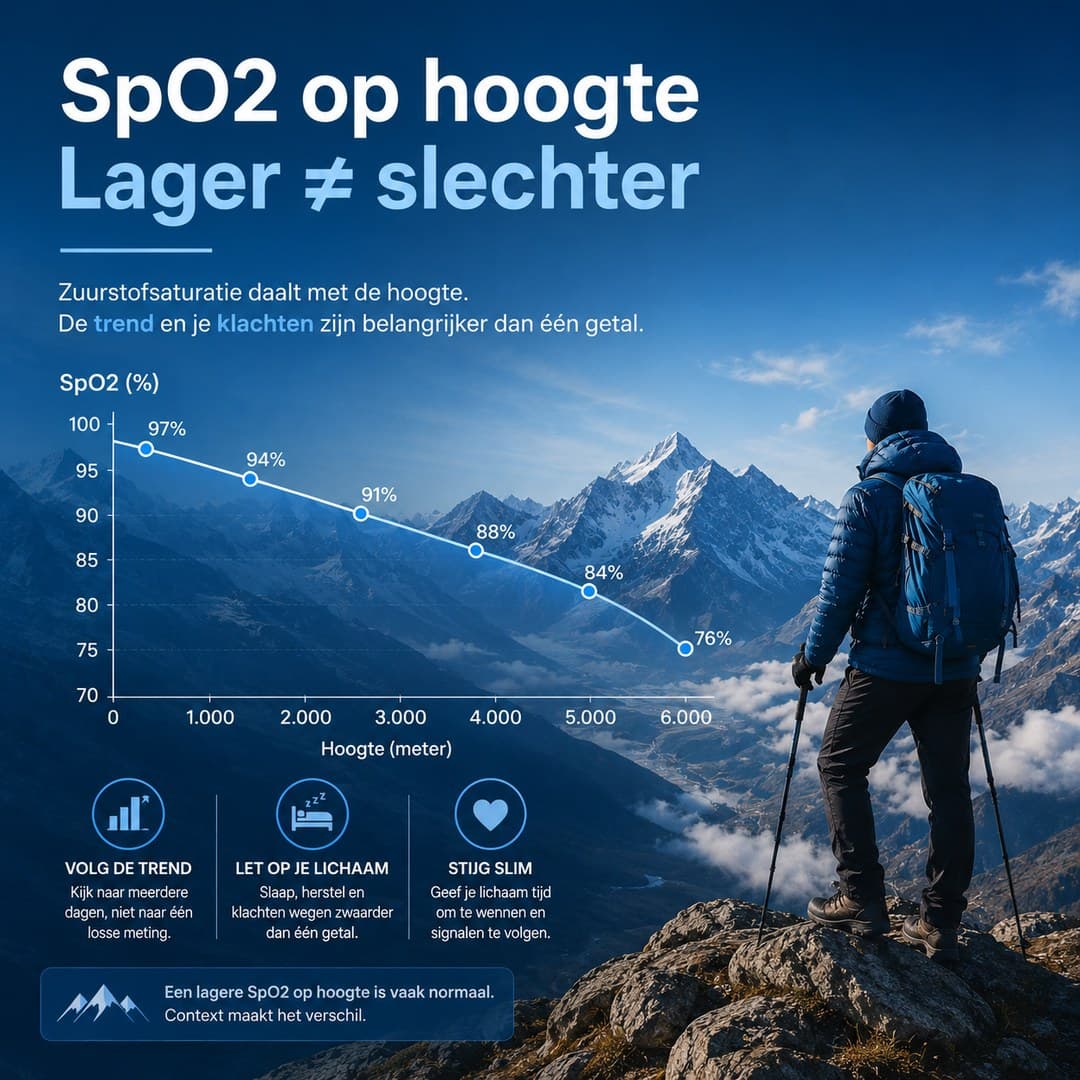
The minimum set consists of five signals: HRV trend, resting heart rate, SpO2 trend, sleep quality and complaints. In this, SpO2 is always a trend. One single saturation measurement says less than a pattern over several nights and mornings.
Daily checkpoints
- HRV trend: stable, rising or several days falling?
- Resting heart rate: normal or significantly higher than your baseline?
- SpO2 trend: matching the set height or strikingly lower?
- Sleep quality: quiet enough or clearly fragmented?
- Symptoms: headache, nausea, dizziness, tightness in the chest or unusual fatigue?
- Training response: Does quiet training feel normal or unusually heavy?
Those using an altitude tent can use SpO2 to better understand physiological load. The goal is not to chase a perfect value. The goal is to see how your body responds to the same setting. You can find more context in the article on saturation in the altitude tent.
Pay particular attention to combinations. A low HRV after a heavy training day is not strange. A low HRV plus elevated resting heart rate plus poor sleep plus lower SpO2 trend is a stronger signal. Then it is usually wiser not to raise the marquee.
Decision rules for building, resting and lowering
Decision rules make HRV-controlled altitude training practical. They prevent you from having to reinterpret from feeling every morning. At the same time, they remain flexible enough to accommodate individual differences.
When can you build up?
Consider a small increase when HRV is stable or recovering for at least 2-3 days, resting heart rate is close to your baseline, sleep quality remains acceptable and you have no relevant complaints. The SpO2 trend may be lower than at sea level, but should be logical and stable for the chosen setting.
When do you keep the height the same?
Keep the altitude the same for mild adaptation signals. Think of some light sleep, a limited drop in HRV or a slightly higher resting heart rate without complaints. This is not a time to increase aggressively. It is a moment to give your body time.
When do you rest or downgrade?
Lower the tent or plan recovery when HRV is markedly lower for several days, resting heart rate remains elevated, sleep quality declines or your sense of training deteriorates. Complaints such as headaches, nausea or tightness always outweigh a nice schedule.
A good rule of thumb: raise only when the previous step has been processed. Not when the schedule says it's time. Especially with experienced athletes and mountaineers, this difference is important. They can often tolerate load mentally, but that does not mean the body is recovering optimally.
Common misunderstandings with HRV-controlled altitude training
The first misconception is that a low HRV is always bad. This is not true. A temporary drop can suit training, travel stress, mental stress or the first few nights in hypoxia. The question is whether the drop recovers.
The second misconception is that a high HRV always means you can increase. That too is oversimplified. Some athletes get a high HRV in fatigue or parasympathetic overreaching. Therefore, you should always look at the overall picture.
The third misconception is that HRV is more important than symptoms. This is unsafe. Symptoms come before data. If you experience headache, nausea, dizziness or tightness, you should reduce the stimulus and assess what is going on.
Reality check: an altitude tent makes preparation controlled, measurable and planable. This can significantly reduce the risk of altitude complaints, but it is no 100% guarantee and no substitute for true acclimatisation during an expedition.
The fourth misconception is that you have to finish higher every week. At Live High Train Low, progression is not an end in itself. The goal is effective stimulation while maintaining recovery. Sometimes a stable week is better than an extra step up.
How this article complements the existing HRV article
A general HRV article mainly helps to understand recovery monitoring. This article goes one step further. It translates HRV into concrete decisions within an altitude program.
Therefore, the focus here is not on what HRV is. The focus is on what you do with it. Do you raise the marquee? Do you keep even? Do you take a rest? Or do you temporarily lower? That makes this article especially practical for athletes and mountaineers who already measure and now want to steer better.
For those who want to look more broadly at impact measurement, performance and recovery is measuring altitude training effect a logical next step. There, it is less about day-to-day adjustment and more about whether the overall programme delivers.
Practical tips for reliable HRV data
Good decisions start with reliable data. That sounds simple, but this is where things often go wrong. HRV is sensitive to measurement timing, posture, breathing, alcohol, late meals, mental stress and sleep duration.
Therefore, measure as consistently as possible. Preferably use the same wearable or sensor. Do not compare values between different devices. An Oura ring, Garmin, Whoop, Polar chest strap or other tool can be useful, but the trend within the same system is more important than the absolute value.
In addition, do not use a new interpretation during an important week. If you suddenly introduce a new HRV system just before an expedition or competition, you don't have a personal baseline. Then chances are your data will be interesting, but not yet decisive.
This is how to make HRV usable for the altitude tent
- Measure at least 5 to 7 days without an altitude stimulus for your baseline.
- Look at 3- to 7-day trends, not one single morning.
- Record sleep quality and complaints next to the HRV value.
- Use SpO2 as a trend, not an absolute truth.
- Increase only after stable response to the previous step.
- Decrease at accumulating signals, even if the schedule says otherwise.
When HRV-controlled altitude training is especially valuable
HRV-controlled altitude training is especially valuable when the margin is small. Think of an athlete who wants to maintain training quality, a mountain athlete with limited acclimatisation time or someone who previously reacted sensitively to altitude.
It is also useful with busy schedules. Many people combine the altitude tent with work, family, training, travel and stress. Then the overall load picture is more important than the schedule on paper.
In such situations, HRV helps not to separate the altitude tent from the rest of life. Your body adds everything up. A hard working week plus intense training plus too fast an altitude build-up can be too much. Even if each factor individually seems acceptable.
This is why a good programme is never just an altitude programme. It is a recovery programme, sleep plan and stimulus plan at the same time. The page on erection with an altitude tent matches that content.
Want to get your height setting right first?
HRV only becomes really valuable when the basics are right: build up gradually, choose the right altitude and monitor your response calmly. Therefore, start with a setting that your body can handle well.
Conclusion: steer by response, not ego
HRV-controlled altitude training makes an altitude training programme more personal. Not because HRV tells everything, but because it helps to better read recovery and load. Especially in Live High Train Low, this is valuable. You want to sleep in hypoxia but stay fresh enough during the day to train, work and recover well.
The gist is simple. Build up when your response is stable. Keep equal when your body is clearly adjusting. Decrease or rest when signals accumulate. In doing so, symptom control always comes before data interpretation.
Those who combine HRV with resting heart rate, SpO2 trend, sleep quality and complaints, get a much stronger picture than with a single isolated value. Thus, altitude training becomes not a guess, but a controlled, measurable and plannable stimulus.
Frequently asked questions about HRV-controlled altitude training
What is HRV-controlled altitude training?
HRV-controlled altitude training means that you use HRV trend to adjust your altitude programme. With it, you determine whether you can build up, better stay the same or need to temporarily lower.
When can I raise the height tent?
Increase only when HRV is stable or recovering, resting heart rate remains normal, sleep quality is acceptable and you have no complaints. Confirm this preferably over several days.
When should I lower the height tent?
Decrease when there is a combination of falling HRV, higher resting heart rate, poorer sleep, lower SpO2 trend and symptoms. Symptoms always outweigh data.
Is one bad HRV measurement reason to quit?
Usually not. One measurement can be noise. Especially look at trends over several days and combine HRV with sleep, resting heart rate, SpO2 trend and sensation.
Can HRV predict altitude sickness?
No, not reliable as a separate value. HRV can help track load and recovery, though. In case of symptoms, always act conservatively.