
What is the optimum height for LHTL height training?
Published 28 July 2012 · 3 min read
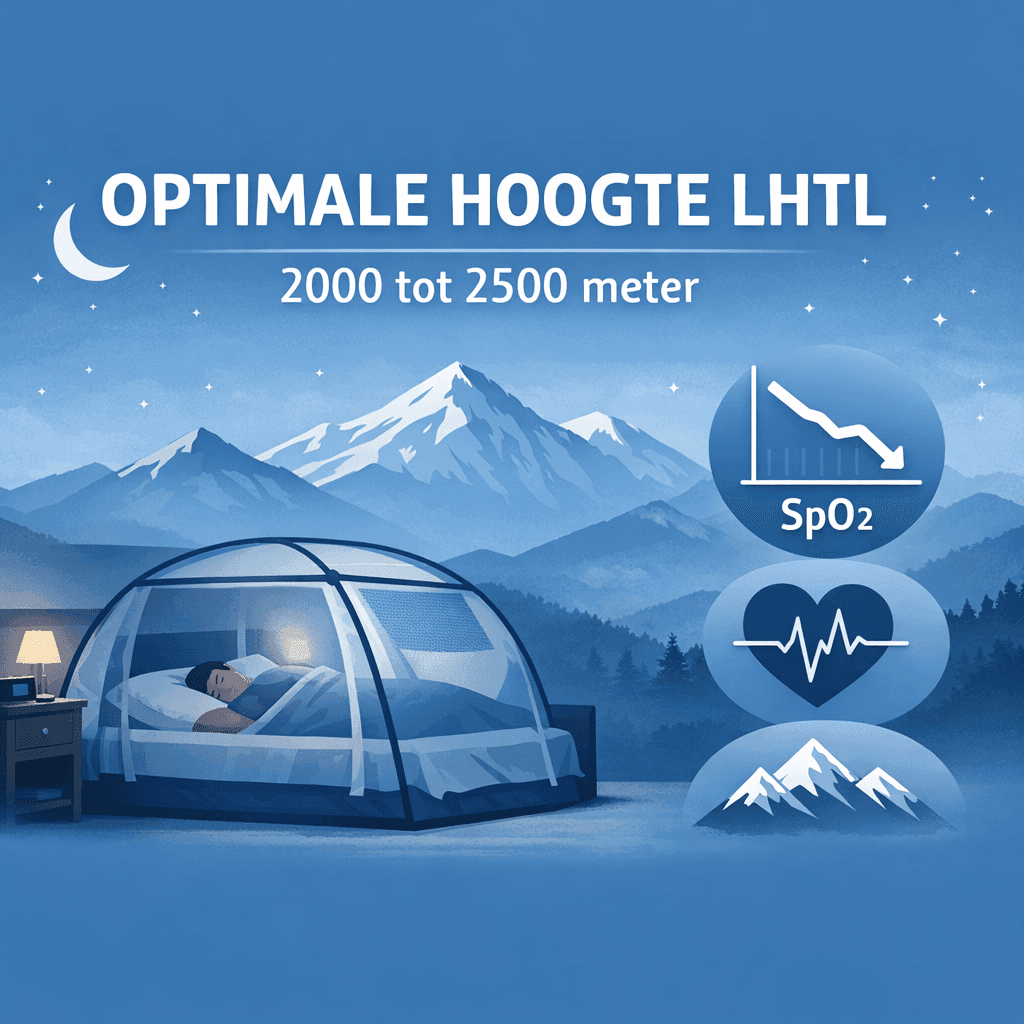
The optimum altitude at LHTL is between 2000 and 2500 metres for most athletes. In this zone, the hypoxic stimulus is strong enough to EPO stimulate, but not so heavily that sleep, recovery or training quality drop significantly. This balance makes this altitude bandwidth physiologically effective as well as practical.
Yet this topic is often misunderstood. Some think higher is always better. Others stay too low, preventing adaptation. In this article, you will get a clear and science-based answer to the question: what is the optimal height in LHTL?
Why optimal height is often chosen incorrectly in LHTL
Live High Train Low, or LHTL for short, means sleeping in hypoxia and training at lower altitude. The aim is haematological adaptation without loss of quality in training. The method is explained in detail at Sleep High Train Low.
The misunderstanding arises because people think maximum hypoxia means maximum gain. This is not correct. Above 2800 metres, physiological stress rises sharply. Sleep quality drops, sympathetic activation increases and recovery slows down.
Below 1800 metres, on the other hand, the EPO response often remains too limited.
The physiological core: why 2,000 to 2,500 metres works
At 2000 to 2500 metres, oxygen pressure drops sufficiently to cause a measurable increase in EPO. This mechanism is discussed in detail in How altitude training increases your EPO levels.
More importantly, this altitude is usually well tolerated during sleep. This is crucial. At LHTL, sleeping the primary stimulus. Do not train.
Thus, the optimal height at LHTL must satisfy three conditions:
- Measurable decrease in nocturnal SpO2
- Maintaining sleep quality
- Full retention of training intensity at low altitude
What happens above 2,500 metres?
From around 2,700 metres, the risk of disturbance increases:
- More nocturnal awakenings
- Increased resting heart rate
- Decrease in deep sleep
- Increase in feelings of fatigue
For expeditionary preparation, higher hypoxia may be useful, see acclimatising at home for mountain expeditions. But for pure sports performance, it is usually suboptimal.
This is how you monitor this lens
You don't determine the optimum height at LHTL by feeling alone. You adjust based on trends.
1. SpO2 trend
View nightly average SpO2 over several days. A drop to 88 to 92 per cent is often appropriate. A single low reading says nothing. The trend over 5 to 7 days does.
2. Sleep quality
Do you wake up more often? Does your subjective sleep score drop? If so, the altitude may have been chosen too aggressively.
3. Recovery feeling
Does your training quality remain intact? Or do you feel progressive fatigue?
Decision rule: If SpO2 drops but sleep remains stable and training quality is maintained, then you are probably in the optimal zone.
The role of a high altitude tent
With an altitude tent, you create normobare hypoxia. Air pressure stays the same, oxygen percentage drops. This enables controlled buildup. Read also altitude tent use complete guide.
Important: an altitude tent is no substitute for acclimatisation, but significantly reduces the risk of altitude sickness when sporting or expeditioning.
Proper use means:
- Start around 1800 metres
- Increase incrementally every 3 to 5 days
- Adjust on SpO2 trend
- Use sleep as a primary stimulus
What do studies say about optimal height LHTL?
Multiple controlled studies show that 2000 to 2500 metres consistently gives haematological gains with no significant drop in training output. Higher altitudes give more stress but not proportionally more performance gains.
The goal is adaptation without overload. That balance is usually in this range.
Decision aid: which height suits you?
Novice user: 2000 metres
Experienced LHTL user: 2200 to 2400 metres
Elite athlete with monitoring: possibly up to 2500 metres
Don't automatically go higher. The optimal altitude at LHTL is the lowest altitude that triggers adaptation without disrupting recovery.
Summary in 30 seconds
- Optimal altitude LHTL: 2000 to 2500 metres
- Sleep is the primary stimulus
- Always assess SpO2 as trend
- Higher is not automatically better
- Maintaining training quality is key
Want to apply this in a controlled way?
Want to use LHTL strategically for maximum sports performance? See here the possibilities for your sport or read the experiences of athletes


