Using altitude tents: a comprehensive guide to deepening your knowledge and making smart decisions
Published 7 January 2026 · 5 min read
Using an altitude tent is a logical step for many athletes and mountain travellers when preparing for performance or stays at altitude. If used properly, an altitude tent can contribute to pre-acclimatisation, better tolerance to low oxygen conditions and reduced risk of altitude problems. At the same time, its use raises many questions: does it really work, who is it suitable for, how long should you sleep in it and when exactly is there no point? This complete guide gives you instant clarity, nuance and practical tools to make an informed choice.
This deepening goes beyond basic explanations. We discuss not only the how, but especially the why, preconditions and pitfalls. This will help you assess whether an altitude tent suits your goals, health and schedule.
What is an altitude tent and what exactly does it do?
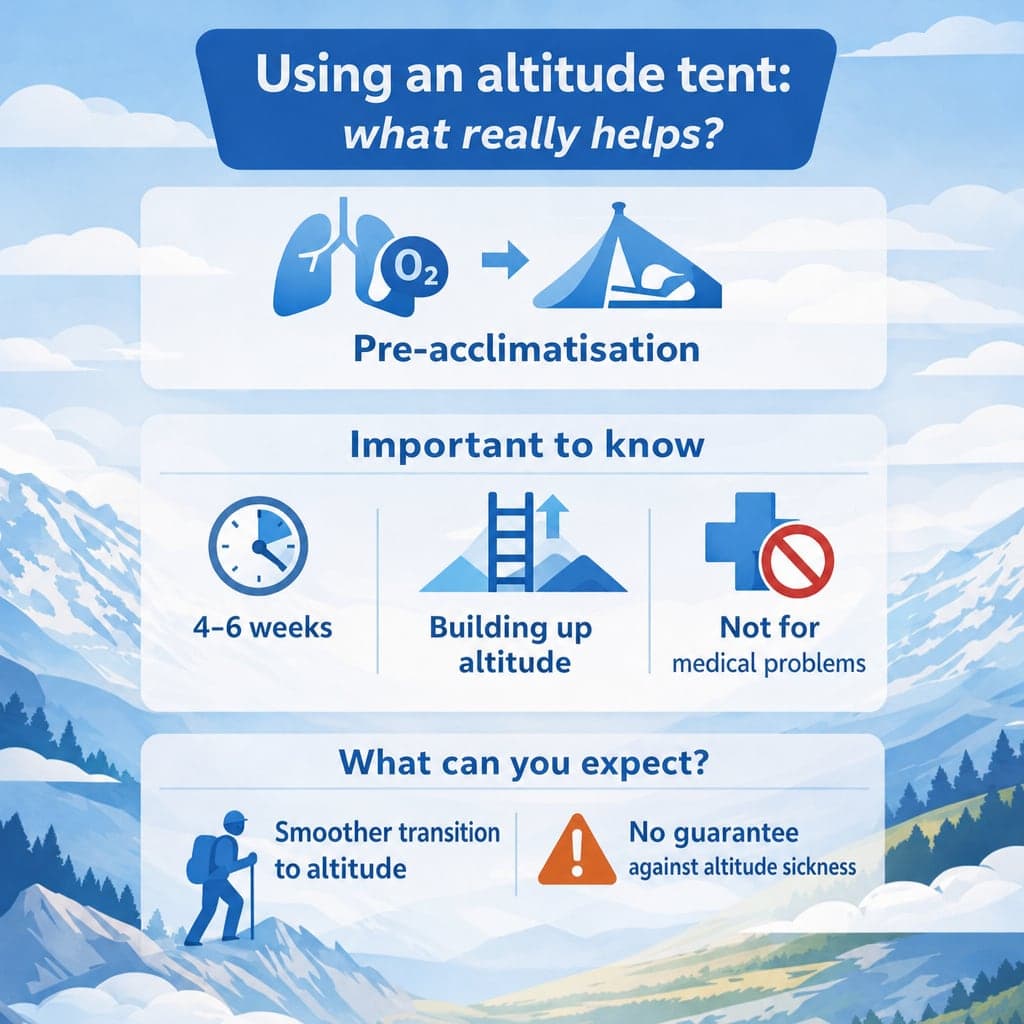
An altitude tent is a sleeping environment in which the oxygen percentage is artificially reduced so that the body experiences a situation similar to staying at altitude. This is done not by lowering air pressure, but by reducing the oxygen content in inhaled air. The body responds with physiological adaptations that also occur at real altitude.
Normobaric hypoxic versus hypobaric
Altitude tents normobarically work hypoxically. Air pressure remains the same as sea level, but oxygen levels fall. In the mountains, there is hypobaric hypoxia, where both air pressure and oxygen pressure are lower. Although not identical, studies show that many acclimatisation mechanisms are similarly activated.
Main physiological effects
- Increase in breathing frequency and ventilation
- Stimulation of erythropoietin (EPO) production
- Adaptation of oxygen transport and use
- Improved ventilatory response to hypoxia
These processes form the basis of pre-acclimatisation.
Who does an altitude tent make sense for?
An altitude tent is not a panacea and certainly not necessary for everyone. The added value strongly depends on the purpose and context.
Endurance and strength athletes
For endurance athletes looking to perform at altitude or at sea level, an altitude tent can help improve oxygen utilisation. Think of runners, cyclists and triathletes who do not have the option of long-term altitude training.
Mountain hikers and expeditioners
For trekkers and climbers travelling to altitudes above 3,000 metres, pre-acclimatisation can help make the transition to altitude less abrupt and prevent altitude sickness. This is especially relevant in tight travel schedules or rapid ascents.
When a high altitude tent is less suitable
- For severe sleep disorders without medical supervision
- In certain heart or lung conditions
- As a substitute for gradual acclimatisation in terrain
In those cases, personal advice is essential.
Scientific evidence and realistic expectations
The effectiveness of altitude tents has been widely studied. The consensus is nuanced: they work, but only under specific conditions.
What does science say?
Research shows that repeated exposure to hypoxia during sleep can lead to measurable acclimatisation effects. The degree of effect depends on duration, altitude equivalent and individual response. Organisations such as the UIAA and the WHO emphasise that pre-acclimatisation is supportive but cannot rule out altitude sickness 100%.
What to expect and what not to expect
- Well: less intense first days at altitude
- Well: better tolerance to exertion at altitude
- Not: 100% protection against AMS, HAPE or HACE
- Not: substitute rest days and slow rise
How to use a high altitude tent properly?
Correct use determines results. The most common mistakes arise from wanting to go too fast or from wrong expectations.
Duration and timing
For meaningful adaptation, we recommend a duration of use of at least 4 weeks and up to 6 weeks. Shorter use rarely produces stable effects. Longer is not necessarily better and may adversely affect sleep quality.
Structure of height
A gradual build-up is crucial. Start at a low altitude equivalent and gradually increase it. This will give the body time to adapt and reduce the likelihood of complaints.
Sleep quality as a guide
Sleep is when adaptation takes place. Poor or restless sleep is a signal to slow down. Pre-acclimatisation only works if recovery remains intact.
Common misunderstandings and mistakes
“The higher, the better”
A tent set too high increases the risk of headaches, poor sleep and downtime. Effective pre-acclimatisation is all about consistency, not extremes.
“With an altitude tent, I no longer need acclimatisation”
This is a dangerous assumption. Even with pre-acclimatisation, a sensible pace of ascent remains essential. Read more about this in the article preventing altitude sickness.
“Everyone reacts the same way.”
Individual differences are great. Some people react strongly, others hardly at all. Monitoring and adjusting are therefore important.
Relationship to altitude sickness and safety
An altitude tent can help you prepare better, but it does not completely reduce the risk of altitude sickness to zero.
AMS, HAPE and HACE in perspective
Pre-acclimatisation can lower the risk of Acute Mountain Sickness, but does not protect against severe forms such as HAPE and HACE. Early recognition and descent remain the most important measures.
Red flags during use
- Persistent headache
- Severe insomnia
- Nausea or dizziness
At these signals, it is wise to lower or temporarily stop the altitude.
Combination with training and daily load
Many athletes combine an altitude tent with the principle of sleep high, train low. This means you sleep in hypoxia but train at normal oxygen levels. This maintains training quality while acclimatisation takes place. You can read more about this in this in-depth article on sleep high train low.
Practical decision moments: does a high altitude tent make sense for you?
- Are you going to stay or perform above 3,000 metres?
- Is your travel time short and the pace of ascent high?
- Have you had complaints at altitude before?
If several questions are answered yes, pre-acclimatisation with an altitude tent can be a valuable addition.
Summary and nuance
Using an altitude tent can make sense as part of thoughtful preparation. It is no guarantee, no substitute for on-site acclimatisation and not a universal solution. Applied correctly, with realistic expectations and sufficient duration, it can indeed contribute to a safer and more comfortable transition to altitude and significantly reduce the risk of altitude sickness.
For those who want to prepare properly for a stay or performance at altitude, more and more mountain sportsmen and athletes are opting for a combination of knowledge, planning and pre-acclimatisation.