Altitude training and red blood cells: the mechanism
Published 26 March 2026 · 4 min read
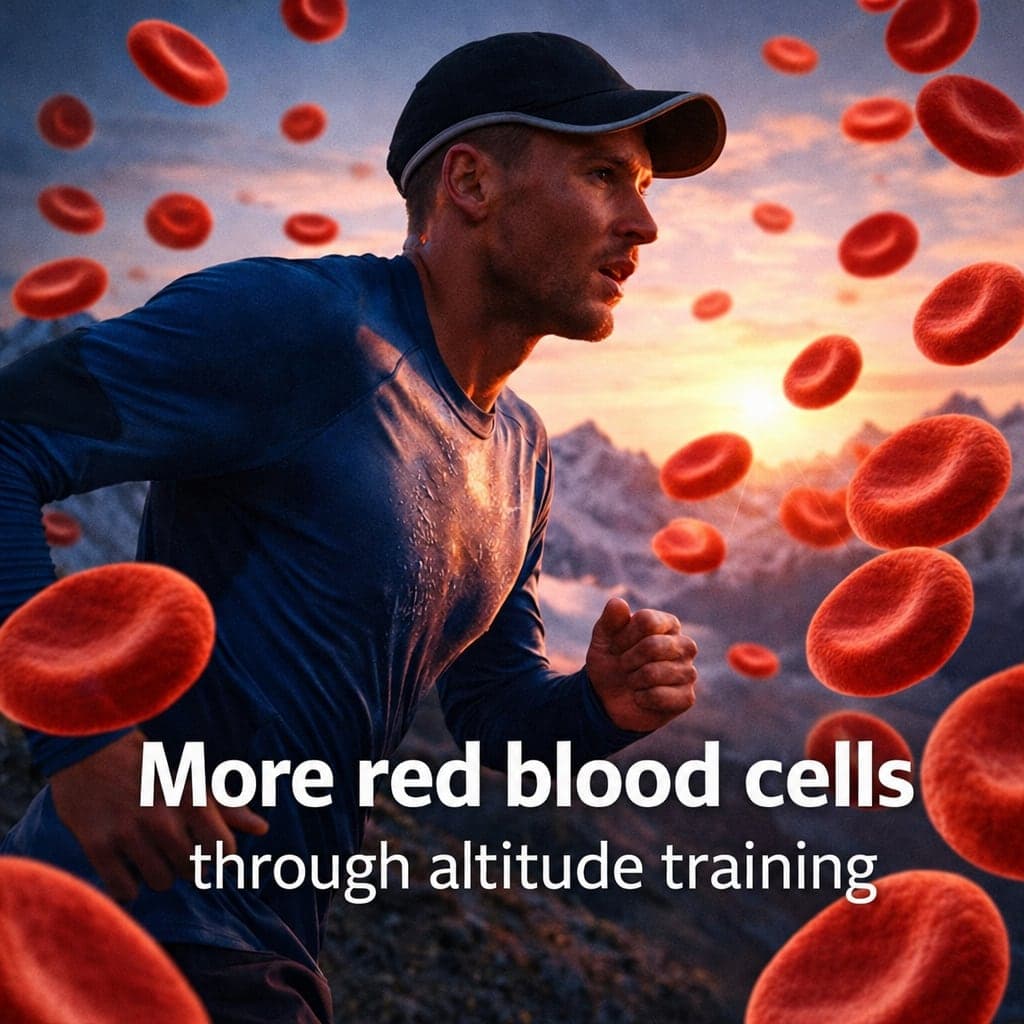
Altitude training and red blood cells are inextricably linked. As soon as your body has less oxygen available, a clever physiological chain reaction starts that eventually leads to more red blood cells. This mechanism is exactly why elite athletes and mountaineers use altitude training: more oxygen transport means better performance and greater resistance to altitude.
Do you want to understand how this process really works and when it is effective? Then understanding the underlying mechanism is essential. In this article, we explain it step by step, including practical applications and measurable signals.
The essentials in 30 seconds
- High altitude training stimulates red blood cell production via EPO production.
- This process is triggered by oxygen deprivation, not altitude per se.
- Effect occurs only after consistent exposure and correct dosing.
What exactly is happening in your body?
When you start altitude training, the amount of oxygen in your blood drops. We call this hypoxia. Your body immediately detects this through sensors in the kidneys.
The response is surprisingly efficient:
- Kidneys register oxygen deprivation
- Production of the hormone EPO (erythropoietin) increases
- Bone marrow produces more red blood cells
- Transport capacity of oxygen increases
This process is completely natural and forms the basis of performance improvement through altitude training.
The EPO peak occurs as early as 24 to 48 hours after exposure to altitude. Yet it often takes 2 to 3 weeks for this to show up in your blood levels and performance. So consistency is more important than intensity.
Why red blood cells are so important
Red blood cells contain haemoglobin, the protein that binds and transports oxygen. The more red blood cells you have, the more efficiently your body can move oxygen to muscles and organs.
This has immediate benefits:
- Better VO2max
- Longer endurance performance
- Less fatigue on exertion
- Better acclimatisation at altitude
Want to dive deeper into physiology? Check out How high training increases your EPO levels.
Featured snippet: how fast do red blood cells rise?
Average attrition at altitude training:
| Time | Impact |
|---|---|
| 1-2 days | EPA rises |
| 1 week | Start of RBC production |
| 2-3 weeks | Measurable increase in red blood cells |
| 4-5 weeks | Maximum effect visible |
The role of sleep in this mechanism
Most of this process happens during rest, and particularly during sleep. Therefore, the principle of sleep high train low so effective.
Prolonged, mild hypoxia during sleep provides a stable stimulus to the body. This is much more effective than short, intense exposure.
Athletes who sleep 6-8 hours a night in an altitude tent often see a more stable and predictable increase in red blood cells than in short hypoxia sessions. The duration of the stimulus determines the effect.
Common misunderstandings
The mechanism behind red blood cells is often misunderstood. Here are the main misunderstandings:
- More height is always better → not true
- Building up faster gives faster results → counterproductive effect
- Red blood cells rise immediately → delayed process
Too aggressive altitude building can actually lead to poorer sleep and less recovery. This disrupts the EPO signal and lags red blood cell gains.
How to monitor this objectively
You don't measure the effect of altitude training by feel, but through trends.
- SpO2 trend in the morning
- Sleep quality
- Recovery after training
- Heart rate variability
Read also oxygen saturation at altitude for interpretation of your measurements.
Key decision rule:
Does your SpO2 stay above 94% for several days? Then you can increase the altitude.
Is your SpO2 structurally dropping towards 90%? Then you need to scale back.
Studies show that the greatest increase in red blood cells occurs with a controlled SpO2 decrease around 92%. This seems to be the optimal balance between stimulus and recovery.
When do you really see results?
Most athletes experience the effect after about 3 to 5 weeks. This depends on:
- Consistency
- Sleep duration
- Individual response
- Nutrition (iron!)
For nutrition and support, see iron and nutrition during altitude training.
Practical steps to increase red blood cells
- Start at low simulation altitude (2000m)
- Build up gradually
- Sleep at least 6 hours per night in hypoxia
- Monitor SpO2 trends
- Keep nutrition optimal (iron status)
Conclusion
The mechanism behind altitude training and red blood cells is clear: oxygen deprivation activates EPO, leading to more red blood cells and better performance.
But the real difference is in the execution. It is not the height itself, but the dosage, consistency and monitoring that determine the result.
Those who understand this process and apply it in a controlled way will get the most out of altitude training without unnecessary risks.
❓ Mini-FAQ
Do red blood cells work immediately after altitude training?
No, the effect usually takes 2-3 weeks before it becomes measurable.
Is more height always better?
No, too much hypoxia can interfere with recovery and reduce effect.
How long does the effect last?
Usually 2 to 3 weeks after stopping altitude training.
Is this suitable for beginners?
Yes, if built and monitored in a controlled way.
Want to experience this for yourself?
Want to benefit from the effect of more red blood cells via altitude training yourself? Then check out our packages for athletes and find out what suits your goal.
Check out our altitude tent rental service
Or read experiences of other athletes