Altitude training for asthma and COPD: when can an altitude tent help?
Published 13 September 2012 · 17 min read
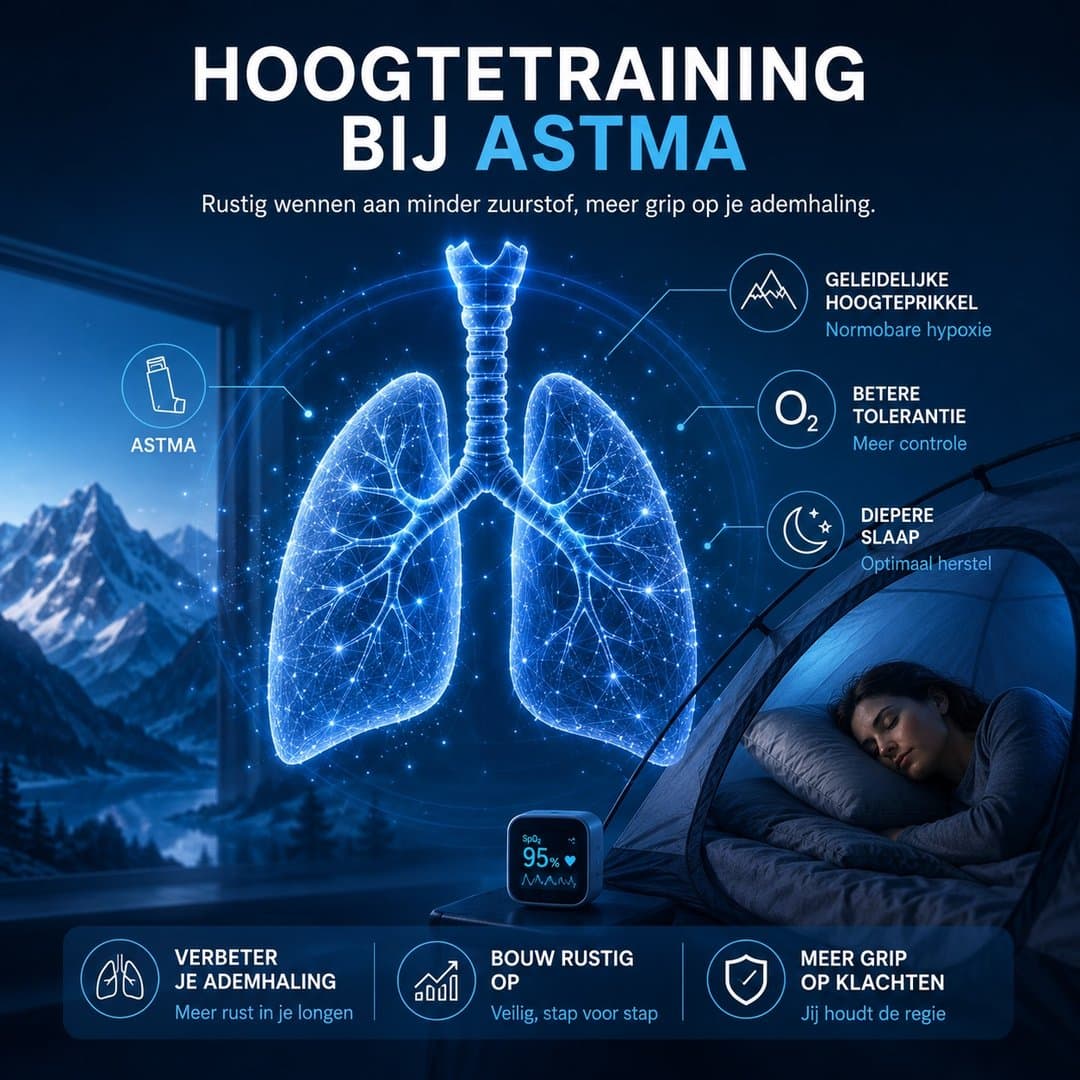
Altitude training for asthma and COPD could be interesting for people who want to acclimatise to less oxygen in a controlled way, learn to monitor their breathing better and discover how their body reacts to hypoxia in a calm manner. Sleeping in a altitude tent, in particular, makes this stimulus predictable, measurable and incrementally buildable. This is important, because with asthma and COPD, altitude itself is not the goal. The goal is control: over exertion, recovery, sleep, saturation and symptoms.
This article helps you determine when altitude training might be beneficial for asthma and COPD, when caution is necessary, and how to use an altitude tent without mistaking it for medical treatment. For a specific safety protocol, we intentionally refer you to separate in-depth articles further on, so that this article remains focused on the question: Does altitude training make any sense in my situation at all?
Short answer: A height tent can be particularly useful for asthma or COPD as a controlled, measurable, and gradual stimulus. You sleep in normobaric hypoxia, where the oxygen percentage is reduced while the air pressure remains the same. This allows you to build up gently at home, monitor your SpO2 trend, and make adjustments more quickly if you experience symptoms. For unstable asthma, severe COPD, low resting saturation, or recent shortness of breath, prior medical consultation is advisable.
Conclusion: Altitude training for asthma and COPD is about controlled exposure, not forcing it.
Nuance: A altitude tent can be supportive, but does not replace a doctor, inhalation medication or lung rehabilitation.
Practical hook: Start low, build up slowly and monitor SpO2 trend, sleep quality, recovery and complaints.
Altitude training for asthma and COPD: what is the real aim?
In healthy athletes, altitude training is often linked to performance, red blood cells, and endurance. In asthma and COPD, the focus is different. It's less about maximum performance and more about controlled adaptation, better body awareness, and safely dosing a hypoxic stimulus.
An altitude tent simulates altitude via normobaric hypoxia. This means that the air pressure in the room remains the same, but the percentage of oxygen in the inhaled air decreases. This gives the body a similar stimulus as at altitude, but in a controlled home environment.
For people with respiratory complaints, this control can be valuable. You don't immediately have to go to a mountain village, spa resort, or altitude training camp. You can start with a mild setting, usually resembling a modest altitude, and build up step by step. This creates room to observe what happens with breathing, sleep, morning feeling, heart rate, and saturation.
For a better understanding of how the body reacts to altitude, our explanation provides a good foundation on altitude training. This article focuses specifically on the respiratory context: asthma, COPD, and the practical benefits of sleeping in a hypobaric chamber.
Waarom een hoogtetent nuttig kan zijn bij astma of COPD
A height tent can be valuable for asthma or COPD in three ways. Firstly, the tent controls the stimulus. Secondly, you can measure and adjust at home. Thirdly, it provides peace of mind, as you are not reliant on a sudden stay at altitude.
In asthma, symptoms are often influenced by triggers such as dust, pollen, air pollution, cold air, exertion, and infections. In COPD, the limited lung reserve plays a particularly important role. This means that a drop in oxygen availability can be noticed more quickly. This is precisely why a height tent is not a product to be used randomly, but a system that requires careful dosage.
The potential benefit, therefore, does not lie in the idea that a high-altitude tent cures asthma or COPD. It does not. The benefit lies in the combination of a predictable oxygen stimulus, a quiet sleeping environment, a measurable protocol, and a clear stopping rule.
🧭 In practice
Many users don't perceive the altitude tent as strenuous training, but rather as an overnight acclimatisation stimulus. That difference is important. You don't need to breathe extra hard or train actively. Your body primarily gets time to react calmly while you sleep.
In the case of asthma: particularly relevant for stable symptoms
For asthma, stability is the primary condition. Altitude training is particularly logical when symptoms are well controlled, medication is stable, and there has been no recent exacerbation. Then, a mild hypoxic sleep stimulus can be interesting as a supplement to a broader approach.
For asthma, there is also a separate section on sport and airway reactions. You can find this in the article about Altitude training and asthma. This current article remains broader, as COPD and asthma are not the same.
In case of COPD: particularly relevant with extra caution
With COPD, the bandwidth is smaller. Someone with mild COPD, good resting saturation and stable symptoms requires a different approach than someone with severe COPD, oxygen therapy or frequent exacerbations. Therefore, in the case of COPD, prior consultation with a doctor or lung nurse is often advisable.
A hypobaric chamber (altitude tent) can only be effective for COPD if the stimulus remains mild enough, monitoring is done carefully, and the user clearly knows when to reduce or stop. The separate article about a height tent for COPD goes deeper into security choices.
During sleep in a high-altitude tent, the physiological process involves simulating lower oxygen levels, mimicking what happens at higher altitudes. This leads to several adaptations: * **Reduced Partial Pressure of Oxygen:** The tent typically uses a system to reduce the concentration of oxygen or simply pumps in air from outside, which at altitude has a lower partial pressure of oxygen. This means there are fewer oxygen molecules available for your body to absorb with each breath. * **Hypoxia:** This reduced oxygen availability leads to a state of mild hypoxia (low oxygen levels in the body). * **Increased Breathing Rate and Depth (Initially):** Your body's immediate response to lower oxygen is to try and compensate by breathing more frequently and/or deeply. However, as you are sleeping, this response might be less pronounced than when awake, but it still occurs. * **Increased Erythropoietin (EPO) Production:** Over time, your kidneys detect the lower oxygen levels and respond by producing more erythropoietin (EPO). EPO is a hormone that stimulates the bone marrow to produce more red blood cells. * **Increased Red Blood Cell Production:** The increased EPO leads to a gradual rise in the number of red blood cells. Red blood cells are responsible for carrying oxygen from the lungs to the rest of the body. * **Improved Oxygen Carrying Capacity:** With more red blood cells, your blood's capacity to carry oxygen increases. * **Increased Capillarisation:** Over a longer period of acclimatisation, there can be an increase in the number of small blood vessels (capillaries) in muscles, which improves oxygen delivery to tissues. * **Mitochondrial Adaptations:** At a cellular level, there can be changes in the number and efficiency of mitochondria, the powerhouses of cells, to better utilise the available oxygen. **In summary, sleeping in a high-altitude tent artificially creates a situation of reduced oxygen. Your body responds by increasing red blood cell production and making other physiological adaptations to improve its ability to transport and utilise oxygen, preparing you for performance at actual high altitudes.**
During sleep in a height tent, inhaled oxygen availability decreases. This can lead to a slight drop in oxygen saturation. The body responds with adaptations in breathing, heart rate, oxygen transport, and recovery processes, among other things. Athletes often talk about red blood cells and EPO. In the case of asthma and COPD, individual tolerance is particularly important.
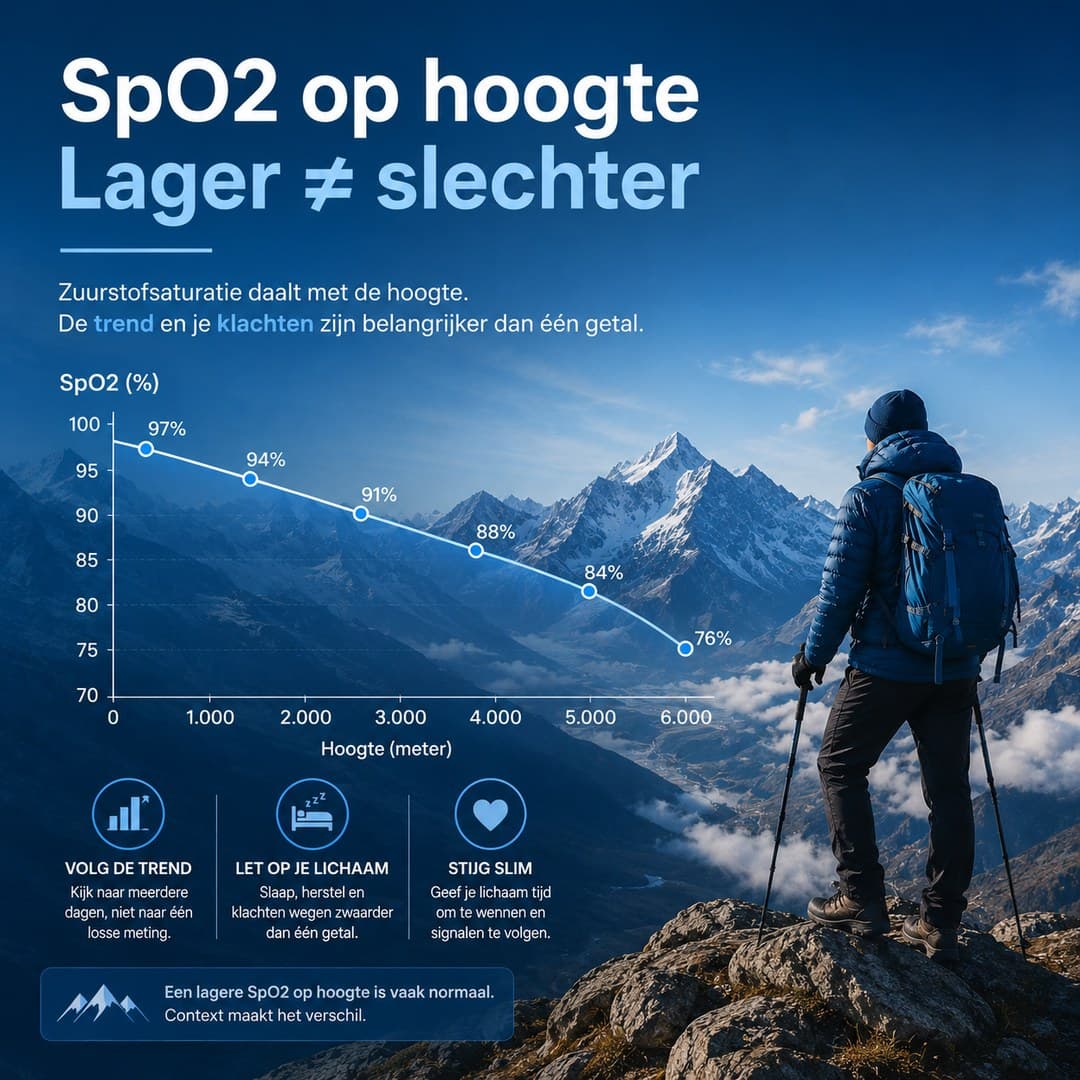
A slight drop in SpO2 can be normal in an altitude tent. However, its significance always depends on the trend, the symptoms, and the individual baseline. A single measurement says little. A series of morning measurements, combined with sleep quality and symptoms, says much more.
This is why Altitude Dream prefers to work with controlled steps in these kinds of situations rather than aggressive altitude settings. For asthma and COPD, the best setting is not the highest setting. The best setting is the one at which your body responds calmly and remains recoverable.
| Situation | Interpretation | Practical significance |
|---|---|---|
| Stable asthma | Usually the most promising group | Start mild, monitor symptoms and build up gradually |
| Exercise asthma | Could be interesting in a sports context | Link sleep stimulus to gentle training, not maximum exertion. |
| Mild COPD | Possible, but more selective | Only with clear monitoring and preferably medical coordination |
| Severe COPD | Higher risk category | Do not start independently without medical advice |
Interpretation: Usually the most promising group.
Practical significance: Start mildly, monitor symptoms, and build up gradually.
Interpretation: Could be interesting in a sports context.
Practical significance: Link the sleep stimulus to moderate training, not maximal exertion.
Interpretation: Possibly, but more selectively.
Practical significance: Only with clear monitoring and preferably medical alignment.
Interpretation: Higher risk category.
Practical significance: Do not start independently without medical advice.
Altitude training for asthma and COPD is not a cure, but it can be better managed.
Historically, mountainous regions have often been mentioned in relation to respiratory complaints. This is partly due to cleaner air, fewer specific allergens, and a different stimulating environment. Nevertheless, staying in the mountains is practically difficult for many people. It costs time, money, and energy. Furthermore, the stimulation is difficult to dose. After all, you are immediately aware of where you are staying.
A height tent works differently. You don't bring mountain air into your home. You create a controlled hypoxic sleeping environment. That's an important difference. The air doesn't automatically get cleaner, but the oxygen stimulus is adjustable. This allows you to determine much more precisely how much stimulus you receive, how long you are exposed to it, and when you make adjustments.
For people with asthma or COPD, that advantage is significant. You don't have to guess. You can start, measure, evaluate and adjust. That makes a high-altitude tent particularly interesting for people who benefit from structure and guidance.
Altitude chamber versus altitude tent at home
Staying at altitude provides a real mountain environment, but is less flexible. An altitude tent does not provide mountain air, but does offer control. For asthma and COPD, that control is often more important than the romance of altitude.
| Method | Advantage | Focal point |
|---|---|---|
| Mountain retreat | Different environment, often cleaner air and real altitude | Less easy to adjust when complaints arise |
| Altitude tent | Adjustable, measurable and can be used at home | No medical treatment and no replacement of medication |
| Long rehabilitation | Medically supervised and functionally oriented | Different objective from hypoxic acclimatisation |
Advantage: Different environment, often cleaner air and real altitude.
Point of attention: Less easy to adjust when complaints arise.
Advantage: Adjustable, measurable and usable at home.
Point of attention: No medical treatment and no replacement of medication.
Advantage: Medically supervised and functionally oriented.
Point of attention: Other objective than hypoxic acclimatisation.
A hypoxie tent is most logical for people whose asthma or COPD is exacerbated by altitude or who are training at altitude to improve their athletic performance.
A altitude tent is most logical for people who are stable, can monitor well, and understand that a gradual build-up is more important than quick results. This applies even more strongly to respiratory conditions. The altitude tent should provide comfort, control, and insight. Not extra stress.
For athletes with exercise-sensitive airways, recreational athletes who want to better understand their capacity, or individuals who react sensitively to changing conditions, it can be interesting. For COPD, it can be particularly relevant for people with mild to moderate symptoms who are well-managed, have not had recent exacerbations, and want to explore how their body reacts to a mild hypoxic stimulus.
Travellers to the mountains with asthma or COPD have an extra reason to test at home. A high-altitude tent can help to objectively assess beforehand how saturation responds to lower oxygen availability. This makes preparations more manageable.
When is this likely to be useful?
- Your asthma or COPD is stable.
- You are taking your medication as prescribed.
- Your oxygen saturation is normal for your situation.
- You can measure daily and note down complaints.
- You want to build up gradually instead of going straight to the summit.
When to consult first or not to start?
- You recently had a lung attack, infection, or exacerbation.
- You wake up with shortness of breath or wheezing.
- Your oxygen saturation is low or highly variable.
- You are using oxygen therapy.
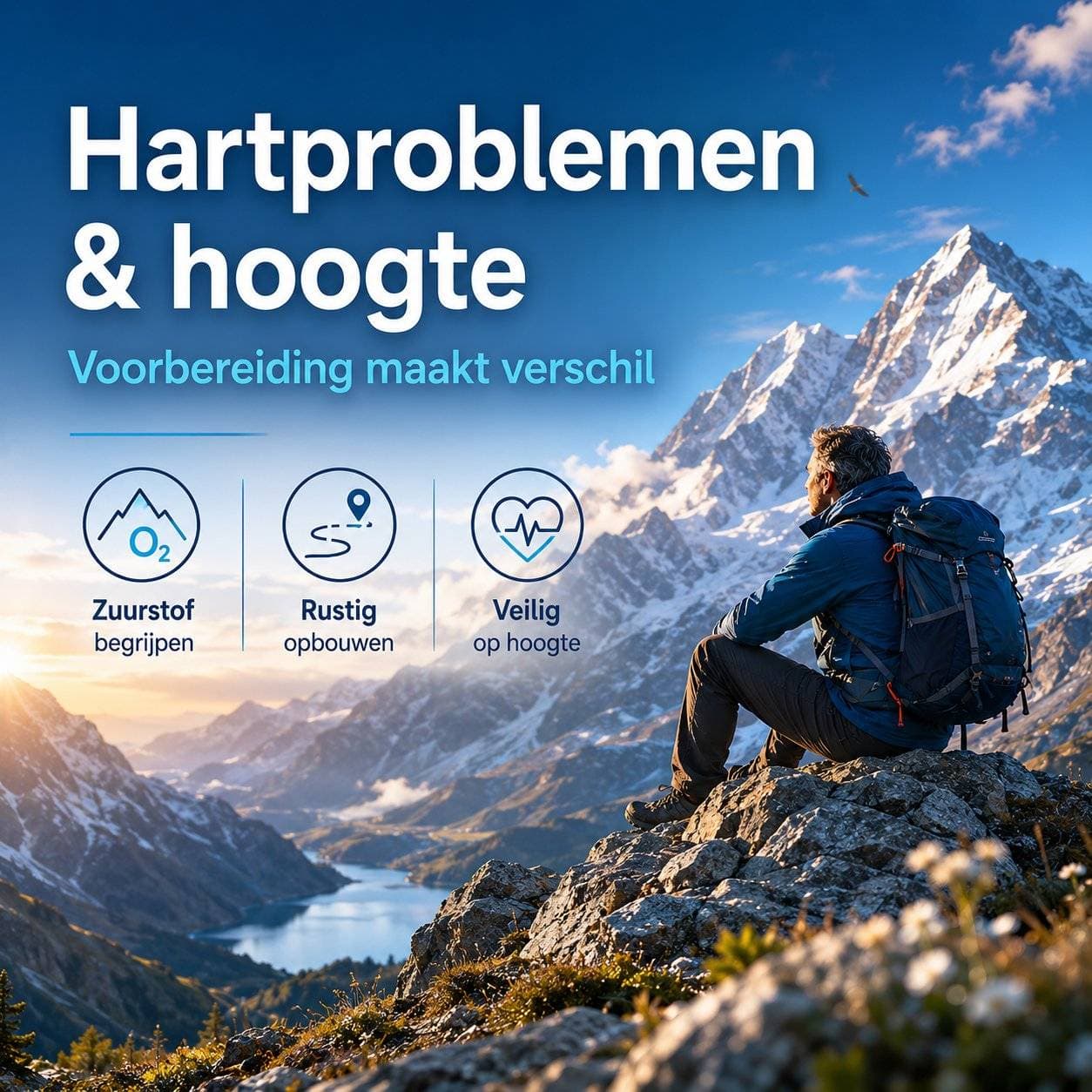
- You have severe COPD or co-existing heart problems.
A safe approach: start low and build up slowly
With asthma and COPD, the ramp-up speed is more important than the final level. A common mistake is thinking that a higher setting automatically works better. That's not true. Too strong a stimulus can actually cause restless sleep, headaches, fatigue, or shortness of breath. Then you lose the benefit of control.
A sensible approach begins with a mild simulation altitude and sufficient nights at the same level. Only when sleep remains good, complaints subside, and the SpO2 trend is acceptable, should you increase gradually.
For general tent setup, you can read further about altitude tent construction diagram. With asthma or COPD, you apply that logic more conservatively.
Practical framework
Use this as a model for thinking, not as personal medical advice. With asthma or COPD, it may be necessary to stay at the same level for longer or start lower.
| Phase | Target | Decision rule |
|---|---|---|
| Starting phase | Getting used to sleeping in the tent | No increase with restless sleep or extra breathlessness |
| Build-up phase | Finding a stable hypoxic stimulus | Only increase during a stable SpO2 trend and good sleep |
| Stabilisation phase | Retain effect without overstimulation | Better to stay stable than to keep increasing |
| Correction phase | Early detection of complaints | Reduce or pause with clear deterioration |
Objective: Getting used to sleeping in the tent.
Decision rule: No increase with restless sleep or increased shortness of breath.
Objective: Find stable hypoxic stimulus.
Decision rule: Only increase if there is a calm SpO2 trend and good sleep.
Objective: Benefit gained without overstimulation.
Decision rule: Better to remain stable than to keep increasing.
Objective: Early detection of complaints.
Decision rule: Reduce or pause on clear deterioration.
This is how you monitor this lens
Objective monitoring is essential for altitude training in asthma and COPD. Not because every measurement is perfect, but because trends help to make sensible choices. Therefore, don't just measure SpO2. Also look at sleep, recovery, symptoms, and daily functioning.
SpO2 should always be viewed as a trend. A single low reading can be due to cold fingers, movement, poor sensor placement, or a measurement error. However, a declining trend over several mornings, combined with poorer sleep or increased breathlessness, is relevant information.
For a deeper understanding of what can be considered normal in a sleep tent, you can read further about saturation in an altitude tent.
| Measuring point | What are you paying attention to? | What do you do with it? |
|---|---|---|
| SpO2 trend | Morning value and trend over multiple days | Don't focus on a single measurement; focus on the pattern. |
| Sleep quality | Doorslapen, wakker worden, ochtendgevoel | Poor sleep is a reason not to increase |
| Respiration | Shortness of breath, wheezing, coughing, phlegm | Decrease, pause or consult upon increase |
| Recovery | Fatigue, resting heart rate, trainability | Deterioration means reducing the stimulus. |
What are you paying attention to? Morning reading and trend over several days.
What do you do with it? Don't steer on 1 isolated measurement, but on a pattern.
What are you paying attention to? Sleep through the night, wake up, morning feeling.
What do you do with it? Poor sleep is a reason not to increase.
What are you paying attention to? Shortness of breath, wheezing, coughing, mucus.
What do you do with it? When increasing, reduce, pause, or consult.
What are you paying attention to? Fatigue, resting heart rate, load capacity.
What do you do with it? Deterioration means reducing stimulation.
Common misconceptions about altitude training in asthma and COPD
There are many misconceptions surrounding altitude training and airway complaints. Some are too optimistic. Others are unnecessarily anxious. The reality usually lies somewhere in between: an altitude tent can be useful, but only if applied carefully.
Misunderstanding 1: An altitude tent cures asthma or COPD
That is incorrect. Asthma and COPD remain medical conditions. A hypoxie tent can provide supportive stimulus, but does not replace a diagnosis, inhaled medication, pulmonologist, pulmonary rehabilitation, or personal treatment plan.
Misunderstanding 2: shortness of breath means it's working
That's also incorrect. Breathlessness is not a goal. With asthma and COPD, increased breathlessness is actually a signal to reduce, pause, or seek advice. A good altitude tent setup should feel manageable.
Misunderstanding 3: the higher, the better
With respiratory complaints, the opposite is usually true. The correct altitude is the altitude to which your body can adapt without disturbing sleep, recovery, and breathing.
Misconception 4: SpO2 is the only indicator.
SpO2 is important, but not enough. Someone can have acceptable saturation and still feel unwell. Conversely, a slight drop can be fitting for the stimulus. Therefore, you always combine SpO2 with symptoms and recovery.
Practical tips for home use
- Start only when your symptoms are stable.
- Use medication as prescribed.
- Measure yourself at the same time every morning.
- Note SpO2, sleep quality, breathlessness and recovery.
- Increase only when several nights have passed peacefully.
- Keep the sleeping area cool, clean, and well-ventilated.
- Do not use a hypoxie tent as a substitute for medical advice.
- Pause on clear increase in symptoms.
Furthermore, for asthma, it is advisable to keep the bedroom as free of irritants as possible. Consider dust, pets, pollen, moisture and temperature. The altitude tent lowers the oxygen percentage, but does not automatically resolve the usual airway triggers in the room.
For COPD, the difference between rest and exertion is particularly important. Someone may respond reasonably at rest, but desaturate more quickly with exertion. Therefore, the altitude tent should not be seen as proof that intensive training or altitude stays are automatically safe.
When do you choose the asthma or COPD protocol?
This article helps you determine if altitude training can be logical for asthma and COPD. Once you want to answer the practical safety question, a protocol article is better. This article no longer focuses on general value but on conditions, starting level, monitoring, and stopping rules.
Therefore use the separate Altitude tent asthma safety protocol when asthma is the main focus. Use the COPD protocol when the focus is on COPD, low lung reserve or oxygen sensitivity. In this way, the articles complement each other from an SEO perspective: this article answers the broad orientation question, whilst the protocol articles address the safety issue.
Do you want to start safely with a sleep high tent for asthma?
Do not begin with the highest setting, but with a gentle protocol. This way, you make the stimulus measurable, you maintain control over your SpO2 trend, and you can make timely adjustments if your breathing changes.
View the safety protocol for a high-altitude tent for asthma
Conclusion: altitude training for asthma and COPD requires careful monitoring, not reckless behaviour
Altitude training for asthma and COPD can be beneficial when carried out gently, in a measurable way and tailored to the individual. The altitude tent makes this possible. You can start at home with a gentle stimulus, monitor your SpO2 trend, assess your sleep quality and make adjustments in good time.
The biggest advantage isn't that you add “height” to your life. The biggest advantage is that you control the stimulus. For people with asthma or COPD, that difference is precisely what matters. Altitude training then becomes not a gamble, but a structured way to discover how your body reacts to less oxygen.
Do, however, remain realistic. An altitude tent is not a treatment for asthma or COPD and is no substitute for medical supervision. However, with stable symptoms, a carefully planned acclimatisation programme and proper monitoring, it can be a useful aid. This is certainly the case if you are looking for a calm, predictable and objective way of managing altitude, oxygen and breathing.
FAQ on altitude training for people with asthma and COPD
Is altitude training safe for people with asthma?
That depends on how stable your asthma is. If your asthma is well-controlled, a gentle acclimatisation to altitude may be beneficial. If you have recently experienced shortness of breath, night-time symptoms or changes to your medication, it is advisable to seek medical advice beforehand.
Can a high-altitude tent help with COPD?
In cases of mild or stable COPD, a high-altitude tent can sometimes be useful as a controlled stimulus. In cases of severe COPD, low resting oxygen saturation, oxygen therapy or recent exacerbations, you should not start this treatment on your own.
Should my SpO2 drop when I’m in a high-altitude tent?
A slight drop may be consistent with the hypoxic stimulus. The trend is what matters. Always consider SpO2 alongside sleep quality, how you feel in the morning, shortness of breath and recovery.
Can I reduce my inhaler medication by altitude training?
No, not on your own initiative. You should only adjust medication in consultation with your doctor. A hypobaric chamber can be supportive, but it is not a replacement for medication.
What is the main benefit of a high-altitude tent for people with respiratory problems?
Control. You can start low, measure at home, build up gradually, and adjust immediately. This makes the stimulus much more manageable than a sudden stay at altitude.
Sources and medical nuances: This article is intended as a practical guide and does not replace personal medical advice. With asthma or COPD, coordination with a doctor, pulmonologist, or respiratory nurse remains important, especially with unstable symptoms, low saturation, oxygen therapy, or recent exacerbation.