Elevation tent for COPD: safety and protocol
Published 9 April 2026 · 10 min read
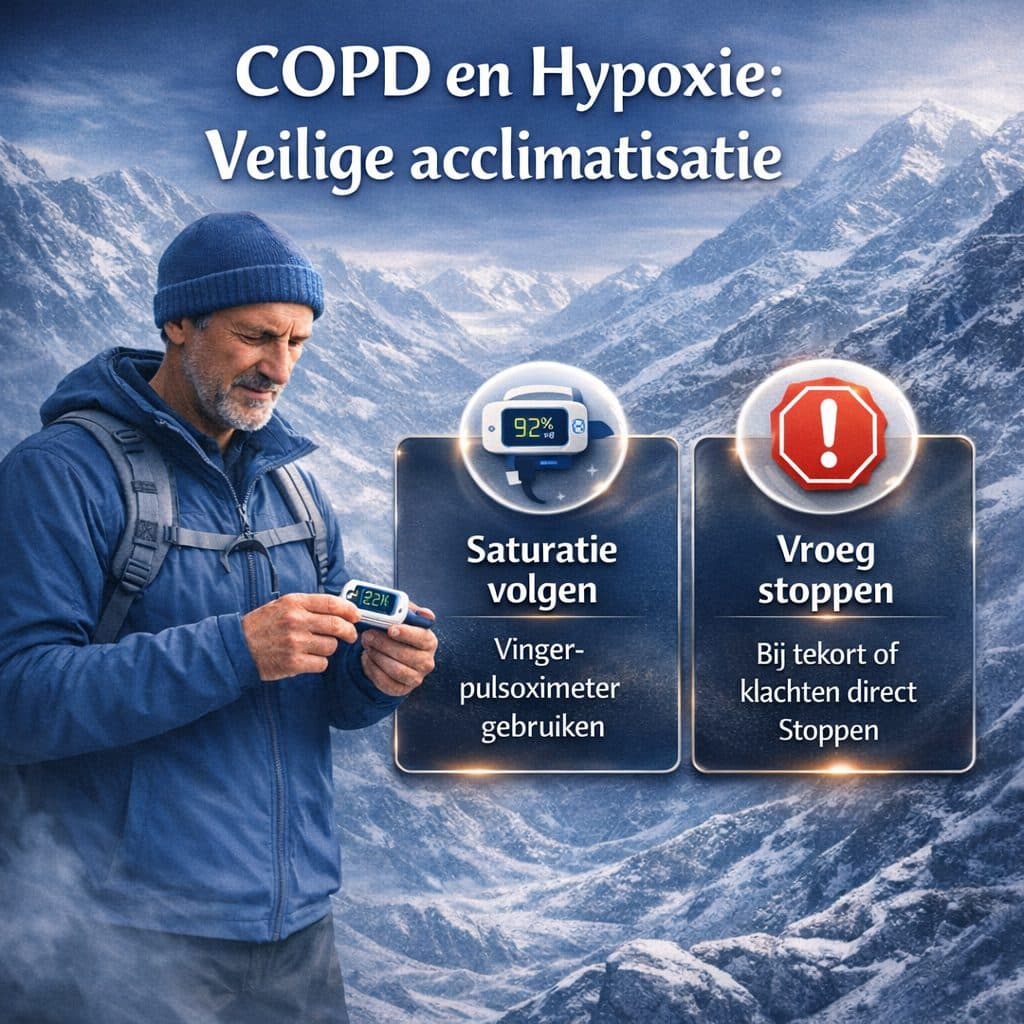
A height tent for COPD requires a different approach to altitude training for athletes. In COPD, the goal is not to go as high as possible, but to make a controlled assessment of whether additional hypoxic load is safely tolerated. Those with COPD considering altitude training should therefore first know for whom it can sometimes be justified, when it is discouraged and what protocol is most prudent.
The short conclusion is clear: an altitude tent is not standard therapy in COPD. In selected, stable situations, a tent can sometimes be part of a carefully supervised preparation for altitude, but only with medical coordination, low initial load, objective monitoring and strict stopping rules. Sports protocols or aggressive build-up schedules should not be copied here.
- An altitude tent in COPD is defensible only as a safety intervention, not as a free experiment.
- The best candidate is stable, not recently exacerbated, has no severe resting hypoxaemia and no obvious CO2 retention.
- Always start lower and shorter than in athletes, monitor SpO2 as a trend and stop immediately if symptoms increase at rest.
Conclusion: in COPD, an altitude tent only makes sense if the selection is rigorous and the protocol remains conservative.
Nuance: a stable COPD patient can sometimes tolerate altitude stimuli, but nocturnal hypoxaemia and sleep disturbance are more likely to occur.
Practical hook: do not see a height tent as a performance tool, but as a controlled test of load capacity with clear stopping rules.
Is an altitude tent for COPD safe?
It depends entirely on the initial situation. COPD means gas exchange is already more fragile. As soon as you lower the oxygen percentage in an altitude tent, it creates additional hypoxic stress. In a healthy person, this is usually an exercise stimulus. In COPD, the same mechanism can actually lead to more dyspnoea, worse sleep, stronger nocturnal desaturation or overload of heart and lung circulation.
Therefore, the first question is not: does an altitude tent work for COPD? The first question is: can this person safely tolerate additional hypoxia? That is a security question, not a marketing question.
It is also important that an altitude tent works with normobaric hypoxia. The air pressure remains the same, but the oxygen percentage drops. As a result, you simulate indoor altitude. For COPD, that makes the system plannable and measurable, but not automatically safe. A plannable stimulus still remains a stimulus.
Reality check: those already struggling with nocturnal saturation, morning headaches, restless sleep or shortness of breath at rest are not logical candidates to add additional hypoxia at home without specialist assessment.
For whom an altitude tent for COPD is sometimes suitable, and sometimes not
A useful way to think about it is this: an altitude tent may suit, at most, the stable, reasonably taxable COPD patient who has a concrete reason to handle altitude in a controlled way. For example, in preparation for staying in the mountains. It makes much less sense in unstable COPD, recent exacerbations or existing oxygen dependence at rest.
| Situation | Review | Why | Practical action |
|---|---|---|---|
| Stable COPD | Only possible after medical check | Load capacity may be sufficient, but nocturnal hypoxia remains a risk | Start with low, short exposure and objective monitoring |
| Recent exacerbation | Not recommended | The situation is not yet stable enough for additional hypoxic load | Recovery, optimisation and reassessment first |
| Existing nocturnal desaturation | Only under specialist direction | Tent may further enhance nocturnal oxygen depletion | Mapping sleep and oxygen profile first |
| CO2 retention or NIV | Mostly unsuitable for home experimentation | Additional hypoxia may strain ventilatory reserve and safety | Do not start without explicit pulmonologist assessment |
| Rest anxiety or LTOT | Basically unsuitable | Safety margin is too small | Do not choose tent protocol as home intervention |
Stable COPD
Assessment: only possible after medical check
Why: load capacity may be sufficient, but nocturnal hypoxia remains a risk
Action: Start low, expose briefly, monitor everything
Recent exacerbation
Assessment: ill-advised
Why: the situation is not yet stable enough
Action: recovery and reassessment first
Existing nocturnal desaturation
Assessment: only under specialist direction
Why: tent may enhance nocturnal oxygen depletion
Action: first map sleep and oxygen profile
CO2 retention or NIV
Assessment: mostly unsuitable for home experimentation
Why: Fan reserve and security come under pressure
Action: do not start without explicit lung specialist assessment
Rest anxiety or LTOT
Assessment: in principle unsuitable
Why: the safety margin is too small
Action: do not choose tent protocol as home intervention
A practical selection limit
There is no universal home game rule that applies to every COPD patient. Nevertheless, conservative selection makes sense. In practice, an altitude tent is mainly discussable in someone who is stable, has not had a recent lung attack, has no obvious CO2 retention, does not need extra oxygen during the day and is not already near the lower limit of safe resting saturation at sea level. Those in doubt should first get a pulmonologist or specialist pulmonary nurse to take a look.
Comorbidities also count heavily. Think coronary artery disease, arrhythmias, pulmonary hypertension, obesity, sleep apnoea, anaemia or an overlap picture with OSA. Especially then, extra hypoxia can derail faster than spirometry alone suggests.
Why sports protocols are not a good fit for COPD
Many athletes use a altitude tent to build up an incentive in a controlled way. This sometimes involves using relatively ambitious heights and long exposures. For COPD, this is not the right thinking. The physiological reserve is smaller, tolerance during sleep is more fragile and the consequences of building up too fast can be much more serious.
More importantly, an athlete often judges a tent for training effect. A COPD patient must judge a tent on safety, sleep quality, recovery and symptom control. That requires a very different threshold for slowing down or stopping.
- Relevant though: stable COPD, clear travel or altitude trigger, good medical follow-up, willingness to start conservatively.
- Not relevant: experimenting out of curiosity, building up quickly for a performance boost, training on low night saturations.
- Immediate braking: more tightness at rest, worse sleep, marked morning headaches, unusual fatigue or cognitive sluggishness.
Safe protocol for a high altitude tent in COPD
There is no widely validated standard home protocol for a high altitude tent in COPD. Therefore, a useful protocol should mainly gentle, approachable and stoppable are. Think of the diagram below as a safety framework, not a sports structure.
- Phase 0 - screening: start only if COPD is stable, medication is optimised and recent exacerbations or respiratory infections are past.
- Phase 1 - wake-up test: first test during the day sitting or lying down briefly on low simulation, e.g. 30 to 60 minutes, with pulse oximeter and symptom observation.
- Phase 2 - first nights: not all night yet. Start with a limited part of the night on low setting and evaluate the morning after.
- Phase 3 - gradual build-up: only longer or slightly higher if several sessions are stable with no obvious deterioration in sleep, symptoms or recovery.
- Stage 4 - ceiling: consciously stay low and conservative. In COPD, lower but stable is better than high but unstable.
How low should you start?
In COPD, it makes sense to start significantly lower than many sports protocols recommend. Think mild simulation, not an immediate jump to high-alpine values. The goal is tolerance first, not forcing adaptation. Jumping too fast mainly creates noise: worse sleep, more complaints and uncertainty about whether the tent is appropriate at all.
Practically, this means: start low first, increase only after several stable measurements and use only small increments. Those who immediately see clear deterioration in sleep, morning feeling or saturation trend have already had their answer. Then continuing is usually not smart protocol, but poor risk management.
What is a sensible build-up?
A defensible build-up is slow. Not higher ánd longer in the same week. Change only one variable at a time: either a little longer or a little higher. Only when the trend is stable over several days, move on. That way it remains interpretable.
This is why a step-by-step build-up works better than a fixed exercise schedule. With COPD, the body's response may set the pace. Not the other way around.
This is how you monitor this lens
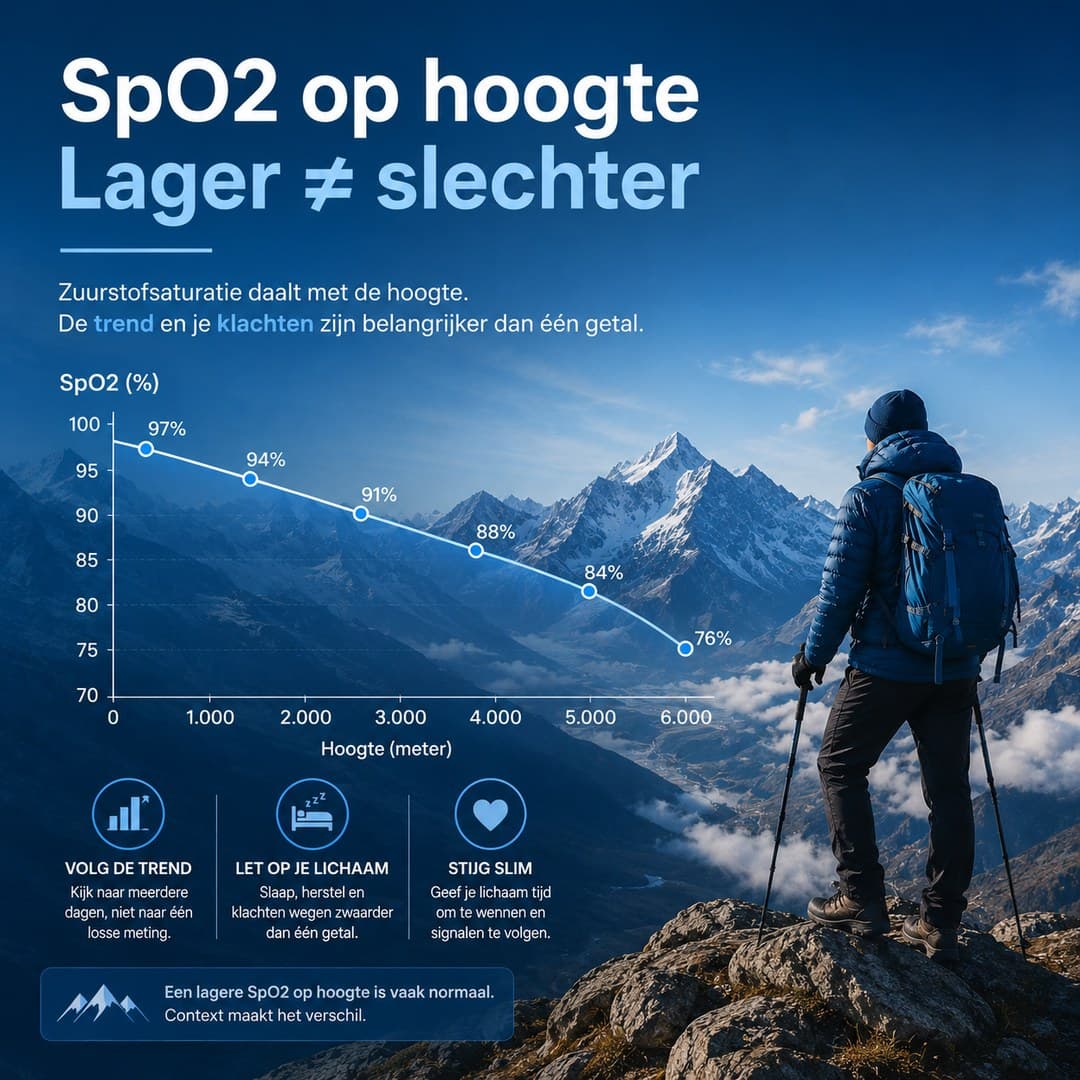
In COPD, you should never steer by one single SpO2 value. Always look at the SpO2 trend in combination with sleep, symptoms and recovery. A single low reading without context says little. A series of worse mornings says much more.
- SpO2 trend: Compare mornings with each other, not with sports standards.
- Sleep quality: more frequent waking, more restless breathing, more dreaming or feeling of panic count.
- Recovery: morning freshness, walking ability in the house, climbing stairs and general energy.
- Symptoms: dyspnoea at rest, wheezing, chest tightness, dizziness, headache, confusion.
- Medication use: clearly need emergency medication more often means that the incentive is probably too great.
A useful rule of thumb is simple: if the measurements stay the same but you feel worse, that is not a stable response. Symptoms weigh heavily in COPD. Unlike in sport, “just getting through a difficult phase” is usually not a good strategy here.
Stopping rules to agree in advance
An altitude tent for COPD is only justified if the stopping rules are fixed in advance. So do not improvise. Before the first night, agree on which signals you will immediately switch back or stop.
Stop immediately and seek medical attention in case of tightness at rest that increases markedly, cyanosis, confusion, oppressive chest pain, new cardiac arrhythmias, conspicuous drowsiness, or a saturation that drops below the individually agreed lower limit and does not recover quickly after switching back.
Less spectacular signs are also important. Think two or three nights in a row with worse sleep, increasing morning headaches, more emergency medication, or the feeling that normally light exertion is suddenly much heavier. These are not details, but early warnings.
Common mistakes when using an altitude tent for COPD
The biggest mistake is thinking like an athlete when you should be acting like a risk manager. In addition, I see five classic mistakes.
- starting without a medical baseline or recent assessment
- starting too high out of enthusiasm
- deploy immediately throughout the night instead of building up in phases
- looking only at one saturation figure and ignoring sleep complaints
- thinking up stopping rules only when there are already problems
An additional fallacy is sports norms adoption. Values or build-up schedules that seem acceptable in healthy athletes are not automatically safe for someone with COPD. The same applies to interpretation of morning measurements. A marquee protocol for COPD should always be more personal and conservative.
Practical tips for home
If you want to keep it safe, make it simple. Use the same measurement time every time, briefly note down symptoms in a log and have a housemate join you for the first few nights. Keep rescue medication handy, make sure you don't experiment during a cold and don't plan a build-up during a busy or poor sleeping period.
In addition, it is wise not to assess the first sessions on your own. An outsider can sometimes see more quickly that you are breathing more restlessly, talking more flatly or looking more tired than you realise.
Also read how to use a tent technically and practically in this guide on setting the correct height and in the overview on saturation in an altitude tent. Always use that information with COPD, though, with extra medical caution.
Understand the basics of safe tent use first?
Anyone considering an altitude tent in COPD would do well to first understand the technical basics and the logic of building up slowly. This also makes the conversation with doctor or pulmonary nurse more concrete and safer.
First read the complete guide on how to use high altitude tents
Conclusion
A height tent for COPD may be negotiable in some cases, but only if safety is the starting point. Not the height, not the duration and not the sense of training are leading. The key questions are: is the COPD stable, is the baseline situation favourable enough, is starting low and is there a clear plan for objective monitoring and timely stopping?
Exactly therein lies the difference between a responsible protocol and a risky experiment. Those with COPD should see an altitude tent as a possible, controlled stimulus under conditions. Not as a standard solution and certainly not as something you copy at random from the sports world.
FAQ
Is altitude training for COPD the same as altitude training for athletes?
No. In athletes, it is often about performance incentive. In COPD, it is first about safety, tolerance and symptom control.
Can someone with COPD immediately sleep an entire night in a high altitude tent?
That is usually not a wise start. A phased build-up with short, low exposure is safer and more interpretable.
Which measurement is most important?
Not one single measurement, but the combination of SpO2 trend, sleep quality, recovery and symptoms at rest.
When is an altitude tent for COPD inadvisable?
In recent exacerbations, marked resting hypoxaemia, CO2 retention, existing nocturnal problems without medical supervision or increasing resting shortness of breath.
Is an altitude tent a substitute for medical treatment for COPD?
No. An altitude tent does not treat COPD. At most, in selected cases, it can be a controlled altitude stimulus within a broader medical plan.