Using a height tent: setting the right height - starting and set-up rules
Published 20 January 2026 · 10 min read

Using a high altitude tent seems simple on paper: you sleep in low-oxygen air, your body adapts and you are better prepared for performance or altitude. In practice, this goes wrong remarkably often. Not because the principle doesn't work, but because the correct height is set incorrectly, the build-up is too fast or because people are steering by metres instead of what their bodies actually show.
In this article, you get a grip. You will learn how to use an altitude tent in a way that is physiologically correct, how to use the determining the correct starting height, how to builds up incrementally based on SpO2 and what signals determine whether to continue, adjust or slow down. This way, a height tent becomes not an experiment, but a guided process with clear decision moments.
Why setting the right height so often goes wrong
Much advice on high altitude tents remains superficial. “Start low”, “build up slowly” or “listen to your body” sounds logical, but lacks direction. What is often missing is a clear decision framework: when is the stimulus right, when is it too light and when does it become too much?
Which is often misunderstood in practice:
- Height is seen as a goal rather than as an incentive.
- Habituation is confused with adaptation: you feel less, so you think you are progressing.
- Slight complaints ignored because they are labelled “normal”.
A high altitude tent works not because you sleep high, but because your body just enough hypoxic stress gets to adjust without derailing sleep and recovery.
What does this mean concretely?
- The correct height is individual.
- Faster or higher is rarely better.
- Sleep quality and SpO2 trends drive your choices, not ambition or calendar days.
What happens physiologically when sleeping in a high altitude tent
Sleeping in an altitude tent means sleeping in normobaric hypoxia. The oxygen percentage in the air is reduced, while the air pressure remains the same. This gives your body a stimulus similar to staying at altitude, but at home, controlled and in small increments.
Important processes triggered by this:
- A increased breath-hold (you will automatically ventilate a little more).
- A shift in how your body deals with oxygen transport and utilisation.
- An incentive for processes that fit haematological adaptation, including EPA-related mechanisms.
These processes only help you if the stimulus is in the right zone. Too little stimulus gives little effect. Too much stimulus often gives a different result: restlessness, loss of sleep and a stress response that actually inhibits adaptation.
Common assumption 1: “If I feel little, nothing will happen”.”
Effective adaptation is often subtle. The absence of symptoms does not mean it has no effect. Conversely, obvious symptoms usually indicate a excessive incentive Or a build-up too fast.
What does this mean concretely?
- No complaints is no problem.
- Obvious complaints are a signal that your approach needs to be adjusted.
- Measurement often gives better input than feeling, especially in the first few weeks.
Using the correct starting height for high altitude tents
The start height determines whether the whole trajectory is stable. Starting too high rarely results in faster adaptation and often leads to exactly the opposite: worse sleep, more restlessness and a greater risk of relapse.
Practical guideline for starting height
- Usually between 1,800 and 2,200 metres.
- Always assessed on nocturnal SpO2 and sleep quality.
- Slight breathlessness is ok, but no pronounced sleep loss.
In many people, a suitable start around a nighttime SpO2 is between 90 and 93%. This is often a zone where the body is stimulated but can still recover.
Scenario 1: starting too high
A well-trained runner starts immediately at 2,700 metres “to gain time”. After a few nights, sleep deteriorates, training feels heavier and the sense of recovery subsides. He thinks he “has to get through it” and pushes on anyway.
This is not a mental weakness, but a wrongly chosen starting incentive. When sleep deteriorates, your body goes into a defence mode. And in that mode, it is harder to adapt.
What does this mean concretely?
- Better to start a little too low than too high.
- Sleep quality is a prerequisite, not an afterthought.
- Switching back is part of coaching, not failure.
Build-up rules: how to raise the height correctly?
A high altitude tent requires consistent repetition. That means: no loose nights at altitude, no switching between high and low within the same week, and no increases because “the schedule says so”.
Final construction rules
- Increase the height with maximum 300 metres per step.
- Each set altitude is maintained all nights of that week.
- Do not increase again until the nocturnal SpO2 stable above 93% lies.
The amount is therefore not increased on the basis of calendar days, but on the basis of physiological adaptation. SpO2 acts as an objective decision indicator here, alongside sleep quality and sense of recovery.
Common assumption 2: “I can build up faster because I am fit.”
Good fitness does not protect against hypoxic stress. Ventilatory and neurological adaptation follow their own pace, independent of your training status. Fitness can help you cope better with your daytime load, but it does not change the basic rule: building up too fast often causes problems.
What does this mean concretely?
- Top athletes make the same mistakes as recreational athletes.
- Fitness does not accelerate adaptation linearly.
- Building up too quickly increases the risk of backlash, especially via sleep disruption.
Using SpO2 as a control tool, not a score
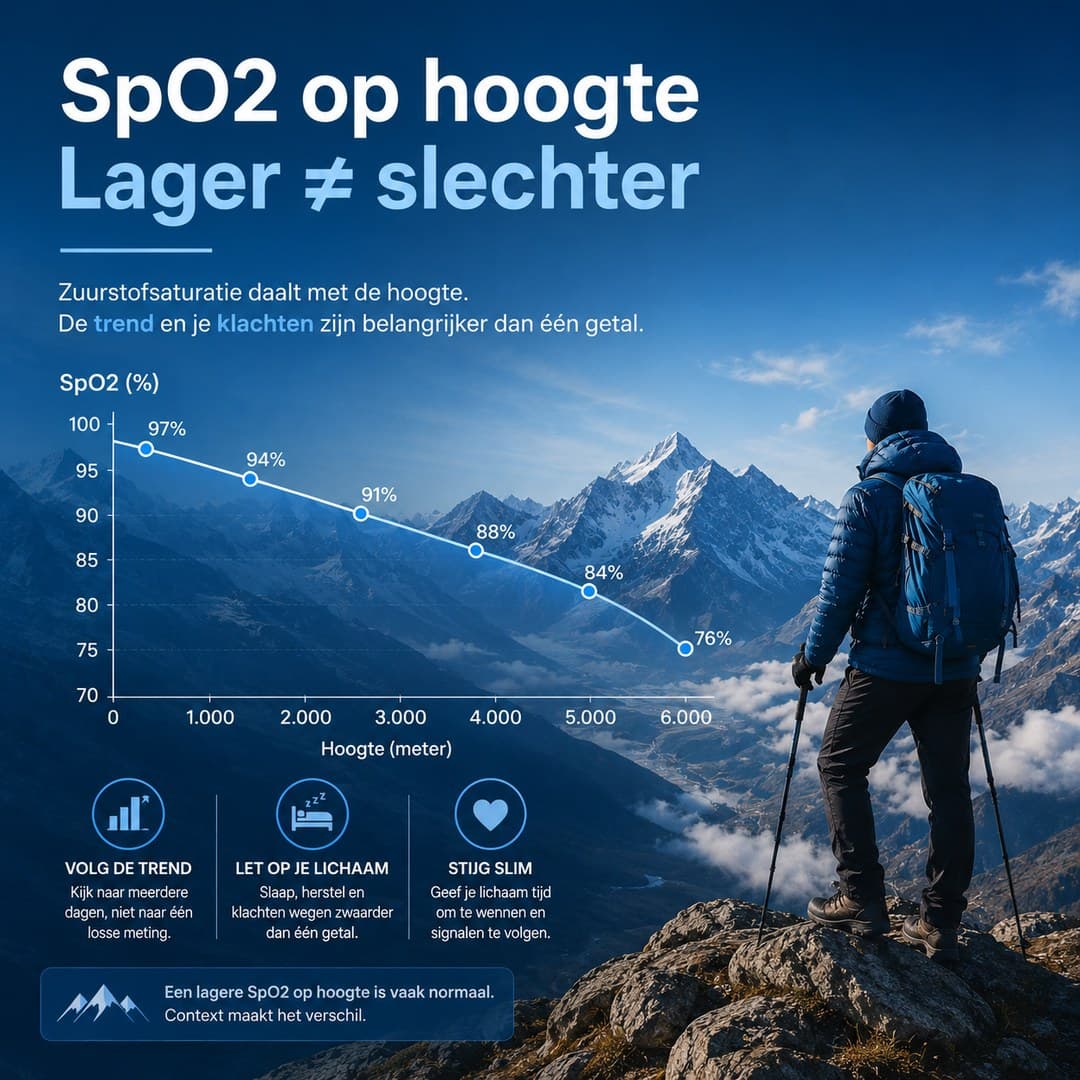
Measuring saturation is not a control compulsion. It is guidance. It helps you keep the stimulus in the right zone, and recognise when your body is ready for the next step.
Guideline values for nocturnal SpO2
- Above 93%: adaptation at this altitude is sufficient. You may consider increasing by up to 300m.
- 88 to 93%: effective zone for many people, provided sleep and recovery remain good.
- Under 85%: stimulus too heavy, increased risk of sleep disturbance and overload.
Important: trends over several nights are more valuable than single measurements. A single low night may be due to circumstances. Multiple low nights with poorer sleep usually indicate too heavy a stimulus.
Common assumption 3: “The lower my SpO2, the better it works.”
Structurally low values can disrupt sleep architecture, increase stress and put pressure on recovery processes. Adaptation occurs at just enough stress, not at maximum stress.
What does this mean concretely?
- Look at recovery, not extremes.
- Nighttime values are leading.
- Too low works against you, even if you can maintain “tough”.
Did you know that... (and why that's handy)
- You nocturnal SpO2 is often lower than during the day, even at the same set height, because breathing and ventilation change during sleep.
- A slight increase in SpO2 after 3 to 5 nights is often a more reliable sign of adaptation than a rapid rise overnight.
- Some people first more restless sleep before SpO2 improves, and that this can be part of normal adjustment, as long as it does not escalate.
- Alcohol, heavy evening meals and late intensive workouts the Be able to lower SpO2 during sleep, independent of the set height.
What does this mean concretely?
- Measure SpO2 as much as possible under similar conditions.
- Assess trends over several nights, not 1 number.
- Don't draw big conclusions based on 1 bad night.
Decision moments while using a high altitude tent
A high altitude tent works best when you not only follow a schedule, but also know when you continue, when you adjust and when you slow down. That is exactly the difference between trying and guiding.
When moving on makes sense
- SpO2 gradually rises towards or above 93%.
- Sleep quality recovers or remains acceptable.
- Training or daily load feels stable.
When adapting is wise
- SpO2 remains low for several nights with no trend upwards.
- Slight headache, restless sleep or noticeably less sense of recovery.
- You notice that you continue to “lag” the day.
When slowing down or stopping is necessary
- Persistent insomnia or markedly deteriorating sleep.
- Nausea, dizziness or strong headache that does not subside.
- Obvious drop in performance or energy that persists for several days.
What does this mean concretely?
- Adaptation is not failure, it is steering.
- Stabilisation is often gain.
- Stopping or downshifting prevents prolonged kickback.
Scenario 2: tractor with sleep problems and doubts
A trekker prepares for a trip to 4,500 to 5,000 metres and uses an altitude tent. The first week goes well, but in week two sleep becomes shorter and more restless. SpO2 hovers around 88 to 90% and does not rise. He hesitates: is this “normal”, or is this a sign that he is going too fast?
In such a situation, it makes sense not to think in terms of “just getting on with it”, but in terms of adaptation conditions. If SpO2 does not improve and sleep worsens, chances are your stimulus is too high for the moment. Then the most logical step is: stabilise altitude or 300 metres back until sleep and SpO2 return to a recoverable zone.
What does this mean concretely?
- No SpO2 improvement plus worse sleep usually means: do not increase.
- A week longer at the same altitude can pay off more than fast-forwarding.
- Your goal is preparation for altitude, not gaining “tent metres”.
Practical tips that make a difference when using high altitude tents
Tip 1: Keep your evenings predictable
A fixed routine helps your body process the hypoxic stimulus. Large fluctuations in bedtime, food or stimuli make your dates messy and your sleep more vulnerable.
What does this mean concretely? More stable breathing, more reliable SpO2 trends and less nocturnal restlessness.
Tip 2: Never raise after a bad night
Even if your “schedule” says you can. A bad night is a signal that recovery is under pressure. Increasing at that time stacks incentives.
What does this mean concretely? Poor sleep = no increase. Stabilise first, then adjust. An extra night at the same altitude is often gain.
Tip 3: Don't combine high sleep with extra stress
An altitude tent is already a physiological stimulus. Extra stress from late intense training, not enough food or not enough rest works against you.
What does this mean concretely? Avoid heavy late workouts, avoid calorie depletion and plan rest periods deliberately, especially in weeks 1 and 2.
Tip 4: Measure smartly, not obsessively
Measurement is meant to guide. Choose a consistent measurement method, compare nights under similar conditions and focus on trends.
What does this mean concretely? Less noise, better decisions and more peace of mind in your process.
Tip 5: Keep 1 simple log rule
Note 3 things every morning: sleep quality (1-10), feeling of recovery (1-10) and a short SpO2 note (trend up, steady, down).
What does this mean concretely? You can see patterns faster and avoid basing decisions on a snapshot.
Altitude tent and pre-acclimatisation in context
At altitude tent use as pre-acclimatisation applies as a practical range:
- Minimum duration: 4 weeks
- Optimal: 4 to 5 weeks
- Maximum: 6 weeks
The set height is individually and incrementally determined based on measured response rate. This is guidance, not a guarantee. The goal is for you to confidently understand which stimulus suits you, and when you are ready for the next step.
Internal floor
When guidance becomes logical
If you find yourself unsure about starting height, build-up or interpretation of SpO2, it is not a sign that you “don't get it”. It is precisely when guidance becomes valuable. An altitude tent works best when your process is consistent and you can back up your decisions.
Want to have your starting height and build-up tailored to your goal and SpO2 response? Then you can opt to rent with advice and guidance so you don't have to gamble.
View Height tent hire and advice
Many users describe afterwards that the difference was not in “going harder”, but in calmness and consistency: sleep better, manage signals better and therefore feel more confident about the trajectory.
A high altitude tent works not because you sleep high, but because you understand when to raise, when to hold on and when to slow down. Those who steer on SpO2, sleep and recovery structurally get more out of it than those who steer on ambition or gauges.
If you remember 1 rule, let it be this one: only increase by up to 300 metres once your nightly SpO2 is stable above 93%, and sleep all nights at the set weekly altitude. That is the essence of controlled, effective pre-acclimatisation.