Using a high altitude tent: saturation in the tent - what is normal for beginners
Published 3 February 2026 · 5 min read

Lead
Using a high altitude tent almost always raises the same question for beginners: “My oxygen saturation drops in the tent - is this normal, or am I doing something wrong?” This doubt is understandable. Saturation readings feel objective and confrontational at the same time. In this article, you will learn what normal SpO₂ values are when using an altitude tent, how to interpret them correctly and when to make adjustments.
The essentials in 30 seconds
Conclusion: A drop in oxygen saturation in the altitude tent is normal and even desirable within clear limits.
Nuance: The value by itself says little without context of sleep, recovery and trend over several nights.
Practical lead: Don't look at one measurement, but follow your SpO₂ progression and combine it with your sleep sensation.
Why saturation in the altitude tent raises so many doubts
For many athletes and mountain enthusiasts, SpO₂ feels like a hard truth. The number is black and white on a screen and seems to tell you whether your body is doing “well” or “badly”. As soon as you use an altitude tent and your saturation drops, doubt arises: is this how it should be, or am I overexerting myself?
This uncertainty is compounded by the fact that online advice is often contradictory. Some sources cite fixed limits, while others warn against measuring themselves. Reality, as so often, is in the middle.
What oxygen saturation actually measures
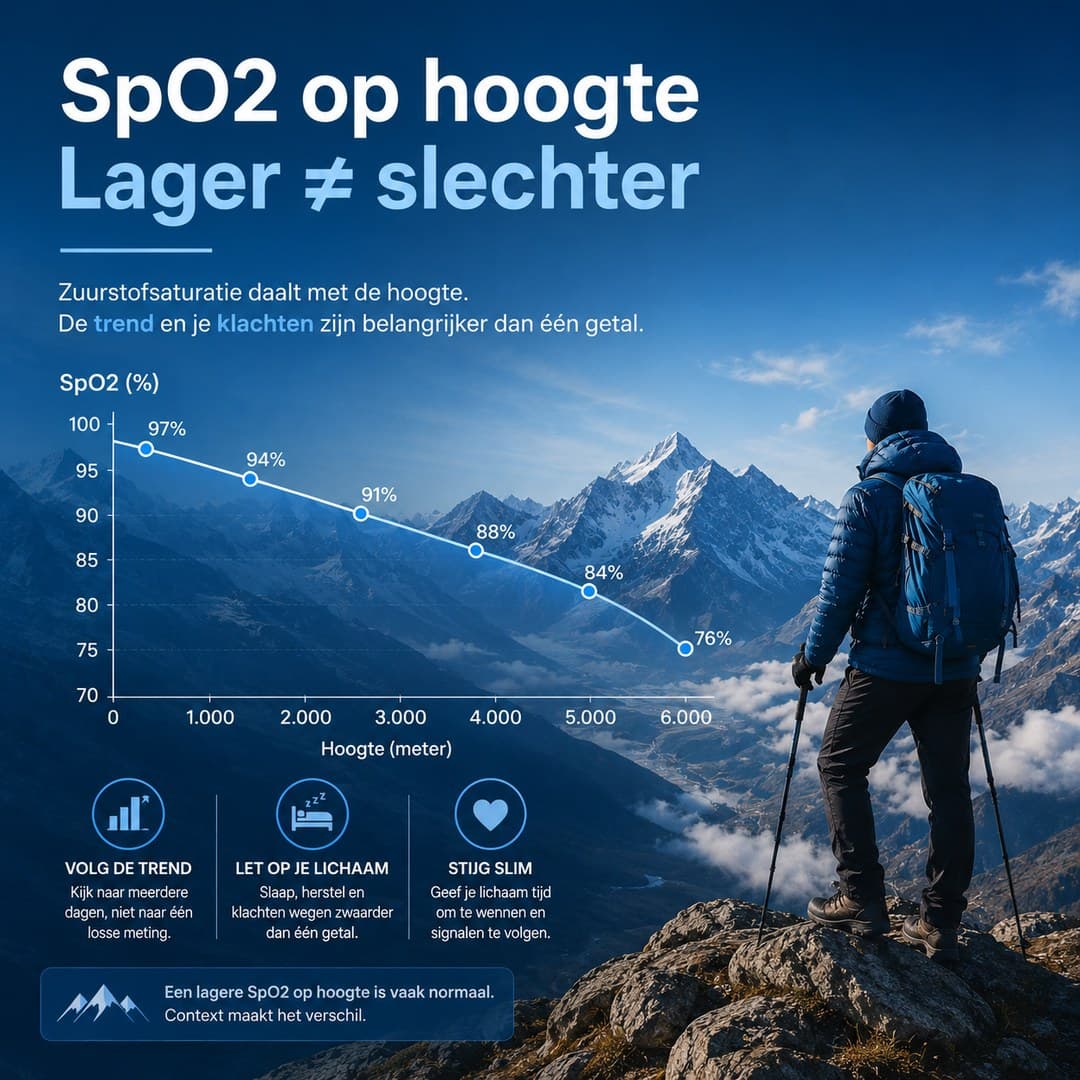
Oxygen saturation (SpO₂) indicates what percentage of your haemoglobin is saturated with oxygen. At sea level, this is usually between 96 and 99 per cent in healthy people. In an altitude tent, the oxygen percentage in the air is reduced via normobaric hypoxia. As a result, the available oxygen drops and your body reacts immediately.
This reaction is not a mistake, but the intention. Your breathing deepens, your heart rate adjusts and adaptive mechanisms similar to natural acclimatisation are activated.
💡 Did you know?
The greatest physiological adaptation to hypoxia does not start during exercise, but during sleep. Precisely because there are no competing stimuli then, the respiratory and adaptive system is given the space to respond stably to lower oxygen availability.
What is a normal SpO₂ in the altitude tent?
For beginners, this is the key question. There is no universal “right” number, but there are safe and realistic ranges.
- At sea level: typically 96 to 99 per cent
- First nights in the high altitude tent: often 90 to 94 per cent
- At higher simulation heights: sometimes temporarily 88 to 90 per cent
Important: a lower value in itself is not a problem as long as it is stable, your sleep quality remains acceptable and you recover during the day. The goal is not to drop as low as possible, but to provide a stimulus that your body can handle.
Why one measurement says nothing
Beginners often make the same mistake: they look at one night or even one moment. SpO₂ is dynamic and sensitive to posture, breathing, temperature and measurement moment.
That is why at Altitude Dream we never work with single numbers, but with trends. Attrition over several nights tells the real story.
⚠️ Reality check
A SpO₂ value of 89 per cent may be perfectly acceptable in someone who sleeps well and wakes up refreshed, while 92 per cent may be problematic with restless sleep, headaches and fatigue. The number is a signal, not a judgment.
The relationship between saturation and sleep quality
Sleep is the primary stimulus when using an altitude tent. If your saturation drops but your sleep deteriorates structurally, the stimulus is too strong. Typical signs of this are frequent waking, shallow sleep or feeling “not rested”.
Therefore, we almost always recommend scheduling one extra hour of sleep per night during a high-tension period. This helps balance recovery and adaptation processes.
Getting used to it step by step: why beginners should build up more slowly
The body needs time to learn to cope with hypoxia. Increasing the simulation height too quickly rarely leads to faster results, but often to worse sleep and unnecessary stress.
A controlled build-up, guided by SpO₂ monitoring, makes the process measurable and planable without forcing the body.
🧭 In practice
A novice user often starts around a simulation of 2,500 to 3,000 metres. Only when the SpO₂ trend stabilises and sleep quality is maintained does it make sense to build up in small increments. This prevents your body from constantly falling behind.
Decision moments: when to continue, adjust or stop
Continue
- SpO₂ stable over several nights
- Good sleep quality
- Normal daytime recovery feeling
Adjust
- Falling SpO₂ trend without stabilisation
- Restless or shortened sleep
- Increasing fatigue
Slow down or stop
- Persistent headache or nausea
- Poor sleep several nights in a row
- No recovery despite rest
📊 Research shows
Studies on hypoxic exposure show that controlled, prolonged stimuli are more effective than aggressive short exposures. In particular, sleep-based hypoxia shows more stable adaptations, provided the load remains within recoverable limits.
The role of the altitude tent in all this
An altitude tent is not a replacement for acclimatisation, but a way to make the process controlled, measurable and planable. The power is not in extremes, but in consistency.
Combining data such as SpO₂ with subjective signals creates a complete picture. Therein lies the real gain, not in chasing low numbers.
Concluding reflection
Saturation in the altitude tent is not an exam you have to pass. It is a feedback signal that helps to understand and adjust the process. Those who learn to look at trends and context get more peace of mind and more return from altitude training.
Many users find that guidance and periodic review help remove doubts and build confidence in the process.
Want to know how your saturation pattern ideally develops within your goals? Then targeted guidance is often the difference between gambling and targeted adjustment.
❓ Mini-FAQ
Should my SpO₂ improve every night?
No. Stabilisation is more important than increase. A steady value with good sleep often indicates effective adaptation.