Highest mountains Europe: top 10 with altitude profile
Published 7 May 2026 · 16 min read
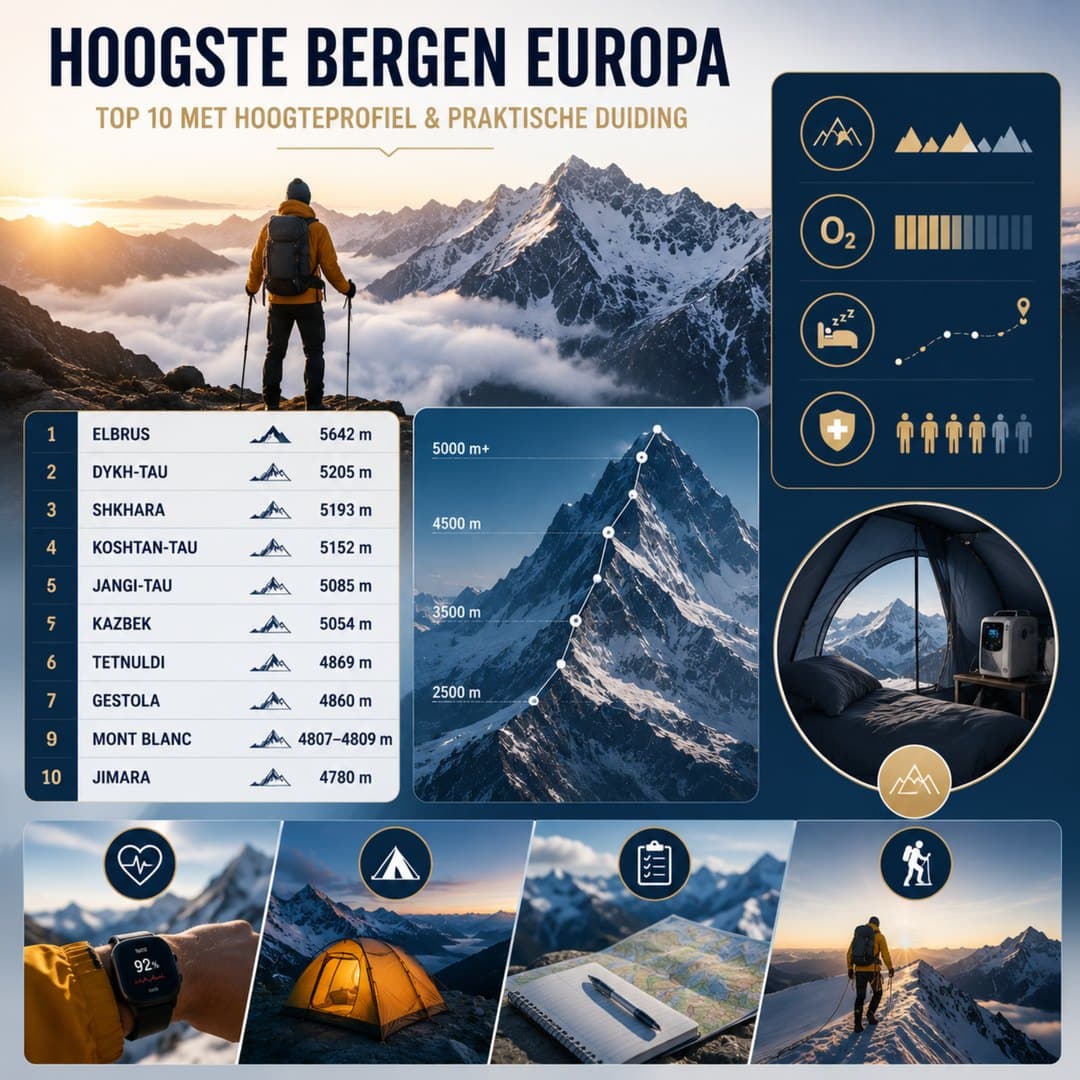
Europe's highest mountains are mainly in the Caucasus, not in the Alps. If you look purely at altitude, you end up with Elbrus, Dykh-Tau, Shkhara and other five-thousanders on or around the border of Russia and Georgia. Mont Blanc remains the highest mountain in the Alps and Western Europe, but in a European ranking including Caucasus it is lower than many people expect.
Yet altitude alone does not tell enough. For climbers, trekkers and expeditioners, altitude profile is especially important. How fast do you climb? Where do you sleep? How long do you stay above 3,000 metres? And how does your body react to falling oxygen pressure? That is why this article pairs the top 10 highest mountains Europe with practical guidance on acclimatisation, altitude sickness and preparation.
Short answer: Europe's highest mountain is Elbrus at 5642 metres. This is followed mainly by Caucasus peaks such as Dykh-Tau, Shkhara, Koshtan-Tau and Jangi-Tau. Mont Blanc is the highest mountain in the Alps at around 4807 to 4809 metres, but not the highest mountain in Europe when you include the Caucasus.
Conclusion: the top 10 highest mountains Europe is dominated by the Caucasus.
Nuance: some lists differ by including or excluding sub-tops.
Practical hook: look not only at altitude, but especially at sleeping height, ascent rate and acclimatisation.
If you want to better understand the physiological impact of altitude, use the height to oxygen table as a basis. Which shows why 4800 metres in the Alps is already serious, while 5000 to 5600 metres in the Caucasus requires even more in terms of sleep, recovery and decision-making.
Highest mountains Europe: right framework first
The rankings below use Europe in the broad mountaineering sense, which includes the Greater Caucasus. Therefore, Elbrus is usually considered the highest mountain in Europe and Europe's Seven Summit. If you place the Caucasus outside Europe, you get a different list. Then Mont Blanc, Monte Rosa and other Alpine peaks come into the picture higher up.
Why this nuance is important
For Google searchers, the question is often simple: what is the highest mountain in Europe? For mountaineers, the answer is more practical. Elbrus is higher, but Mont Blanc is logistically closer and therefore more relevant for many Western European climbers. Moreover, each mountain requires different preparation. Therefore, a ranking is only valuable if you also understand what the altitude means in practice.
Highest mountains Europe: top 10 with practical interpretation
The top 10 consists mainly of Caucasus peaks. Still, the differences are great. Some mountains are relatively popular, such as Elbrus and Kazbek. Other peaks are much more technical, remote and less suitable as a first big altitude goal. As a result, you should not read this list as a bucket list in order, but as an altitude risk profile.
Top 1 to 5: the highest five-thousanders
| Grade | Mountain | Height | Area | Practical interpretation |
|---|---|---|---|---|
| 1 | Elbrus | 5642 m | Caucasus, Russia | Highest European summit in the usual Seven Summits list. Acclimatisation and weather especially determine the margin. |
| 2 | Dykh-Tau | 5205 m | Caucasus, Russia | Much more technical than Elbrus. Serious alpine experience is necessary. |
| 3 | Shkhara | 5193 m | Caucasus, Georgia/Russia | Complex terrain, glaciers and remote character. Not a classic entry-level mountain. |
| 4 | Koshtan-Tau | 5152 m | Caucasus, Russia | High, technical and physically demanding. Altitude profile and route planning are crucial. |
| 5 | Jangi-Tau | 5085 m | Caucasus, Russia/Georgia | A true five-thousander with expedition feel. Sleeping height and recovery must be monitored. |
Height: 5642 m
Area: Caucasus, Russia
Clarification: highest European summit in the usual Seven Summits list. Acclimatisation and weather, in particular, determine the margin.
Height: 5205 m
Area: Caucasus, Russia
Clarification: much more technical than Elbrus. Serious alpine experience is necessary.
Height: 5193 m
Area: Caucasus, Georgia/Russia
Clarification: complex terrain, glaciers and remote character. Not a classic entry-level mountain.
Height: 5152 m
Area: Caucasus, Russia
Clarification: high, technical and physically demanding. Altitude profile and route planning are crucial.
Height: 5085 m
Area: Caucasus, Russia/Georgia
Clarification: a real five-thousander with expedition feel. Sleeping height and recovery must be monitored.
Top 6 to 10: where Mont Blanc comes into the picture
From spot 6, you can see an interesting transition. Kazbek remains a true five-thousander, while Tetnuldi, Gestola, Mont Blanc and Jimara are around 4800 metres. Yet that does not mean these mountains are easy. Especially around this altitude, many climbers underestimate the combination of rapid ascent, poor sleep and summit stress.
| Grade | Mountain | Height | Area | Practical interpretation |
|---|---|---|---|---|
| 6 | Kazbek | 5054 m | Caucasus, Georgia/Russia | More popular than many other Caucasus peaks, but still a serious high altitude summit. |
| 7 | Tetnuldi | 4869 m | Caucasus, Georgia | Lower than 5,000 metres, but still demanding due to terrain, glacier and sleeping height. |
| 8 | Gestola | 4860 m | Caucasus, Georgia/Russia | High-alpine terrain. Less well known, but certainly no less serious. |
| 9 | Mont Blanc | approximately 4807 to 4809 m | Alps, France/Italy | Highest mountain in the Alps and Western Europe. Highly relevant for European climbers. |
| 10 | Jimara | 4780 m | Caucasus, Georgia/Russia | Less well known, but clearly a serious expedition summit due to altitude and location. |
Height: 5054 m
Area: Caucasus, Georgia/Russia
Clarification: More popular than many other Caucasus peaks, but still a serious high altitude summit.
Height: 4869 m
Area: Caucasus, Georgia
Clarification: lower than 5000 metres, but still demanding due to terrain, glacier and sleeping altitude.
Height: 4860 m
Area: Caucasus, Georgia/Russia
Clarification: high-alpine terrain. Less well known, but certainly no less serious.
Height: approximately 4807 to 4809 m
Area: Alps, France/Italy
Clarification: tallest mountain in the Alps and Western Europe. Highly relevant for European climbers.
Height: 4780 m
Area: Caucasus, Georgia/Russia
Clarification: less well known, but clearly a serious expedition peak due to altitude and location.
Source control heights: the heights in these rankings have been checked against Peakbagger Europe 4500-meter Peaks. In addition, for Elbrus, the general altitude context was checked via Britannica.
Highest mountains Europe and altitude profile: why metres don't say everything
Europe's highest mountains do not form a uniform category. A summit of 4800 metres in the Alps feels different from a summit of 5200 metres in the Caucasus. This is not only because of the difference in altitude. Distance, cold, route complexity, glacier terrain and rescue possibilities also determine the actual load.
The main physiological line
Yet the same principle applies everywhere. As you ascend, air pressure drops. The oxygen percentage in the air remains roughly the same, but each breath provides less usable oxygen. As a result, your body has to work harder for the same effort. Moreover, sleep, recovery, appetite and decision-making can noticeably deteriorate.
Why sleep height matters more than top day height
This is why the altitude profile is more important than just the summit day. A route where you climb from 1500 to 4200 metres in a short time can be riskier than a longer route that slowly builds up to 4800 metres. Sleeping altitude is especially important. This is because your body mainly adapts to the altitude at which you spend longer periods of time.
| Height zone | What is happening? | Practical significance | Examples from the top 10 |
|---|---|---|---|
| 2500-3500 m | The first clear height incentive arises. | Quiet rise and sleep quality follow. | Approach to many Alpine and Caucasus routes. |
| 3500-4500 m | Oxygen pressure drops noticeably. | Acclimatisation days become more important. | Huts, camps and approach routes towards Mont Blanc or Caucasus. |
| 4500-5000 m | Recovery and sleep become more sensitive. | Altitude sickness prevention will be a key theme. | Mont Blanc, Tetnuldi, Gestola, Jimara. |
| 5000 m+ | The hypoxic load is high. | Prior acclimatisation and monitoring give more margin. | Elbrus, Dykh-Tau, Shkhara, Koshtan-Tau, Jangi-Tau, Kazbek. |
What is happening? The first clear height incentive arises.
Practical significance: calm rise and sleep quality follow.
Examples: run-up to many Alpine and Caucasus routes.
What is happening? Oxygen pressure drops noticeably.
Practical significance: acclimatisation days become more important.
Examples: huts, camps and approach routes towards Mont Blanc or Caucasus.
What is happening? Recovery and sleep become more sensitive.
Practical significance: altitude sickness prevention will be a key theme.
Examples: Mont Blanc, Tetnuldi, Gestola, Jimara.
What is happening? The hypoxic load is high.
Practical significance: Prior acclimatisation and monitoring give more margin.
Examples: Elbrus, Dykh-Tau, Shkhara, Koshtan-Tau, Jangi-Tau, Kazbek.
Why Elbrus is different from Mont Blanc
Elbrus and Mont Blanc are often mentioned in the same breath. Yet they are different goals. Elbrus is higher and fits within the classic Seven Summits logic. Mont Blanc is lower, but technical and objectively dangerous enough not to be underestimated. Therefore, each mountain requires its own preparation.
Elbrus: mainly altitude, cold and weather margin
At Elbrus, much revolves around altitude, weather and the transition to above 5,000 metres. The normal route is more technically accessible than many other Caucasus peaks. Still, the summit day remains long and physiologically demanding. Therefore, you should not judge Elbrus as a simple hiking mountain, but as a serious five-thousander.
Mont Blanc: quicker to reach, but not easier
At Mont Blanc, route choice, glaciers, rockfall, crowds, hut reservations and objective alpine danger play a big role. For those preparing specifically for this mountain, is Mont Blanc acclimatisation therefore a separate focus.
The mistake many climbers make is seeing Mont Blanc as “only 4800 metres”. This is misleading. At that altitude, oxygen pressure is already considerably lower than at sea level. If you travel quickly to Chamonix from the Netherlands or Belgium and then sleep in a short time above 3800 metres, your body will have little time to adjust.
Elbrus vs Mont Blanc in preparation
Elbrus: more emphasis on long-term hypoxic load, 5000-metre adaptation and high-altitude summit day.
Mont Blanc: more emphasis on route skill, alpine timing, objective danger and rapid altitude gain from the valley.
Agreement: for both goals, it helps to know in advance how your body reacts to oxygen deprivation, poor sleep and increasing load.
Europe's highest mountains and the risk of altitude sickness
Altitude sickness does not arise because someone is “not fit enough”. Fitness helps for strain and recovery, but does not automatically protect against acute mountain sickness. A strong athlete may develop symptoms if the rate of ascent is too high. A slower climber may actually respond well if the schedule is calm enough.
Why ascent rate is so decisive
Therefore, any ascent above 3,500 metres involves a plan for preventing altitude sickness. That plan does not start with medication. It starts with ascent rate, sleep elevation, rest days, hydration, nutrition, symptom recognition and willingness to adjust.
International guidelines stress that gradual ascent is one of the most important preventive measures. Above 3,000 metres, the CDC recommends increasing sleep altitude by a maximum of about 500 metres per day. The CDC also recommends additional acclimatisation days in case of further ascent. The Wilderness Medical Society cites the same principle: sleep altitude in particular, not just the highest daily altitude, determines risk.
Sources acclimatisation guidelines: see the CDC Yellow Book on high altitude travel and the Wilderness Medical Society 2024 altitude summary.
Practice interpretation: a summit of 5000 metres is not automatically more dangerous than a summit of 4800 metres. The difference is often in the profile. If you sleep peacefully higher, your body gets time. If you climb fast, sleep poorly and ignore symptoms, the margin gets smaller.
Acclimatising at home ahead of European highs
For many European mountain goals, available time is limited. Climbers fly to Georgia, Russia, France, Italy or Switzerland and want to head for hut, camp or summit window within a few days. Just then, acclimatising at home before a mountain expedition be a valuable preparation.
What an altitude tent does and does not do
An altitude tent works via normobaric hypoxia. This means that the air pressure in the chamber remains the same, but the oxygen percentage in the tent is reduced in a controlled way. So you don't sleep under lower air pressure, but in air with less oxygen. This gives your body a hypoxic stimulus while you continue to train, work and recover at home.
For targets around 4000 to 5000 metres, sleeping in an altitude tent can be especially helpful for going into the first days at altitude in a more controlled way. It makes preparation measurable and planable. Moreover, it can significantly reduce the risk of altitude sickness, provided you build up the programme gradually and combine it with sensible acclimatisation on site.
The right nuance for serious climbers
An altitude tent is no 100% guarantee and no substitute for real acclimatisation in the mountains. Still, it makes the process much more manageable. You can track your sleep, morning feeling, SpO2 trend and recovery in advance. As a result, you don't leave for altitude blank, but with more information about your own response to oxygen deprivation.
Sample structure for a European 4000-5000m summit
Week 1: Calmly get used to sleeping with reduced oxygen. Focus on sleep quality and morning feeling.
Week 2: gradually increase hypoxic stimulus. Adjust only if sleep and recovery remain stable.
Week 3: make longer nights and track SpO2 as a trend, not as an isolated measurement.
Week 4: consolidate. Better to arrive stable than to increase aggressively just before departure.
This is how you monitor this lens
Objective monitoring prevents your preparation from relying on feelings alone. Especially in Europe's highest mountains, you don't want to discover on the mountain that you react badly to altitude. Therefore, use a combination of measurement data and observation.
Measure not one value, but the pattern
Monitoring points for altitude preparation
- SpO2 trend: look at several mornings in a row, not one single value.
- Sleep quality: watch for falling asleep, sleeping through, restlessness and waking up with a headache.
- Recovery: track resting heart rate, fatigue and training response.
- Symptoms: note headache, nausea, dizziness, loss of appetite and unusual shortness of breath.
- Tax: Avoid heavy training blocks if sleep and recovery clearly deteriorate.
When sleeping in an altitude tent, SpO2 is mainly useful as a trend. A single measurement can be affected by cold fingers, measurement position, movement or sleep phase. Therefore, look at the pattern. If your saturation becomes more stable, you sleep better and you feel normal during the day, that is a more favourable signal than a single single measurement.
Keep making adjustments even in the mountains
On-site monitoring also remains relevant. A climber who sleeps badly the first night at 3800 metres, has a headache and feels little appetite should take it seriously. The solution is not to continue automatically. Often rest, a lower sleeping altitude or an extra day of acclimatisation are wiser.
Decision rules for your preparation
The top 10 highest mountains Europe is interesting as a ranking, but the real question is more personal: what does your goal mean for your preparation? That's why it's better to think in decision rules than in prestige.
When extra preparation is wise
When is extra acclimatisation preparation wise?
Strong consideration, though: if your goal is above 4,000 metres, you have limited time on site, you had previous altitude complaints or you are departing quickly from sea level.
Definitely take it seriously: if you head towards 5,000 metres or higher, such as Elbrus, Kazbek or other Caucasus peaks.
Don't rely on it blindly: if you are fit but have no recent altitude experience. Fitness and altitude adaptation are not the same thing.
For a first high Alpine ascent, a shorter and controlled programme can already be valuable. For Caucasus peaks above 5,000 metres, more extensive preparation makes more sense. This includes not only sleeping in an altitude tent, but also realistic route planning, sufficient rest days, medical checks where necessary and a clear stop plan.
How this fits within larger expedition goals
Those looking more broadly at European or global height challenges can also compare the rankings alongside the Seven Summits lay. In this, Elbrus is Europe's top mountain. Yet that does not mean it is an easy mountain. The normal route is more accessible than many other Caucasus giants, but altitude, cold and weather remain decisive.
Common misconceptions about Europe's highest mountains
A strong article on Europe's highest mountains should not only rank, but also correct. Many persistent misunderstandings exist precisely around this topic. As a result, some climbers prepare too lightly.
Misconception 1: Mont Blanc is Europe's highest mountain
That's only true if you don't count the Caucasus as Europe. In the most common mountaineering and Seven Summits context, Elbrus is higher. Mont Blanc does remain the highest mountain in the Alps and Western Europe.
Misconception 2: Elbrus is mainly a long walk
The normal route is less technical than Dykh-Tau or Shkhara. Yet that does not make the altitude load small. A summit day above 5,000 metres requires a different physiological margin than a trek in the Alps at 3,000 metres.
Misconception 3: altitude sickness mainly affects inexperienced people
In reality, anyone can develop symptoms. Previous experience, slow ascent and good preparation reduce the risk, but do not eliminate it completely. This is why monitoring remains important, even for fit and experienced athletes.
Misconception 4: An altitude tent replaces the mountain
That is not the right framing. The added value is in controlled pre-acclimatisation beforehand. You make the first hypoxic stimulus measurable already at home, making the transition to the mountains less abrupt.
Practical preparation by type of European summit
Not every mountain in the top 10 requires the same route. Therefore, it is wise to tailor your preparation to the type of goal. That way, you avoid approaching a technical Caucasus summit as if it were an accessible Alpine route.
Three types of targets, three preparation routes
| Type of target | Examples | Main risk | Practical preparation |
|---|---|---|---|
| High Alps | Mont Blanc | Rapid altitude gain, crowds, route conditions. | Technical preparation, cabin planning, sleep altitude monitoring and pre-acclimatisation if required. |
| Accessible five-thousanders | Elbrus, Kazbek | Altitude load, cold, weather reversal and summit day. | Gradual acclimatisation, pre-sleeping in altitude tent, monitoring and extra reserve days. |
| Technical Caucasus summit | Dykh-Tau, Shkhara, Koshtan-Tau | Technique, objective danger, remote terrain and altitude. | Experienced guide team, serious alpine experience, expedition planning and strong acclimatisation base. |
Examples: Mont Blanc
Main risk: rapid altitude gain, crowding, route conditions.
Preparation: technical preparation, cabin planning, sleep altitude monitoring and pre-acclimatisation if necessary.
Examples: Elbrus, Kazbek
Main risk: altitude load, cold, weather reversal and summit day.
Preparation: progressive acclimatisation, pre-sleeping in altitude tent, monitoring and extra reserve days.
Examples: Dykh-Tau, Shkhara, Koshtan-Tau
Main risk: technique, objective danger, remote terrain and altitude.
Preparation: experienced guide team, serious alpine experience, expedition planning and strong acclimatisation base.
Preparation as a system
Especially with goals above 4000 metres, it is smart to think of your preparation as a system. You work on fitness, technique, equipment, route knowledge, acclimatisation and monitoring. The weakest link often determines how comfortable and safe the expedition feels. Therefore, planning in advance is more important than correcting afterwards.
Prepare controlled for a European height summit
Are you heading for a mountain around 4000 to 5000 metres, such as Mont Blanc, Kazbek or another European high altitude peak? With an altitude tent, you can already get used to less oxygen in a controlled way at home. This significantly reduces the risk of altitude sickness, without completely replacing real acclimatisation in the mountains.
Conclusion: the highest mountain is not always the greatest challenge
Europe's highest mountains are largely in the Caucasus. Elbrus is the highest at 5642 metres, followed by such serious five-thousanders as Dykh-Tau, Shkhara, Koshtan-Tau and Jangi-Tau. Mont Blanc remains the highest mountain in the Alps and the most recognisable altitude target for many Western European climbers.
The real lesson from this top 10
The most important lesson is not in the ranking. The altitude profile determines how tough a mountain becomes physiologically. How fast do you climb? Where do you sleep? How long do you stay above 3,000 metres? How does your body react to falling oxygen pressure? And how much margin do you build in beforehand?
Those who seriously prepare for a European high altitude summit combine fitness and technique with acclimatisation, monitoring and realistic decision-making. Sleeping in an altitude tent can play a valuable role in this. It makes pre-acclimatisation controlled, measurable and planable. As a result, you can significantly reduce the risk of altitude sickness and start the trip with more confidence.
FAQ on Europe's highest mountains
What is the highest mountain in Europe?
Europe's highest mountain is Elbrus in the Caucasus. The peak is 5642 metres high and is considered the European Seven Summit in the mainstream mountaineering context.
Why do many people think Mont Blanc is the highest mountain in Europe?
Mont Blanc is the highest mountain in the Alps and Western Europe. If you place the Caucasus outside Europe, Mont Blanc comes first. In the broad European mountaineering definition, Elbrus is higher.
From what altitude does acclimatisation become important?
From around 2,500 metres, altitude can become influential. Above 3000 metres, sleeping altitude becomes increasingly important. Above 4000 metres, acclimatisation should really be part of your plan.
Does a high altitude tent help prepare for European mountains?
Yes, especially at targets around 4000 to 5000 metres. An altitude tent can significantly reduce the risk of altitude sickness, as you get used to less oxygen in a controlled way beforehand. It remains a support, though, not a guarantee.
Is Elbrus technically more difficult than Mont Blanc?
The normal route on Elbrus is often less technically complex than many Mont Blanc routes. Yet Elbrus is higher. As a result, there is a greater emphasis on acclimatisation, cold, weather and long loads.