What are the Seven Summits? The ultimate challenge for mountaineers
Published 30 June 2017 · 5 min read
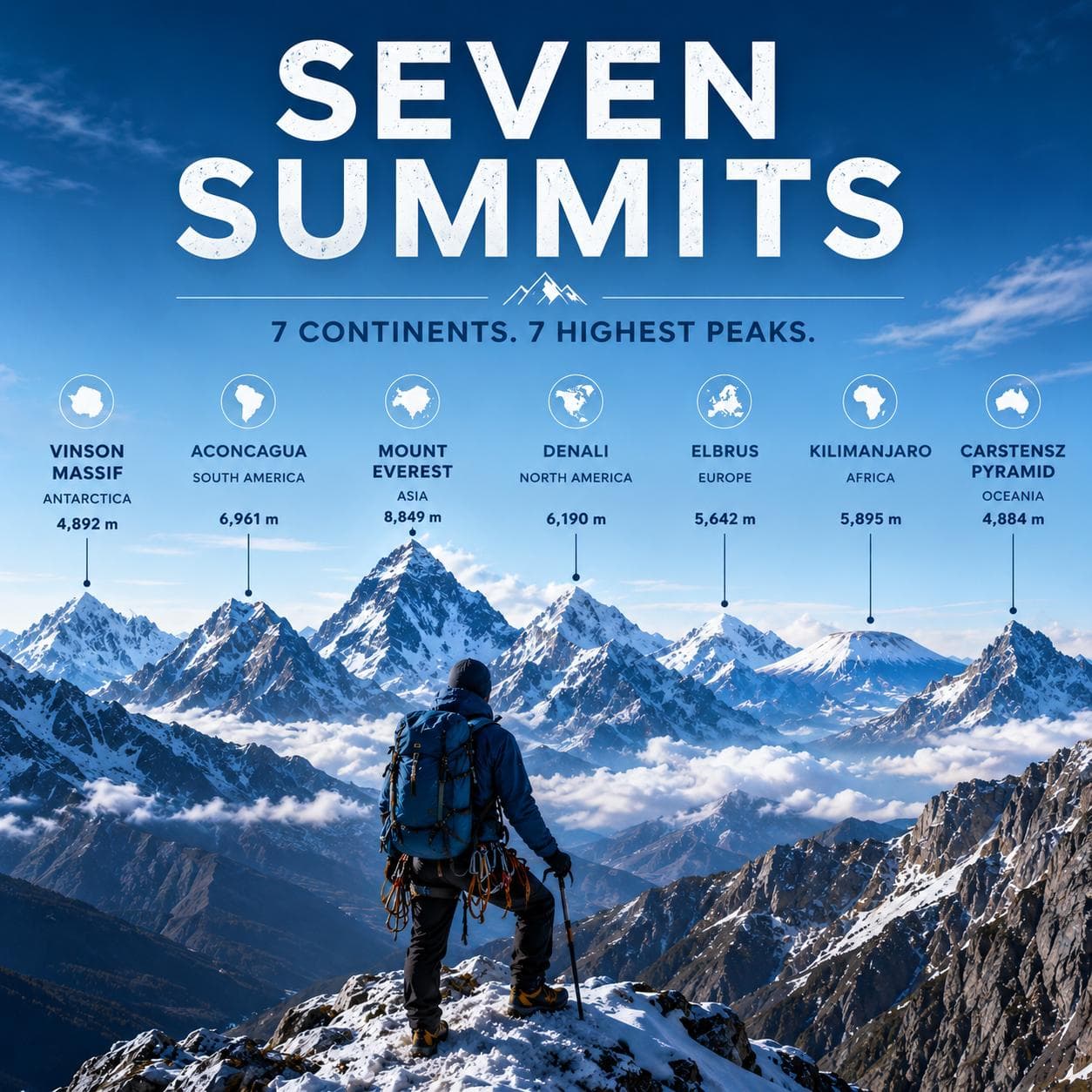
The Seven Summits For many mountain enthusiasts, they represent the most iconic goal within alpinism. The concept is simple: climb the highest mountain on each continent. In practice, this means a years-long journey across some of the most challenging and impressive mountains in the world.
However, those who dream of the Seven Summits not only face technical climbs, extreme weather conditions and logistical challenges. Altitude often forms the biggest limiting factor. Precisely for this reason, experienced climbers are paying more and more attention to acclimatising at home for mountain expeditions before they leave.
Short answer:
- The Seven Summits are the highest mountains on each of the seven continents.
- The list includes Everest, Aconcagua, Denali and Kilimanjaro, among others.
- Altitude sickness poses a significant risk on several mountains.
- A good acclimatisation strategy significantly increases the chances of a successful ascent.
- Sleeping in a hypobaric chamber before an expedition can significantly reduce the risk of altitude sickness.
Conclusion: The Seven Summits are primarily a challenge of altitude, logistics and perseverance.
Nuance: The technical difficulty varies greatly from mountain to mountain.
Practical hook: Preparation for altitude often determines more than just fitness.
The Seven Summits are the highest mountains on each of the earth's seven traditional continents.
The Seven Summits are the highest mountains on each of the seven continents. The concept was popularised by American businessman and mountaineer Richard Bass first climbed all seven summits.
Although several versions of the list exist, the version below is the most commonly used nowadays.
| Continent | Top | Height | Country |
|---|---|---|---|
| Asia | Mount Everest | 8.849 m | Nepal / Tibet |
| South America | Aconcagua | 6.961 m | Argentina |
| North America | Denali | 6.190 m | Alaska |
| Africa | Kilimanjaro | 5.895 m | Tanzania |
| Europe | Elbrus | 5,642 m | Russia |
| Antarctica | Vinson Massif | 4.892 m | Antarctica |
| Oceania | Carstensz Pyramid | 4.884 m | Indonesia |
Continent Asia
Height: 8.849 m
Country: Nepal / Tibet
Continent South America
Height: 6.961 m
Country: Argentina
Continent North America
Height: 6.190 m
Country: Alaska
Continent Africa
Height: 5.895 m
Country: Tanzania
Why are the Seven Summits so popular?
The appeal lies in the combination of adventure, world travel, and personal growth. Each mountain requires a different approach.
Acclimatisation plays an important role on Kilimanjaro, while Denali is known for its extreme cold. Everest combines high altitude with long expeditions. Carstensz Pyramid, on the other hand, demands technical climbing skills.
Many climbers therefore see the Seven Summits as a life project rather than a sporting challenge.
💡 Did you know? More people reach the summit of Mount Everest annually than there are worldwide who have successfully completed all of the Seven Summits.
Which of the Seven Summits cause the most altitude problems?
For most recreational climbers, altitude sickness presents a greater challenge than technique.
Especially Everest, Aconcagua, Denali and Kilimanjaro regularly cause acclimatisation problems. Therefore, an understanding of altitude sickness essential before planning an expedition.
| Mountain | Height risk | Why? |
|---|---|---|
| Everest | Very high | Extreme altitude above 8,000 metres |
| Aconcagua | High | Rapid ascent towards 7,000 metres |
| Denali | High | Low air pressure and heavy load |
| Kilimanjaro | Moderate to high | Often too fast ascent schedules |
Risk: Very high
Reason Extreme altitude above 8,000 metres
Risk: High
Reason Rapid ascent towards 7,000 metres
Risk: High
Reason Low air pressure and heavy load
Risk: Moderate to high
Reason Often too fast ascent schedules
Why sleeping in a high-altitude tent beforehand can make a big difference
One of the biggest misconceptions in expedition climbing is that acclimatisation only begins once you arrive in the mountains.
In reality, many physiological adaptations can already be stimulated at home. By sleeping in a hypobaric tent for several weeks in advance, controlled normobaric hypoxia is created. This gives the body the opportunity to gradually adapt to lower oxygen availability.
Anyone who prepares themselves well with a altitude tent often starts with a clear advantage over climbers who depart entirely from sea level.
Crucially, a height tent is not a substitute for acclimatisation on the mountain itself. However, it does make preparation controlled, measurable, and planable. For many expedition participants, this significantly reduces the chance of altitude sickness.
Practical preparation for Seven Summits climbers
- Ideally, start 4 to 8 weeks before departure.
- Gradually build up the height.
- Ideally, aim for 7 to 9 hours of sleep per night in the tent.
- Monitor morning values and recovery.
- Combine acclimatisation at home with a sensible ascent schedule on the mountain.
This is how you monitor this lens
- Track SpO2 as a trend over multiple days.
- Observe changes in sleep quality.
- Check recovery, energy and training feel.
- Please note headache, nausea and restless sleep.
- Increase the simulation height only when the adjustment is proceeding stably.
More background on interpreting values can be found in our guide on oxygen saturation at altitude.
Common Mistakes in Seven Summits Preparation
- Confusing condition with acclimatisation.
- Ascending too quickly during the expedition.
- Do not plan any rest days.
- Be aware of the location and start thinking about height adjustment.
- Ignoring the warning signs of altitude sickness.
⚠️ Reality check: The strongest athlete in the group is not necessarily the one who copes best with altitude. Individual susceptibility to altitude sickness varies greatly.
Preparing for a Seven Summits expedition?
Anyone embarking on an expedition to Aconcagua, Denali, Everest, or any other high-altitude trek can gain significant benefits from a structured pre-acclimatisation programme before their journey begins.
Conclusion
The Seven Summits offer a unique combination of adventure, perseverance and the challenges of high altitude. For most participants, success is determined not only by fitness or technique, but above all by how well the body is prepared for high altitude.
Therefore, more and more climbers are investing in a well-thought-out acclimatisation strategy beforehand. By being exposed to lower oxygen levels in a controlled manner at home for weeks, the chance of altitude sickness can be significantly reduced, and the expedition begins from a better starting position.
Frequently asked questions
Which Seven Summit is technically the most difficult?
For many climbers, Carstensz Pyramid is considered more technically challenging than Kilimanjaro or Elbrus due to the rock climbing involved.
Which of the Seven Summits is the most challenging in terms of altitude?
Mount Everest, at 8,849 metres, is by far the highest and most extreme mountain on the list.
Can you climb the Seven Summits without altitude experience?
That is not wise. Most climbers gain experience through prior expeditions to 4,000, 5,000, and 6,000 metres.
Is a high-altitude tent useful on Seven Summits expeditions?
Yes. An altitude tent can make the preparation process more controlled and predictable, and significantly reduce the risk of altitude sickness, without completely replacing acclimatisation on the mountain.