Aconcagua Normal Route or Polish Traverse: which route suits your acclimatisation best?
Published 17 May 2026 · 15 min read
Aconcagua Normal Route Polish Traverse: which route suits your acclimatisation?
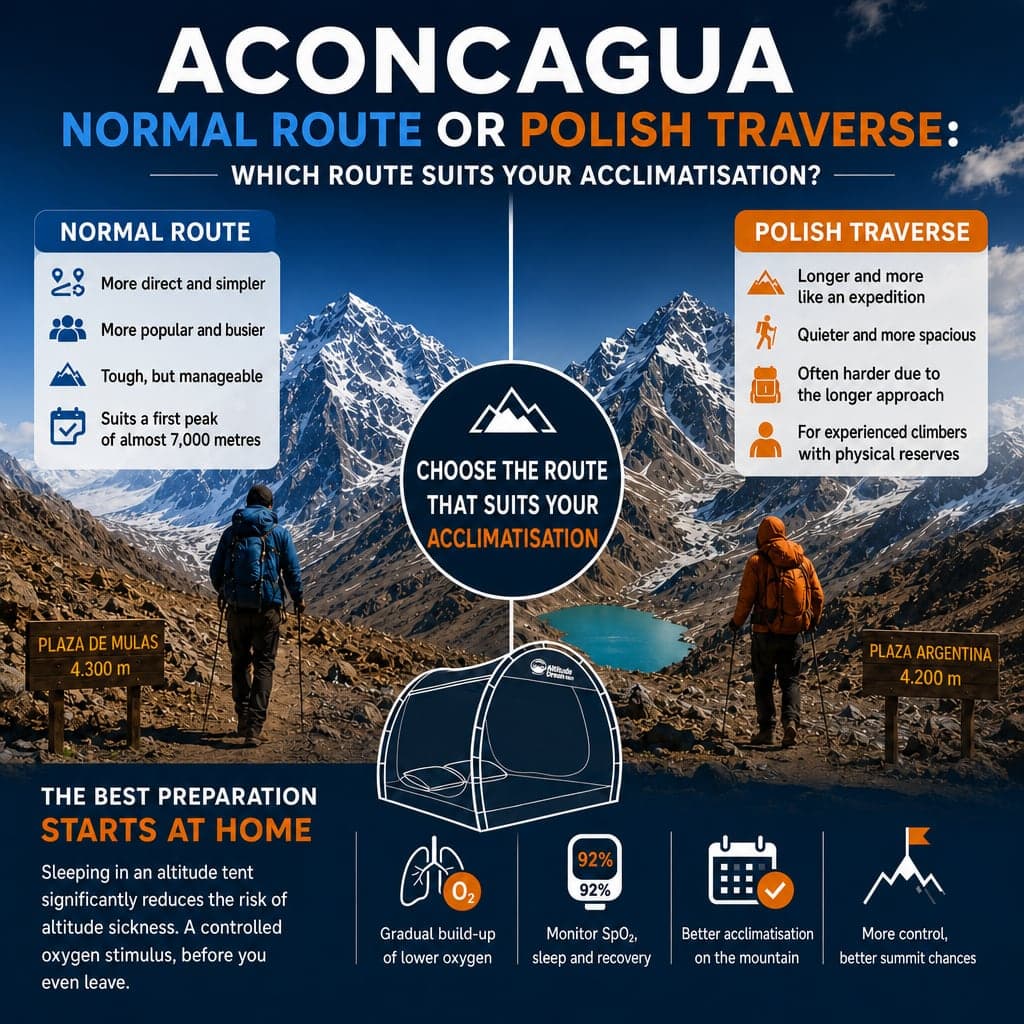
Aconcagua Normal Route Polish Traverse It's not a simple choice between easy and difficult. A better question is: which route suits your acclimatisation profile, experience, sleep quality, and preparation? At 6,961 metres, Aconcagua is not a technical mountain in the classic sense, but it is physiologically serious. Your success therefore depends less on the name of the route and more on how well your body copes with altitude, recovery, and oxygen deficiency.
The Normal Route is logistically simpler, more direct, and more popular. The Polish Traverse feels more like an expedition, is quieter, and often demands more physical reserves. However, the Polish Traverse is not automatically better for acclimatisation. A longer route only helps if the pace, rest days, sleeping altitudes, and your recovery are well structured. Therefore, beforehand acclimatising at home for mountain expeditions At Aconcagua, it's highly valuable: sleeping in an altitude tent significantly reduces the chance of altitude sickness and makes your preparation measurable, controlled, and planable.
Short answer: Choose the Normal Route if you want to tackle Aconcagua primarily safely, clearly, and with simpler logistics. Choose the Polish Traverse if you're seeking more of an expedition feel, are physically strong, and already have experience with longer days at altitude. For acclimatisation, the route itself is not the deciding factor, but rather your progression, sleeping altitude, rest days, SpO2 trend, recovery, and preparation with a high-altitude tent.
Conclusion: The Normal Route is usually the most sensible choice for those climbing Aconcagua as their first nearly 7000-metre mountain.
Nuance: The Polish Traverse is better suited to experienced climbers, but demands more physical reserve and recovery capacity.
Practical hook: Don't start your acclimatisation in Argentina, but prepare your body at home with controlled nights in a high-altitude tent.
Aconcagua Normal Route Polish Traverse: The real difference
Many route descriptions get stuck in the dichotomy: Normal Route is busier and simpler, Polish Traverse is more beautiful and harder. This is partly true, but not specific enough to make an informed decision. The comparison Aconcagua Normal Route Polish Traverse only becomes valuable when you look at recovery, sleep quality, ascent rate and physical load.
The Normal Route goes via the west side of Aconcagua, with Plaza de Mulas as the well-known base camp. The route is technically relatively simple, but the altitude, cold, wind, and summit day remain serious. The Polish Traverse starts on the other side, via the Vacas Valley and Plaza Argentina, and later traverses towards the higher camps on the Normal Route side. As a result, this route often feels quieter, more spacious, and more expeditionary.
Crucially, there is confusion surrounding the name “Polish”. Many people use Polish Route to actually mean the Polish Traverse or False Polish. This is different from the technical Polish Glacier Direct. The Polish Glacier Direct is much more serious and requires a different climbing profile. Therefore, for most commercial expeditions, the comparison is between the Normal Route and the Polish Traverse, not a technical ice route.
Practice interpretation: When asking each provider, explicitly clarify which “Polish” route is meant. The Polish Traverse, False Polish, and Polish Glacier Direct are not synonymous. This makes a significant difference for acclimatisation and risk assessment.
Aconcagua Normal Route Polish Traverse: Comparison at a glance
A route description only becomes useful when you consider not only the scenery and difficulty, but also the physiological load. For Aconcagua, this means: how many days do you need, how fast do you ascend, how well do you sleep, what is your carrying load, and how does your body react from 5000 to almost 7000 metres?
| Aspect | Normal Route | Polish Traverse | Acclimatisation |
|---|---|---|---|
| Logistics | More direct and simpler organised | Longer and more expedition-like | The normal route requires less logistical margin. |
| Pressure | More popular and busier | More peaceful and spacious | Quiet can help mentally, but it is no guarantee of acclimatisation |
| Physical strain | Solid, but mostly more manageable | Often heavier due to a longer run-up and load. | More tax can affect recovery and sleep |
| Sense of direction | More classic and practical | More expedition feel | Experience must not take precedence over recovery |
| Best profile | First Aconcagua or first almost 7000 metres | Experienced climber with ample physical reserve | Select based on experience and acclimatisation history |
Normal Route: More direct and simpler organised.
Polish Traverse longer and more expeditionary.
Significance: The normal route requires less logistical margin.
Normal Route: more popular and busier.
Polish Traverse quieter and more spacious.
Significance: Rust can help mentally, but is no guarantee of acclimatisation.
Normal Route: firm, but mostly clearer.
Polish Traverse often heavier due to a longer approach and carrying load.
Significance: More stress can affect recovery and sleep.
Normal Route: more classic and practical.
Polish Traverse more expeditionary feel.
Significance: The experience must not take precedence over recovery.
Normal Route: First Aconcagua or first nearly 7000 metres.
Polish Traverse Experienced climber with ample physical reserve.
Significance: Choose based on experience and acclimatisation history.
Which route is better for acclimatisation?
The Polish Traverse seems attractive on paper for acclimatisation, as the route is often longer and feels more gradual. However, that is not an automatic win. Acclimatisation is not just about time at altitude. It's also about how deeply you experience fatigue, how well you sleep, and whether your body gets enough rest to adapt.
A longer route with heavy days can actually put extra strain on your body. Especially if you sleep poorly, eat little, or notice that recovery after carry days is lagging. In that case, a seemingly better acclimatisation route may still be less suitable.
The normal route can actually be very sensible if the schedule contains sufficient rest days, the rate of ascent is well-structured, and you have laid a solid foundation beforehand. A good Aconcagua acclimatisation schedule remains more important than the marketing name of the route.
Aconcagua Normal Route Polish Traverse viewed from acclimatisation
Normal Route: often better when you're looking for overview, simplicity and control. Especially when you acclimatise at home beforehand and take enough rest days on location.
Polish Traverse Often better if you already have experience with high mountains, recover well under load and consciously choose a longer expedition build-up.
Main rule: The route that you can better execute, monitor and adjust is usually wiser than the route that looks better on paper.
When do you choose the Normal Route for the Aconcagua Polish Traverse?
The Normal Route is not “easy”. That word doesn't suit a mountain of almost 7000 metres. However, this route is the most rational choice for many climbers. Especially if the Aconcagua is your first expedition above 6000 metres.
You are more likely to choose the Normal Route if you want a clear logistical structure, if you have limited expedition experience, or if you primarily want to maximise your chances of reaching the summit safely. Simplicity is also important if you know you are prone to poor sleep at altitude. Less logistical complexity means more focus on recovery, sleep and monitoring.
The Normal Route is probably a better fit if:
- you've never been around 7,000 metres;
- you particularly want a verifiable route;
- If you are susceptible to headaches, poor sleep or a low appetite at altitude;
- you have less experience with expedition days and high camps;
- you want to acclimatise beforehand at home and calmly continue this on location.
For many well-prepared climbers, this is the most sensible route. Not because it is easy, but because it is easier to plan and monitor. This fits well with preparation involving sleeping in a high-altitude tent beforehand and wanting to execute smartly on location.
Aconcagua Normal Route Polish Traverse: when is the Polish Traverse a better fit?
The Polish Traverse is better suited to climbers who are looking for more than just the most direct route to the summit. The route offers more room, more of an expedition feel, and often a stronger sense of remoteness. This can be mentally appealing. But it also demands more physical margin.
This route is particularly interesting if you already know how your body reacts to altitude. Have you slept above 5,000 or 6,000 metres before? Do you recover well after long days? Do you keep eating, drinking and sleeping when conditions become harsh? Then the Polish Traverse might be a good fit.
However, it remains important to look honestly at one's capacity and fatigue. A longer lead-in can help, but only if your body responds well to it. Those who arrive too fatigued in the higher camps will gain little from the extra days built into the route earlier on.
The Polish Traverse is probably the better choice if:
- have you got experience above 5000 or 6000 metres;
- You are strong in multi-day backpacking;
- you continue to sleep well in expedition conditions;
- you consciously choose peace and a sense of adventure;
- you have enough time for a generous schedule with reserve and rest days.
The biggest misunderstandings about Aconcagua route choice
At Aconcagua, many wrong decisions arise because climbers take route information too literally. “Not technical” is then read as “not difficult”. And “longer route” is read as “better acclimatisation”. Both conclusions are too simplistic.
Avoid these logical fallacies
- Misunderstanding 1: The normal route is easy. The route is technically limited, but the altitude remains extremely taxing.
- Misunderstanding 2: The Polish Traverse is always better for acclimatisation. Extra days only help if recovery and sleep remain good.
- Misunderstanding 3: Fitness replaces acclimatisation. Good fitness does not automatically protect against altitude sickness.
- Misunderstanding 4: Diamox doesn't solve poor planning. Medication can play a role, but it doesn't replace a sensible schedule.
- Misunderstanding 5: You always notice altitude sickness early enough. Symptoms can start subtly and quickly become more severe.
This is why route selection should always go hand in hand with recognising symptoms. Anyone who takes the signs of altitude sickness seriously too late loses valuable time. Therefore, educate yourself beforehand on altitude sickness symptoms and risks, especially with a mountain like Aconcagua.
Why sleeping in a high-altitude tent beforehand is so important
Aconcagua is a mountain where sleeping in a high-altitude tent at home beforehand can be very beneficial. Not because a high-altitude tent replaces the expedition, but because you can build up a controlled stimulus of less oxygen even before you leave. This often makes the first few days at altitude less abrupt.
An altitude tent works with normobaric hypoxia: the oxygen percentage is reduced while the air pressure remains normal. So you sleep at home in an environment with less available oxygen. This means your body receives an acclimatisation stimulus while you can train, work, and recover normally during the day.
For Aconcagua, that is particularly relevant because the mountain is high enough to cause serious problems, yet the route often appears technically accessible. This is precisely the combination where people can underestimate the physiological risk. Sleeping in a high-altitude tent beforehand significantly reduces the chance of altitude sickness, especially when done gradually and combined with monitoring.
Practical preparation with an altitude tent
Ample space: Ideally, start several weeks before departure, so your body can gradually get used to it.
Build up slowly: Do not increase simulated altitude based on feel, but on sleep, recovery, and SpO2 trend.
Use sleep as a stimulus The altitude tent is not extra training that you have to force. It is a controlled sleeping environment.
Monitor every morning: Look at the trend, not a single isolated measurement.
Don't leave overtired: Better to build up a bit more conservatively than to start too aggressively and travel with sleep deprivation.
For practical implementation, it is important that you know which values are normal during construction. Therefore, do not rely solely on instinct, but also on the guidelines around saturation in an altitude tent. This helps to make the stimulus strong enough, without unnecessary forcing.
How to monitor this objectively
Route selection and preparation are strengthened when you make your body's reactions measurable. Particularly for Aconcagua, you shouldn't rely solely on motivation or fitness. Altitude sickness often arises from a combination of ascending too quickly, poor sleep, insufficient recovery, and pushing on for too long with subtle complaints.
The most important metric is your SpO2 trend. Not a single reading, but the pattern over several days. Combine this with sleep quality, resting heart rate, appetite, headaches, nausea, and general feeling of recovery. At altitude, context is always important.
| Signal | What you are following | What it can mean | Practical action |
|---|---|---|---|
| SpO2 trend | Morning values over several days | A slowdown can indicate insufficient adaptation or fatigue. | Do not accelerate, consider extra rest |
| Sleep | Falling asleep, waking up, breathing, feeling rested | Poor sleep can limit recovery and acclimatisation | More conservative plans and recovery to be prioritised |
| Symptoms | Headache, nausea, dizziness, appetite | Can be associated with the early stages of altitude sickness | Do not ascend further with clear complaints |
| Recovery | Fatigue after wear days or camp changes | Slow recovery increases risk in higher camps | Rest day or slower pace |
What you're following: morning values over several days.
Significance: Slowing down can indicate insufficient adaptation or fatigue.
Action: Do not accelerate, consider extra rest.
What you're following: Falling asleep, waking up, breathing, feeling rested.
Significance: Poor sleep can limit recovery and acclimatisation.
Action: Prioritise more conservative planning and recovery.
What you're following: Headache, nausea, dizziness, appetite.
Significance: May indicate the onset of altitude sickness.
Action: do not rise further with clear complaints.
What you're following: fatigue after carrying days or camp changes.
Significance: Slow recovery increases risk in higher camps.
Action: Choose a rust day or a slower pace.
To better interpret those measurements, first familiarise yourself with oxygen saturation at altitude. This prevents you from attaching too much importance to one number, but it does help to take trends seriously.
Aconcagua Normal Route Polish Traverse: decision rules for your route choice
A good choice doesn't feel heroic, but logical. You don't choose the route that sounds most impressive, but the route that fits your physiological margin. That is certainly important on Aconcagua. The mountain often punishes overconfidence not technically, but physically.
| Your profile | Most logical choice | Why |
|---|---|---|
| First 6000 plus | Normal Route | More overview and less logistical complexity |
| Experienced expedition climber | Polish Traverse | More space, longer build-up and stronger expedition feel |
| Sensitive to heights | Normal route with strong pre-acclimatisation | Control, quiet and monitoring are more important than the route experience. |
| Strong but little experience of heights | Normal Route | Fitness is no substitute for acclimatisation |
| A lot of time and experience | Polish Traverse | Only if your recovery capacity and planning are ample |
Choice: Normal Route.
Why: greater overview and less logistical complexity.
Choice: Polish Traverse.
Why: more space, longer setup and a stronger expedition feel.
Choice: Normal route with strong pre-acclimatisation.
Why: Control, rest, and monitoring are more important than the route experience.
Choice: Normal Route.
Why: Fitness is not a substitute for acclimatisation.
Choice: Polish Traverse.
Why: Only if your recovery capacity and planning are sufficient.
Practical preparation per route
For both routes, your preparation requires three layers: general fitness, mountain-specific resilience, and acclimatisation. Many climbers focus on the first two. They walk, run, cycle or do strength training. That is useful, but not enough. The altitude stimulus requires separate attention.
For the Normal Route, the emphasis is on controlled execution. You want to arrive fit, sleep well, eat sufficiently, and not ascend too quickly. For the Polish Traverse, an additional burden is added. You not only need to acclimatise, but also recover from longer days and possibly carrying more.
Aconcagua Normal Route Polish Traverse Preparation Protocol
8 to 12 weeks in advance: Build stamina, strength endurance and prepare for long hikes with a backpack.
4 to 6 weeks in advance: Start sleeping in an altitude tent and monitor SpO2, sleep and recovery.
Last 2 weeks: Reduce training stress and monitor sleep quality. Acclimatisation works better if you don't leave exhausted.
On-site Follow the plan, take complaints seriously, and don't use rest days as a luxury, but as part of the strategy.
The altitude tent remains a tool here, not a guarantee. It does not replace proper acclimatisation. However, it makes the process much more controllable. This is precisely valuable for Aconcagua, as the difference between “fit enough” and “sufficiently acclimatised” can be significant.
Frequently Asked Questions about Aconcagua Normal Route and Polish Traverse
Is the Polish Traverse harder than the Normal Route?
Usually, yes, in a physical and logistical sense. The Polish Traverse is often longer, quieter, and more expeditionary. Technically, it is not the same as the Polish Glacier Direct. Therefore, always check which route is specifically meant.
Which route is better for acclimatisation?
That depends on pace, rest days, sleep altitude and recovery. The Polish Traverse can be beneficial due to a longer build-up, but only if you don't become too fatigued. The Normal Route can work excellently with a good schedule and strong pre-acclimatisation.
Is the Normal Route suitable as a first nearly 7000-metre mountain?
For many climbers, yes. The route is logistically clearer than the Polish Traverse. However, the altitude remains a serious challenge. Good preparation, sufficient rest days and sleeping in a high-altitude tent beforehand are strongly recommended.
Does an altitude tent reduce the chance of altitude sickness on Aconcagua?
Yes, sleeping in an altitude tent beforehand can significantly reduce the risk of altitude sickness. It is not a 100% guarantee and is no substitute for acclimatisation on the mountain, but it is a controlled and measurable form of preparation.
Should I adapt my route choice if I'm susceptible to altitude sickness?
Often, yes. In that case, it's better to opt for a route and plan with maximum control, sufficient rest days, and good monitoring. For many climbers, that means the Normal Route, combined with acclimatising at home and a conservative schedule.
Sources and further exploration
For general route information about Aconcagua, you can find route descriptions from Guided Peaks, Ian Taylor Trekking and Vertical Performance consult. Always use that information in conjunction with your own acclimatisation plan, experience, and medical context.
Prepare for Aconcagua with more control
Whether you choose the Normal Route or the Polish Traverse: ideally, your acclimatisation should begin at home. With an altitude tent, you can build up controlled acclimatisation to less oxygen in advance and significantly reduce the risk of altitude sickness.
Conclusion on the Aconcagua Normal Route Polish Traverse
The choice between Aconcagua Normal Route Polish Traverse It's not about ego, status or preferred routes. The right route is the one that suits your acclimatisation profile. For many climbers, the Normal Route is the most sensible choice: clearer, easier to plan and simpler to monitor. For experienced climbers with plenty of physical scope, the Polish Traverse can be a wonderful, quieter and more expedition-like option.
However, you make the most important decision before you even leave. Those who sleep in a hypobaric chamber at home beforehand give their body a controlled oxygen stimulus and significantly reduce their chances of altitude sickness. This not only makes your preparation stronger but also more measurable. And on a mountain like Aconcagua, that's precisely the difference between hoping you'll react well and leaving prepared with a plan.