Climbing Mont Blanc acclimatisation: schedule with or without altitude tent
Published 27 February 2026 · 3 min read
Climbing Mont Blanc acclimatisation determines whether you stand strong at the summit or have to descend prematurely. Most summit attempts fail not because of technique, but because of insufficient adaptation to altitude. Fortunately, you can plan acclimatisation. Either classically in the mountains or at home with an altitude tent.
This article gives you a concrete acclimatisation schedule for Mont Blanc. With and without an altitude tent. You will learn when to do what, how to monitor objectively and when to make adjustments.
Climbing Mont Blanc acclimatisation in 30 seconds
- Mont Blanc is 4808 metres high
- Altitude sickness can occur as early as above 2,500 metres
- Acclimatisation revolves around gradual hypoxic exposure
- A height tent makes this process planable and measurable
- SpO2 trend is more important than single measurement
Those who follow these principles significantly increase the chances of a safe and powerful summit attempt.
Why climbing Mont Blanc acclimatisation is often underestimated
Mont Blanc is sometimes seen as a technically achievable 4,000-metre mountain. This is true. But physiologically, 4800 metres is serious altitude. Air pressure drops, oxygen pressure decreases and your body switches to a stress response.
Without preparation, you often see:
- Headache at 3,000 metres
- Poor sleep above 3,500 metres
- Accelerated resting heart rate
- Reduced appetite
These are early signs of altitude sickness. Those who fail to capitalise on this increase the risk of a failed summit attempt.
What happens physiologically during acclimatisation?
At lower oxygen pressures, the body adapts via:
- Increased breathing
- Increase in EPO production
- Stimulation of red blood cell formation
- Improved oxygen delivery to muscles
You can read more in depth in how altitude training works.
These adaptations take time. On average, 10 to 21 days for stable adaptation above 4000m.
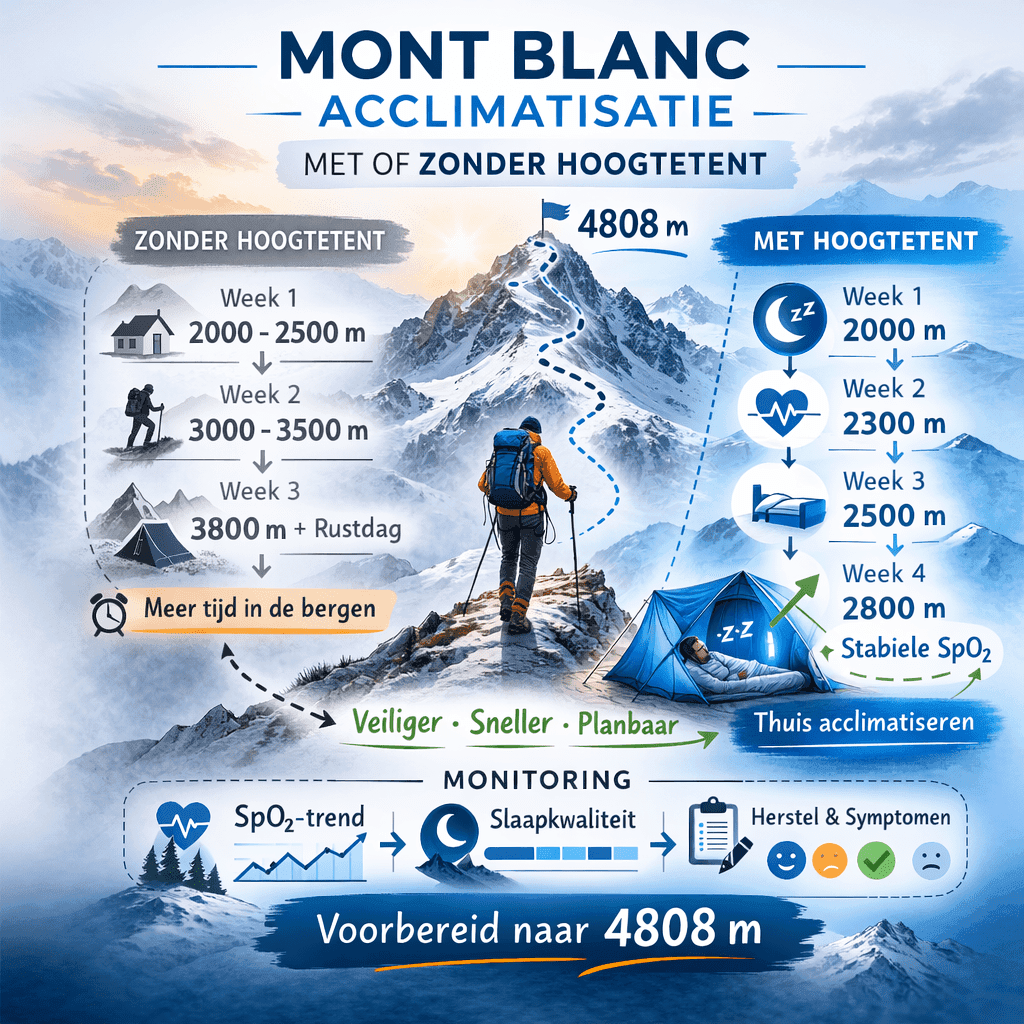
Schedule 1 - climbing Mont Blanc acclimatisation without altitude tent
This classic schedule requires extra mountain days in advance.
Week 1
- 2 to 3 nights sleeping around 2000 to 2500 metres
- 1 day trip up to 3000 metres
Week 2
- 2 nights sleep around 3000 metres
- Day trip up to 3500 metres
- 1 rest day lower sleep
Week 3
- 1 overnight stay around 3800 metres
- Rest day at 2,500 metres
- Start summit attempt
Benefit: natural exposure.
Disadvantage: precious time in the mountains and weather-dependent.
Schedule 2 - climbing Mont Blanc acclimatisation with high altitude tent
With an altitude tent, you start 4 to 6 weeks in advance. You sleep in normobaric hypoxia at home. Air pressure remains the same, oxygen percentage is reduced.
You can find more explanations of use in the altitude tent complete guide.
Week 1
- Simulation 2000 metres
- 6 to 8 hours of sleep per night
Week 2
- Simulation 2300 metres
- SpO2 morning value monitoring
Week 3
- Simulation 2500 metres
- At least 8 hours of sleep
Week 4
- Simulation 2800 metres
- Increase only when SpO2 trend is stable
The aim is not to simulate extreme altitude, but stable adaptation at 2500 to 2800 metres. That is the optimal zone for pre-acclimatisation towards 4800 metres.
In-depth reading in acclimatising at home for mountain expeditions.
This is how you monitor this lens
Acclimatisation is measurable. Avoid making decisions on feelings alone.
1. SpO2 trend
Measure at the same time every morning. Look at trends over 5 to 7 days. A stable or slightly increasing trend at the same simulation altitude means adaptation.
2. Sleep quality
Pay attention to sleep-in time, night waking and subjective rest score.
3. Recovery feelings and symptoms
Headaches, nausea or extreme fatigue are signals not to increase further.
Decision rule: Increase simulation height only when SpO2 is stable and sleep quality remains good for at least 3 nights.
What is the difference in practice?
Without an altitude tent, you often arrive tired at the start of the summit attempt. With pre-acclimatisation, you arrive already partly adapted.
An altitude tent will significantly reduce the risk of altitude sickness. It is no substitute for acclimatisation in the mountains, but makes the process controlled, measurable and planable.
Which option suits you?
- Limited holidays → high altitude tent
- Lots of time in Alps beforehand → classic schedule
Conclusion
Climbing Mont Blanc acclimatisation is not a detail, but a strategic choice. Those who structure it in advance increase safety and peak performance.
🏔 Prepare optimally for Mont Blanc
Want controlled acclimatisation towards 4,000 metres and above?
Check out the Mont Blanc pre-acclimatisation package
Read altitude tent experiences of other Mont Blanc climbers
🏔 Delve further into Mont Blanc climbing:
Climbing Mont Blanc: Which route?
Climbing Mont Blanc without experience?
Climbing Mont Blanc: All tips and information