Climbing Mont Blanc: Which route?
Published 23 January 2016 · 3 min read
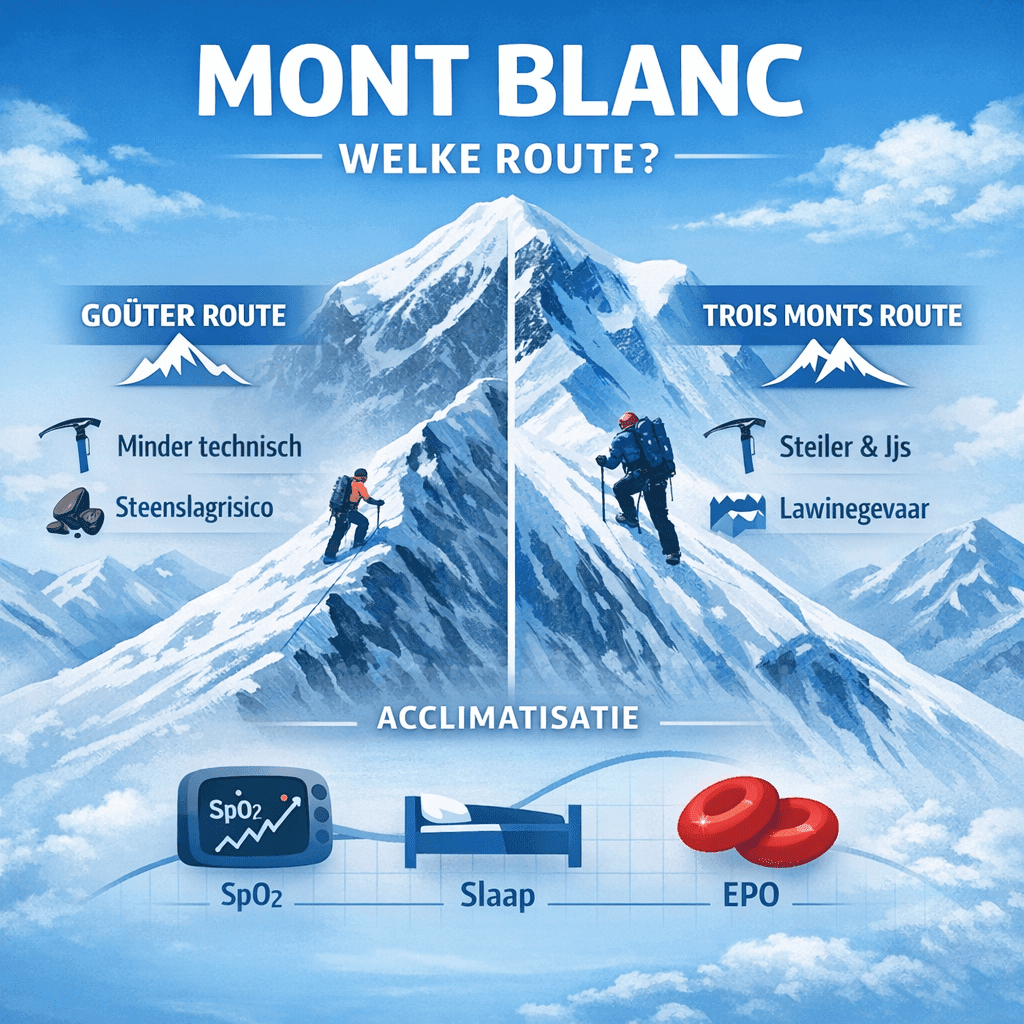
Climbing Mont Blanc which route you choose determines not only your chance of success but also your margin of safety. Most climbers hesitate between the Goûter route and the Trois Monts route. Both take you to 4,810 metres, but differ greatly in objective risks, technical difficulty and physical strain. This article gives you a clear overview, including acclimatisation strategies and concrete decision rules.
Climbing Mont Blanc which route makes sense to you?
Who the Mont Blanc wants to climb, often underestimate how different the routes are. Many websites call them both “normal route”. This is technically true, but physiologically and risk-wise they are not equivalent.
The key question is not: which route is shorter?
The real question is: which route suits your experience, pace and acclimatisation?
Route 1: Goûter route via Nid d'Aigle
The Goûter route is the most frequently chosen option. You start via the Tête Rousse hut, cross the infamous Grand Couloir and climb via the Goûter hut towards Dôme du Goûter and finally the summit.
- Technical difficulty: PD
- Longer but less steep snow sections
- Larger crowds in high season
- Objective risk: stone chips in Grand Couloir
Advantage: technically less complex than Trois Monts.
Disadvantage: longer exposure to altitude above 4,000 metres.
Route 2: Trois Monts route
The Trois Monts route starts from the Cosmiques hut and crosses Mont Blanc du Tacul and Mont Maudit before reaching the Bosses Gorge.
- Technical difficulty: PD+
- Steeper ice and snow passes
- Less crowded
- Increased exposure to seracs and avalanche danger
This route is more physically explosive. The slopes are steeper and mistakes are punished faster.
What many climbers misjudge
Many people focus on technical difficulty. But above 4,000 metres, physiology plays a bigger role than technique.
At 4,800 metres, your oxygen pressure drops by about 40 per cent. Even well-trained athletes notice that their pace halves. Those who are insufficiently acclimatised are at risk of altitude sickness.
Therefore, acclimatisation is often more important than route choice.
Acclimatisation for Mont Blanc
For a climb above 4,000 metres, we recommend at least 2-3 weeks of preparation. This can be via an intermediate ascent in the Alps, or via acclimatising at home for mountain expeditions.
An altitude tent works via normobaric hypoxia. Air pressure remains the same, but oxygen levels are reduced. Sleep is the primary stimulus. By building up gradually, you stimulate EPO production and red blood cell production.
Also read our complete guide on how to use a high altitude tent.
This is how you monitor this lens
For a safe climb, you need to measure your preparation, not gamble.
- SpO2 trend: Measure daily at rest when getting up. Look at the trend over 7 days, not a single measurement.
- Sleep quality: number of interruptions, restless breathing, night waking.
- Recovery feeling: morning pulse, headache, fatigue or decreased appetite.
Concrete decision rule: If your morning SpO2 drops below 88 per cent for several days and you feel obvious fatigue, do not increase the simulation altitude further.
Which route to choose? A rational decision tree
Choose the Goûter route as:
- This is your first 4,000 metres
- You are technically less experienced
- You prefer a gradual snow climb
Choose the Trois Monts route as:
- You are comfortable with steep snow and ice
- You have good crampon technique
- Your fitness level is very strong
Please note that in poor conditions, choice often lapses. Guides then determine the safest option.
Differentiations often overlooked
1. The mental strain of crowding on the Goûter route is real.
2. Energy peaks at Trois Monts require better glycogen strategy.
Both factors influence your top chance.
Conclusion
Climbing Mont Blanc which route you choose is not an aesthetic choice, but a combination of experience, fitness and acclimatisation. Those who objectively monitor their preparation and know their limits significantly increase the chances of a safe summit day.
Ready to train responsibly to 4,000 metres?
With our 4,000-metre Mont Blanc package, you build controlled and measurable acclimatisation.
Check out the Mont Blanc 4,000m package
Read high altitude tent experiences of other Mont Blanc climbers