Are there any health risks associated with sleeping in a high altitude tent?
Published 31 July 2012 · 9 min read
Short answer
- For healthy users, sleeping in an altitude tent is completely risk-free when set up gradually.
- The most common problems are restless sleep & fatigue when hypoxic stimulus is too strong.
- People with heart or lung disease, existing hypoxaemia, sleep apnoea or high-risk pregnancy need extra medical tuning.
Conclusion: sleeping in an altitude tent is rarely black and white safe or unsafe.
Nuance: the right dose of hypoxia varies by person, health situation and sleep tolerance.
Practical hook: Steer by trend, not by bravado or one single SpO2 measurement.
When sleeping in an altitude tent is usually justified
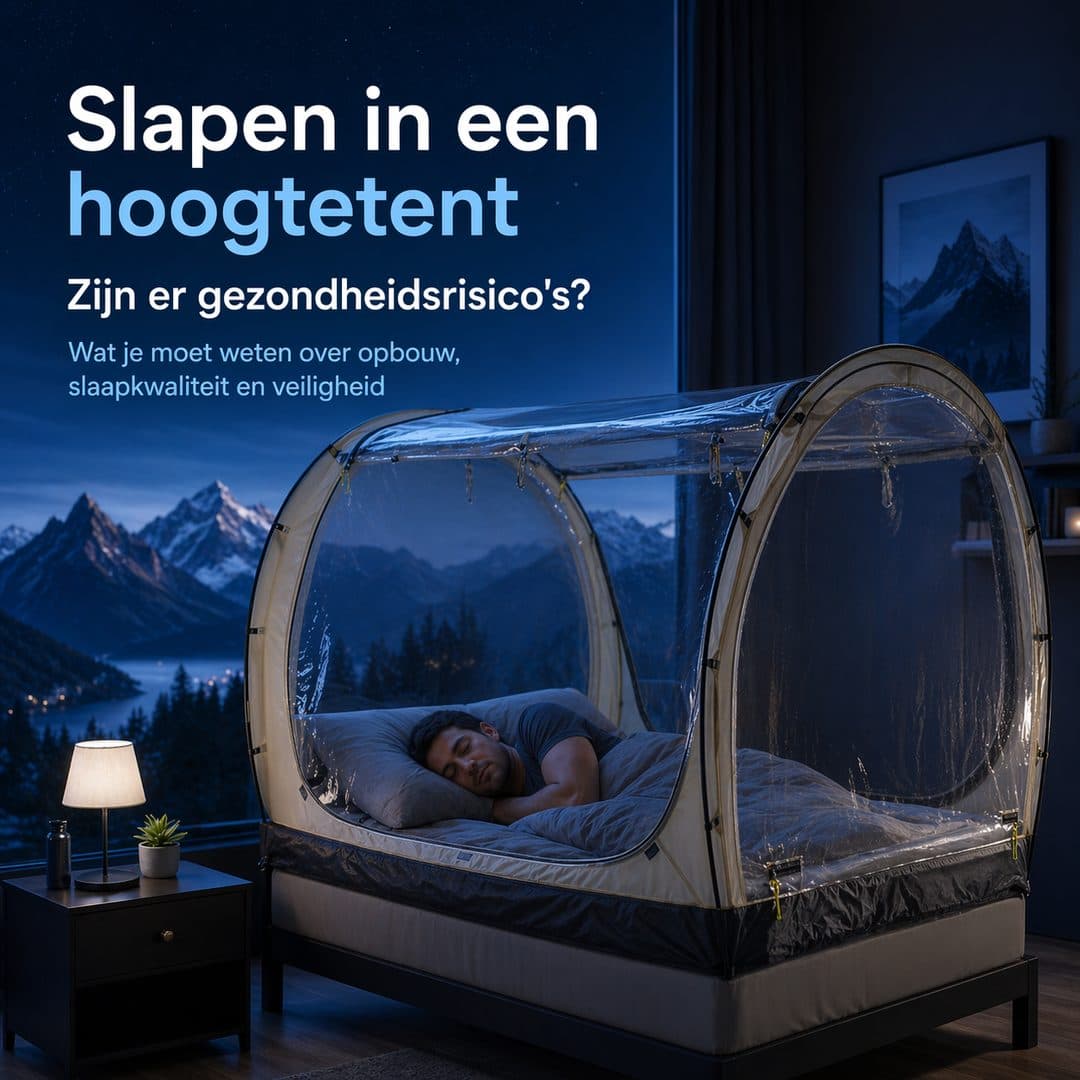
An altitude tent works via normobaric hypoxia. That means air pressure stays the same while oxygen levels drop. So it is not exactly the same as sleeping on a mountain, but it mimics an important part of the altitude stimulus. This allows the body to adapt to less available oxygen in a controlled way.
For healthy people without relevant heart, lung or sleep disorders, that stimulus is almost always quite tolerable if you start low and don't increase too quickly. Those who first want to understand where the limits lie would do well to also consider the advantages and disadvantages of a high altitude tent well side by side. This helps to keep realistic expectations.
⚠️ Reality check
An altitude tent is not risky because it is a tent. Problems arise mainly when the hypoxic stimulus does not match one's health, sleep quality or build-up pace. So the real question is usually not whether it can be done, but whether the dose is right at the moment.
Even in a good setting, you may feel more breathlessness in the first few nights. Some users sleep lighter, wake up more often or notice that their heart rate feels slightly higher. This is not necessarily immediately wrong. It only becomes unfavourable when symptoms accumulate and recovery deteriorates.
Which complaints are normal and which are a signal
Not every complaint means that sleeping in an altitude tent is unsafe. There is a difference between normal habituation and a stimulus that is too strong. It is precisely this distinction that needs to be quickly visible. Therefore, below is a compact status overview with both desktop and mobile versions.
| Situation | What you notice | What it means | What you do |
|---|---|---|---|
| Normal habituation | Lighter sleep, a bit more breathlessness, mild morning headaches in the first nights. | Often a temporary adaptation phase to a new hypoxic stimulus. | Do not increase further. Wait for 2 to 3 nights of stability first. |
| Adjust | Repeated waking, markedly worse recovery, declining SpO2 trend along with symptoms. | The set altitude or exposure duration is probably too high for now. | Step down, hold the same level longer and reassess the trend. |
| Stop and consult | Chest tightness at rest, chest pain, confusion, severe nausea or disruption of an existing condition. | This does not fit normal habituation and requires immediate reassessment. | Stop hypoxic exposure and seek medical coordination. |
Normal habituation
What you notice: lighter sleep, slightly more breathlessness, mild morning headaches in the first nights.
Significance: often temporary adjustment.
Action: Do not increase yet. Wait and see stability first.
Adjust
What you notice: more frequent waking, worse recovery, declining trend along with complaints.
Significance: incentive is too strong now.
Action: Step down and hold longer.
Stop and consult
What you notice: tightness at rest, chest pain, confusion or severe symptoms.
Significance: this does not fit with normal habituation.
Action: stop and seek medical coordination.
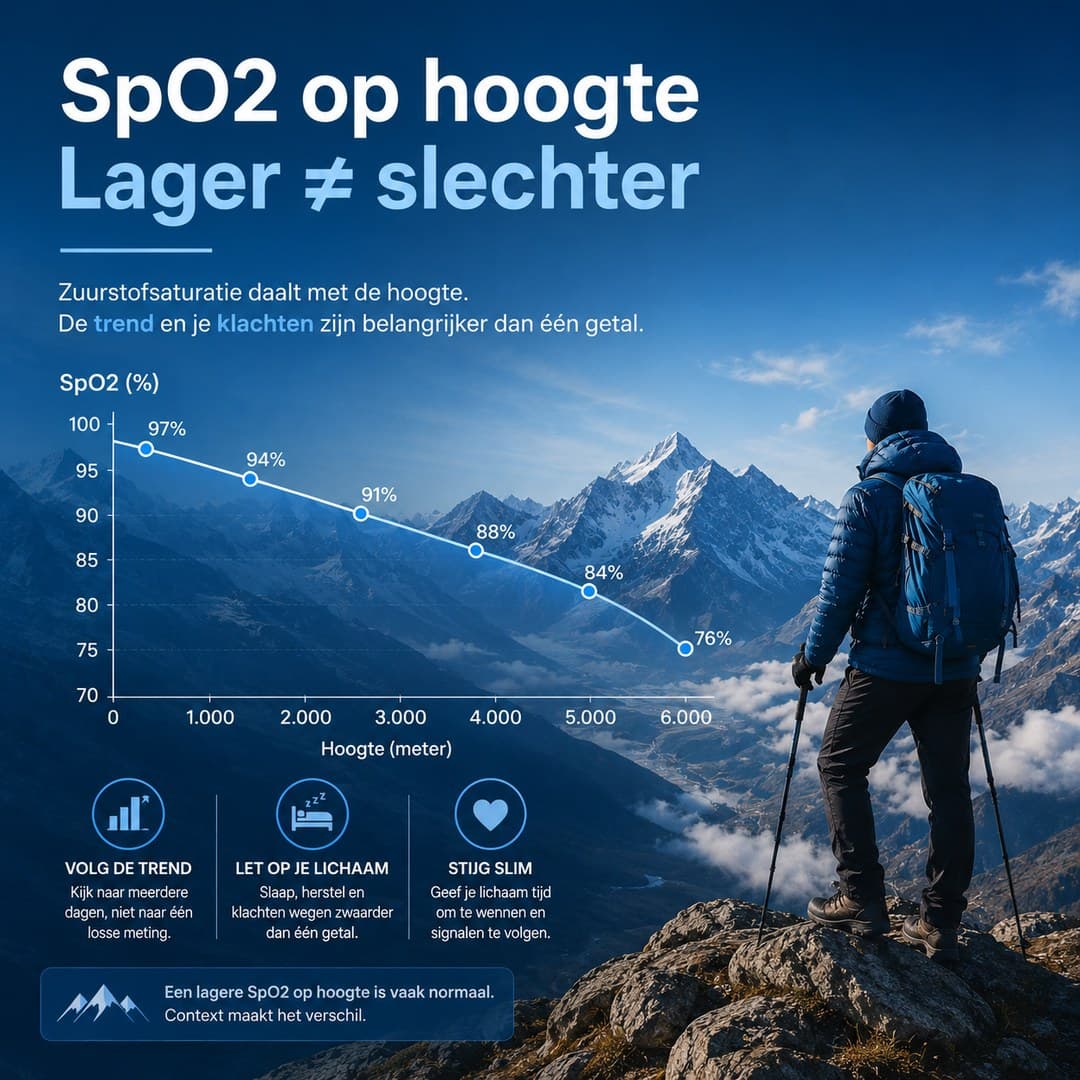
The mistake often made is that a user only looks at a number. For example, low saturation in the morning. That number only says something when it coincides with sleep quality, recovery and symptoms. Therefore, it makes more sense to understand What normal saturation in a high altitude tent roughly means than to respond to one isolated measurement.
For those for whom sleeping in an altitude tent requires extra attention
Extra caution is needed for some groups. Not because an altitude tent is necessarily prohibited, but because less available oxygen can lead to complaints or dysregulation more quickly. This is especially true when something is already in play in breathing, lung function, heart function or oxygen uptake.
Additional medical tuning is prudent at:
- coronary artery disease or heart failure
- chronic lung disease or existing low oxygen levels
- obstructive sleep apnoea, especially if severe
- severe obesity combined with respiratory problems
- a pregnancy requiring extra caution
- a recent deterioration in health or new unexplained symptoms
This is also exactly why an absolute statement like “there are no health risks” is too simplistic. In practice, safety depends on context. Someone who is healthy, builds up calmly and monitors well is substantially different from someone with sleep apnoea, chronic lung problems or a dysregulated cardiovascular profile.
🧭 In practice
A height tent is most useful when you can dose the stimulus. Once your health, medication or sleep is already fragile, the question shifts from “how high can I go?” to “what load remains responsible and meaningful for me?”
What really causes complaints in a high altitude tent
Most complaints do not come from a “bad tent”, but from a mismatch between stimulus and load capacity. This can have several causes:
- the set altitude rises faster than your breathing and sleep can adjust
- you are already using the tent while recovery, training or stress levels are already under strain
- you have a hidden sensitivity to sleep disturbance or periodic breathing fluctuations
- you interpret a first good night as proof that you can immediately go higher
Those who notice that sleeping becomes restless would do well not to suspect “altitude” alone. Training load, colds, alcohol, dehydration and excessively warm bedroom air can also make a difference. As a result, a setting that went fine last week can suddenly become too much.
Thinking too simple
If a high altitude tent is safe, I just have to get used to it.
When my saturation is low, I'm fine.
If I sleep well for one night, I can immediately go higher.
Better starting point
Safety depends on dose, buildup and individual tolerance.
A trend with context says more than a single loose value.
Stability over several nights is more important than one good outlier.
In particular, if you want to understand why the night in particular is so sensitive, it helps to also look at common myths about sleeping in an altitude tent. This prevents you from confusing normal adaptation symptoms with real alarm signals.
Here's how to build sleeping in a high altitude tent more safely
A good build-up is rarely spectacular. It is precisely the boring build-up that usually works best. The gist is simple: start lower than your ego wants, hold longer than your impatience likes and only increase when sleep and recovery remain stable.
Conservative start
Start with a relatively mild setting. The first nights are meant to get to know sleep and breathing stimulus.
Stabilise first
Don't increase immediately. First, see if you sleep reasonably several nights in a row and recover normally.
Small steps
Only go up in small steps. If your sleep quality drops markedly, then you have gone too early or too high.
Workable final level
The best setting is not the highest, but the highest that still allows sleep, recovery and adherence.
Practically, this means that it is better to choose a workable, sustainable incentive than an impressive altitude on paper. Especially in pre-acclimatisation, consistency is more rewarding than forcing. Those who want to work on this in concrete terms can later delve into the article on setting the correct height in a height tent.
This is how you monitor this lens
Objective monitoring prevents two classic mistakes: going up too early and making adjustments too late. Therefore, use not just one signal, but a combination of four practical anchors.
SpO2 trend
Look at the pattern over several mornings. A single low reading with no complaints need mean little.
Sleep quality
Note falling asleep, waking up at night and how rested you get up. This is often the most sensitive measure.
Recovery
Pay attention to daytime fatigue, training quality and overall load capacity. A good protocol supports recovery, not the other way around.
Symptoms
Headache, nausea, shortness of breath or chest pressure immediately change the interpretation. Symptoms give context to each number.
A useful decision rule is this: if your SpO2 trend decreases AND your sleep or recovery worsens markedly at the same time, do not increase further. If that picture persists for several nights, then step back. In doing so, you make acclimatisation something controlled, measurable and plannable, without pretending that an altitude tent is a guarantee.
Practical tips for calmer and safer use
- Increase only when you are stable for several nights.
- Use not only a saturation monitor, but also a simple sleep and symptom log.
- Avoid big jumps right after heavy training days or bad nights.
- Factor colds, allergies or nasal congestion into your assessment.
- Do not see a step back as failure, but as good dosage.
- For pre-existing conditions: agree your protocol in advance with a doctor who understands altitude physiology.
FAQ
Is sleeping in an altitude tent safe for healthy people?
Often yes, as long as the build-up is gradual and sleep, recovery and symptoms remain good. Increasing too quickly is the most common mistake.
Which complaint is most common?
Restless sleep is at the top of the list. In addition, mild headaches and fatigue are common in the early stages.
Can an altitude tent replace real acclimatisation?
No. An altitude tent can support the process and make it more plannable, but does not completely replace the mountain.
When should I stop?
In case of tightness at rest, chest pain, confusion, severe nausea or obvious disruption of an existing condition.
Is lower saturation always good news?
No. A lower value only says something in conjunction with your trend, sleep quality, recovery and symptoms.
Want to start safely with a high altitude tent?
Then don't start gambling by feel. Work with a gentle build-up schedule first, so that sleep quality, recovery and altitude stimulus remain balanced.
Conclusion
Sleeping in an altitude tent is not something to put away as completely risk-free, but neither is it something that is necessarily dangerous. For healthy users, it is usually a viable incentive, as long as you build up calmly and monitor objectively. The right measure is not how high you can set the tent, but whether you still sleep, recover and function well at that setting.
This makes the altitude tent exactly what it should be: not a panacea and not a substitute for real acclimatisation, but a controlled, measurable and plannable support for those who want to prepare smartly.