Mont Blanc altitude: all about Europe’s highest mountain
Published 31 March 2026 · 10 min read
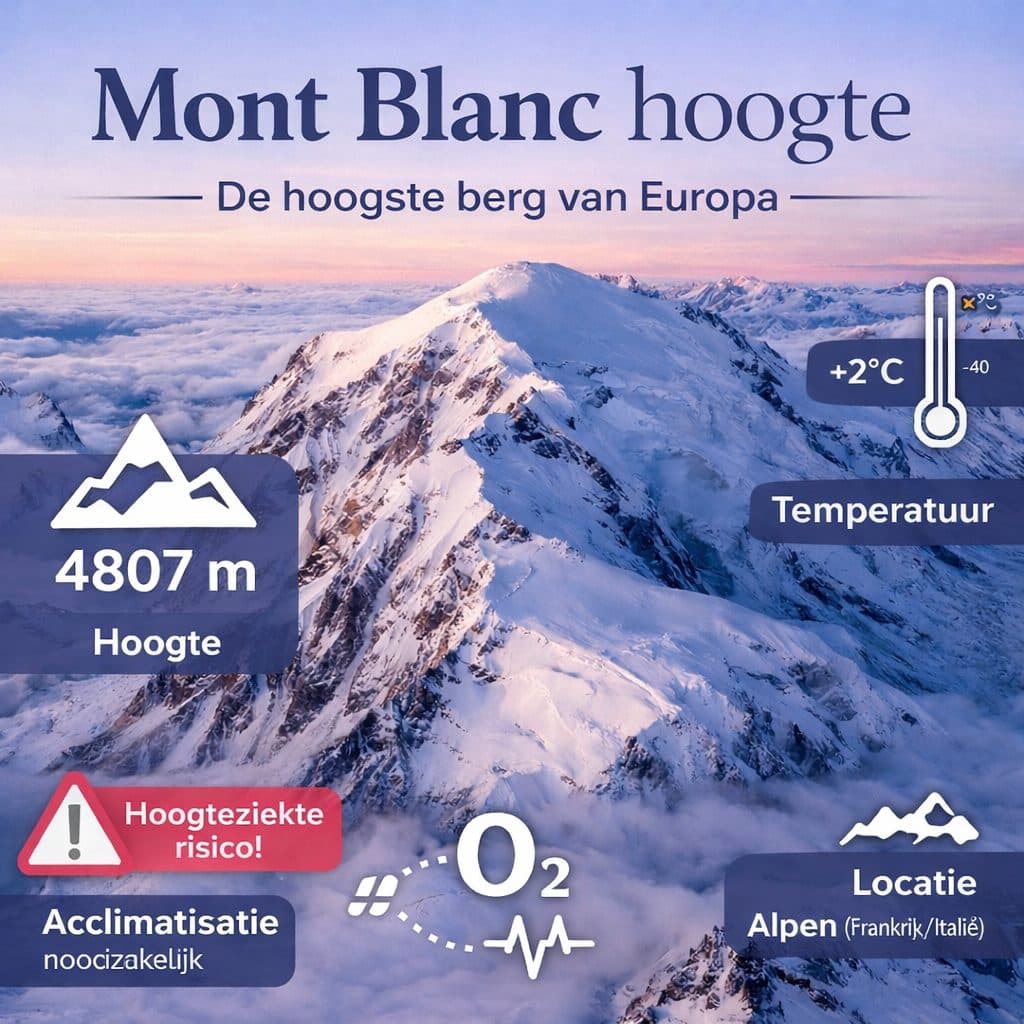
The Mont Blanc altitude is the starting point of a larger question for many mountaineers, hikers and travellers: exactly how high is this mountain, and is Mont Blanc really the highest mountain in Europe? The short answer is clear. Mont Blanc is 4,807 metres high, making it the highest mountain in the Alps and Western Europe. Those looking strictly geographically at Europe often also end up with Mount Elbrus in the Caucasus. This is precisely why Mont Blanc is not only an iconic peak, but also a mountain where facts, prestige and preparation are often mixed up.
For those planning a trip to Chamonix, considering a climb or simply wanting to better understand what altitude does to your body, that nuance is important. Because you don't make the real difference with a nice round number, but with proper acclimatisation, realistic expectations and a plan that fits your experience.
The essentials in 30 seconds
Mont Blanc is 4,807 metres high and the highest mountain in the Alps and Western Europe.
The title ‘highest mountain in Europe’ depends on how you define the border of Europe.
For your body, what matters most is this: above 4,000 metres, load, recovery demand and risk of altitude complaints increase markedly.
Mont Blanc height at a glance
If you are mainly looking for a quick and clear answer, this overview will help:
- Name: Mont Blanc
- Height: 4,807 metres
- Location: border area of France and Italy, in the Mont Blanc massif
- Region: Alps
- Practical status: highest mountain in the Alps
- Common description: Western Europe's highest mountain
The latter is not just semantics. Many people search on ‘highest mountain in Europe’ and come up with Mont Blanc, because it is historically, culturally and touristically Europe's best-known major mountain. But in a geographical sense, Mount Elbrus is often seen as Europe's highest point. For most travellers and climbers, it is therefore more accurate to speak of the highest mountain in the Alps or Western Europe.
💡 Did you know?
The official altitude of Mont Blanc is periodically re-measured. This is because the rock base is fixed, but the snow and ice cover on top can vary slightly from season to season and year to year. That's why you sometimes see slight variations in publications.
Why the question ‘Europe's highest mountain?’ is not so simple
On paper, it looks like an easy quiz question. In practice, the answer depends on the geographical boundary you use between Europe and Asia. Those who count the Caucasus entirely as part of Europe name Mount Elbrus as Europe's highest mountain. Those who look primarily at the traditional Alpine context name Mont Blanc as the highest mountain in Europe or, more precisely, Western Europe.
In practice, Mont Blanc is Europe's most famous classic 4,000-er. The mountain has an almost mythical status. Not only because of its altitude, but also because of its history, the alpinist tradition around Chamonix and the combination of accessibility and risk. It is precisely this combination that makes the mountain attractive and treacherous at the same time.
⚠️ Reality check
Mont Blanc seems attainable for many people because it is relatively close and commercially widely offered. That says little about the real strain at altitude. Above 4,000 metres, sleep, recovery, appetite and exertion often react noticeably differently than below.
What does 4,807 metres physiologically mean for your body?
The Mont Blanc altitude is not an extreme Himalayan level, but it is high enough to give a clear physiological effect. Many people already feel changes in breathing, sleep and exertion above about 2,500 metres. Around 4,000 metres, that difference becomes much more concrete for many climbers.
The reason is simple. As you ascend, the available oxygen pressure drops. In percentage terms, the air contains about the same amount of oxygen, but per breath, you get less usable oxygen. As a result, your body has to work harder to adequately supply muscles, brain and other tissues.
On Mont Blanc, that often means:
- faster breathing at rest and during exercise
- higher heart rate at the same pace
- more fatigue with relatively simple load
- poorer sleep quality
- slower recovery between efforts
- greater susceptibility to dehydration and energy loss
Those who underestimate this often find themselves in trouble even before the summit day has really started. Not because Mont Blanc is always extremely difficult technically, but because a small mistake in pace, sleep, nutrition or hydration is magnified more quickly at this altitude.
Altitude, oxygen and risk: what changes towards Mont Blanc?
| Height zone | What you often notice | Practical risk |
|---|---|---|
| Up to 2,000 m | Usually little height effect in healthy people | Restricted |
| 2.000 - 3.000 m | Faster breathing, first sleep effects, lower training quality | Light to moderate |
| 3.000 - 4.000 m | More fatigue, slower recovery, more prone to headaches | Moderate |
| 4.000 - 4.807 m | Obvious drop in performance, greater physiological stress | Seriously, especially without preparation |
For Mont Blanc, the latter zone is particularly relevant. You don't have to do an expedition at 6,000 metres to take altitude seriously. The transition from normal functioning to marked loss of performance often happens earlier than people expect.
Therefore, it is smart to also understand in advance how oxygen saturation at altitude behaves and why acclimatisation is not just something for expeditions outside Europe.
Why Mont Blanc can feel much heavier than its altitude suggests
Many sporty people look at 4,807 metres and think: that's high, but not extremely high. Yet for many climbers, Mont Blanc feels tougher than expected. This has to do with several factors coming together.
First, there is the duration of the effort. A Mont Blanc climb is rarely a short, fresh peak attempt. Often, you already pile up fatigue in the days before. Second, you usually don't sleep as well at altitude. Third, on top of that comes cold, equipment, stress and often an early or nocturnal departure time. So you are not starting from an ideal physiological state.
Moreover, altitude often amplifies small errors. Too high a walking pace downstairs becomes a problem at the top. Too little drinking you notice faster. Poor pacing costs more. A moderate night's sleep weighs more heavily. As a result, the summit day feels not only like a physical test, but also a test of preparation and discipline.
🧭 In practice
On Mont Blanc, many treks go wrong not because of one big problem, but because of a sum of small things: climbing too fast, not sleeping enough, not eating enough, not drinking enough and a body not yet sufficiently accustomed to altitude.
How do you smartly prepare for the Mont Blanc altitude?
Good preparation for Mont Blanc starts not on the mountain, but in the weeks before. The key question is simple: how do you narrow the gap between your normal sea level and a strenuous effort above 4,000 metres?
For this, roughly three building blocks are important:
- General condition: a solid aerobic base, sufficient climbing endurance and load capacity.
- Specific mountain preparation: hiking with altitude difference, endurance effort, controlling pace, testing equipment.
- Acclimatisation: prior exposure to altitude, either on location or via home preparation in an altitude tent.
Those who see Mont Blanc primarily as a sporting bucket list often focus too much on fitness alone. But being fit is not the same as being acclimatised. A strong runner or cyclist can still feel surprisingly weak at altitude if the body has not had enough time to adapt.
It is therefore wise to also look into acclimatising at home for mountain expeditions and in a specific approach for Climbing Mont Blanc and acclimatisation. In doing so, you will make your preparation not only more athletic, but also physiologically smart.
Acclimatisation for Mont Blanc: how much difference does it really make?
For a mountain like Mont Blanc, acclimatisation often makes a bigger difference than people think. Not because it removes all risk, but because it better prepares your body for the combination of less oxygen, poorer sleep and repeated exertion at altitude.
Good acclimatisation can help with:
- better sleeping comfort in the days before the summit
- less chance of headaches and nausea
- more stable energy level during the ascent
- calmer breathing and better pacing
- more confidence in how your body reacts
Importantly, though, acclimatisation is not magic. It does not make you invulnerable. It mainly lowers the chances of you hitting your physiological limit too hard on the wrong day, with the wrong recovery profile.
In home preparation, Altitude Dream works with normobaric hypoxia. In this, you don't lower the air pressure, but the oxygen percentage in the inhaled air. This makes the process planable, controlled and easier to dose. For many mountain athletes, this is practical, especially when time on location is limited.
📊 Research shows
Altitude preparation rarely revolves around one perfect session. The effect comes from repeated, well-dosed exposure. Therefore, a gradually built and measurable schedule usually works better than a few isolated, heavy stimuli without monitoring.
Common misconceptions about Mont Blanc altitude
Misconception 1: 4,807 metres is not high enough to really suffer.
That's not right. For many people, this is more than high enough to feel distinct altitude effects, especially with rapid ascent and limited sleep at altitude.
Misconception 2: If you are fit, you don't need acclimatisation.
Conditioning helps, but does not replace acclimatisation. A strong cardiovascular system does not automatically protect you from altitude sickness.
Misconception 3: Mont Blanc is mainly technically difficult, not physiologically demanding.
That too is too simplistic. On many routes, it is precisely the combination of altitude, timing, duration and fatigue that is the decisive factor.
Misconception 4: One good saturation measurement says it all.
Not at altitude. Oxygen saturation should always be assessed as a trend, along with sleep, recovery and symptoms. A single isolated value says little without context.
Those who want to delve into these kinds of nuances often also benefit greatly from the broader guide on preventing altitude sickness and to the basic page on Climb Mont Blanc.
This is how you monitor this lens
Good preparation for Mont Blanc becomes stronger if you not only train, but also objectively monitor how your body reacts. This does not have to be complicated, as long as you consistently watch trends.
- SpO2 trend: look at the line over several days, not one single morning value
- Sleep quality: pay attention to falling asleep, restlessness, waking up and feeling rested
- Recovery: observe fatigue, training response and general freshness
- Symptoms: always take headaches, nausea, weird fatigue and pressure on the head seriously
A simple decision rule helps. See that your SpO2 trend is structurally under pressure, while sleep and recovery are deteriorating at the same time? Then that is usually not a time to increase the load further. Stabilise first, then increase.
That is exactly why preparation at altitude works better if you build up calmly, rationally and incrementally. Don't force it, do observe it.
For whom is pre-acclimatisation for Mont Blanc of particular interest?
Not everyone has the same need for preparation. Yet there are distinct profiles for whom pre-acclimatisation in an altitude tent often makes extra sense:
- people with little time on site
- climbers prone to altitude complaints
- athletes who want to be able to perform quickly on arrival
- people who previously slept poorly at altitude
- busy travellers who want to plan preparation at home
For these groups, it is especially attractive that you can build up in a controlled way at home, instead of letting everything depend on a few days in the Alps. This gives peace of mind and makes the process more predictable.
The real conclusion about the Mont Blanc altitude
So the question ‘Mont Blanc altitude: all about Europe's highest mountain?’ deserves a nuanced answer. Yes, Mont Blanc, at 4,807 metres, is the highest mountain in the Alps and in Western Europe. No, the claim ‘highest mountain in Europe’ is not entirely unambiguous, as Mount Elbrus ranks higher as Europe's highest point in many geographical definitions.
For your preparation, that debate is ultimately less important than anything else: 4,807 metres is high enough to take seriously. Not just on paper, but especially in what it does to breathing, recovery, sleep and performance. Those who approach Mont Blanc as a mountain that demands respect are simply more likely to have a strong and safer experience.
If you want to plan the transition to 4,000 metres and higher more intelligently, acclimatising in advance is often the most rational step. Not as a guarantee, but as a controlled way to make the process measurable, calmer and more planable.
Preparing for Mont Blanc?
Want controlled acclimatisation at home for a climb around 4,000 metres? Then check out the Mont Blanc-appropriate package and read how others experienced their preparation.
View the 4000m acclimatisation package
Read customer experiences with similar goals
❓ Mini-FAQ
Exactly how high is Mont Blanc?
Mont Blanc is 4,807 metres high. Small variations in measurements can occur due to snow and ice on the summit.
Is Mont Blanc the highest mountain in Europe?
It depends on the geographical definition. Mont Blanc is the highest mountain in the Alps and Western Europe. Elbrus is often cited as the highest mountain in Europe.
Can you get altitude sick on Mont Blanc?
Yes. Even below 5,000 metres, you can get obvious altitude complaints, especially with rapid ascent and limited acclimatisation.
Is fitness enough for Mont Blanc?
No. Good fitness helps, but does not replace acclimatisation, pacing and recovery.
Does acclimatising at home in an altitude tent make sense for Mont Blanc?
For many people, yes. Especially if you have limited time on location or were prone to altitude sickness before.