Inca Trail altitude: acclimatising before Machu Picchu
Published 15 April 2026 · 14 min read
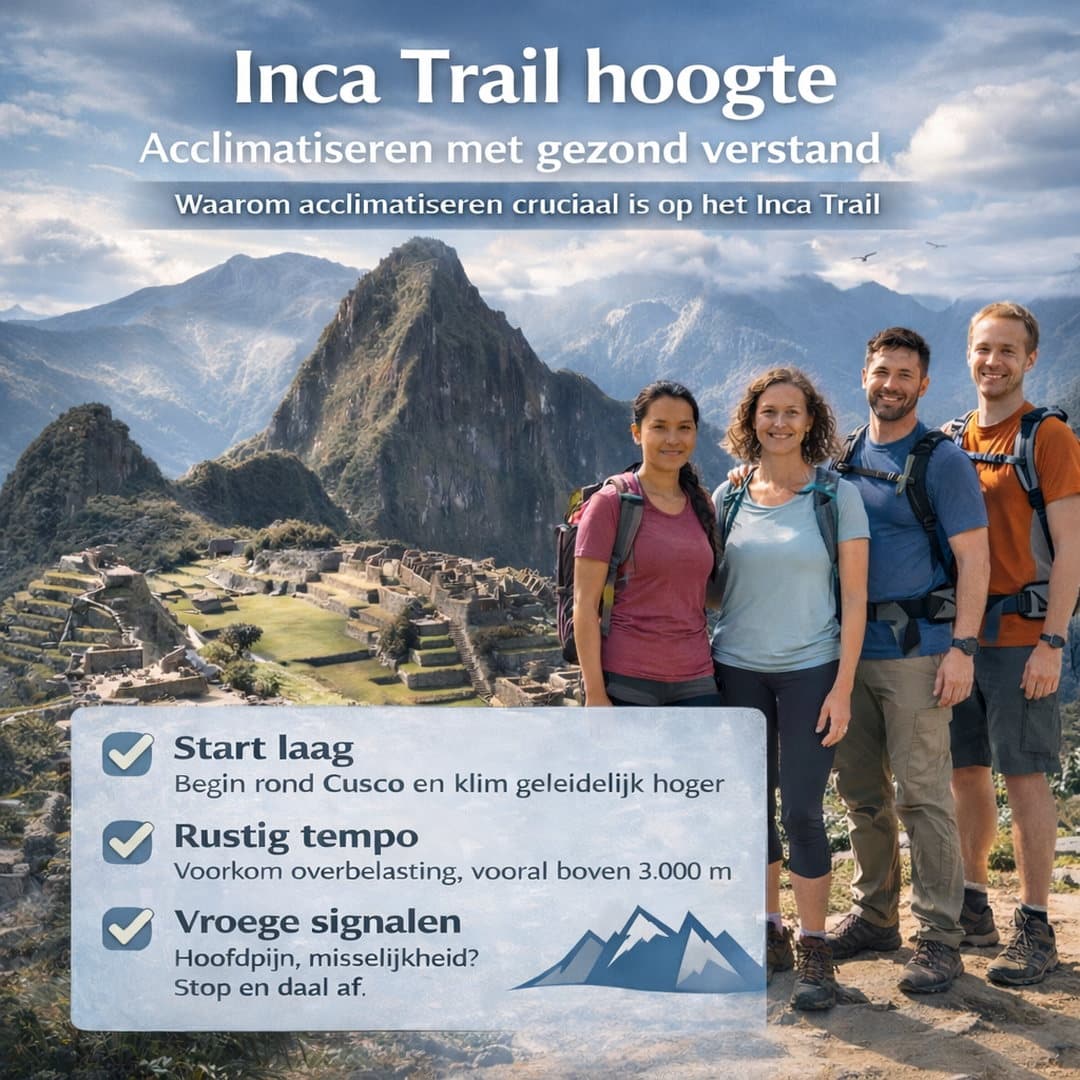
The Inca Trail altitude is often misjudged. Not because Machu Picchu itself is extremely high, but because many travellers go from sea level to Cusco in a short time, sleep there at about 3,400 metres and then climb to 4,215 metres on Warmiwañusqa, better known as Dead Woman's Pass, during the trail. Those who read this guide will understand where the strain really increases, how best to plan the days before departure and when extra acclimatisation or pre-acclimatisation becomes useful.
Short answer: the Inca Trail is tough for most people not mainly because of the distance, but because of the combination of arriving at altitude, sleeping above 3,000 metres and passing over 4,215 metres.
- The classic trail starts around 2,700 metres and peaks at 4,215 metres.
- Cusco is already around 3,400 metres, and for many travellers it immediately feels like real altitude.
- Sacred Valley is often smarter as a first sleeping base because you usually sleep a little lower there.
- The first 3-5 days in Peru often determine how much margin you have later on the trail.
- With little travel time, pre-acclimatisation at home can support your preparation in a controlled way.
Conclusion: the real crux of the Inca Trail is not in Machu Picchu itself, but in the build-up to the high pass and the sleeping altitudes before it.
Nuance: many fit travellers can handle this route just fine, provided they do not ascend too fast and plan their first days in Peru wisely.
Practical hook: Those who first acclimatise more calmly in Sacred Valley and then go higher often start noticeably stronger.
Why Inca Trail altitude works differently from Machu Picchu alone
Many people search on Machu Picchu and automatically focus on the final destination. This is logical, but physiologically not the most important point. Machu Picchu is around 2,430 metres. That's lower than Cusco. The heaviest load on the classic Inca Trail occurs earlier, when you already sleep high up and continue on day 2 to Warmiwañusqa at 4,215 metres.
In other words, the route to Machu Picchu is often tougher than Machu Picchu itself. This is precisely why preparation is so important. Your margin is usually determined not by how strong you are at sea level, but by how well your body tolerates the first jump to altitude.
Route heights at a glance
Route heights that are really relevant
| Point on route | Height | Practical significance |
|---|---|---|
| Arrival Cusco |
approx. 3,400 m | This is where the first real adjustment phase begins for many travellers. Headaches, languidness and worse sleep are common here. |
| Preparation Sacred Valley |
often approx. 2,800 to 3,000 m | Sleeping slightly lower often gives more comfort in the first few days and makes the transition to the trail calmer. |
| Trailstart Km 82 |
approx. 2,700 m | The route starts relatively mild, but still feels tough when you have barely adjusted. |
| First camp Wayllabamba or Ayapata |
approx. 3,000 to 3,300 m | This is often where you first notice how well you have digested your arrival in Peru. |
| Heaviest point Warmiwañusqa |
4.215 m | This is where the real turnaround comes in. Those who started too fast or slept badly usually feel it immediately here. |
| Second sleep Pacaymayo or Chaquicocha |
approx. 3,600 m | After the toughest climb, you should recover sufficiently here for the rest of the trek. |
| Second pass Runkurakay Pass |
approx. 4,000 m | Still high enough to magnify fatigue or symptoms if you are already at the limit. |
| Last camp Wiñay Wayna |
approx. 2,600 m | The lower sleeping height here often makes the body feel more spacious immediately. |
| Finish Machu Picchu |
approx. 2,430 m | The destination is lower than Cusco. So the route there is tougher than the final altitude suggests. |
The same information in map form
Arrival
Cusco - approx. 3,400 m
For many travellers, this is where the first real adjustment phase begins. Headaches and worse sleep are common here.
Preparation
Sacred Valley - often about 2,800 to 3,000 m
Sleeping slightly lower often gives more comfort in the first few days and a calmer start.
Trailstart
Km 82 - approx. 2,700 m
Relatively mild start, but not mild enough if you are not yet well-adjusted.
First camp
Wayllabamba or Ayapata - approx. 3,000 to 3,300 m
This is often where you really see whether your preparation was good enough.
Heaviest point
Warmiwañusqa - 4,215 m
This is where the real turnaround comes in. Starting too fast is usually punished here.
Second sleep
Pacaymayo of Chaquicocha - approx. 3,600 m
Recovery after Day 2 will be decisive for the rest of the tour here.
Second pass
Runkurakay Pass - approx. 4,000 m
Again, height remains a factor, especially if you are already tired or have symptoms.
Last camp
Wiñay Wayna - approx. 2,600 m
The lower sleeping height here often makes the body feel better immediately.
Finish
Machu Picchu - approx. 2,430 m
The destination is lower than Cusco. This makes the route tougher than many travellers think.
Why this practically matters so much
So those who look only at Machu Picchu as an endpoint often underestimate the real strain. As a result, many travellers leave too soon, sleep too high in the first days and arrive at the toughest climb with too little reserve.
Which height is still manageable for most people and where the real turnaround will come
For most healthy travellers, altitude starts to become really relevant from around 2,500 metres. From there, the first symptoms can already appear, especially if you ascend rapidly. Nevertheless, many people can still function reasonably comfortably up to that altitude, as long as they do not immediately start exerting heavy effort.
The real turnaround usually comes between roughly 3,200 and 3,500 metres. That is precisely the zone in which Cusco is located. From that level, sleep quality, recovery, appetite and exertion are often noticeably affected. If you then go on to 4,000 metres and higher, your margin narrows. This is not because the same route suddenly becomes technically extreme, but because the same pace simply costs more.
Practical rule of thumb: up to around 2,500 metres altitude is still doable for many people. Around Cusco altitude, the real physiological test begins for many travellers. Above 4,000 metres, you therefore have to rely much less on willpower and much more on dosage.
Why the first few days in Peru are decisive
The first 72 hours set the tone
The first 3-5 days after arriving at altitude are often the most important. During this period, your body has to switch to an environment with less available oxygen. As a result, your breathing changes, your sleep often becomes lighter and the same effort feels heavier. Those who fill those first days too aggressively often arrive at the start later on the trail with less reserve.
That is why it is smart not to think in sightseeing or training drift, but in margin. The question is not how much you can handle in those first days. The question is how much reserve you want to carry into day 2 of the Inca Trail. For many travellers, exactly that makes the difference between a controlled trek and an unnecessarily strenuous experience.
What you better do then
Just in the beginning, plan quiet days, sleep a little lower if possible and avoid unnecessary peak loads. If you want to understand what is behind this physiologically, also read what happens in the first 72 hours at altitude.
Cusco versus Sacred Valley in preparation
Practical and iconic, but immediately high
Cusco is logistically convenient and the classic base for many travellers. The downside is that you sleep right around 3,400 metres here.
For some people, this is fine. For many others, this is just high enough to immediately get worse sleep, languid or headaches.
Often smarter as first sleeping base
Many places in Sacred Valley are slightly lower. That difference seems small, but often feels surprisingly large in practice.
Those lower first nights in particular therefore often give more comfort, less friction and a calmer build-up towards the trail.
Therefore, for the Inca Trail, Sacred Valley is often the better first step if you are coming straight from low altitude. Not because Cusco is wrong, but because sleeping lower in the first nights simply gives more margin. Then you can still go to Cusco briefly, for example for your briefing or final shopping.
Those who had previous complaints at altitude or know they react sensitively often gain even more from this. In that case, it is smart to also use your own risk factors for altitude sickness include in your planning.
Concrete 3- to 5-day acclimatisation protocol
The protocol below is designed for travellers who want to walk the Inca Trail without unnecessary guesswork. It is not a luxury schedule, but a practical build-up that increases your chances of a stable start.
Protocol for the days before the Inca Trail
| Day | Sleeping height | Purpose of the day | Exercise dosage |
|---|---|---|---|
| Day 1 | Sacred Valley | Arrive, hydrate, find rhythm | Only gentle walking. No heavy hills and no intensive excursions. |
| Day 2 | Sacred Valley | First light activation | 60 to 90 minutes of gentle walking. Stop well before heavy breathing or acidification. |
| Day 3 | Sacred Valley of Cusco | Tolerance testing | Short active day, but no long pedal blocks and no performance drive. |
| Day 4 | Cusco or surroundings Ollantaytambo | Rest, equipment check, early dinner | Just loosen up. So don't make it a tourist summit day. |
| Day 5 | Trailstart | Starting with reserve | Conservative pace. Stay deliberately below your normal trekking pace for the first few hours. |
Day 1
Sleeping height: Sacred Valley
Objective: arrive, hydrate and find rhythm.
Tax: just quiet walking.
Day 2
Sleeping height: Sacred Valley
Objective: initial light activation.
Tax: 60 to 90 minutes of leisurely walking.
Day 3
Sleeping height: Sacred Valley of Cusco
Objective: tolerance testing.
Tax: short active day, without performance pressure.
Day 4
Sleeping height: Cusco or Ollantaytambo region
Objective: rest and equipment check.
Tax: just loosening up, no heavy day.
Day 5
Sleeping height: trail start
Objective: start calm and controlled.
Tax: first hours clearly conservative.
If you only have 3 days in Peru before the trail, make days 1 and 2 in Sacred Valley the priority and keep your trail start even quieter. If you have 4 or 5 days, you increase your chances of getting better sleep, fewer complaints and more margin on day 2.
Pace, sleep, eating, drinking and exercise dosage
- Pace: walk the first day of the trail more slowly than you think you need to. The Inca Trail punishes overestimation later, not immediately.
- Sleeping: Consider sleep as a core variable. One restless night is possible, but several bad nights with complaints require adjustment.
- Food: Eat lightly and regularly. Big, heavy meals are rarely smart if your stomach is already reacting more slowly at altitude.
- Drinking: drink scattered throughout the day. The goal is to stay stable, not forcefully eliminate litres.
- Effort: Don't use the first 48 hours after arrival to prove your fitness. Instead, use them to build up reserves.
Those who approach the trail as a race against themselves mainly increase the chances of a bad second day. The smartest approach is usually boring: start flat, find rhythm, drink early, eat regularly and don't waste energy on spikes that do nothing.
How to recognise early symptoms of altitude sickness
The first signals
Early altitude sickness often starts subtly. Headache is the core symptom. To this are often added reduced appetite, nausea, dizziness, fatigue or a somewhat hungover feeling. Many travellers downplay this, precisely because the symptoms are not dramatic at first.
Pay particular attention to headaches in combination with nausea, worse sleep, unusual fatigue, less appetite or a noticeably heavy feeling at a leisurely pace. These are often the first signs that your body needs more margin.
When it is no longer ordinary fatigue
Yet that is exactly when you should pay attention. At altitude, a mild complaint is not a detail, but information. Especially if complaints get worse the higher you go or if they continue to increase even at rest.
Severe alarm signals immediately require a different response. Consider confusion, shaky walking, obvious coordination problems, tightness at rest or chest pressure. Then it is no longer a matter of walking more calmly, but of not ascending further and descending if necessary. For the broader safety base, this article on preventing altitude sickness a logical next step.
When not to push through
There are three times when pushing on is almost always the wrong choice. First, when symptoms clearly increase as you go higher. Second when you don't improve even at rest. And thirdly when you start experiencing symptoms that no longer fit ordinary exercise fatigue.
Many travellers make the same fallacy here: they confuse motivation with safety. At altitude, this is dangerous. After all, your body does not respond to ambition. It responds to oxygen availability, recovery and load.
This is how you monitor this lens
Objective monitoring does not have to be complicated. A simple pulse oximeter can help, as long as you always read SpO2 as a trend and never as a loose absolute. One number says little. The pattern over several mornings, combined with sleep and symptoms, says much more.
What you can follow objectively on a daily basis
| Measuring point | What are you paying attention to? | Practical interpretation |
|---|---|---|
| SpO2 trend | Morning measurement under equal conditions | A stable or quietly improving trend is more favourable than an erratic decline with complaints. |
| Sleep quality | Falling asleep, waking up, total rest | One bad night is possible. Multiple worse nights with complaints require more margin. |
| Symptoms | Headache, nausea, appetite, dizziness | Do not normalise. At altitude, symptoms are functional signals. |
| Recovery feeling | How hard does the same pace feel today? | If a gentle climb suddenly feels heavy, that is often more important than one isolated measurement. |
SpO2 trend
Preferably measure in the morning at a quiet time.
Look at the pattern over several days, not one figure.
Sleep quality
Look at falling asleep, sleeping through and how rested you wake up.
A downward trend is more relevant than one troubled night.
Symptoms
Watch for headache, nausea, dizziness and decreased appetite.
So consider complaints as data, not noise.
Recovery feeling
Compare how heavy the same leisurely pace feels today.
A clear relapse often says a lot.
Those who deploy pre-acclimatisation can also use this same principle at home. Then the core remains the same: build up gradually, track effect and don't sail on one isolated measurement. For those who want to go deeper into that, this explanation on acclimatising at home for mountain expeditions the most logical floor.
Decision block: when to start, when to rest extra, when to slow down
You sleep reasonably well, have no obvious headache or nausea and quiet walking feels controlled. Then you are more likely to have a sufficient margin.
You have mild symptoms, but they remain stable. Then not sleeping higher and keeping load low is often smarter than pushing on.
Symptoms increase, even at rest. Or you become stuffy, confused or shaky. Then you should not push on, but descend and organise help.
How pre-acclimatisation at home can help with limited travel time
Not everyone has the luxury of quietly building up in Peru for 4 or 5 days before the Inca Trail. Just then, pre-acclimatisation at home can be useful. The logic is simple: you try to organise part of the initial adjustment stimulus before departure, so you don't start your first high nights completely blank. As a result, you often start with more margin.
At Altitude Dream, this involves normobaric hypoxia. It is not the air pressure that changes, but the oxygen percentage. An altitude tent can therefore support acclimatisation in a controlled, measurable and plannable way. This can significantly reduce the risk of complaints, especially when you have limited travel time. At the same time, the nuance remains important: an altitude tent is no substitute for real acclimatisation on location.
The best way to approach this is calmly and systematically. No abrupt jumps to extreme simulation heights, but a gradual build-up with monitoring of sleep, recovery and SpO2 trend. This way you keep the approach reliable and practical.
Want to start the Inca Trail with more margin?
If you have little time between arriving in Peru and starting your trek, a leisurely pre-acclimatisation plan at home can help you start your first days at altitude in a more controlled way.
Conclusion
Those who want to tackle the Inca Trail properly should not only look at Machu Picchu, but especially at the route there. The real strain is in the combination of arrival altitude, sleeping altitude and the passage over 4,215 metres. For most people, the turning point is not only at the pass itself, but earlier: when sleeping around Cusco altitude without a proper build-up.
This is why a thoughtful start in the Sacred Valley, a leisurely 3-5-day protocol and objective monitoring often makes more difference than extra training urges. On this route, the smartest traveller is usually not the one who can push the hardest, but the one who dares to dose best.
FAQ
Is the Inca Trail altitude tougher than Machu Picchu itself?
Yes, Machu Picchu is lower than Cusco. The heavy load is mainly in the route there, with high sleeping altitudes and the passage over 4,215 metres.
Is Cusco or Sacred Valley better before the Inca Trail?
For many travellers, Sacred Valley is smarter as a first sleeping base because you usually sleep a little lower there. This often gives more comfort in the first few days.
How many days of acclimatisation do you ideally need?
For this route, 3-5 days is often a much wiser preparation than just 1 or 2 days. Especially if you are coming straight from sea level.
When not to push through on the Inca Trail?
Do not push forward in cases of increasing headache, nausea, obvious exhaustion or symptoms that get worse even at rest. And certainly not with confusion, shaky walking or tightness at rest.
Can an altitude tent help for the Inca Trail?
Yes, especially if you have little time between arrival in Peru and the trail start. An altitude tent can support acclimatisation in a controlled, measurable and plannable way, but does not replace acclimatisation on location.