Physiology: what changes occur in the first 72 hours at altitude?
Published 31 December 2025 · 4 min read
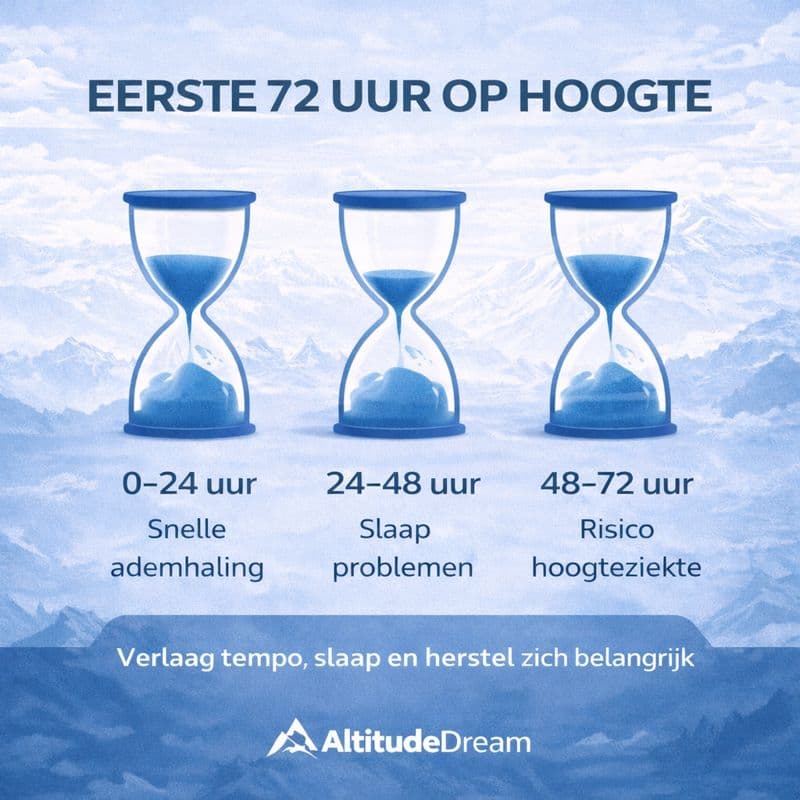
The first 72 hours at altitude are physiologically decisive. During this short period, your body makes the biggest adjustments to the lower oxygen supply. How you get through this phase largely determines whether you feel comfortable, sleep well and can continue your ascent safely, or whether you develop symptoms such as headaches, insomnia and altitude sickness.
In this article, you will discover:
- what there is by phase (0–24, 24–48 and 48–72 hours) changes in your body
- which adjustments are desirable and which signals are warning signs
- why these first few days often go wrong
- how you can support these physiological processes
- what this means for acclimatisation, pace and pre-acclimatisation
Key message: Your body can adapt very well to altitude, but only if you respect your pace, recovery and sleep.
See also (internal links):
Altitude sickness: symptoms, risks and treatment
What is a normal acclimatisation rate per 1000 metres?
Altitude tent hire and personal advice
Why the first 72 hours are so crucial
As soon as you are above approximately 2,500–3,000 metres When you breathe in, the oxygen pressure drops noticeably. Each breath contains fewer oxygen molecules, while your energy consumption remains the same or even increases due to cold, exertion and stress.
Your body does not react to this all at once, but in phases. The first 72 hours are characterised by rapid, largely neurohormonal adjustments. Structural adjustments (such as extra red blood cells) follow later.
This explains why many people:
- day 1 feeling “fine”
- day 2 sleeping worse
- day 3 suddenly develop symptoms
Phase 1: the first 0–24 hours at altitude
What happens immediately?
Within minutes to hours after arriving at altitude, your body reacts with:
- faster breathing (hyperventilation)
- higher heart rate, even at rest
- increase in stress hormones (such as adrenaline)
These are acute compensatory mechanisms to compensate for the lower oxygen supply.
What do you notice yourself?
- out of breath more quickly during exercise
- slight feeling of unease
- often still few complaints
Many people underestimate this phase because they “still feel fine”. That is precisely why mistakes are often made here.
What helps at this stage?
- very slow pace (even if it feels easy)
- drink enough, but do not overdo it
- no strenuous effort
- do not sleep higher than planned
Phase 2: 24–48 hours at altitude
Ventilatory adaptation begins
During this phase, your body attempts to make oxygen uptake more efficient by:
- further increased breathing rate
- changes in acid-base balance (respiratory alkalosis)
- increased urine output (fluid loss)
This is physiologically necessary, but may cause side effects.
Typical experiences in this phase
- sleep worse or waking up frequently
- mild headache
- reduced appetite
- feeling tired more quickly
This is often the moment when people start to wonder: “Will this pass, or will it get worse?”
What does physiology say?
Mild symptoms at this stage include not necessarily dangerous. They are often part of normal acclimatisation. The risk arises when you, during this phase:
- rising too quickly
- does not get enough sleep or rest
- ignores signals
Phase 3: 48–72 hours at altitude
Decisive phase for acclimatisation
During this period, there are roughly two scenarios:
Scenario A: successful adaptation
- breathing stabilises somewhat
- sleep becomes more restful
- energy is partially recovered
- mild symptoms are decreasing
Scenario B: failed acclimatisation
- persistent or increasing headache
- nausea
- obvious sleep problems
- feeling of “running on empty”
This is often the moment when altitude sickness manifests itself if the pace is too high.
What's happening under the bonnet?
Start slowly:
- kidney adjustments to correct acid-base balance
- signals for increased EPO production
- adjustment of muscle and cerebral blood flow
But these processes take time. You cannot force them.
Why these 72 hours often go wrong
The most common mistakes:
- “I feel good, so I can keep going.”
- skip acclimatisation days
- let the group or schedule determine the pace
- underestimating sleep and recovery
Physiologically speaking, you are then playing catch-up. Complaints often arise. delayed.
What does this mean for acclimatisation strategy?
1) Respect sleeping height
Your body recovers during sleep. Sleeping too quickly is the biggest risk factor.
2) Use acclimatisation days effectively
Active rest (climb high, sleep low) supports physiological adaptation without overexertion.
3) Do not expect a linear process
Good days and bad days alternate. The trend is more important than the snapshot.
The role of pre-acclimatisation
Because the first 72 hours are particularly stressful, more and more hikers and athletes are opting for pre-acclimatisation.
By sleeping in an altitude tent beforehand:
- the ventilatory response is already partially active
- the first night at real altitude is calmer
- the physiological shocks are smaller
This does not replace acclimatisation on the mountain, but it reduces the stress on your system.
Further explanation:
Altitude tent hire and personal advice
FAQ: physiology and the first days at altitude
Is it normal that I sleep poorly?
Yes. Sleep disturbances are one of the most common reactions in the first 48 hours.
When should I be concerned?
If symptoms increase after 48–72 hours or worsen with further elevation.
Does fitness help?
Good physical condition helps with exertion, but does not protect against altitude sickness.
Conclusion: what changes occur in the first 72 hours at altitude?
The first 72 hours at altitude are a physiological test phase. Your body is shifting to a new equilibrium, but that takes time and rest.
Those who respect this period:
- acclimatises more safely
- sleeps better
- has more energy left
- reduces the risk of altitude sickness
Those who push themselves too hard during this period often pay the price later on.
Would you like to be well prepared and get through these first 72 hours more effectively?
Ask for personal advice or hire a height tent