What is a normal acclimatisation rate per 1000 metres?
Published 28 December 2025 · 5 min read
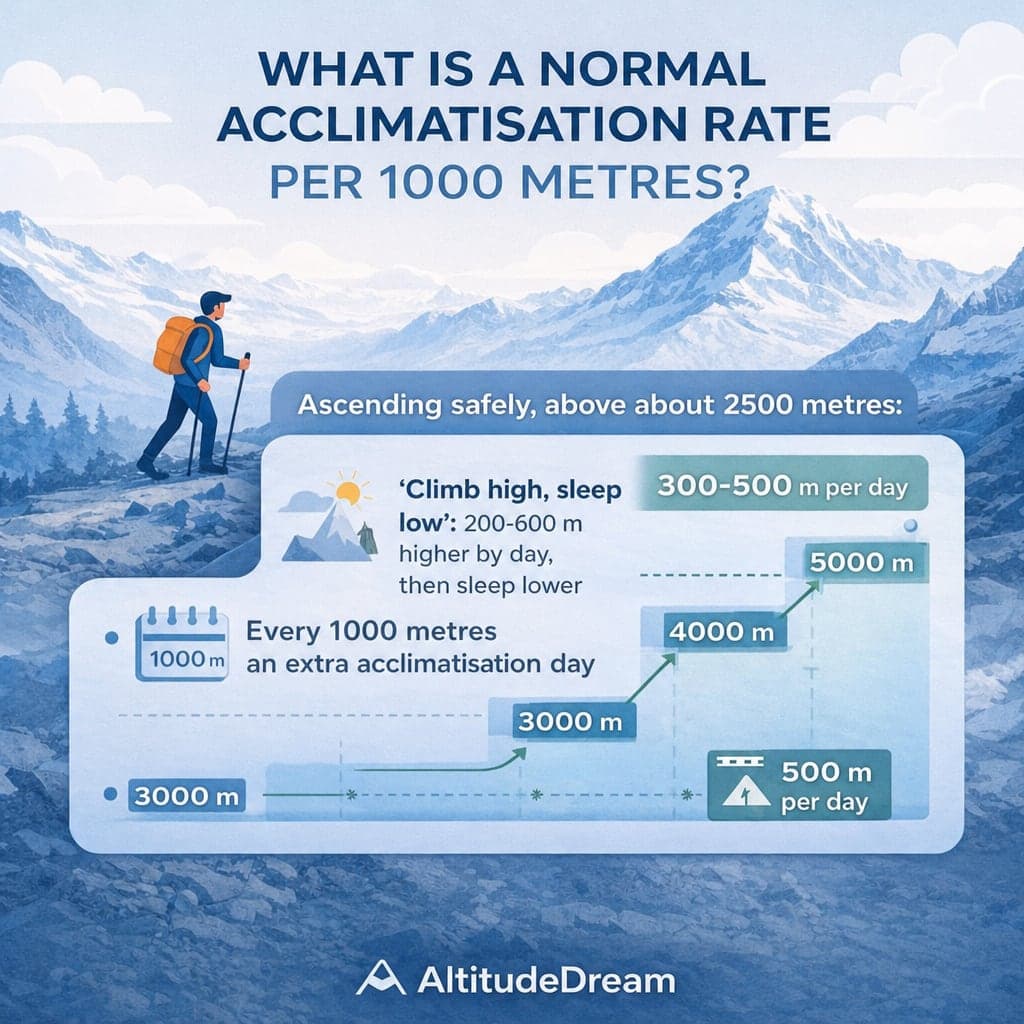
A normal and safe acclimatisation rate is on average 300 to 500 metres increase in sleeping altitude per 1000 metres of altitude, as soon as you exceed approximately 2,500 to 3,000 metres. Climbing faster significantly increases the risk of altitude sickness, while climbing slower increases your comfort, safety and chances of success.
In this article, we explain exactly:
- what acclimatisation speed means physiologically
- how quickly your body can actually adapt per 1000 metres
- Why “climb high, sleep low” is so powerful
- What are realistic speeds for pullers and climbers?
- how to apply this knowledge to popular destinations such as Kilimanjaro and Everest Base Camp
- how to improve your acclimatisation speed with pre-acclimatisation
Important: Acclimatisation is not a matter of willpower or fitness. It is a biological process that takes time. Anyone who ascends faster than their body can handle will sooner or later experience symptoms.
See also (internal links):
Altitude sickness: symptoms, risks and treatment
What do we mean by acclimatisation speed?
Acclimatisation speed is not about how fast you can walk uphill, but about how quickly your body can adapt to less oxygen.
One distinction is crucial here:
- Ascent rate during the day: how many metres of elevation you walk
- Ascent rate at sleeping altitude: how much your body needs to recover
For acclimatisation, the following almost always applies: sleeping height. Going higher during the day is fine, as long as you sleep lower afterwards.
Why is acclimatisation speed per 1,000 metres so important?
Above approximately 2,500 metres, the oxygen pressure decreases noticeably. Every additional 1,000 metres means:
- less oxygen per breath
- increased respiratory rate
- higher resting heart rate
- changes in fluid and acid-base balance
Your body adapts by, among other things:
- produce more red blood cells
- to breathe more deeply and efficiently
- optimise oxygen transport
These adjustments take time. If you go too fast, there will be a mismatch between exertion and adjustment. That is precisely where altitude sickness begins.
The guideline: what is a normal acclimatisation rate?
International guidelines and practical experience are remarkably consistent:
From approximately 2,500–3,000 metres
- Maximum 300–500 metres increase in sleeping altitude per day
- An additional acclimatisation day every 1,000 metres
In concrete terms, this means:
- If you are going from 3,000 to 4,000 metres, plan for at least 2 to 3 days.
- If you are going from 4,000 to 5,000 metres, allow another 2 to 3 days.
Maintaining this pace significantly reduces the risk of altitude sickness.
Why 300–500 metres per day works
This bandwidth matches the speed at which:
- ventilation adjusts itself
- oxygen transport becomes more efficient
- your sleep quality improves
Climbing faster may sometimes “feel good” in the first few days, but complaints often arise later on. Many hikers feel fine on day 2 or 3 and therefore push themselves too hard, only to get stuck on day 4 or 5.
Important nuance: These are averages. Some people need more time, others slightly less. No one knows in advance exactly which group they belong to.
Climb high, sleep low: the accelerator within safe limits
One of the most effective ways to stay within a safe acclimatisation rate and still make progress is climb high, sleep low.
This means:
- during the day, go 200–600 metres higher than your sleeping place
- then return to the same sleeping height
This gives your body a strong stimulus without sabotaging recovery.
Examples:
- sleeping at 3,800 metres, climbing to 4,300 metres during the day
- sleeping at 4,400 metres, climbing to 4,800–5,000 metres during the day
What happens if you acclimatise faster than your body can handle?
An excessive acclimatisation rate increases the risk of:
- acute mountain sickness (AMS)
- poor sleep and exhaustion
- loss of appetite and energy
- in severe cases: HAPE or HACE
Common mistakes:
- raising the height of your bed too quickly because it “feels good”
- cancel acclimatisation days to make up for lost time
- let peer pressure dictate the pace
What does this mean for popular treks?
Everest Base Camp
Everest Base Camp is located at 5,364 metres. A safe schedule includes:
- at least 2 acclimatisation days (Namche and Dingboche)
- gradual rise above 4000 metres
Anyone who goes faster than the classic schedule greatly increases the risk.
Kilimanjaro
Kilimanjaro is an exception because you ascend extremely quickly. Here, the guideline is often exceeded, which explains why altitude sickness is so common.
Solution:
- choose a route of at least 7–8 days
- consider pre-acclimatisation
Alps and Andes
The same logic applies here. Even experienced mountaineers adhere to the 300–500 metre rule as soon as they spend several days above 3,000 metres.
Can you train your acclimatisation speed?
You cannot change your genetic predisposition, but you can acclimatise beforehand.
By sleeping in an altitude tent for 3–6 weeks beforehand:
- you start with a higher tolerance for oxygen deficiency
- acclimatisation on the mountain goes more smoothly
- can you experience more comfort within the same schedule
This is particularly valuable if:
- you have a tight schedule
- you previously experienced altitude sickness
- you go above 4500–5000 metres
Find out more:
Altitude tent hire and personal advice
FAQ: acclimatisation rate per 1000 metres
Is 500 metres per day always safe?
It is a guideline, not a guarantee. Your body's signals always take precedence.
Can I acclimatise more quickly if I am fit?
No. Fitness helps with walking, not with oxygen uptake.
Is standing still better than rising slowly?
Extra acclimatisation days are often more effective than climbing a little bit every day.
What if I feel fine but exceed the guideline?
Many complaints are delayed. You often only feel unwell later on.
Conclusion: what is a normal acclimatisation rate?
A safe and realistic acclimatisation rate is 300 to 500 metres increase in sleeping altitude per day per 1000 metres of altitude, with additional acclimatisation days for every new thousand metres.
Those who respect this pace:
- reduces the risk of altitude sickness
- sleeps better
- has more energy left
- enjoy the trip more
Are you unsure whether your schedule is realistic, or would you like to improve your acclimatisation before you leave? Then targeted advice or pre-acclimatisation is a logical next step.
Start here:
Rent an altitude tent or request personal advice