How susceptible are you to altitude sickness? Mapping risk factors
Published 8 March 2026 · 14 min read
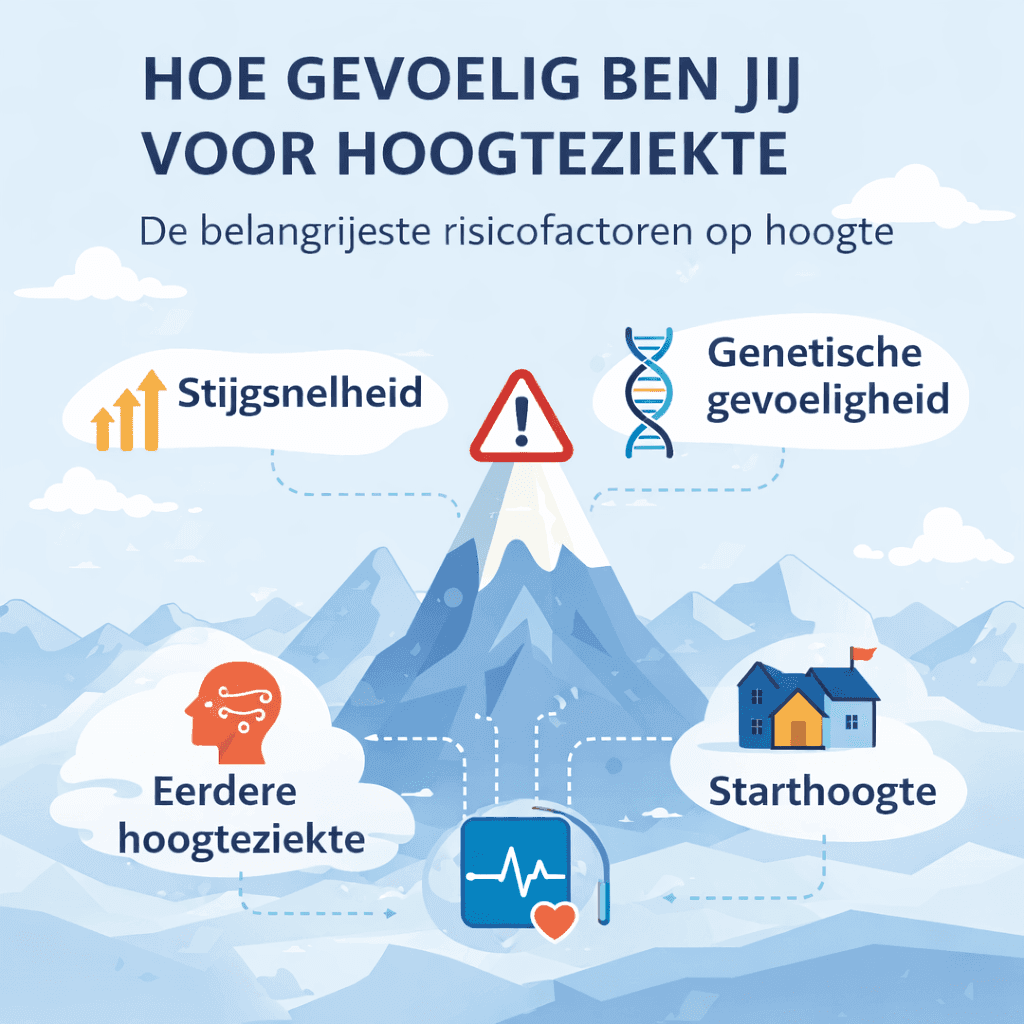
Susceptibility to altitude sickness varies greatly from person to person. Some people develop symptoms as early as around 2,500 metres, while others function flawlessly above 4,000 metres. Susceptibility to altitude sickness is determined by a combination of physiology, rate of ascent and acclimatisation. It is therefore important to realistically assess your risk in advance.
Many mountain travellers think that being in good shape is enough protection. It doesn't. Even fit athletes can develop altitude sickness if they ascend too quickly or take too little time to acclimatise. In this article, we clearly outline the main risk factors so that you can better assess how susceptible you are to altitude sickness and what you can do to prevent problems.
You will discover which factors really weigh heavily, which assumptions are often wrong and how objective monitoring can help you prepare smarter. This makes this article not only an explanatory piece, but also a practical decision guide for trekkers, alpinists and expeditioners.
The essentials in 30 seconds
- Altitude sickness occurs due to lower oxygen pressure at altitude.
- Anyone can get altitude sickness, even people with excellent fitness.
- Susceptibility to altitude sickness is mainly related to rate of ascent, previous symptoms and individual physiological response.
- Rapid movement to high altitude greatly increases the risk.
- With slow acclimatisation and pre-acclimatisation, you can significantly reduce the risk of altitude sickness.
What determines susceptibility to altitude sickness?
Susceptibility to altitude sickness is mainly determined by the way your body reacts to oxygen deprivation. At altitude, the partial pressure of oxygen drops. As a result, less usable oxygen enters the blood per breath. The body has to adapt to this, but not everyone does so as quickly or as efficiently.
This adaptation occurs through, among other things, faster breathing, changes in heart rate, shifts in fluid balance and, over time, increased red blood cell production. Yet people respond very differently to this. This explains why two people with the same level of training at exactly the same altitude can experience completely different symptoms.
So susceptibility to altitude sickness is not a matter of willpower or mental toughness. It is mainly a biological and practical issue: how fast do you climb, how does your body react and how well do you give yourself time to adjust?
Why altitude sickness is often misunderstood
Altitude sickness is still often seen as something that mainly happens to untrained or unprepared people. This is not the case. In practice, fanatical and fit mountain athletes regularly get into trouble because they want to climb too fast, overestimate their bodies or ignore early signals.
Another misconception is that altitude sickness would only be a problem at extreme altitudes. In reality, the first symptoms can appear as early as about 2,500 metres. From 3000 metres the risk increases markedly, and above 4000 metres acclimatisation is essential for many people. According to the International Society for Mountain Medicine, symptoms of acute altitude sickness can occur as early as these altitude zones, especially during rapid ascents. Read more at the International Society for Mountain Medicine.
Therefore, it is smarter not to think in terms of “I'm fit, so it won't be too bad”, but in terms of risk, adaptation and monitoring.
The main risk factors for altitude sickness
1. Rapid ascent rate
Without a doubt, the most important risk factor is how fast you ascend. The faster your sleep elevation increases, the less time your body has to adapt to the lack of oxygen. This greatly increases the risk of headaches, nausea, sleep disturbances and other symptoms.
A common guideline is to increase sleeping altitude above 2,500 metres by no more than 300 to 500 metres per day. It is also wise to include an extra acclimatisation day every 3 to 4 days. Anyone who skips this step increases the chances that a normal reaction to altitude will progress to true altitude sickness.
You can find more depth on this in the guide on preventing altitude sickness.
2. Previous altitude sickness
If you have had altitude sickness before, this is an important indicator that you may be susceptible again. Previous symptoms are one of the strongest predictive factors. This is especially true if the symptoms already arose at relatively modest altitudes or if you developed symptoms despite a reasonably leisurely ascent schedule.
That doesn't mean you can't do any more mountain treks. It does mean that you need to take your preparation more seriously. People with known susceptibility to altitude sickness often benefit greatly from a tighter acclimatisation plan, better monitoring and, in some cases, pre-acclimatisation beforehand.
3. Individual physiological or genetic susceptibility
Not everyone reacts the same way to altitude. Some of these differences seem to be genetic or physiological. Some people increase their breathing quickly and effectively, while others react less strongly. The regulation of fluid in the brain and lungs also differs from person to person, as does the body's ability to cope with oxygen deprivation.
As a result, susceptibility to altitude sickness can vary widely even with similar preparation. This is also why there is no simple home test that predicts exactly how you will react at altitude.
4. High starting height of your trip
The higher your journey starts, the greater the risk. If you fly directly to a destination at 3000 to 3600 metres and sleep there immediately, the risk of symptoms increases markedly. Your body is then abruptly exposed to lower oxygen pressure without a gradual transition.
Examples of high-risk take-off situations include:
- arriving directly in La Paz or Cusco
- a trek that starts directly above 3,000 metres
- a mountain route where you climb considerably as early as day 1
In such situations, extra caution is needed, even if you feel fit on arrival.
5. Excessive exertion in the first few days
The first few days at altitude are meant for adaptation, not performance. Anyone who immediately starts hiking hard, climbing fast or doing heavy training increases the strain on a body that is already under pressure from the lack of oxygen.
As a result, mild signals can turn into real symptoms more quickly. Starting quietly is therefore not a sign of weakness, but of smart mountain behaviour.
6. Poor sleep and insufficient recovery
Disturbed sleep is quite normal at altitude, but when sleep quality deteriorates markedly for several nights and this is accompanied by headaches, fatigue or loss of appetite, it may indicate insufficient acclimatisation. Sleep is not only a symptom carrier, but also a recovery time. Poor nights can increase the risk of further symptoms.
Which is not a reliable predictor
Good condition
Good fitness does not protect against altitude sickness. This is one of the most important points to remember. Fit people may actually be more at risk if it makes them climb faster, run harder or take their symptoms seriously too late.
Age
Age is not a clear or consistent predictor. Younger travellers are not automatically protected and older travellers are not automatically more vulnerable. Individual response and mode of ascension weigh more heavily.
Gender
There is no convincing evidence that men or women are structurally more susceptible to altitude sickness. The course is mainly determined by individual response and behaviour at altitude.
How high is your risk of altitude sickness? 5-question self-check
Want a quick initial assessment of your risk of altitude sickness? Then use this practical self-check. It is not a medical diagnosis, but it is a useful way to better assess your susceptibility to altitude sickness in advance.
- Have you had altitude sickness before?
Yes = increased risk. - Will your trip start directly above 2,500 to 3,000 metres?
Yes = increased risk. - Do you ascend several sleeping heights in quick succession?
Yes = increased risk. - Do you have little room for rest days or acclimatisation?
Yes = increased risk. - With previous elevation or hypoxia, do you react quickly with headache, poor sleep or marked SpO2 drop?
Yes = increased risk.
Interpretation:
- 0 to 1 times yes: low to moderate risk, depending on altitude and pace.
- 2 to 3 times yes: clearly increased risk, plan extra carefully.
- 4 to 5 times yes: high risk, acclimatisation and preparation are essential.
This self-check works especially well when combined with a realistic ascent schedule and honest assessment of previous experiences. This is precisely where things often go wrong in practice.
How do you recognise a high susceptibility to altitude sickness?
There is no simple test that predicts in advance exactly how susceptible someone is to altitude sickness. Nevertheless, there are clear signs that indicate an increased risk. The more of these factors apply to you, the more seriously you should approach your preparation.
- you have had altitude sickness before
- your journey starts immediately at high altitude
- you ascend several sleep heights in quick succession
- your sleep deteriorates rapidly on previous high altitude trips
- your SpO2 drops markedly and recovers slowly over several days
- you react quickly to altitude with headaches, nausea or decreased appetite
People with high susceptibility to altitude sickness often find that their bodies protest faster than those of travelling companions. The important thing then is not to push on, but rather to slow down, monitor and adjust where necessary.
Symptoms indicating onset of altitude sickness
The first symptoms usually appear within 6 to 24 hours of arriving at higher altitudes. At first, they are sometimes subtle. This is precisely why they are often underestimated. A high susceptibility to altitude sickness does not always manifest itself immediately in severe symptoms, but often first in small signs that become increasingly obvious.
- headache
- nausea
- loss of appetite
- dizziness
- poor sleep
- unusual fatigue
- lethargy on exertion
You can find more explanation of these signals in altitude sickness symptoms and risks.
At what altitude does the risk really start to increase?
Not every height carries the same risk. The table below gives a practical overview. It is a general indication. Individual sensitivity and rate of ascent remain decisive.
| Height | General risk | Practical interpretation |
|---|---|---|
| 1500 - 2000 m | Very low | For most people, no relevant complaints |
| 2500 m | Low to moderate | First symptoms are possible in susceptible individuals |
| 3000 - 3500 m | Moderate | Risk increases markedly, especially with rapid rise |
| 4000 - 4500 m | High | Good acclimatisation becomes necessary for many people |
| 5000 m and above | Very high | Without preparation and tight pace, risk rises sharply |
Can you test if you are prone to altitude sickness?
Many people wonder if there is a test you can use to determine in advance how susceptible you are to altitude sickness. The short answer is: there is no test that can predict this with certainty.
In fact, susceptibility to altitude sickness is influenced by several factors at once. Consider ascent rate, previous exposure to altitude, individual physiological response and the way your body adapts to oxygen deprivation.
Nevertheless, there are some medical tests that can provide insight into how your body reacts to an oxygen-deficient environment.
Hypoxia tolerance test or hypoxia intolerance test
One of the best-known studies is the hypoxia tolerance test, sometimes also the hypoxic ventilatory response test called. In Dutch, it is sometimes referred to as a hypoxia intolerance test. During this test, a person breathes air with a lower oxygen percentage for a short period of time, similar to conditions at higher altitudes.
Doctors or researchers then look at, among other things:
- the change in respiratory rate
- heart rate response
- the drop in oxygen saturation or SpO2
- any symptoms such as dizziness or headaches
The purpose of this test is to see how strongly the body responds to oxygen deprivation.
Why this test cannot properly predict altitude sickness
Although a hypoxia test can provide useful information, research and practical experience show that its predictive value for altitude sickness is limited. People who respond well to hypoxia in a laboratory test may still develop symptoms during a real mountain trek.
Conversely, people with a weaker test response can sometimes acclimatise without any problems when ascending slowly. Therefore, mountain doctors do not usually consider these tests a reliable predictor of altitude sickness. Practical factors such as a leisurely pace of ascent, previous experience at altitude and a good acclimatisation schedule usually prove much more important.
A more realistic way to assess your risk
In practice, mountain doctors and expedition organisations mainly look at a combination of factors to assess the risk of altitude sickness:
- previous experiences with altitude
- the planned ascent rate of the route
- the starting altitude of the trip
- body response to previous exposure to hypoxia
You can read more background on this in the complete guide to altitude sickness.
Pre-acclimatisation as practical preparation
Some mountain travellers choose to do a period of pre-acclimatisation beforehand. This can be done, for example, by sleeping in an altitude tent for several weeks. In doing so, via normobaric hypoxia the oxygen percentage is reduced while the air pressure remains the same.
This controlled exposure allows the body to already start adapting to low-oxygen conditions. This makes it possible to see in advance how sleep quality, sense of recovery and oxygen saturation respond to a simulated altitude stimulus.
An altitude tent is no substitute for acclimatisation in the mountains, but it does make the process controlled, measurable and planable. In many cases, it can significantly reduce the risk of altitude sickness.
This is how you monitor this lens
You can never fully predict susceptibility to altitude sickness, but you can monitor it more and more closely. Objective monitoring helps you see earlier whether you are adapting well or falling behind. Don't look at individual snapshots, but trends.
1. SpO2 trend
Preferably measure your oxygen saturation under similar conditions, such as at rest in the morning. One single measurement says little. The trend over several days is more useful. If your SpO2 remains stable or gradually improves as you go higher, that is usually a more favourable signal than a decreasing trend combined with symptoms.
You can read more background in oxygen saturation at altitude.
2. Sleep quality
Pay attention to how fast you fall asleep, how often you wake up and how rested you get up. Sleeping worse is normal at altitude, but several nights of marked deterioration are a signal to stay alert.
3. Recovery feeling and symptom development
Ask yourself every day:
- Are the headaches increasing or decreasing?
- am I eating normally?
- Do I feel better or heavier than expected on exertion?
- Does my body recover sufficiently after a rest?
Concrete decision rule: If your symptoms increase after an ascent and do not improve with rest, do not plan a further ascent. If the symptoms persist or worsen, then descending is wise.
Four practical risk profiles
To make susceptibility to altitude sickness more concrete, you can roughly identify yourself in one of these profiles:
Profile 1 - Low risk
You have reacted well to altitude before, ascending slowly and planning sufficient acclimatisation days. You also deliberately stay below your maximum exertion level in the beginning.
Profile 2 - Moderate risk
You still have little experience with higher altitude, but a fairly leisurely schedule. You do not yet know quite how your body reacts and therefore need extra monitoring.
Profile 3 - Increased risk
You have had previous complaints, your trip starts high or you have a compact programme. In that case, a conservative strategy is wise.
Profile 4 - High risk
You've had obvious altitude sickness before, little room in the itinerary and you're going to 4000 metres or higher. Then thorough preparation is essential and pre-acclimatisation is often a logical choice.
How do you significantly reduce the risk of altitude sickness?
Slowly rising
This remains the bottom line. Rising slowly gives the body time to adapt and remains more effective than troubleshooting afterwards.
Pre-planning at sleep level
Look not only at daytime height, but especially at where you sleep. The sleep altitude in particular determines to a large extent how much physiological stimulus your body receives.
Pre-acclimatisation at home
For trips to higher altitude, pre-acclimatisation at home can be a smart step. Especially with a tight schedule or previous susceptibility to altitude sickness, this can make a significant difference. You can read more about this in acclimatising at home for mountain expeditions.
Sleeping in an altitude tent
An altitude tent works via normobaric hypoxia. This involves reducing the oxygen percentage while keeping the air pressure the same. The aim is to pre-expose the body in a controlled manner to a stimulus similar to altitude. Sleep is the primary stimulus here, as prolonged nocturnal exposure is usually more effective than short single sessions.
An altitude tent is not a replacement for acclimatisation in the mountains, but it makes the process controlled, measurable and planable. With step-by-step acclimatisation and SpO2-controlled adjustment, an altitude tent will significantly reduce the risk of altitude sickness, especially when travelling above 4000 metres or for people with an increased risk profile.
You can find more practical background in the complete guide to using an altitude tent.
When should you be extra careful?
Extra caution is wise in the following situations:
- you have had altitude sickness before
- you go to sleep above 4000 to 5000 metres
- your journey starts immediately at high altitude
- you have few days to build up slowly
- you notice clear signs of reduced adaptation early on
In these cases, it is smart to think not only about route planning beforehand, but also about an active strategy to deal with your susceptibility to altitude sickness.
Conclusion: how susceptible are you to altitude sickness?
You cannot predict susceptibility to altitude sickness with absolute certainty, but you can estimate the risk much better than most people do. The biggest risk factors are rapid ascent, previous altitude sickness, high starting altitude and individual physiological susceptibility. Good fitness is not a reliable protection in this respect.
Those who take their susceptibility to altitude sickness seriously choose a realistic ascent plan, monitor objective trends such as SpO2 and sleep quality, and intervene early when symptoms increase. By doing so, you not only increase your safety, but also the chances of enjoying your trek rather than being limited by it.
Going to 4,000 metres or higher soon?
Do you have a tight travel schedule, have you been prone to altitude sickness before or want to leave better prepared? Then a controlled pre-acclimatisation programme can make a big difference.