IHT training at home: what is intermittent hypoxic training and does it really work?
Published 26 February 2026 · 4 min read

IHT training at home is rapidly gaining popularity among endurance athletes who want to improve their oxygen system without spending weeks at altitude. But what exactly is intermittent hypoxic training? Does it really work? And how is it different from sleeping in an altitude tent?
In this article, you get a clear, science-based answer. You will learn what IHT training at home does physiologically, when it makes sense, how to apply it safely and how to objectively monitor whether it is having an effect.
What is IHT training at home?
IHT stands for intermittent hypoxic training. It means consciously breathing air with a lower oxygen percentage for short blocks. This is usually done through a mask connected to an altitude generator.
Unlike classical altitude training you do not stay in hypoxia continuously. You alternate hypoxic periods with normal breathing air. Think of blocks of 3 to 6 minutes of hypoxia, followed by recovery.
Important: in IHT training at home, you work with normobaric hypoxia. Air pressure remains the same. Only the oxygen percentage drops. This simulates altitude without being physically in the mountains.
Why is intermittent hypoxic training often misunderstood?
Many athletes think IHT is the same as sleeping in an altitude tent. This is not true.
Sleeping in hypoxia is a prolonged stimulus of 7 to 9 hours per night. IHT training at home is a short-term, intensive stimulus of usually 20 to 40 minutes.
The physiological effects therefore vary in nature and depth. If you want to understand how long-term exposure works, read also how altitude training works.
IHT is not a substitute for acclimatisation. It is a complementary form of training that can excite specific systems.
What happens physiologically during IHT training at home?
1. Acute drop in SpO2
During hypoxia, your oxygen saturation drops. This activates chemoreceptors and increases your breathing frequency.
2. HIF-1 activation
Hypoxia activates hypoxia inducible factor 1, which stimulates adaptations in mitochondria and oxygen transport, among other things.
3. Improving oxygen efficiency
Research shows that repeated hypoxic stimuli can improve peripheral oxygen utilisation. This is especially relevant for endurance athletes.
4. Limited EPO stimulation
In contrast to prolonged exposure, EPO rise in IHT is usually mild. For natural EPO stimulation via prolonged hypoxia read How to naturally increase EPO.
Does IHT training at home really work for sports performance?
The honest answer: sometimes yes, sometimes no.
Effect depends on:
- training status
- frequency and duration
- combination with normal training
- individual response
Meta-analyses show modest improvements in VO2max and time to exhaustion, especially in already trained athletes. Recreational athletes tend to see less pronounced effects.
IHT works best as part of a broader hypoxia concept, for example combined with a sleep high train low strategy.
For whom is IHT training at home useful?
- Endurance athletes seeking extra incentive
- Athletes who do not want to use a full height tent
- Athletes in maintenance period
- Climate rooms not available
For expedition preparation, prolonged pre-acclimatisation is more effective. See acclimatising at home for mountain expeditions.
How do you apply IHT training safely at home?
Step 1 - Start conservatively
Start around 2,500 metres simulation.
Step 2 - Work with intervals
For example, 5 minutes of hypoxia, 5 minutes of recovery, 4 to 6 repetitions.
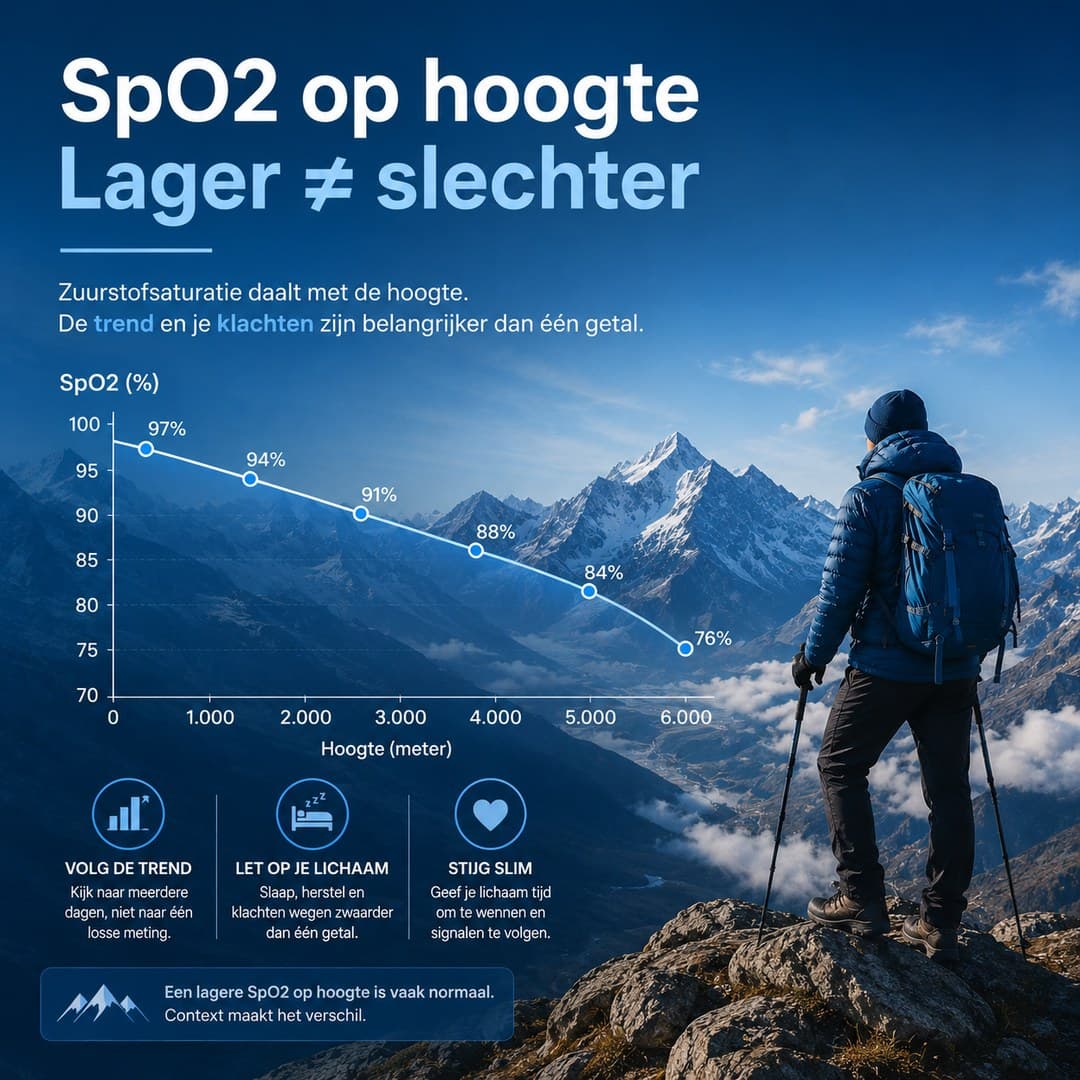
Step 3 - Monitor SpO2 as a trend
A single measurement says little. Look at the progression over weeks.
Step 4 - Build up step by step
Increase only if morning SpO2 remains stable.
This is how you monitor this lens
Objective monitoring prevents overloading.
1. SpO2 trend
Measure morning SpO2 daily. If the trend structurally drops below your baseline, reduce your hypoxia dose.
Decision rule: If your average morning SpO2 drops more than 3 percentage points below normal for 3 days, then lower your altitude or frequency.
2. Sleep quality
Restless sleep or elevated heart rate may indicate overexertion.
3. Recovery feeling
Reduced training quality or persistent fatigue are signals to adjust.
IHT training at home versus altitude tent
An altitude tent works via prolonged exposure during sleep. Sleep is the primary stimulus for structural adaptation.
An altitude tent works with normobaric hypoxia, is built up incrementally and is SpO2-controlled.
IHT is short-term and mainly metabolic focused. For structural haematological adaptation, long-term exposure in an altitude tent is more effective.
The essentials in 30 seconds
- IHT training at home is short hypoxia intervals
- Effect mainly on oxygen efficiency
- Limited EPO stimulation
- Not equivalent to sleeping in hypoxia
- Monitor SpO2 as a trend
- Always build up step by step
Conclusion: does intermittent hypoxic training work?
IHT training at home can be a valuable additional incentive for sports performance. It is not a panacea. It does not replace long-term hypoxia or acclimatisation.
Those who apply it in a targeted, controlled and SpO2-driven way can make subtle but meaningful gains.
Want to take a professional approach to hypoxia training?
Discover our sports-focused hypoxia programmes including counselling.