Hypoxia and longevity: what does the science say about oxygen deprivation and healthy ageing?
Published 12 May 2026 · 15 min read
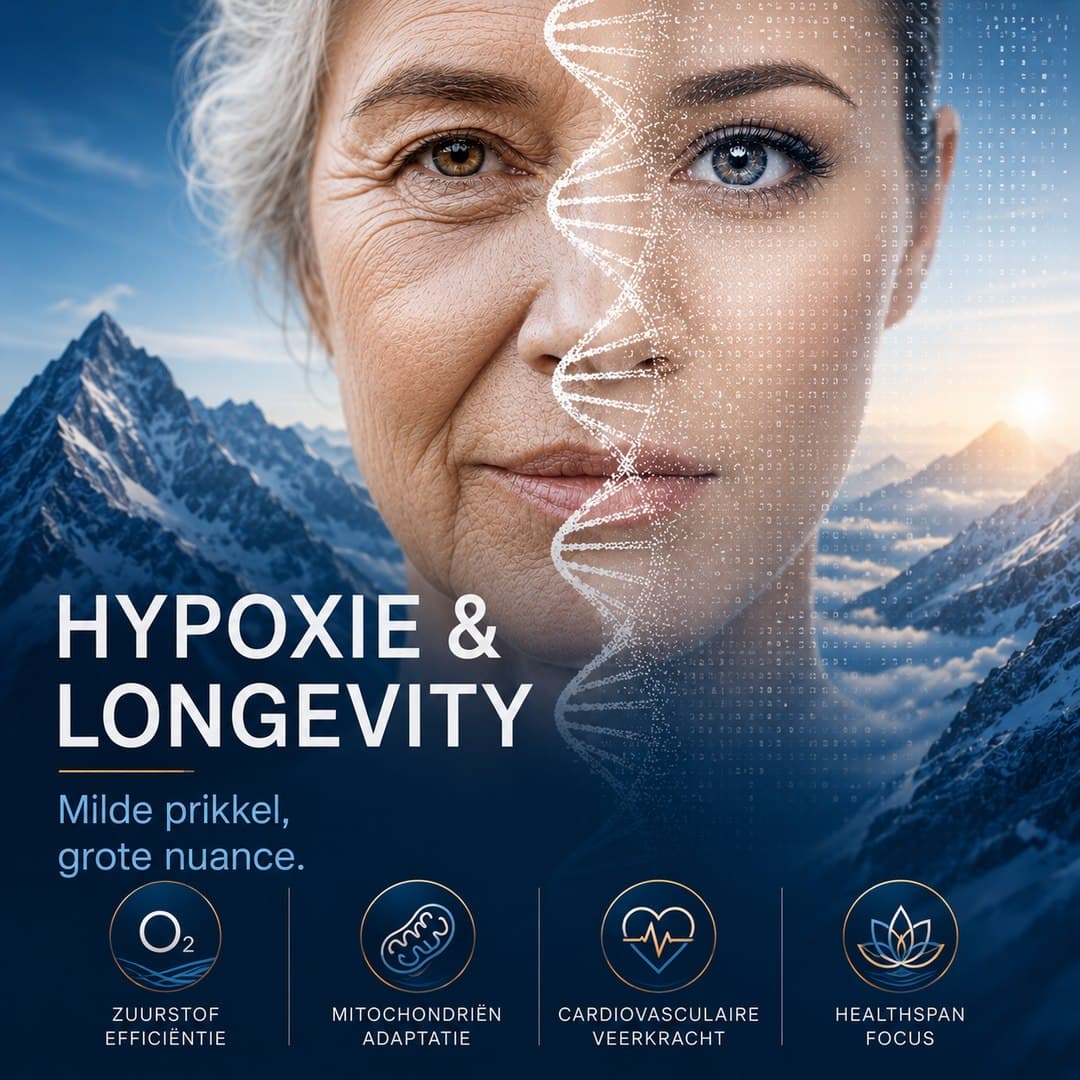
Hypoxia and longevity is an interesting young niche within healthy ageing. The idea is simple: a controlled stimulus of less oxygen can force the body to deal more efficiently with energy, recovery and oxygen transport. Yet, the practical conclusion is nuanced. It is not a proven anti-ageing treatment, but possibly a hormetic stimulus that fits within a broader healthspan plan.
For anyone following Peter Attia, Huberman Lab, or Reddit's r/longevity, this theme will likely sound familiar. Longevity is increasingly focused on measurable resilience: VO2max, mitochondrial function, muscle mass, glucose regulation, sleep, and recovery. Oxygen availability directly relates to this domain, as it has a direct impact on energy metabolism, stress response, and adaptation.
Altitude Dream does not see hypoxia as a shortcut to a longer life because of this. However, controlled normobaric hypoxia can be a practical way to better dose, monitor, and link the oxygen stimulus to preparation, training, or healthspan goals. For those who want to understand the basics first, further information can be found in our guide on altitude training.
Short answer: Hypoxia may contribute to healthy ageing through hormesis, mitochondrial adaptation, oxygen efficiency, and cardiovascular stimulation. However, the evidence in humans is not yet strong enough to consider hypoxia a longevity treatment. The most sensible application is controlled, mild, measurable, and embedded within a broader plan including exercise, sleep, nutrition, and recovery.
Conclusion: Hypoxia is interesting for longevity, but not yet a proven healthspan protocol.
Nuance: Animal studies, height epidemiology and small human studies are promising, but not definitive.
Practical hook: Use hypoxia only as a dosed stimulus, not as a replacement for training or medical prevention.
"What do we mean by hypoxia and longevity?"
Hypoxia means the body has less oxygen available than normal. This can happen at actual altitude, in an altitude chamber, during intermittent hypoxic training, or in an altitude tent. Altitude Dream uses normobaric hypoxia, where the air pressure remains normal, but the oxygen percentage in the inhaled air is controlled to be lowered.
Longevity is all about healthspan.
In this context, longevity doesn't simply mean getting as old as possible. The interesting question is healthspan: how long do you remain strong, mobile, mentally sharp, metabolically healthy, and physically resilient? Therefore, the topic connects with thinkers such as Peter Attia and Huberman Lab. They place great emphasis on cardiorespiratory fitness, VO2 max, Zone 2, strength training, sleep, and measurable prevention.
An oxygen stimulus is added as an extra layer. Not on top of the pyramid, but as a possible refinement. The idea is that mild oxygen deficiency allows the body to practise with a situation where oxygen is scarcer, thereby activating certain adaptation processes. Consider changes in oxygen transport, energy metabolism, blood flow, mitochondrial efficiency and stress response.
The value lies in the correct dosage
This means hypoxia is not a magical longevity instrument. It is rather a controlled stressor. Just as training, cold, heat or fasting only make sense in the right dosage, the same applies to lack of oxygen. Too little stimulus achieves little. Too strong a stimulus actually causes strain. The value lies in the zone in between.
📊 Research shows that mild hypoxia becomes particularly interesting when viewed as hormesis. A small, temporary stress stimulus can trigger adaptation. Chronic, severe, or poorly monitored hypoxia can conversely be detrimental. Therefore, the dose, duration, frequency, and individual tolerance determine the direction of the effect.
Hypoxia and longevity: the scientific core
The science surrounding Hypoxia and longevity consists of four layers. First, there is fundamental research on cells, genes, and model organisms. In addition, there are animal studies in which oxygen restriction sometimes influences lifespan. Next, there is epidemiology in humans living at moderate altitude. Finally, there are smaller human studies on intermittent hypoxia, often in the elderly, athletes, or rehabilitation groups.
Waarom dierstudies voorzichtig gelezen moeten worden
These layers don't all tell the same story. In C. elegans, a commonly used worm model, strong effects on lifespan have been described with specific hypoxia protocols. This is biologically interesting, as it points to stress responses that are also partly evolutionarily conserved in humans. Nevertheless, the translation remains limited. A worm is not a human. Therefore, you cannot derive a direct protocol for healthy ageing from it.
In humans, the picture is more subtle. Reviews on living at moderate altitudes suggest that mild hypoxia may be associated with favourable patterns regarding cardiovascular health and ageing. At the same time, many confounding factors are involved. People living in mountainous regions often move differently, live differently and have different environmental factors. Selection and genetic background can also play a role.
What you can practically get out of it
The most defensible conclusion is therefore clear: hypoxia is biologically plausible as a healthspan stimulus, but the evidence is still building. For Altitude Dream, this means we approach hypoxia primarily from a practical and measurable perspective. The question is not: does this extend my life? A better question is: can controlled hypoxia support my preparation, oxygen efficiency, and adaptation process?
| Proof layer | What it suggests | What you are not allowed to conclude from it |
|---|---|---|
| Cell and animal model | Hypoxia can influence stress response, mitochondria, and longevity pathways. | That the same effect automatically occurs in humans. |
| Moderate height | Living at altitudes between 1500 and 2500 metres may be associated with favourable healthspan signals. | That height is the only cause. |
| Humane IHT studies | Small studies show potential effects on fitness, cognition, or cardiometabolic markers. | That there is already a universal longevity protocol. |
| Sports Physiology | Hypoxia can support adaptation around oxygen transport and training. | That more hypoxia is always better. |
Suggestion Hypoxia can impact stress responses, mitochondria, and longevity pathways.
Do not conclude: that the same effect occurs automatically in humans.
Suggestion Living at altitudes of 1500 to 2500 metres can be associated with favourable healthspan signals.
Do not conclude: that height alone is the cause.
Suggestion Small studies show possible effects on fitness, cognition, or cardiometabolic markers.
Do not conclude: that there is already a universal longevity protocol.
Suggestion Hypoxia can support adaptation around oxygen transport and training.
Do not conclude: that more hypoxia is always better.
Why oxygen deficiency can be a hormetic stimulus
Hormesis is the principle whereby a small dose of stress can make the body stronger. Training is the best-known example. A heavy session will not break you down if the dosage is correct. It makes you stronger after recovery. Oxygen deprivation may work according to the same logic. The body notices that oxygen is less readily available and adapts processes.
The role of HIF and mitochondria
One of the central players is HIF, the hypoxia-inducible factor. This is not a supplement or a trick, but a biological regulatory system. HIF helps cells respond to low oxygen availability. This can involve processes such as blood vessel formation, energy metabolism, glucose utilisation, and oxygen transport.
In addition, there is a lot of interest in mitochondria. These cell components convert nutrients and oxygen into usable energy. As we age, mitochondrial efficiency often decreases. That is an important theme within longevity. Because hypoxia puts the energy system under pressure, it is logical that researchers are looking into whether mild hypoxia can stimulate mitochondrial adaptation.
When hormesis is overloaded
Yet the core remains: adaptation arises from dosage plus recovery. Those who go too deep, build up too quickly, or combine oxygen deficiency with sleep deprivation, heavy training, and stress, can achieve the opposite. Then the stimulus becomes not hormesis, but overload. If you want to better understand how the body reacts to oxygen deficiency, then our in-depth look at physical reactions to oxygen deprivation a logical follow-up.
What Attia, Huberman, and r/longevity add to this
The value of Peter Attia and Huberman Lab isn't in a claim that hypoxia extends life. Their value lies primarily in their framework for thinking. Longevity is usually translated there into measurable capacity: how well does your cardiovascular system function, how strong are you, how well do you recover, and how large is your physiological reserve?
Why VO2max and Zone 2 remain important
VO2max plays a leading role in this. Higher cardiorespiratory fitness is strongly associated with lower mortality risks in large observational datasets. Zone 2 training is receiving a lot of attention because it supports the aerobic base, fat oxidation, and mitochondrial function. Strength training remains essential as muscle mass and functional capacity are important for ageing independently.
Within that framework, hypoxia can be an additional stimulus. After all, it directly affects oxygen uptake, oxygen transport, and efficiency. However, it does not replace the basics. Without exercise, sleep, nutrition, strength training, and recovery, hypoxia becomes a standalone tool without a foundation.
What Reddit is useful for, but not proof
Reddit r/longevity is interesting as a source of signals. The discussion around intermittent hypoxia shows that the healthspan community is receptive to new stressor-based interventions. This is precisely where nuance is needed. A preprint or animal study can strengthen a hypothesis, but cannot yet prove a consumer protocol.
Hypoxia in longevity: strong and weak interpretation
Strong interpretation Controlled hypoxia is an interesting stimulus that may fit into a broader strategy for oxygen efficiency, fitness, and adaptation.
Weak interpretation: Hypoxia doubles your lifespan, as observed in a model organism under specific conditions.
Practical conclusion: use hypoxia as a measurable training or acclimatisation stimulus, not as a standalone longevity promise.
Hypoxia and longevity in practice: when is it relevant?
For most healthy people, longevity doesn't start with hypoxia. It starts with sleep, daily exercise, strength training, aerobic base, healthy nutrition, stress management, and medical prevention. Only then does an additional stimulus become interesting. This oxygen stimulus is particularly suitable for people who are already consciously working on fitness, recovery, or altitude adaptation.
For athletes, mountain sports enthusiasts, and healthspan thinkers
These could be athletes who want to stimulate their oxygen system. They could be mountaineers who want to acclimatise in a controlled way. The healthspan target group may also be interested. In that case, it's not about peak athletic performance, but about better physiological resilience. Dosage is important precisely for this group.
An altitude tent makes that dosage practical. You don't have to travel to the mountains to get a controlled hypoxic stimulus. You can gradually increase the altitude, monitor the response, and make adjustments. Sleeping remains the most logical context for live high, train low: you give the body a long-term, relatively gentle stimulus while you can move or train normally during the day.
Tailor the application to the purpose
What's important is that the objective remains clear. For an expedition, hypoxia is mainly about acclimatisation. For sport, it's often about performance and adaptation. In the context of longevity, it's more about resilience, oxygen efficiency, and recovery capacity. These goals appear similar, but they require a different interpretation.
When does this make sense?
Relevant though: if you are healthy, already have a solid foundation, and want to use hypoxia in a controlled manner as an additional stimulus.
Caution: in case of cardiovascular disease, severe lung problems, sleep apnoea, pregnancy, unexplained complaints, or low resting saturation.
Illogical if you use hypoxia as a replacement for exercise, sleep, nutrition or medical guidance.
This is how you monitor this lens
The link between hypoxia and longevity should not be guided by feeling alone. Precisely because the subject is susceptible to hype, objective monitoring is important. This also fits with how Altitude Dream works: not stimulating harder than necessary, but dosing more intelligently based on response.
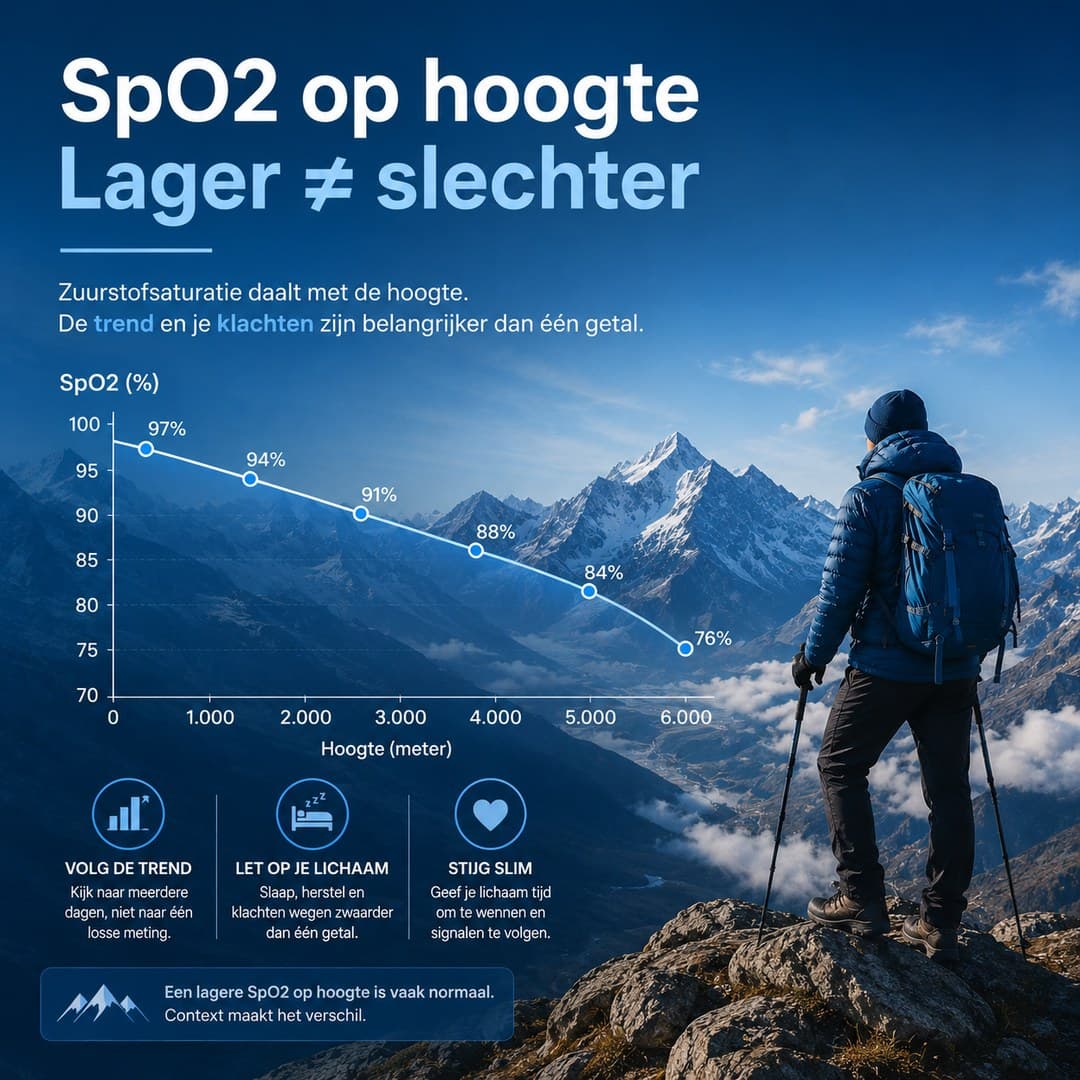
SpO2 is a trend, not an isolated score
The most important measurement is SpO2, but always as a trend. A single value says little. The trend over several nights tells more. Does your saturation suddenly drop much further than normal? Is your sleep getting worse? Do you wake up with a headache? Is your recovery declining? Then the stimulus is likely too much.
In addition, you look at sleep quality, resting heart rate, HRV, morning feeling, and symptoms. If you exercise, you can also track power, pace, RPE, and recovery duration. For longevity, it is mainly relevant whether the stimulus keeps your system resilient. A good protocol does not feel like exhaustion, but like manageable adaptation.
| Measuring point | What are you looking at? | Practical interpretation |
|---|---|---|
| SpO2 trend | Average reaction over multiple nights. | Stability is more important than a single perfect value. |
| Sleep | Sleep duration, sleeping through the night, waking up, subjective rest. | Poor sleep often means the stimulation level is too high. |
| Recovery | Resting heart rate, HRV, muscle sensation and mental alertness. | Recovery from illness usually requires reduced stimulation or rest. |
| Symptoms | Headache, nausea, dizziness, shortness of breath. | Complaints are leading. If in doubt, reduce or stop. |
What are you looking at? average response over multiple nights.
Interpretation: Stability is more important than a single perfect value.
What are you looking at? Sleep duration, uninterrupted sleep, waking up, subjective rest.
Interpretation: Poor sleep often means the stimulation is too high.
What are you looking at? Heart rate, HRV, muscle sensation, and mental freshness.
Interpretation: Full recovery usually requires less stimulation or rest.
What are you looking at? headache, nausea, dizziness, shortness of breath.
Interpretation: Complaints are leading. If in doubt, reduce or stop.
For deeper understanding around measuring and interpreting, our guide on oxygen saturation at altitude Useful. For healthspan goals too, the main rule remains the same: SpO2 is a trend indicator, not an absolute scorecard.
A cautious protocol for the healthspan target audience
There is no universal hypoxia and longevity protocol yet. Therefore, it is wiser to think in terms of principles. Start gently. Build up slowly. Measure your response. Keep training, sleep, and recovery stable. Only then can you assess whether hypoxia adds anything.
Start mild and build up when stable
For a healthy, experienced user, a gradual build-up towards moderate simulated altitude can be logical. Do not think of extreme heights, but of a controlled stimulus that the body can process. At Altitude Dream, this is always combined with explanation, installation, monitoring and practical guidance.
The main mistake is wanting to go too fast. Longevity isn't about a heroic burst. It's about consistency. If oxygen deprivation structurally worsens your sleep, it could undermine one of the key pillars of healthy ageing. Therefore, the best stimulus is often the one that challenges your body just enough without breaking your recovery.
Cautionary building principle
Phase 1: start with a mild altitude stimulus and observe sleep, SpO2 trend, and morning feeling.
Phase 2: Increase only when multiple nights have passed stably without clear complaints.
Phase 3: keep the stimulus constant as sleep or recovery decreases.
Phase 4: Lower the dose or pause if you experience headaches, restless nights, shortness of breath, or a decline in recovery.
For people who want to train specifically with short hypoxia blocks intermittent hypoxic training a different model from sleeping in a altitude tent. One works with short, defined sessions. The other works with longer nocturnal exposure. Both require different dosages and interpretations.
Common misconceptions about hypoxia and longevity
The first misconception is that a lack of oxygen is automatically healthy. That is not true. Oxygen deprivation can trigger adaptation, but also cause stress, poorer sleep, headaches or cardiovascular strain. The difference lies in intensity, duration, timing, and personal sensitivity.
Why proof is not the same as a protocol
A second misconception is that animal studies are directly applicable to humans. Basic research is valuable because it reveals mechanisms. However, humans live longer, more complex lives with more variables. A protocol that works impressively in a model organism is not yet a proven healthspan intervention for healthy adults.
Hypoxia is also not more important than VO2max, muscle strength, or sleep. In the current longevity literature, exercise, cardiorespiratory fitness, strength, metabolic health, and sleep remain much more strongly supported. Only when that foundation is in place does an additional oxygen stimulus become interesting.
A hypoxie tent is not a medical treatment
The final misconception is that a height tent is the same as a medical treatment. A height tent makes hypoxic exposure controlled, measurable, and planned. This can be valuable for acclimatisation, sport, and potentially healthspan experiments. However, it is not a treatment and not a guarantee of a health outcome.
Practical checklist for responsible use
- Start only when your basic health and sleep are in order.
- Use hypoxia as an additional stimulus, not as a replacement for training.
- Monitor SpO2 as a trend over multiple nights.
- Track sleep quality, resting heart rate, HRV and morning feeling.
- Build only when your reaction remains stable.
- Reduce the stimulus if there are complaints or clearly poor recovery.
- Consultation regarding heart, lung, or sleep-related conditions.
The facilitating role of Altitude Dream
Altitude Dream's role lies precisely in the middle, between curiosity and responsibility. We're seeing hypoxia cropping up more and more in discussions about longevity, VO2max, mitochondria, HRV, glucose, and healthspan. At the same time, we know from altitude physiology that oxygen stimuli need to be carefully dosed.
Control makes the difference
Therefore, we primarily facilitate control. An altitude tent lowers the oxygen percentage while keeping the air pressure normal. This allows you to use a simulated altitude stimulus at home without having to travel to altitude directly. Our role is not to promise that this slows down ageing. We make the stimulus professional, measurable, and practically applicable.
This means: clear explanations, realistic expectations, installation, advice on acclimatisation and monitoring. For mountaineers, this can significantly reduce the risk of altitude-related symptoms, without offering a 100% guarantee. For athletes, it can help them to plan their training stimulus more effectively. For the healthspan target group, it can be a controlled way of exploring hypoxia within a broader preventive framework.
The right question beforehand
The right question, therefore, is not whether hypoxia is the new longevity hack. The right question is whether a controlled oxygen stimulus makes sense for your goals, health, and resilience. That's where professional use begins.
First understand hypoxia, then apply it.
If you want to explore hypoxia from the perspective of healthspan, sport, or altitude preparation, start by understanding its effects, dosage, and monitoring. This way, the stimulus remains controlled, measurable, and appropriate for your goals.
Conclusion: interesting, but not yet a proven longevity tool
Hypoxia and longevity is a promising theme, particularly as it touches on hormesis, mitochondria, oxygen efficiency and cardiovascular fitness. The science is interesting enough to take seriously, but still too young to make grand claims.
The most balanced conclusion is therefore a practical one. Hypoxia can be a valuable stimulus when applied mildly, controlled, and measurably. But the fundamentals remain unchanged: movement, strength training, aerobic capacity, sleep, nutrition, recovery, and medical prevention. Without those fundamentals, hypoxia is primarily noise.
For Altitude Dream, the added value lies in professional dosing. Not as a promise of longer life, but as a way to safely, predictably, and objectively manage oxygen deficiency. It is precisely for this reason that hypoxia fits into a modern healthspan approach: not harder, not more extreme, but smarter and better monitored.
FAQ on Hypoxia and Longevity
Can hypoxia help to age healthily?
Possible, but the evidence in humans is not yet strong enough for definitive claims. Hypoxia is mainly interesting as a hormetic stimulus within a broader healthspan plan.
Is a lack of oxygen always healthy?
No. Mild, controlled hypoxia can trigger adaptation. However, overly severe or poorly monitored hypoxia can strain sleep, recovery, and health.
What is the difference between IHT and sleeping in a height tent?
IHT works with short hypoxia blocks. Sleeping in a altitude tent provides a longer nocturnal stimulus. Both require different dosing and monitoring.
Why is hypoxia discussed in longevity circles?
Because hypoxia affects mitochondria, oxygen transport, stress response, and cardiovascular fitness. These are important themes within healthspan.
Who is not suitable for hypoxia without consultation?
Medical advice is advisable in cases of cardiovascular disease, severe lung problems, sleep apnoea, pregnancy, unexplained symptoms, or low resting saturation levels.