
How does Intermittent Hypoxic Training work?
Published 23 December 2012 · 8 min read
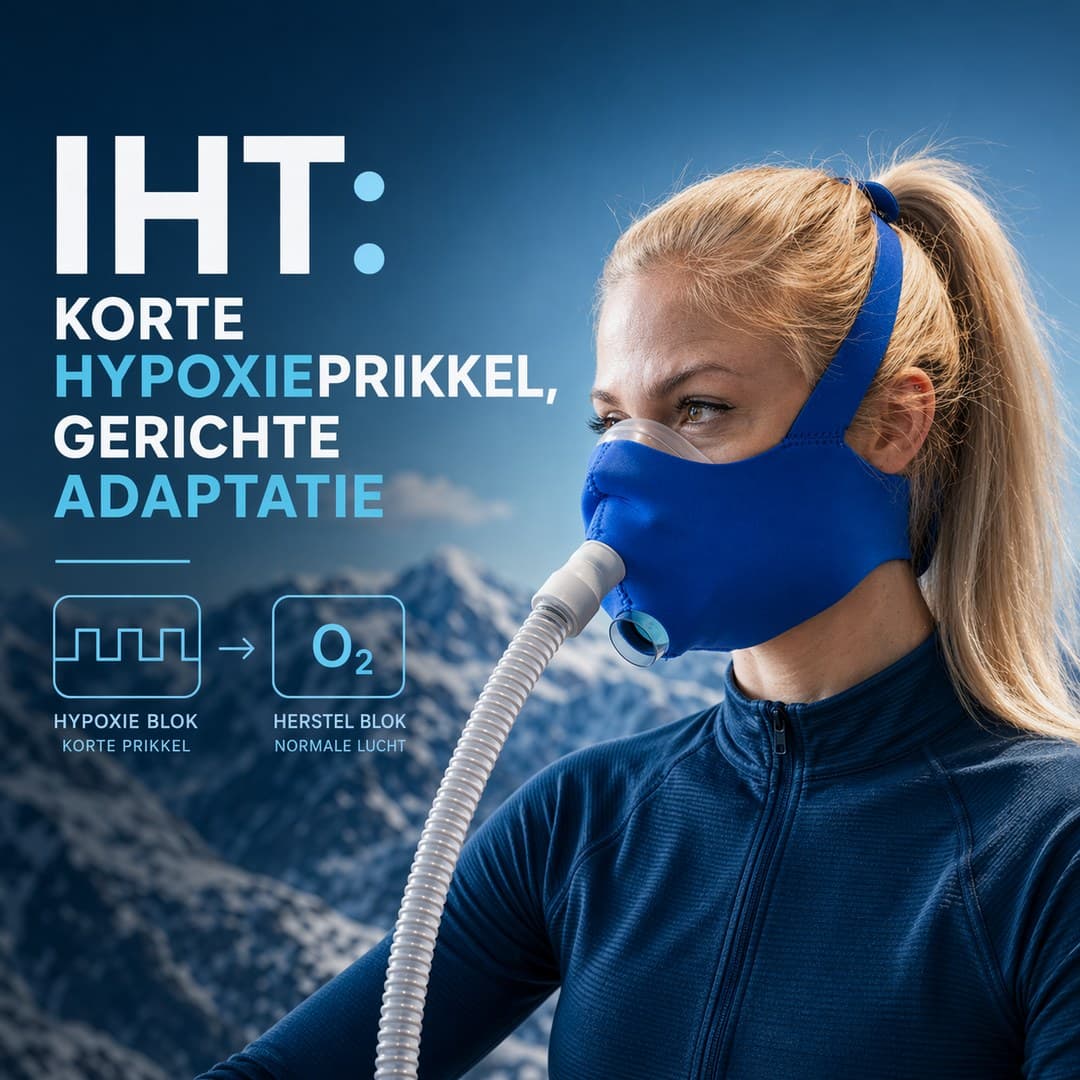
Intermittent hypoxic training, often abbreviated to IHT, is a method where you alternate short blocks of low-oxygen air with recovery in normal air. It sounds technical, but the gist is simple: you give your body a targeted hypoxia stimulus without having to spend days at altitude. This makes intermittent hypoxic training interesting for athletes, mountain travellers and people who want to target altitude training, but not automatically the best choice for everyone.
If you are still unsure which approach is best suited to your goal, it is smart to take the different forms of altitude training side by side. Indeed, IHT has a different impact profile than sleeping in a high altitude tent, a classic live high train low track or a true altitude stage.
Short answer
- IHT is a protocol with short hypoxia blocks and recovery times.
- The method can help with ventilatory adaptation, efficiency and training stimulus.
- For a higher total hypoxic dose, a high altitude tent or longer high altitude pathway often makes more sense.
- The value of IHT depends heavily on purpose, timing, structure and guidance.
Conclusion: IHT is mainly a targeted additional incentive, not an all-in-one solution.
Nuance: The effect is usually smaller and more protocol-sensitive than in well-executed longer-term hypoxic exposures.
Practical hook: Look first at your goal: performance, acclimatisation, training variety or recovery of training quality.
What exactly intermittent hypoxic training is
In intermittent hypoxic training, you breathe air with less oxygen than at sea level for short periods. This is followed by another recovery block with normal air. In many home systems, this is done via normobaric hypoxia: the air pressure remains the same, but the oxygen percentage is reduced. So your body experiences an altitude stimulus, but not the same combination of stimuli as during a real mountain environment.
In practice, the term IHT is sometimes used broadly. One provider means short sessions at rest with a mask, the other means light or interval exercise in hypoxia. This is precisely why it is important to look not only at the name, but at the content of the protocol: how many minutes of hypoxia, how much recovery, how often per week, with what goal and at what intensity.
How intermittent hypoxic training works in your body
The power of IHT is in repeated, controlled exposure. Because of those short hypoxia blocks, your body has to temporarily work with less available oxygen. That triggers a series of reactions. Your breathing becomes more sensitive to oxygen deprivation, the regulation of exertion changes and cellular signalling pathways associated with adaptation are activated.
If you want to delve further into those initial reactions, you can also read about what happens physiologically at oxygen deficiency in the body. This helps to understand why some people adapt quickly and others react much more sensitively to the same stimulus.
For athletes, it is especially important that IHT is not of primary interest because it would provide huge amounts of extra red blood cells in a short time. For that, the total hypoxic dose is usually too limited. The added value is more often in other adaptations: more efficient load handling, a stronger ventilatory stimulus, peripheral muscle adaptations and a smart extra training signal without necessarily having to sleep high for days in a row.
When intermittent hypoxic training makes sense
IHT makes particular sense if you are looking for a targeted, relatively brief hypoxia stimulus. Think of an athlete who is short on time, an athlete who wants to maintain training quality at sea level, or a mountain traveller who wants to add an extra preparatory stimulus without immediately deploying a complete altitude training programme.
This can also be useful at home. A targeted protocol for IHT training at home is especially interesting when you want structure but don't want to sleep in hypoxia for nights on end. It is important then to know whether your goal is performance, habituation, supportive acclimatisation or simply protocol control.
IHT
Especially suits: short, focused extra incentive.
Strong point: Quick to deploy, easy to dose and little impact on sleep.
Less suitable as: you especially want to build up a lot of total hypoxic exposure.
Altitude tent
Especially suits: prolonged pre-acclimatisation or sleep high.
Strong point: more total hypoxic dose and well-scheduled at home.
Less suitable as: you sleep badly in hypoxia or only want short sessions.
Real height
Especially suits: mountain-specific preparation and terrain experience.
Strong point: context-specific, with realistic pacing and recovery stimulus.
Less suitable as: want to keep your training quality high or have little time.
How intermittent hypoxic training works in practice
The best way to look at IHT is as a dosage module. Not as a loose gadget. You build a good protocol. First you look at how someone responds. Only then do you increase duration, frequency or depth of the stimulus. This is not only safer, but also smarter. Going too heavy too soon makes your sessions more likely to get messy and the quality drops.
Indicative start-up protocol
Phase 1 - getting used to it
Work with mild hypoxia and short blocks. The goal is to build tolerance, not force it. Think in minutes that remain doable, with full recovery between stimuli.
Phase 2 - building up
Only when response, recovery and sleep remain stable, increase the session duration or number of repetitions. The quality of the protocol remains leading.
Phase 3 - targeted
Now you tailor the protocol to your goal. For sports performance, acclimatisation or supportive stimulus, you choose a different timing and emphasis.
Phase 4 - evaluating
After a few weeks, look not just at feeling, but at trend data. If the protocol is not working, adjust instead of automatically going harder.
Checklist for a good start
- First, formulate one clear main goal.
- Choose a protocol that suits your schedule and recovery capacity.
- Start with an incentive that feels doable.
- Do not immediately combine IHT with heavy training weeks without experience.
- Evaluate only after several sessions, not on the basis of one day.
Common misconceptions about IHT
The biggest misconception is that IHT would be the same as sleeping in a high altitude tent. It isn't. An altitude tent mainly builds up total hypoxic exposure, often during the night. IHT works with short, defined stimuli. The overlap is in the oxygen deprivation, but the training logic and adaptation are not identical.
A second misconception is that lower saturation is automatically better. In reality, a single low reading says little. You are not looking for a spectacle number, but a usable stimulus that you tolerate well and that fits within the rest of your load.
A third misconception is that IHT is always enough for mountain preparation. For some purposes, it can be a useful addition. But if you really need a lot of acclimatisation gains, additional total exposure usually remains more important than just short sessions.
This is how you monitor this lens
Good IHT is measurable. Not clinically excessive, but objective enough to see if your protocol is working. In doing so, always use multiple signals simultaneously.
What you pay attention to
SpO2 trend: look at attrition over several sessions, not a single isolated value. You can find more context on interpretation at oxygen saturation at altitude.
Sleep quality: restless nights after sessions are a signal that the overall load may be too high.
Recovery: pay attention to fatigue, resting heart rate, training freshness and overall load capacity.
Symptoms: headache, nausea, agitation, dizziness or noticeable tightness are not signs to reason away.
Practical decision rules
If you continue to feel stable after several sessions, you can slowly build up the protocol.
Deteriorate sleep and recovery, lower the stimulus before jumping to conclusions.
If obvious symptoms arise, stop and evaluate goal, dosage and timing.
If you see no effect, ask not only if it was too light, but also if the goal fits IHT.
When IHT is and is not the best choice
Makes sense though
You are looking for a short, controllable hypoxia stimulus.
You want to maintain training quality at sea level.
You want to work focused at home without immediately sleeping nights in hypoxia.
You use IHT as a supplement, not as a magical replacement for everything.
Less logical
You expect big effects with no consistent build-up.
Your goal especially requires a lot of total hypoxic exposure.
You are already on the edge of overwork or poor sleep.
You have acute symptoms, unexplained tightness or relevant medical risks without screening.
For people with pregnancy, unstable cardiovascular or pulmonary problems, acute infection, recent medical complaints or unexplained exertion symptoms, IHT should not be something you try out on your own without obligation. If so, medical coordination is wise before you start.
FAQ on intermittent hypoxic training
Is intermittent hypoxic training the same as sleeping in an altitude tent?
No. IHT works with short sessions. An altitude tent usually builds up a much larger total hypoxic dose, especially during sleep or prolonged rest.
How quickly do you notice effects of IHT?
It depends on goal, frequency and baseline. You often look better at trends over several weeks than at a feeling after one session.
Can IHT prevent altitude sickness?
IHT can be a useful preparatory incentive, but is no guarantee against altitude sickness. For serious mountain goals, total acclimatisation remains decisive.
Is a lower SpO2 during a session always better?
No. A useful trend is more important than an extremely low single reading. Well-tolerated incentives usually work better than spectacular numbers.
Unsure if IHT is the right form for you?
Not every goal requires the same hypoxia stimulus. Sometimes a short IHT protocol makes sense; sometimes an altitude tent or some other form of altitude training fits better. Compare options first, so you choose in a focused way.
Conclusion
Intermittent hypoxic training can have a lot of value, but especially if you are sharp on target. Think of it as a precision tool. Not as a replacement for any other form of altitude training. For some athletes, it's a smart extra incentive. For some mountain travellers, it's a useful addition. And for others, on the contrary, more total hypoxic exposure is the better route.
Those who use IHT properly work in a controlled, measurable and planable way. Those who sell it too big often make it more vague than necessary. That is precisely where the difference lies between an interesting tool and a method that really delivers.


