How high can you go with a height generator?
Published 28 August 2012 · 7 min read

How high you can safely and meaningfully go with a height generator depends on your objective, your experience, and how well your body reacts to oxygen deprivation. Many users focus too quickly on “as high as possible”, whereas controlled progression is usually much more effective. For most athletes, the optimal sleeping altitude lies between 2000 and 3000 metres simulation. For mountain expeditions, higher altitudes can be worked towards temporarily, but only with sufficient progression, monitoring, and recovery.
In this article, you will learn what heights are realistic with a height generator, when higher is not automatically better, and how to create a safe, measurable climb with a height tent or height chamber.
Short answer: Most altitude generators can technically simulate up to around 6000 metres or higher, but that doesn't mean it's physiologically sensible or safe for prolonged use. For sleep altitude, the practical zone is usually between 2000 and 3500 metres.
- 2000 – 2500 metres: often an ideal starting zone
- 2500–3500 metres: strong acclimatisation stimulus
- 3500+ metres: use only under controlled and targeted conditions
Conclusion: Going higher with a height generator isn't automatically better.
Nuance: The optimal height depends on recovery, sleep quality, and SpO2 trend.
Practical hook: A gradual build-up usually yields more effect and fewer complaints.
Why “as high as possible” is often the wrong question
An altitude generator lowers the oxygen percentage in the air via normobaric hypoxia. The air pressure remains the same, but your body experiences less available oxygen. This activates physiological processes relevant to acclimatisation, recovery, and performance.
However, a misunderstanding often arises: as if higher simulation altitudes automatically lead to better results. In practice, it usually works differently.
With excessively aggressive heights, you actually see more often:
- poorer sleep quality
- more night waking
- higher resting heart rate
- persistent fatigue
- declining training quality
- more headaches or nausea
That's why a controlled build-up often works better than a maximum simulated altitude from day one. Especially with sleeping in a hypoxia tent, it's not just about the altitude itself, but primarily about the combination of dose, duration, and recovery.
Those who wish to understand more about the physiological basis of hypoxic training can also read the article on how altitude training works read.
Which altitudes are practically and physiologically relevant?
The zones below give a realistic picture of how altitude generators are typically used for acclimatisation at home and altitude training.
| Height zone | Practical significance | Typical application |
|---|---|---|
| 1500 - 2000 m | Very mild irritation | Initial phase and acclimatisation |
| 2000 – 2500 m | Often optimal base zone | Sleep height for athletes |
| 2500-3000 m | Robust acclimatisation stimulus | Expeditions and achievements |
| 3000 - 3500 m | More physiological stress | Dish preparation |
| 3500 metres | For controlled use only | Short, focused sessions |
Significance: Very mild irritation
Application Initial phase and acclimatisation
Significance: Often optimal base zone
Application Sleep height for athletes
Significance: Strong acclimatisation stimulus
Application Expeditions and achievements
Significance: More physiological stress
Application Dish preparation
Significance: For controlled use only
Application Short, focused sessions
For most users, the “sweet spot” is surprisingly often lower than expected, especially when sleep quality and training load remain important.
Technically, how high can a height generator go?
Many modern altitude generators can produce oxygen percentages that correspond to altitudes of approximately 5,000 to 6,500 metres. Some systems can even go to lower oxygen percentages.
However, that doesn't mean you should sleep there for a long time.
The technical capacity of a generator is, after all, different from its physiologically optimal operating zone. Compare it to a sports car: just because it can drive at 300 km/h doesn't mean that's the best speed for everyday use.
⚠️ Reality check
With prolonged sleeping above approximately 3500 metres simulation, the chance of sleep disturbance and overload clearly increases. This does not mean that higher blocks are never useful, but they require more experience and monitoring.
For expeditions in the 5000 to 8000 metre range, higher simulated altitudes are sometimes used temporarily as an additional acclimatisation stimulus. This should ideally be done gradually and not abruptly.
How do you safely build height?
A good build-up usually works better than rapid ascent. That applies to both athletes and mountain climbers.
Example of a calm build-up
| Week | Height | Focus |
|---|---|---|
| Week 1 | 1800 – 2200 m | Acclimatisation and sleep quality |
| Week 2 | 2200 – 2600 m | Stable adaptation |
| Week 3 | 2600 – 3000 m | Stronger hypoxic stimulus |
| Week 4+ | Depending on the purpose | Fine-tuning and monitoring |
Height: 1800 – 2200 metres
Focus: Acclimatisation and sleep quality
Height: 2200 – 2600 metres
Focus: Stable adaptation
Height: 2600 – 3000 metres
Focus: Stronger hypoxic stimulus
Height: Depending on the purpose
Focus: Fine-tuning and monitoring
This approach aligns better with how the body actually acclimatises. You can read more about this in the article on The erection schedule for a height tent.
When does going higher make sense?
Higher simulation altitudes can be useful when:
- has been acclimatising stably for several weeks
- your sleep quality remains good
- your recovery remains stable
- you are working towards an expedition above 5000 metres
- if you have experience with hypoxic training
For expeditions to, for example, the Andes, Himalayas or 6000-metre peaks, a temporary higher stimulus may be logical. Even there, however, the principle still applies: controlled progression generally works better than forcing it.
When acclimatising at home, it's ultimately not about the highest possible setting, but about a sufficiently strong stimulus that you can also sustain over time.
Common mistakes in higher education
- Too rapid a climb in simulation altitude
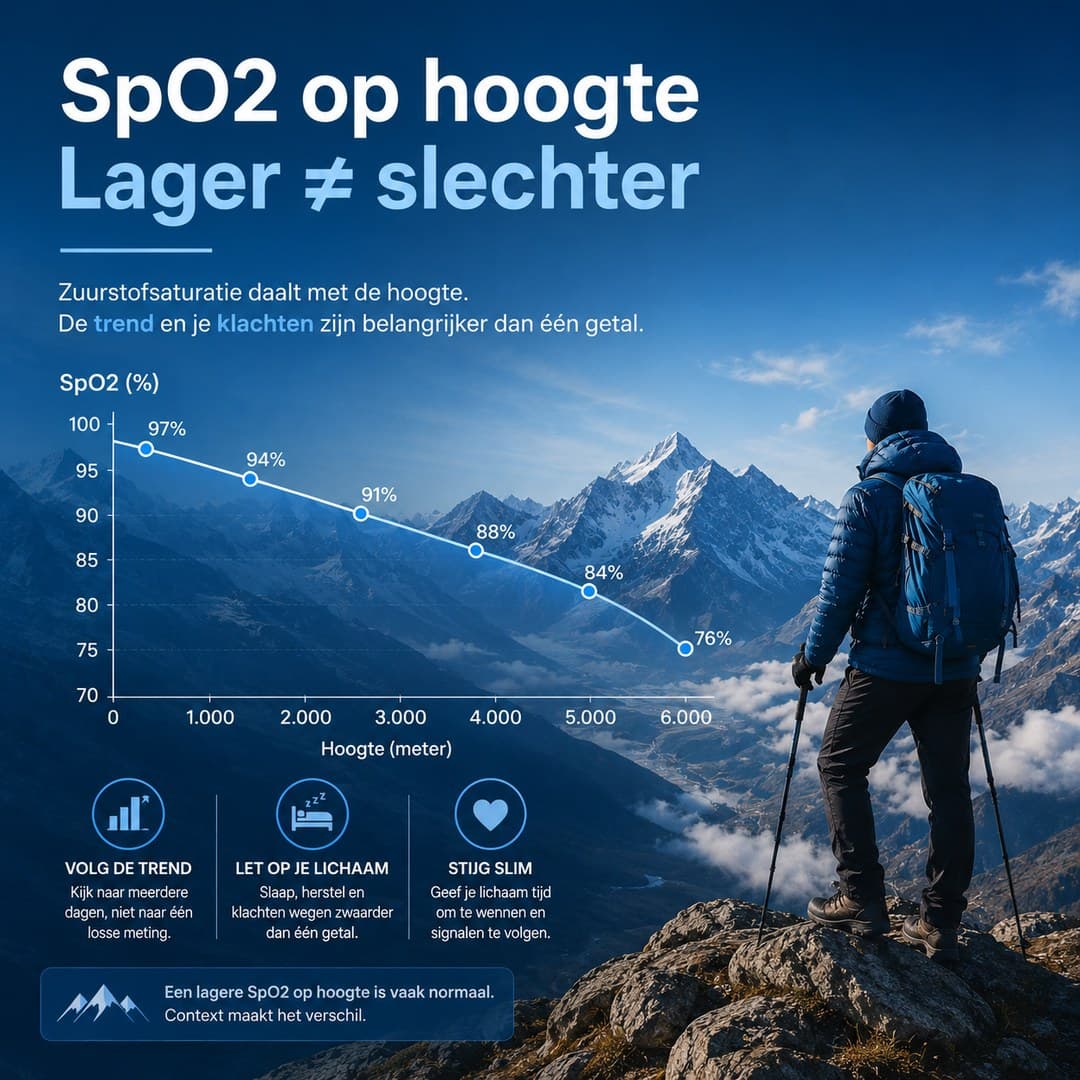
- Just look at SpO2
- Ignoring poor sleep
- underestimating training fatigue
- starting directly above 3500 metres
- Ignore nocturnal complaints
The combination of high training load and aggressive hypoxia, in particular, can disrupt recovery. Therefore, sleep quality and how you feel in the morning are often at least as important as a good saturation reading.
💡 Did you know?
Many top athletes do not sleep extremely high up in a altitude tent. They actually choose an altitude at which recovery, sleep and training quality remain stable. This often yields more results in the long term.
This is how you monitor this lens
Never ski blind. Good monitoring prevents you from building up too quickly or too aggressively.
| Parameter | What are you looking at? | Interpretation |
|---|---|---|
| SpO2 trend | Comparing multiple days | Trend more important than isolated value |
| Sleep quality | Doorslapen en herstelgevoel | Deterioration can mean too much stimulus. |
| Recovery | Fast heart rate and fatigue | Persistent decline is a warning sign |
| Symptoms | Headache, nausea, restlessness | Adjust if complaints increase |
Focus: Comparing multiple days
Interpretation: Trend more important than isolated value
Focus: Doorslapen en herstelgevoel
Interpretation: Poorer sleep can indicate excessive stress/burden
Focus: Fast heart rate and fatigue
Interpretation: Persistent decline is a warning sign
Focus: Headache, nausea and restlessness
Interpretation: Adjusting when complaints increase
Those who wish to understand more about the safe interpretation of saturation at altitude can also read the article about oxygen saturation at altitude read.
When should you go lower?
A lower setting is often smarter when:
- you sleep badly for several nights
- you constantly wake up exhausted
- my training quality is noticeably decreasing
- your morning heart rate remains elevated for a long time
- you develop a headache or nausea
In many cases, sleeping slightly lower ultimately leads to more acclimatisation, as you can sustain the stimulus better.
This also ties in with the principle of sleep high train low, where the balance between hypoxic stimulus and training quality is central.
Do you want to know which height is logical for your purpose?
For some athletes, 2200 metres works optimally. For expeditions, temporarily going higher can be advantageous. A good plan isn't about maximum altitude, but about the right balance between stimulus, recovery, and timing.
FAQ
Is it possible to sleep directly at 4,000 metres in a height tent?
This is usually discouraged. A gradual build-up often gives better sleep quality and more stable adaptation.
Is taller always more effective?
No. Simulation times that are too long can worsen recovery and sleep.
What is usually the best sleep height for athletes?
For many athletes, the effective zone lies between approximately 2,000 and 3,000 metres.
Can you acclimatise for expeditions with an altitude generator?
Yes. An altitude tent or altitude chamber can support acclimatisation in a controlled, measurable, and planned way. However, it remains a supplement to real acclimatisation.
When should you lower the height?
If poor sleep persists, you experience significant fatigue, or your symptoms worsen, reducing your intensity or workload is often advisable.
Conclusion
The maximum altitude of an altitude generator is less important than the altitude at which your body remains stable and functional. For most users, controlled zones between 2000 and 3000 metres already provide a strong stimulus.
Higher intensities can sometimes be beneficial, especially for larger expeditions. However, the best strategy generally remains the same: build up gradually, monitor objectively, and take sleep quality seriously.