Erythropoietin (EPO): what is it and how do you raise it?
Published 22 April 2026 · 10 min read
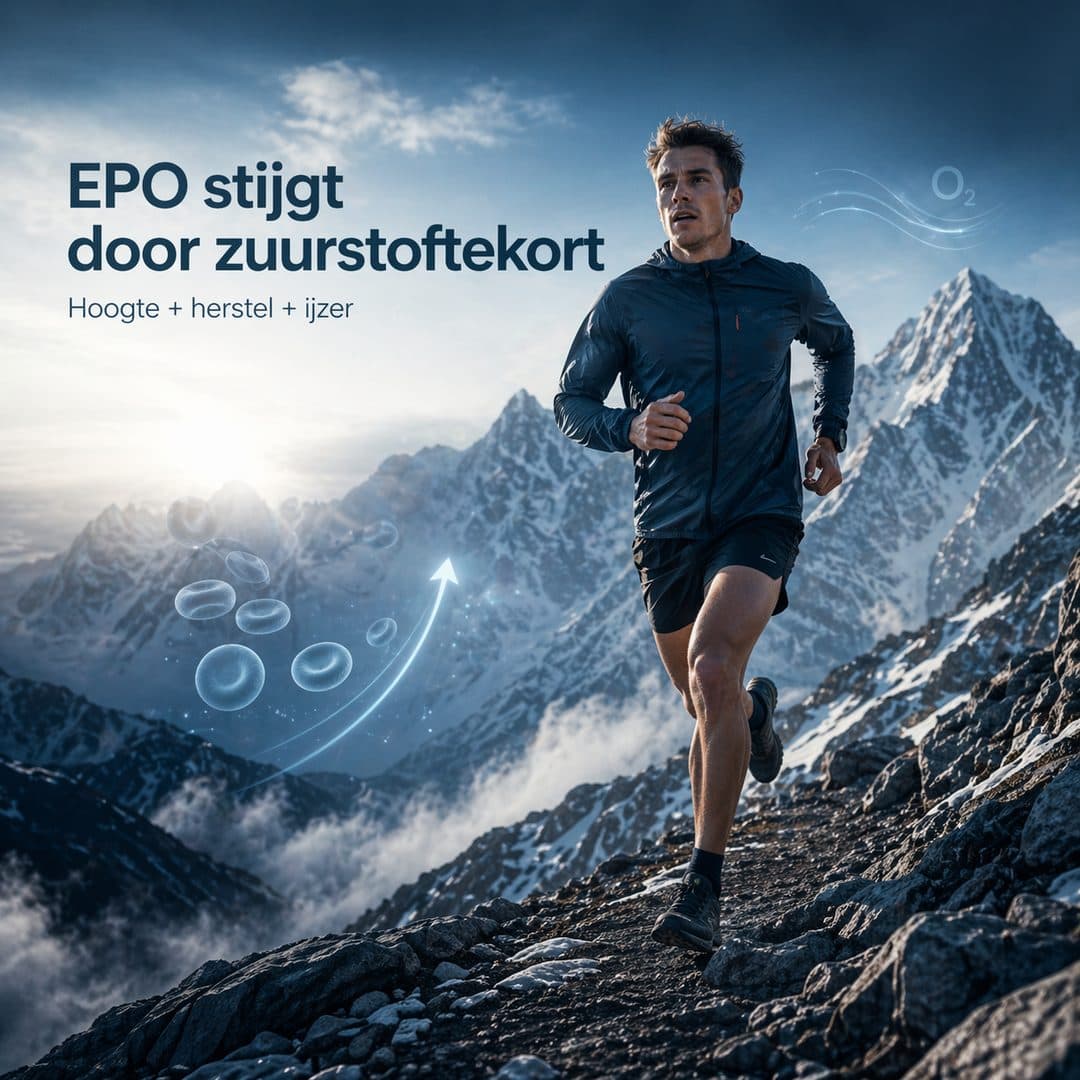
When you search for erythropoietin (EPO), you usually want to know if you can improve your oxygen transport, endurance or acclimatisation. The honest answer is sober. EPO is not a loose performance button. Your body makes it primarily in response to oxygen deprivation. Therefore, a real hypoxic stimulus, such as altitude or well-dosed simulated altitude, works better than quick hacks, supplement claims or breathing tricks. Moreover, not only EPO determines your result, but also iron status, recovery and training quality.
Direct response
- EPO is a hormone mainly from the kidneys that stimulates the production of red blood cells during oxygen deprivation.
- In practice, those who want to increase EPO naturally end up mainly with altitude, altitude training or controlled normobaric hypoxia.
- The hormonal rise starts quickly, but usable blood adaptation usually requires days to weeks and sufficient iron availability.
- Supplements, breathing masks and loose tricks are not a full alternative to a true hypoxic stimulus.
Conclusion: If you want to increase EPO, oxygen deprivation is the main route and not a loose “biohack”.
Nuance: More EPO does not automatically mean better performance, as iron, sleep and recovery have to cooperate.
Practical hook: Therefore, think in incentive plus preconditions plus monitoring.
What exactly is erythropoietin (EPO)?
Erythropoietin, commonly abbreviated as EPO, is a signalling hormone. It is mainly produced by cells in the kidneys when they notice a decrease in available oxygen. EPO then signals the bone marrow to produce more red blood cells. This makes sense: when oxygen becomes scarcer, your body wants to make its transport more efficient.
This also immediately removes the first fallacy. EPO is not the same as performance. It is the beginning of a chain. First the hormone rises, then your body has to actually build new red blood cells, and only then can that translate into higher haemoglobin mass and better oxygen delivery to your muscles. If you want to understand the broader physiological context, you can see this in the physiological benefits of altitude training.
The timeline is also important. In research, you see that EPO can rise within hours after acute hypoxia and often peaks within 24 to 48 hours. But the blood count changes more slowly. For noticeable adaptation, you usually need a large enough hypoxic dose, spread over several days or weeks. As a result, it makes little sense to look for quick fixes for one evening or one workout.
⚠️ Reality check
EPO is a trigger, not a final destination. Without sufficient iron, recovery and training build-up, the hormonal stimulus often remains stuck in something that seems interesting only on paper. The gains only occur when the whole chain cooperates, from kidney to bone marrow to performance.
How do you increase erythropoietin (EPO) naturally?
The most reliable natural route is simple: a real hypoxic stimulus. This can be in the mountains, during an altitude training session, or via well-set simulated altitude. The body does not respond to the idea of altitude, but to a sufficiently strong and sufficiently repeated drop in oxygen availability. This is precisely why the classical principle of sleep high, train low so relevant.
For athletes, the practical advantage of simulated altitude is that you can dose the stimulus better. In an altitude tent, it involves normobaric hypoxia: the air pressure remains the same, but the oxygen percentage drops. That makes the stimulus plannable. At the same time, nuance remains important. An altitude tent is neither a panacea nor a substitute for real acclimatisation on the mountain. Above all, it is a controlled way of getting the body used to less oxygen.
Those who want to cleverly increase EPO therefore not only look for more hypoxia, but also for the right dose. In the literature, you see effect mainly when the exposure is substantial enough: several hours a day, for at least a few weeks, rather than short single sessions. Too much stimulus doesn't work either, by the way. Then sleep deteriorates, recovery subsides and the net effect disappears.
What really works for EPO, and what especially doesn't?
| Route | Effect on EPA | When logical | Practical assessment |
|---|---|---|---|
| High altitude tent | Obvious and repeated hypoxic stimulus | In endurance sports, peak blocks and pre-acclimatisation | Main route if you really want to boost EPO naturally |
| Sleep high, train low | Well-supported for erythropoietic adaptation | When training quality at sea level remains important | Often smarter than just training hard in hypoxia |
| IHT or IHE | Can support, but not always strong enough as main stimulus | As a supplement or when sleep at altitude is not possible | Interesting, but usually not a full-fledged substitute |
| Correcting iron deficiency | Enables blood adaptation, but is not itself the main stimulus | In case of low iron status or high iron consumption | Essential prerequisite, not a shortcut |
| Supplements, masks, hacks | Little evidence for sustained EPO enhancement without true hypoxia | Especially marketing-sensitive | Not choosing it as a main strategy |
High altitude tent
Effect on EPA: clear and repeated hypoxic stimulus.
When logical: in endurance sports, peak blocks and pre-acclimatisation.
Practical assessment: this is the main route if you really want to boost EPO naturally.
Sleep high, train low
Effect on EPA: well-supported for erythropoietic adaptation.
When logical: when training quality at sea level remains important.
Practical assessment: often smarter than just training hard in hypoxia.
IHT or IHE
Effect on EPA: can support, but is not always strong enough as a main stimulus.
When logical: as a supplement or when sleep at altitude is not possible.
Practical assessment: interesting, but usually not a full-fledged substitute.
Correcting iron deficiency
Effect on EPA: enables blood adaptation, but is not itself the main stimulus.
When logical: in case of low iron status or high iron consumption.
Practical assessment: essential prerequisite, not a shortcut.
Supplements, masks, hacks
Effect on EPA: little evidence for sustained EPO elevation without true hypoxia.
When logical: especially marketing-sensitive.
Practical assessment: not choose it as a main strategy.
In summary, the hypoxic stimulus remains leading. Iron, nutrition and recovery mainly determine whether that stimulus actually produces useful adaptation.
Why more EPA is often oversimplified
The search question is understandable, but often too narrow. Many athletes think that higher EPO automatically means they get faster. In reality, the bottleneck is often elsewhere. Think low iron status, too little recovery, poor timing of hypoxic blocks or too much training stress. In that case, although you can generate a hormonal stimulus, you don't build much from it.
This is also why loose supplement claims are usually disappointing. They do not activate the fundamental signal that the kidneys need. The same applies to many respiratory hypotheses. Without real and repeated drops in oxygen availability, the effect on EPO usually remains limited or too short-lived to make much of a practical difference. If you want to better understand this supporting layer, also read about iron and nutrition during altitude training.
A second misconception is that higher would always be better. This sounds logical, but is often a mistake in practice. As soon as sleep quality and recovery collapse, you work against your goal. So the best EPO strategy is not the most aggressive, but the best dosage. This applies both to athletes and to people preparing for a mountain goal.
Practical protocol: this is how to smartly tackle natural EPO enhancement
- First, define your goal. Want to perform better at sea level, prepare a peak block or acclimatise for altitude? That determines the form and timing.
- Check your preconditions. Sufficient energy intake, stable sleep, recovery space and reasonable iron status are not a detail, but the basics.
- Choose a true hypoxic stimulus. This can be done via an altitude train, sleep high train low or a controlled system at home. Those wishing to delve into the differences can read how intermittent hypoxic training works.
- Start conservative. The first few days are meant to see how your body reacts, not to go as high as possible.
- Think in blocks of weeks, not single sessions. The hormonal surge may start quickly, but the usable adaptation builds up more slowly.
- Evaluate by outcome, not by feeling alone. Is your sleep getting calmer, training staying good and seeing functional progression? Then the dosage is usually more correct.
Common mistakes
- You focus on EPO, but ignore iron deficiency.
- You increase the altitude stimulus faster than your sleep can handle.
- You use short hypoxia sessions as if they were equivalent to sleep at altitude.
- You expect marked performance improvement within a few days.
- You only measure motivation or fatigue, but no trend in recovery.
This is how you monitor this lens
In EPO and altitude training, monitoring is not a luxury. It prevents you from expecting too much from too small a stimulus, or instead pushing too hard with a block that undermines your sleep and recovery. The most important rule here: look at trends, not just one isolated measurement.
What are you looking at?
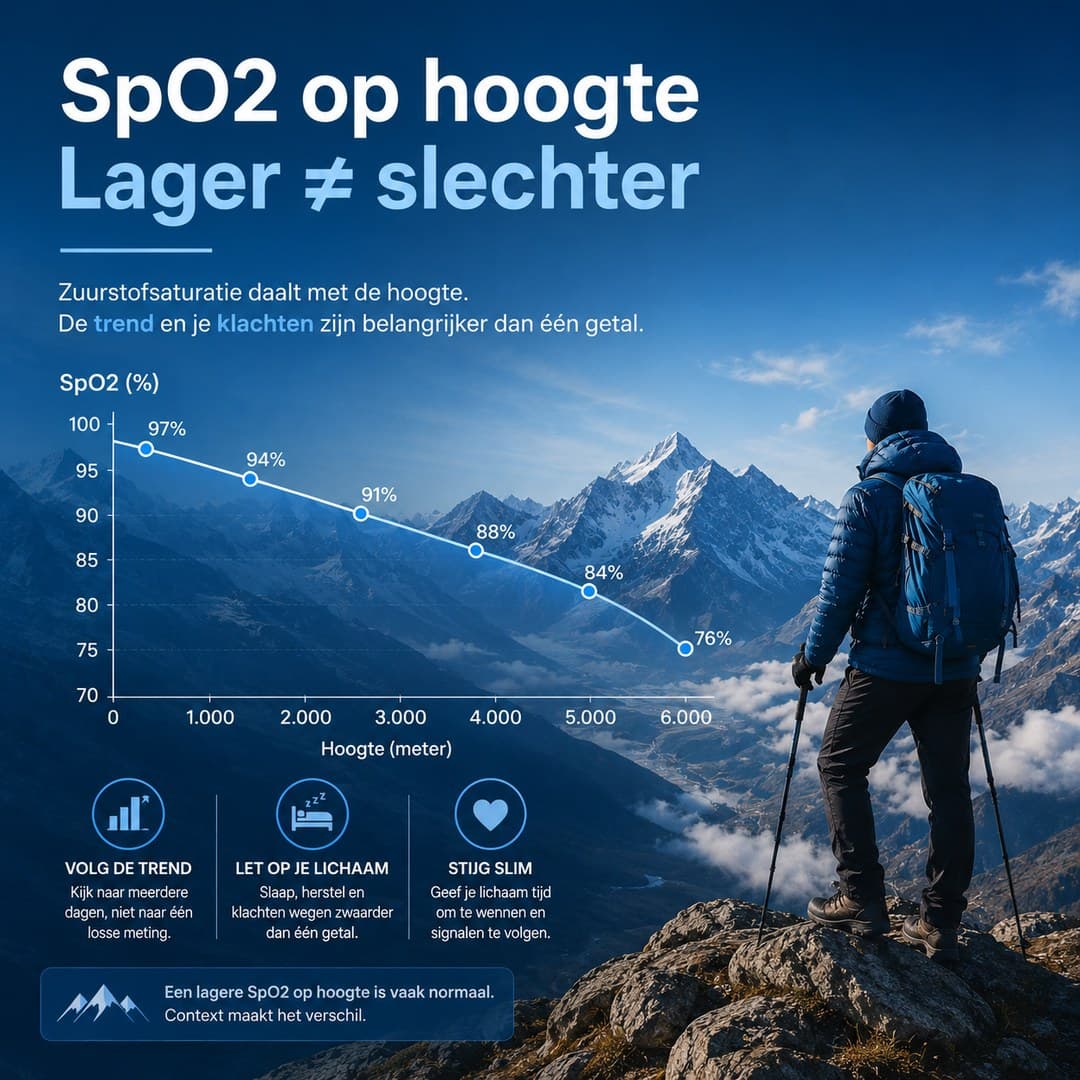
- SpO2 trend: not the absolute value, but the pattern over several days.
- Sleep quality: sleeping through, restlessness, frequent waking, feeling of recovery when getting up.
- Recovery: training quality, daytime fatigue, resting heart rate or general freshness.
- Symptoms: headaches, nausea, restless breathing or markedly worse functioning.
How do you interpret that?
- A slight adjustment phase in the first few days may be normal.
- Persistent poor sleep is not a sign of extra gain, but often of too much stimulus.
- If your training quality declines structurally, adjusting is smarter than forcing it.
- In case of a longer block or unexplained fatigue, laboratory monitoring may make sense via doctor or sports doctor.
Anyone serious about this would do well not to measure only subjectively. This is precisely why it is valuable to also look at how to measure the effect of altitude training. Then you steer for adaptation instead of hope.
When does focusing on EPA make sense, and when does it not?
Focusing on EPO is especially logical when oxygen transport can really be a limiting factor. You often see this in endurance athletes, during peak blocks towards an important race, or during pre-acclimatisation for altitude. Then it makes sense to think about the right hypoxic stimulus and its timing.
On the contrary, that focus makes less sense when the basics are still rattling. If your training consistency is low, your sleep is unsettled, your energy intake is deficient or you probably have low iron levels, more EPO rarely provides the greatest return. Then you have to solve the limiting factor first. After all, EPO is not a band-aid for a deficient base.
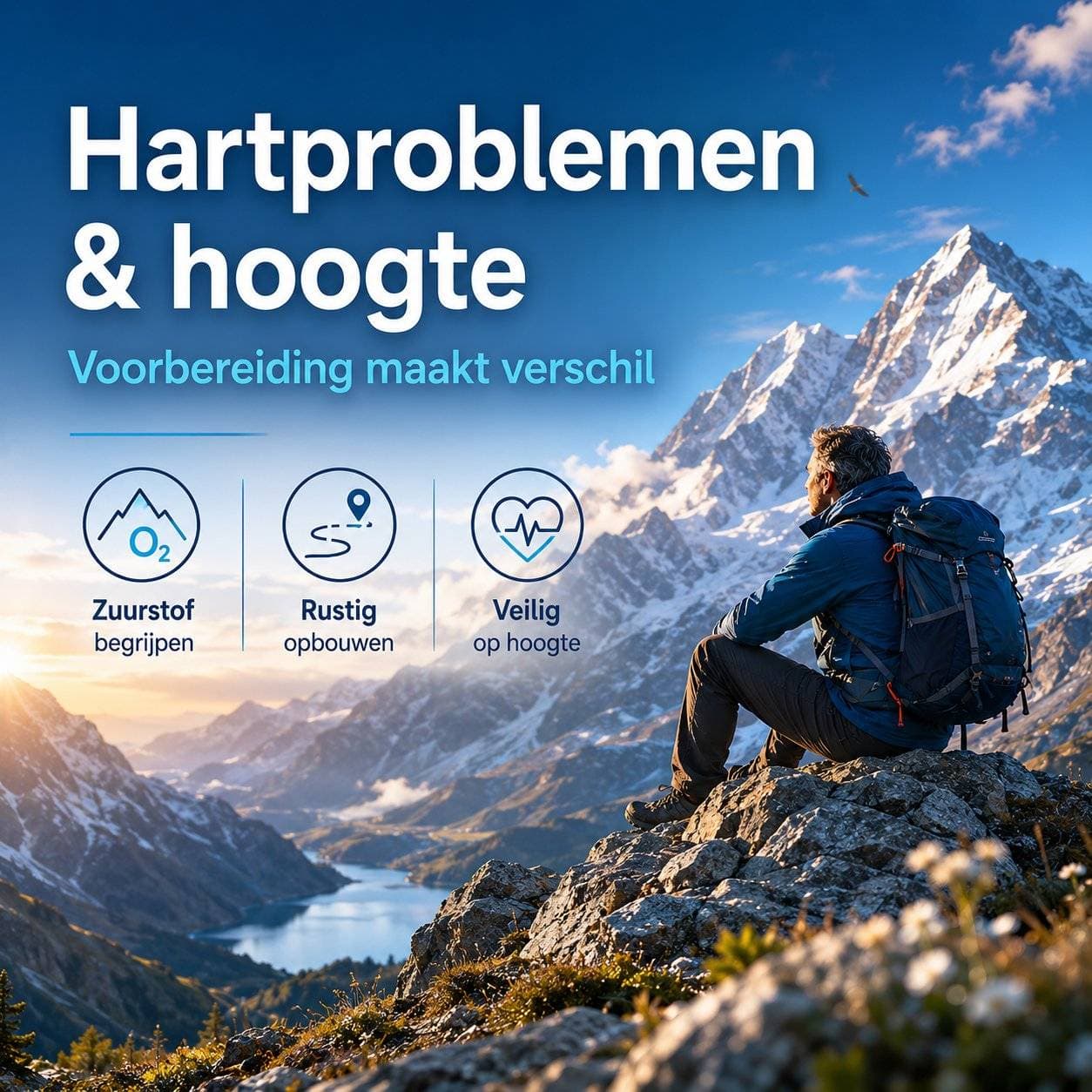
A separate issue is medical context. Synthetic EPO and other ESA agents belong in medical indications, such as certain forms of anaemia in kidney disease or chemotherapy, and are deliberately used there under supervision. In sports, EPO and similar drugs are on the banned list. So anyone with unexplained fatigue, anaemia or suspicion of a medical problem should not think in performance hacks, but in diagnostics via doctor or sports doctor.
Frequently asked questions about erythropoietin (EPO)
How fast does EPO rise after exposure to altitude?
Often within hours. The peak is regularly within 24 to 48 hours. That does not yet mean that your performance changes with it immediately. More time is needed for that.
Can you increase EPO without altitude or hypoxia?
Not in a way that is comparably reliable. Peripheral conditions such as iron and recovery help, but without a true hypoxic stimulus, the main stimulus usually fails.
Is an altitude tent the same as doping?
No. An altitude tent uses a natural physiological response to less oxygen. Synthetic EPO is a drug and is banned in sport.
Are breathing masks enough to really increase EPO?
Usually not. They often do not provide the same sustained hypoxic dose as sleeping or staying in a hypoxic environment for long periods of time.
Is this only relevant for elite athletes?
No. Ambitious recreational endurance athletes and mountain travellers can also benefit from a well-dosed approach, provided the goal is clear.
Want to choose the right altitude training form?
If you want to increase EPO, the next question is not whether to use hypoxia, but which form suits your goal, timing and load capacity. This follow-up article will help you sharpen that choice.
Conclusion
Erythropoietin is a clever survival mechanism of the body, not a magic shortcut. Those who want to increase Epo naturally therefore end up with a real hypoxic stimulus rather than loose marketing claims. But that is precisely where the key nuance lies: success is not only determined by the hormone itself, but by the whole context around it. Think iron availability, sleep, recovery and the right timing of your block.
That makes this topic less spectacular than many search results suggest, but more useful. If you look rationally, you don't need to look for the highest grade or the fastest hack. You want a stimulus strong enough to provoke adaptation, but controlled enough to leave recovery and training quality intact. That's exactly where the difference between smart raising and just trying harder arises.