Climbing Elbrus: route, altitude and preparation
Published 24 March 2026 · 4 min read
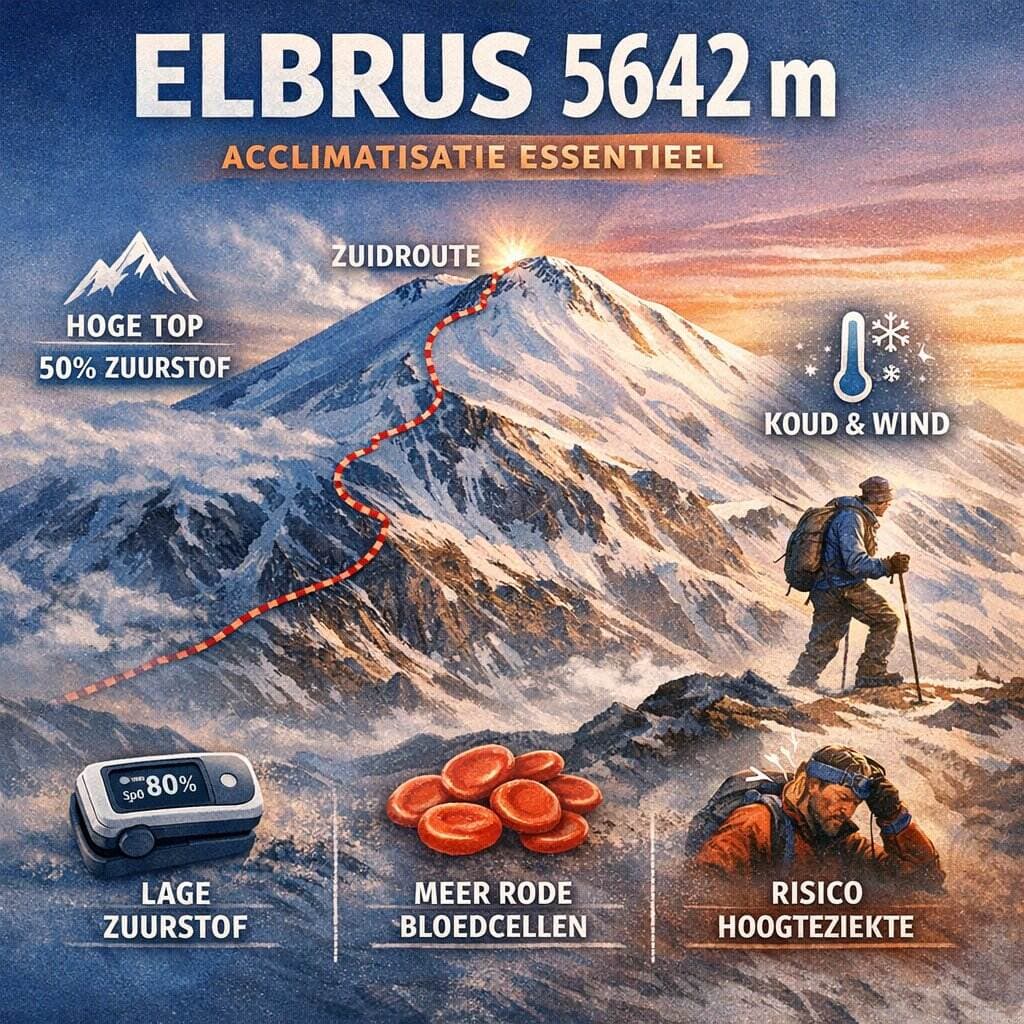
Climbing Elbrus means climbing to a height of 5642 metres. This makes Mount Elbrus the highest mountain in Europe and one of the Seven Summits. Many climbers underestimate this mountain because the technical difficulty is limited, but it is precisely the altitude that makes Elbrus tough. Above 5000 metres, the body reacts strongly to oxygen deprivation, causing fatigue, headaches and loss of performance quickly. Those who prepare well and take acclimatisation seriously increase their chances of reaching the summit safely.
In this article, you will read how high Elbrus is, which route is most commonly used, how a typical expedition goes and how to prepare your body for this altitude.
Read also: Seven Summits explained
The essentials in 30 seconds
Elbrus is 5642 metres high and requires good acclimatisation.
Most failed attempts are due to altitude sickness and exhaustion.
Preparation in advance significantly increases the chances of success.
🏔 Why Elbrus is heavier than many people think
Mount Elbrus is often seen as a relatively easy mountain because the standard route is not technically difficult. There are no steep rock faces and no complicated climbing techniques required. Yet every year, many climbers quit early. The reason is almost always the same: altitude.
At 5642 metres, only about half the oxygen is available compared to sea level. That means each step takes more energy, recovery is slower and the body has to constantly fight to take in enough oxygen.
Many people still feel fairly normal up to about 3,500 metres. Above 4000 metres, that changes rapidly. Breathing becomes heavier, sleeping gets worse and the pace drops. Those who then continue ascending too quickly develop symptoms of altitude sickness.
Read also: altitude sickness explained
📊 How much oxygen is there at the altitude of Elbrus?
| Height | Oxygen available | Effect on body |
|---|---|---|
| 2000 m | 80% | slight adjustment |
| 3000 m | 70% | faster breathing |
| 4000 m | 60% | obvious fatigue |
| 5000 m | 50% | great burden |
| 5642 m | ±48% | very hard effort |
Read also: height to oxygen table
🧭 The most frequently used route on Elbrus
Most expeditions use the south route. This route starts from the ski area and uses lifts and huts. This makes the climb seem easier than, say, in the Alps, but that can be misleading. Because you get to high altitude relatively quickly, the body has less time to adapt.
A typical expedition starts around 2000 metres, after which you sleep in a few days above 4000 metres. For many people, that is when the first symptoms appear. Headaches, poor sleep and reduced appetite are normal, but should not get worse too quickly.
Other routes, such as the north route, are quieter and often better for acclimatisation, but physically tougher.
⚠️ Why many Elbrus expeditions fail
Most failed attempts have nothing to do with technique, but with a combination of altitude, cold and fatigue. The summit day is especially tough. You usually leave in the middle of the night and often spend 10 to 12 hours on the road.
At this altitude, the body works differently. Muscles acidify faster, the heart has to work harder and recovery takes longer. If you are not properly acclimatised, every step feels like walking through thick air.
Typical causes of failed attempts are:
- too rapid rise
- poor acclimatisation
- cold and wind
- depletion
- altitude sickness
📅 How a normal Elbrus expedition goes
A standard Elbrus programme usually lasts seven to 10 days. That is relatively short for a mountain above 5,600 metres. Therefore, it is important to build up acclimatisation properly.
| Day | Height | Target |
|---|---|---|
| 1 | 2000 m | arrival |
| 2 | 3000 m | Getting used to height |
| 3 | 3500 m | acclimatisation |
| 4 | 4000 m | sleep high |
| 5 | 4500 m | climbing training |
| 6 | rest | |
| 7 | top day |
This schedule works well if your body adapts quickly, but not everyone reacts the same to altitude.
Read also: acclimatising for 6000 metres
🧪 This is how you monitor acclimatisation objective
With high mountains, it is wise not to rely on feeling alone. You can track acclimatisation well by measuring a few signals.
- SpO2 trend in the morning
- sleep quality
- resting heart rate
- headache or nausea
- recovery after exercise
Important rule:
If your SpO2 stays above 94% for several days, you can go higher.
If your SpO2 stays around 90% or lower, you are going too fast.
Read also: oxygen saturation at altitude
🏕 Preparation beforehand makes all the difference
As most Elbrus expeditions are relatively short, more and more climbers are choosing to prepare for altitude beforehand at home. Acclimatising in advance allows the body to start adjusting before the expedition even starts.
This happens through prolonged exposure to air with less oxygen. The body responds by making more red blood cells and using oxygen more efficiently. As a result, acclimatisation on the mountain is often more relaxed.
Read also: acclimatising at home for mountain expeditions
💡 When preparation is extra important
- first time above 4000 metres
- first time above 5000 metres
- short expedition
- prone to altitude sickness
- little time for acclimatisation
🎯 Conclusion
Climbing Elbrus is technically feasible for many mountaineers, but the altitude makes this expedition tough. Giving the body time to adjust reduces the risk of altitude sickness and increases the chances of reaching the summit. Good preparation, a leisurely acclimatisation schedule and listening to the body's signals are more important than speed.
Want to prepare for a climb above 6,000 metres?
Check out the pre-acclimatisation programme for 6000 metres here
❓ FAQ
How high is Elbrus?
5642 metres.
Is Elbrus difficult?
Not technically, but physically demanding due to height.
How long does the climb take?
Usually 7 to 10 days.
Do you need acclimatisation?
Yes, above 5000 metres, acclimatisation is essential.