Getting started in mountaineering: are you ready for 4,000, 5,000 or 6,000 metres?
Published 21 May 2026 · 14 min read
Starting mountaineering requires more than rope techniques, crampons, and good physical condition. The most important question is: what altitude level is now suitable for your experience, body, and preparation? A first 4000m peak in the Alps requires something different than trekking above 5000 metres or a first 6000m peak in the Andes or Himalayas. Those who build up these steps smartly increase their chances of success and simultaneously reduce the risk of altitude sickness considerably.
For novice mountaineers, altitude often feels abstract at first. On paper, 4000, 5000 or 6000 metres is primarily just a number. In reality, the strain on sleep, recovery, breathing, appetite, and decision-making changes with each altitude level. Therefore, good preparation is much more than just training. You need to know when you are technically ready, how your body reacts to altitude, and when extra acclimatisation beforehand becomes sensible.
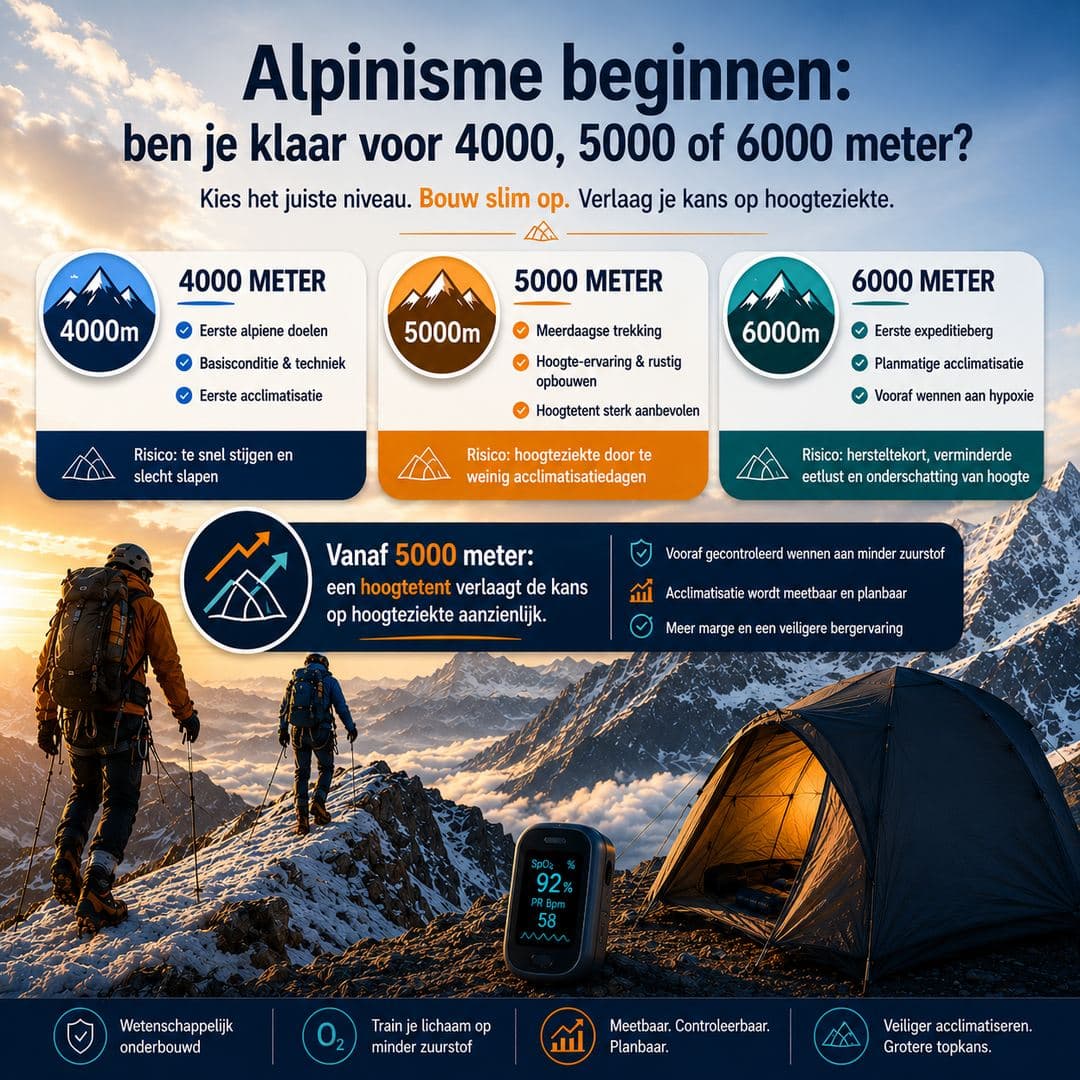
Short answer: It's best to start mountaineering step by step. First, build up basic experience in the Alps. Then, choose your first 4000m peak with a logical acclimatisation profile. Only attempt a 5000m peak with a clear plan. From 5000m upwards, we strongly recommend a height tent, as sleeping with less oxygen beforehand measurably supports acclimatisation and can significantly reduce the chance of altitude sickness.
Conclusion: Climbing doesn't start at the highest mountain, but with the right next step.
Nuance: Technique, conditioning, and sensitivity to height do not always develop at the same rate.
Practical hook: Use 4000, 5000 and 6000 metres as decision levels for your preparation.
Starting mountaineering without overestimating yourself
Many people start mountaineering from hiking, trail running, skiing, climbing or mountain trekking. This forms a strong foundation. Yet mountaineering is a different world. In alpine terrain, altitude, cold, changing weather, fatigue and technical choices all come together.
This is why a good first step is not just about peak performance, but primarily about resilience. Can you sustain effort for several days in a row? Do you remain calm when the pace is slow? Do you recognise symptoms such as poor sleep, headaches, or a reduced appetite? Furthermore, it is important that you understand how your body reacts to acclimatising at altitude.
This last point in particular is often underestimated. Someone can be fit at sea level and still sleep poorly at 3,500 metres. Even strong climbers sometimes get headaches above 4,500 metres. Furthermore, technical skill says little about how well your body processes altitude.
In practice: The best beginner mountaineer is not the one who climbs the fastest, but the one who reads their limits well. Altitude rewards patience. Those who progress too quickly from the Alps to higher mountains usually lack not strength, but acclimatisation.
The roadmap: from hiker to 6000 metres
A strong foundation consists of three stages. First, you learn to move in alpine terrain. Then, you discover how your body reacts at altitude. Only then does a 5000m or 6000m peak become logical. This sequence sounds simple, but in practice, ambitious mountaineers often skip the second step too quickly.
Many problems arise there. Above 4,000 metres, oxygen scarcity becomes noticeable. From 5,000 metres, recovery clearly slows. Heading towards 6,000 metres, preparations must then become much more systematic. Not because every 6,000er is extremely technical, but because the physiological margin for error becomes smaller.
| Level | Suits | Most important preparation | Greatest risk |
|---|---|---|---|
| 4,000 metres | First Alpine goals in the Alps | Basic condition, technique, guide or course, first acclimatisation | Rising too quickly and sleeping poorly |
| 5,000 metres | Multi-day trekking or higher alpine objectives | Altitude experience, gradual acclimatisation, monitoring and preferably a hyperbaric chamber | Altitude sickness due to too few acclimatisation days |
| 6000 metres | First expedition mountain or high trekking peak | Systematic acclimatisation, sleep strategy and pre-acclimatisation to hypoxia | Recovery deficit, reduced appetite and underestimation of height |
Fits first Alpine objectives in the Alps.
Preparation: Basic fitness, technique, guide or course, initial acclimatisation.
Risk: rising too quickly and sleeping badly.
Fits multi-day treks or higher alpine objectives.
Preparation: Altitude experience, gradual build-up, monitoring and preferably an altitude tent.
Risk: Altitude sickness due to too few acclimatisation days.
Fits first expedition mountain or high trekking peak.
Preparation: Systematic acclimatisation, sleep strategy and pre-acclimatisation to hypoxia.
Risk: recovery deficit, reduced appetite, and underestimation of altitude.
Starting mountaineering at 4000 metres: the first real test
For many aspiring mountaineers, a first 4,000-metre peak is the moment where hiking, climbing, and altitude come together. Consider accessible alpine summits, a first glacier tour, or a guided ascent with a mountain guide.
At 4000 metres the air is noticeably thinner. Breathing quickens, your heart rate is higher, and sleep can become more restless. Nevertheless, this altitude remains very achievable for many people, provided the progression is correct. A night at altitude, a gentle lead-up, and a controlled ascent rate often make a big difference.
For example, if you're thinking about Mont Blanc, you shouldn't just look at the route. The build-up in the days before is at least as important. Good preparation for Mont Blanc acclimatisation involves timing, sleep altitude and recovery. Extra training hours in the final week usually won't fix a poor acclimatisation profile.
You are likely ready for your first 4,000er if:
- feeling up to it for several days in a row in mountainous terrain;
- basic experience of ascending, descending and cold conditions is present;
- starting calmly feels more important than picking up the pace;
- headache, nausea and poor sleep at altitude are recognisable signs;
- Technical risks are covered with a guide, course, or experienced partner.
From 4000 to 5000 metres: where the altitude tent becomes important
The step from 4000 to 5000 metres feels smaller than it is. At 5000 metres, sleeping often becomes more difficult. Recovery also takes longer. Furthermore, many people notice that their appetite decreases and that a normal walking pace suddenly feels strenuous.
From this level, the preparation therefore fundamentally changes. Where 4000 metres often revolves around a good alpine day, 5000 metres requires more attention to multi-day load. Not just the summit day counts, but also the days before and after.
This is why we clearly recommend a height tent from 5,000 metres and up. This is especially true with few acclimatisation days, rapid travel, or a previous sensitivity to altitude. The reason is simple: at home, the body already receives a controlled low-oxygen stimulus. This means your trip doesn't start completely from scratch.
A classic mistake is assuming that success on a 4,000-metre peak automatically gives you confidence for 5,000 metres. This might be justified, but only if the route, sleeping altitudes, and acclimatisation days are correct. A 5,000-metre peak with a quick approach and few rest days can consequently feel harder than a technically more difficult mountain with better preparation.
4000 metres often feels like: An alpine test of technique, fitness and initial acclimatisation.
5000 metres often feels more like: A test of sleep, recovery, nutrition and patience.
"Les" Don't just train harder. Above all, plan smarter and, from this level, actively consider an altitude tent.
Starting mountaineering towards 6000 metres: preparation becomes decisive
A first 6000er is a milestone for many mountaineers. Think of Mera Peak, Island Peak, Huayna Potosi, Cotopaxi, Elbrus as a transitional goal or other high expedition-style mountains. The technical difficulty varies greatly from mountain to mountain. However, the physiological load always remains serious.
Around 6,000 metres, the difference between being well-prepared and just not quite prepared often becomes significant. Nights weigh heavier. Minor complaints can quickly accumulate. Additionally, mental acuity becomes more vulnerable when sleep, energy intake, and oxygen availability are under pressure.
A concrete plan should therefore always be in place for a first 6000er. acclimatising for 6000 metres. That plan doesn't just start on the mountain. It begins weeks earlier, with training, equipment, route selection, a medical check where necessary, and ideally, sleeping in a high-altitude tent.
A high-altitude tent works with normobaric hypoxia. The air pressure remains normal, while the oxygen percentage is reduced. This allows the body to get used to a low-oxygen stimulus in a controlled way at home. This does not replace actual acclimatisation on the mountain. However, the process becomes more measurable, gradual, and better planned. Especially for travel above 5000 metres, this can significantly reduce the risk of altitude sickness.
Important: A high-altitude tent does not offer a 100% guarantee against altitude sickness. However, it does make your preparation more controlled, measurable and predictable. From 5,000 metres onwards, this is not a luxury, but often an important part of a sensible acclimatisation strategy.
Technically ready is not the same as physiologically ready
This may be the most important lesson for anyone starting out in mountaineering. Technique and physiology don't always go hand in hand. Being able to belay well, ascend efficiently, and move comfortably in crampons doesn't automatically mean altitude is being processed well.
Conversely, an athlete might react physically well to altitude, but still have insufficient safety margins in alpine terrain. This also calls for caution. Both situations therefore require different preparation.
Technical preparation concerns rope, snow, ice, rock, route selection and decisions in terrain. Physiological preparation revolves around oxygen, sleep, recovery, appetite, headaches, SpO2 trend and ascent rate. Ultimately, both lines must converge.
| Primer | What you train | How to tell if it’s right |
|---|---|---|
| Technology | Crampons, rope use, glacier, easy rock and snow | Moving calmly and safely without continuous mental stress |
| Condition | Long days, climbing with a backpack, descending with tired legs | Reasonable recovery within 24 hours after a hard day of mountaineering |
| Height | Sleeping, recovering and functioning with less oxygen | Mild complaints and a stabilising SpO2 trend |
Training: crampons, rope use, glacier, easy rock and snow.
Signal Moving calmly and safely without continuous mental stress.
Training: Long days, climbing with a rucksack, descending with tired legs.
Signal Reasonably recover from a tough mountain day within 24 hours.
Training: Sleeping, recovering and functioning with less oxygen.
Signal mild symptoms and a stabilising SpO2 trend.
When a high-altitude tent becomes important
For a first 4000er, a so-called "altitude tent" isn't always necessary. However, acclimatising to less oxygen beforehand can be beneficial with a rapid approach, few acclimatisation days, or previous altitude sickness. The advice becomes considerably stronger from 5000 metres. At 6000 metres or higher, hypoxic preparation is an essential part of serious training for many people.
The value lies primarily in control. At home, you can gradually build up, monitor sleep, and observe how your body reacts. This means you leave better prepared. The body already has experience with lower oxygen levels, while the environment remains safe and comfortable.
A good plan requires patience. Setting it too high too quickly often backfires. The progression must happen step-by-step, ideally guided by sleep quality, symptoms and SpO2 trend. A practical altitude tent construction diagram Assists in approaching this in a structured manner.
| Target | Altitude tent advice | Why |
|---|---|---|
| 4,000 metres | Optional | Anxiety due to rapid travel, limited acclimatisation or previous complaints |
| 5,000 metres | Highly recommended | Sleep, recovery and appetite are clearly more sensitive to altitude |
| 6000 metres | Highly recommended | The margin of error is getting smaller and getting used to it in advance provides more margin. |
Opinion: Optional.
Why: useful with rapid travel, limited acclimatisation or pre-existing complaints.
Opinion: Highly recommended.
Why: Sleep, recovery and appetite become noticeably more sensitive to altitude.
Opinion: Highly recommended.
Why: The margin of error is getting smaller and getting used to it in advance provides more leeway.
Practical guide for acclimatising at home:
- Start well before departure, preferably several weeks in advance.
- Start conservatively and gradually increase the simulated height.
- Use SpO2 trend, sleep quality and complaints as guidance.
- Avoid large jumps in height setting.
- Keep the last week stable instead of building aggressively.
This is how you monitor this lens
Objective monitoring prevents your preparation from relying solely on gut feeling. This is important because altitude sickness can sometimes start subtly. A slight headache, poorer sleep, or unexplained fatigue, for example, can mean your body needs more time.
In particular, pay attention to trends. A single SpO2 measurement says little. A series of measurements combined with sleep quality, resting heart rate, and symptoms provides much more information. Especially when using an altitude tent, the trend is more important than a single value.
| Measuring point | What you are following | Practical interpretation |
|---|---|---|
| SpO2 trend | Morning value and nocturnal trend | Stability often counts for more than one perfect value |
| Sleep | Wake up, feeling of rest, breathing, feeling of recovery | Poor sleep may indicate an excessive altitude stimulus |
| Complaints | Headache, nausea, appetite, dizziness | Increasing complaints requesting slowing down, rest, or descending the mountain |
| Recovery | Resting heart rate, fatigue, training feel | Slow recovery may indicate too much overall load |
Measurement: morning value and nocturnal trend.
Interpretation: Stability often counts for more than one perfect value.
Measurement: Waking up, feeling of rest, breathing and feeling of recovery.
Interpretation: Poor sleep can indicate excessive height stimulation.
Measurement: Headache, nausea, appetite, and dizziness.
Interpretation: increasing complaints, asking to slow down, rest or descend the mountain.
Measurement: resting heart rate, fatigue and training feel.
Interpretation: Slow recovery may indicate too much total load.
Those who go to altitude can also learn a lot from oxygen saturation at altitude. Don't use those measurements to push through forcefully, but to recognise patterns. Often the best decision isn't the hardest decision, but the choice that protects your top chances over multiple days.
Decision rules: which height level is right for you now?
The choice between 4000, 5000 and 6000 metres should not be made on ambition alone. Ambition helps, but altitude requires timing. a good decision takes into account experience, available preparation time, travel plans and previous reactions to altitude.
Opt for 4000 metres if: Alpine experience is still limited, glacier terrain feels new, or technical basic skill development is central.
Choose 5000 metres if: previous experience above 3500 to 4000 metres was positive, multi-day recovery goes well and acclimatisation is seriously planned in advance.
Opt for 6000 metres if: There is altitude experience, sufficient preparation time, and monitoring, rest days and preferably an altitude tent are part of the plan.
Common mistakes made by novice mountaineers
Most mistakes don't arise from a lack of motivation. They mainly arise from too little distinction between fitness, technique, and altitude. As a result, people sometimes plan an ambitious goal without the progression fitting their bodies.
Above all, avoid these mistakes:
- choosing a 5000er or 6000er without previous nights at altitude;
- in recent weeks, still training extremely hard instead of a fresh start;
- Seeing altitude sickness as something that can always be ignored;
- Giving too little attention to sleep and recovery;
- having no plan for adjustments when complaints increase;
- Deploying a high-altitude tent too late or too aggressively.
A strong preparation rarely feels spectacular. Yet, it is precisely that calmness that is valuable. Experience grows step by step, goals remain challenging but realistic, and data supports your instincts. This not only increases your chances of reaching the summit, but more importantly, your chances of a safe and strong mountain experience.
Prepare 5000 or 6000 meters in a controlled manner
Are you heading from the Alps towards a higher expedition mountain? From 5,000 metres, a high-altitude tent is strongly recommended. Your body can adapt to less oxygen at home, while you measurably build up acclimatisation. This significantly lowers the chance of altitude sickness, without replacing actual acclimatisation on the mountain.
Conclusion: to start mountaineering, take the right next step
Starting mountaineering isn't a leap from zero to the Himalayas. It's a journey. First, you learn to move in alpine terrain. Then, you discover how your body reacts to altitude. After that, you can consciously progress to 4000, 5000, and eventually 6000 metres.
The best choice is therefore not automatically the highest mountain. Better is a goal that suits your technical skill, fitness, experience, and acclimatisation ability. Those who take this seriously increase their chances of a strong experience while simultaneously lowering the risk of altitude sickness.
A wysokości tent can play an important role in this. Especially from 5000 metres, with a rapid ascent or on a first 6000er, sleeping at altitude with less oxygen beforehand is a sensible extra layer in your preparation. This makes acclimatisation controlled, measurable, and plannable. This gives peace of mind beforehand and more headroom on the mountain.
Frequently asked questions about mountaineering, beginning
What is a good first mountain for beginners in mountaineering?
A good first mountain is technically straightforward, has a logical altitude profile and offers guidance or safe route choices. Many beginners start with alpine courses or straightforward 3000ers and 4000ers in the Alps.
When are you ready for a first 4000er?
You are usually ready for a first 4000er when mountain fitness, basic skills and ascent pace are under control. Gentle acclimatisation beforehand remains important.
Is 5000 metres much heavier than 4000 metres?
Yes, often. Sleep, recovery and appetite are particularly clearly affected at 5000 metres. That is why 5000 metres requires more planning than just fitness training.
Een hoogtetent is zinvol voor het alpinisme wanneer u zich voorbereidt op expedities naar extreme hoogtes, zoals de Mount Everest of de K2. Het wordt gebruikt om uw lichaam te laten wennen aan lagere zuurstofniveaus voordat u de daadwerkelijke berg beklimt. Dit kan helpen om de symptomen van hoogteziekte, zoals hoofdpijn, misselijkheid en duizeligheid, te verminderen en uw prestaties tijdens de beklimming te verbeteren.
A height tent is especially useful for rapid travel, limited acclimatisation days, previous altitude sickness or goals from 5000 metres. The setup must be gradual and measurable.
Does an altitude tent completely prevent altitude sickness?
No. An altitude tent does not offer a 100% guarantee. However, sleeping in conditions with lower oxygen levels beforehand can aid acclimatisation and significantly reduce the risk of altitude sickness.