Andean expedition acclimatisation 5000 metres: complete preparation for altitudes above 5000 metres
Published 9 March 2026 · 8 min read
A Andean expedition acclimatisation 5000 metres is not a detail in your preparation, but one of the key success factors of your entire climb. Those climbing above 5,000 metres in the Andes face much lower oxygen pressure, slower recovery and a significantly higher risk of altitude sickness. This is why a smart acclimatisation schedule is essential.
Many expeditioners focus mainly on fitness, equipment and logistics. Yet in practice, the outcome of an expedition is often determined by something else: how well your body adapts to altitude. In this article you will read how acclimatisation works above 5,000 metres, how much oxygen is still available, which mistakes are often made and how pre-acclimatisation at home can greatly improve your chances.
Those who prepare well not only increase the chances of a successful summit day, but also of a safer and more enjoyable expedition.
The essentials in 30 seconds
- Above 5,000 metres, effective oxygen availability drops to about 50 to 55 per cent of sea level.
- Acclimatising an Andean expedition 5000 metres usually requires 7 to 14 days of focused adaptation.
- The biggest risks come from climbing too fast, not enough rest days and insufficient preparation.
- A good strategy combines gradual ascent, objective monitoring and, where relevant, pre-acclimatisation at home.
- An altitude tent is no substitute for acclimatisation in the mountains, but it can significantly reduce the risk of altitude sickness.
Andean expedition acclimatisation 5000 metres: what changes at altitude?
From about 5,000 metres, the load on the body changes significantly. Not because the oxygen percentage in the air drops, but because air pressure decreases. As a result, the partial oxygen pressure drops and your body can absorb less oxygen per breath.
You usually notice this very quickly. Your breathing speeds up, your heart rate is higher and strenuous efforts suddenly feel much harder. Your sleep quality can also deteriorate and recovery between efforts takes longer.
These reactions are normal in themselves. The problem mainly arises when you rise too fast and your body is not given enough time to adapt. Then the risk of altitude sickness clearly admitted.
Oxygen percentage at 5,000 metres in the Andes
Many people search on terms such as oxygen at 5000 metres, oxygen level 5000m or oxygen percentage altitude. The answer is important for anyone planning an Andean expedition.
The oxygen percentage in the air remains around 21 per cent at altitude. Yet the effective oxygen availability at 5000 metres in the Andes only about 50 to 55 per cent of sea level. This is because of the lower air pressure. So you are not breathing air with less oxygen percentage in absolute terms, but your body can use much less of it.
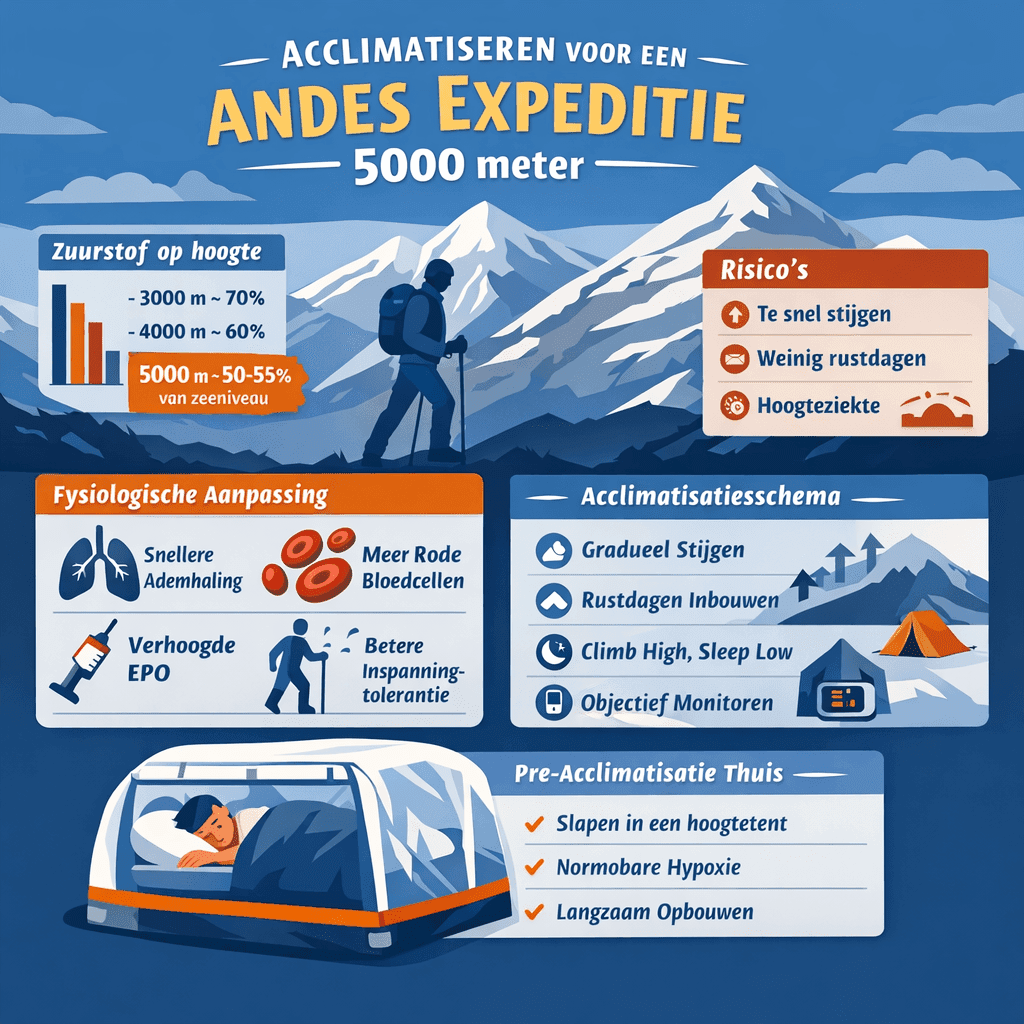
- 3000 metres - about 70 per cent effective oxygen availability
- 4,000 metres - about 60 per cent
- 5000 metres - about 50 to 55 per cent
- 6000 metres - about 45 per cent
This is why exertion at 5,000 metres feels much heavier than at sea level. Even gentle walking pace can then be firmly taxing.
How acclimatisation works physiologically
Acclimatisation is not a singular process. The body adapts on several levels simultaneously. Moreover, that adaptation is not linear. Initial reactions occur quickly, but the more valuable adaptations take time.
Faster breathing
The first reaction to altitude is usually an increase in ventilation. Your body tries to take in more oxygen by breathing faster and deeper.
Change in blood chemistry
This increased breathing changes the acidity of the blood. The kidneys help correct this over time. This allows the increased breathing stimulus to be better sustained.
More red blood cells
After a few days, EPO production increases. That hormone stimulates the production of red blood cells, which carry oxygen around the body. More background on this in How high training increases your EPO levels.
Better functional tolerance
Besides these measurable changes, the body also develops a better tolerance to exercise in hypoxic conditions. You often only notice this after several days: walking feels calmer, sleep improves and recovery is slightly smoother.
How to prepare for an Andean expedition acclimatising 5000 metres?
Good preparation starts well before departure. Especially for an expedition to mountains like Aconcagua or other peaks above 5,000 metres, it pays to build your plan early.
The basis consists of four elements:
- a gradual ascent schedule
- deliberate rest days
- objective monitoring of your reaction to altitude
- where relevant pre-acclimatisation at home
The biggest mistake is thinking that fitness solves the problem. Strong fitness helps, of course, but does not protect you from altitude sickness. In practice, fit athletes often ascend just too fast.
The classic acclimatisation schedule for the Andes
Many Andean expeditions operate on the principle climb high, sleep low. That means you go higher during the day to provide an acclimatisation stimulus, but sleep lower to recover better.
That model works because while the body is exposed to hypoxia, it does not have to operate continuously at the highest load.
| Day | Activity | Sleeping height |
|---|---|---|
| 1 | Arrival at 2800 metres | 2800 metres |
| 2 | Quiet acclimatisation hike | 2800 metres |
| 3 | Move to 3300 metres | 3300 metres |
| 4 | Climbing higher up to 3800 metres | 3300 metres |
| 5 | Moving to 3800 metres | 3800 metres |
| 6 | Acclimatisation climb to 4400 metres | 3800 metres |
From there, the ascent schedule usually becomes even more careful. The higher you go, the less margin your body has. You can read more practical background in preventing altitude sickness.
How long does acclimatisation take for an Andean expedition above 5000m?
For most mountain expeditions, the body needs at least 7 to 14 days to partially adapt to altitudes around 5,000 metres. This does not mean that you are completely immune to problems after that period, but it does mean that your basic adaptation is usually significantly better.
During that period, you often see these changes:
- increased breathing
- increase in EPA
- more red blood cells
- slightly better exercise tolerance
- improving sleep and recovery, provided the build-up is good
Those who go straight from sea level to an aggressive ascent schedule significantly increase the risk of complaints. Therefore, building in time is not a luxury, but an essential part of expedition planning.
How high is your risk of altitude sickness above 5,000 metres?
Not everyone reacts the same to altitude. There is no simple test that predicts exactly how sensitive you are. However, you can better assess your risk profile in advance.
5-question self-check
- Have you had symptoms of altitude sickness before?
- Do you climb faster than 500 metres per day above 3,000 metres?
- Do you sleep above 3,500 metres early in the expedition?
- Have little high-mountain experience?
- Going straight from sea level to high altitude?
The more questions you answer yes to, the more important a conservative acclimatisation schedule becomes. Even an extra rest day or preparatory pre-acclimatisation can then make a lot of difference.
Pre-acclimatisation before departure for the Andes
More and more expeditioners are choosing to start their preparation already at home. This is often done with a high altitude tent or similar system for normobaric hypoxia. In the process, the air pressure remains the same but the oxygen percentage in the supplied air is reduced.
The main stimulus occurs during sleep. Precisely because you are exposed for several hours a night, the body can get used to lower oxygen availability in a controlled way. You can read more about this in acclimatising at home for mountain expeditions.
What is important is the right nuance: an altitude tent is no substitute for acclimatisation in the mountains. It does, however, make preparation much more planable and measurable, and can significantly reduce the risk of altitude sickness.
Important principles in pre-acclimatisation
- gradual increase
- sleep as a primary stimulus
- working with normobaric hypoxia
- SpO2-controlled adjustment
This is how you monitor this lens
A good Andean expedition acclimatisation 5000 metres requires not only feeling, but also objective follow-up. Relying on motivation or experience alone is insufficient. Right trends often give the first signal that your schedule is too aggressive.
1. SpO2 trend
Preferably measure your oxygen saturation daily at the same time, for example in the morning at rest. Never look at one single measurement, but at the trend over several days.
2. Sleep quality
If you wake up often, sleep very lightly or feel exhausted the next morning, this could indicate too much strain or too fast a build-up.
3. Recovery feelings and symptoms
Watch for headaches, nausea, loss of appetite, noticeable fatigue and a feeling of not recovering from simple exertion.
Concrete decision rule: If your SpO2 trend drops over several days and symptoms increase at the same time, schedule an extra rest day or temporarily do not increase further.
More background on interpretation of oxygen measurements can be found at oxygen saturation at altitude.
Common mistakes during an Andean expedition
- climbing too fast above 3500 metres
- not taking enough rest days
- poor hydration
- continue to provide heavy training incentives during acclimatisation
- ignore warning signals because the summit day is already planned
These are precisely the mistakes that still kill many well-prepared athletes. Not because they are weak, but because altitude requires a different logic than training at sea level.
Why an external science base is useful
Those who want to understand more deeply how acute altitude sickness and acclimatisation work on a physiological level can also consult this medical background: scientific explanation of acclimatisation and altitude illness.
Such a resource is especially useful if you look at your preparation very analytically yourself or plan an expedition with greater altitude differences in a short time.
Conclusion: a good Andean expedition acclimatisation 5000 metres often determines the difference
A successful ascent above 5,000 metres in the Andes rarely depends solely on fitness or willpower. In practice, your acclimatisation often determines whether you continue to function strongly, or gradually get bogged down by fatigue, poor sleep or altitude complaints.
Good preparation for a Andean expedition acclimatisation 5000 metres consists of a smart ascent schedule, honest monitoring and, where relevant, thoughtful pre-acclimatisation at home. In doing so, you make the process more controlled, measurable and safe.
Want to prepare your Andean expedition in a more focused way?
With a controlled pre-acclimatisation programme, you can acclimatise your body to altitude even before departure. This is especially relevant if you have little time on location or want to climb above 5,000 metres with the strongest possible starting position.
Check out the 5000m expedition package
Read altitude tent experiences of people who have gone before you