
Altitude training physiological benefits: what really happens in your body?
Published 15 August 2012 · 3 min read
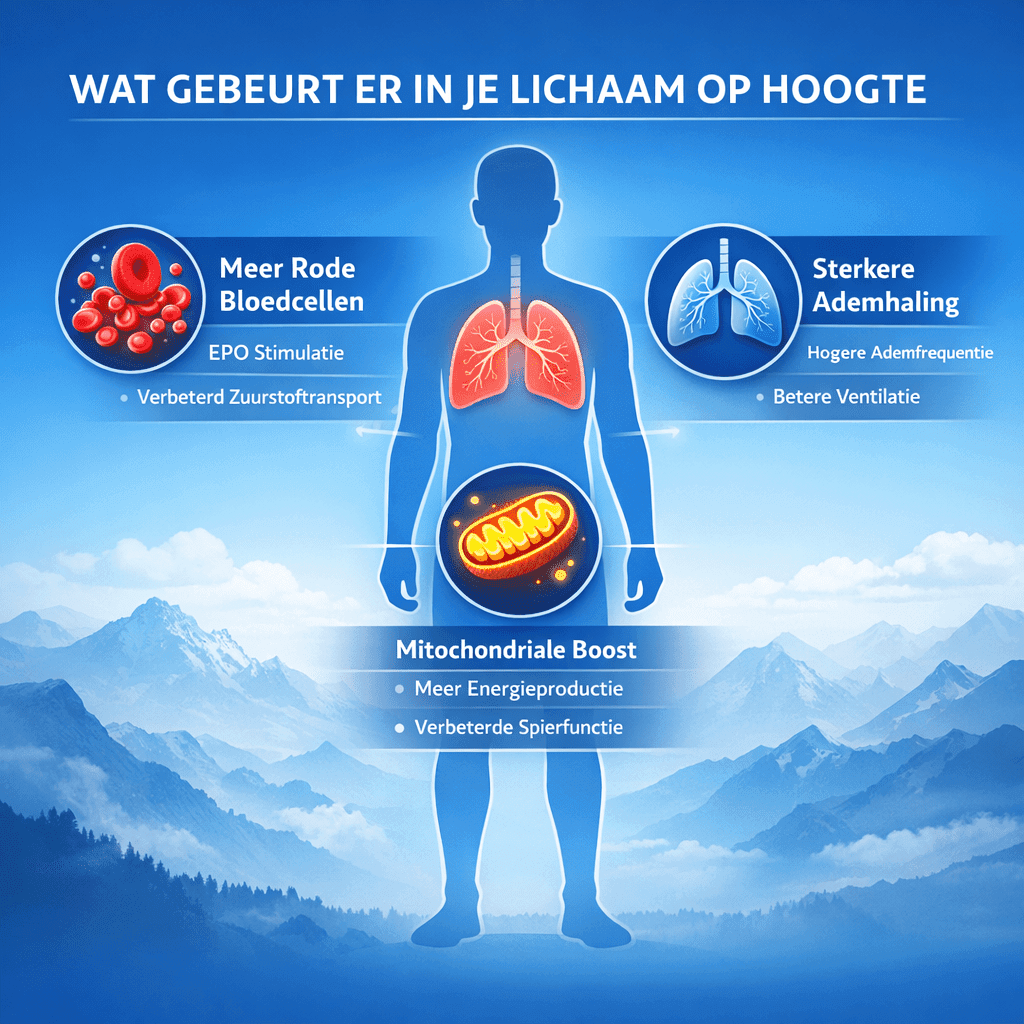
Altitude training physiological benefits are often reduced to one word: more red blood cells. This is too simplistic. The real gains lie in a combination of hormonal stimulation, cellular adaptation, improved oxygen efficiency and metabolic optimisation. In this article, you will read what is happening objectively in your body, how to monitor it and when it makes sense to use altitude training strategically.
Want to understand the basics first? Then also read how altitude training works before going any further.
The core in 60 seconds
- Altitude training activates EPO production via hypoxic stimulus.
- Your body increases oxygen transport capacity.
- Mitochondrial efficiency may improve.
- Ventilatory response becomes stronger.
- Effectiveness depends on dosage and monitoring.
So the question is not whether altitude training works. The question is how to correctly exploit the physiological benefits.
Why altitude training is often misunderstood
Many athletes think that altitude training automatically leads to performance improvement. This is incorrect. Without sufficient exposure, correct altitude and proper monitoring, the effect remains limited.
The biggest misconception? That only EPA counts. In reality, adaptation is broader.
1. EPO stimulation and increased oxygen transport capacity
When you sleep in hypoxic conditions, the oxygen pressure in your blood drops. Your kidneys respond with increased production of erythropoietin. You can read more about this here: how altitude training increases your EPO levels.
This leads to:
- Increase in haemoglobin
- Improved oxygen transport
- Higher aerobic capacity
Note that this effect only occurs with sufficient duration and correct height.
2. Improved mitochondrial efficiency
Hypoxia stimulates cellular signalling pathways such as HIF-1α. As a result, your body adapts at the cellular level.
Consequence:
- More efficient use of available oxygen
- Possible improvement in fat oxidation
- Delayed lactate accumulation
This explains why some athletes perform more efficiently at sea level after a well-built programme.
3. Ventilatory adaptation
Your respiratory centre becomes more sensitive to CO2 and oxygen drops. Because of this:
- Increases your breathing volume
- Improve your ventilation efficiency
- Is breathing work becoming more economical
You can read more background on oxygen saturation here: oxygen saturation at altitude.
4. Capillary density and peripheral adaptation
Prolonged exposure can lead to improved blood flow in muscle tissue. This supports oxygen delivery in active muscles.
This effect is subtle but relevant in endurance athletes.
Live High Train Low as a strategic model
Most of the scientific evidence exists for the Live High Train Low principle. In doing so, you sleep at altitude and train low.
Why?
- You maintain training quality
- You maximise hypoxic exposure
- You minimise fatigue
This is how you monitor this lens
Subjective feeling is insufficient. Always monitor:
1. SpO2 trend
Measure daily at the same time. Look at trend over several days. A drop followed by stabilisation indicates adaptation.
2. Sleep quality
Restless sleep may indicate too rapid altitude gain.
3. Recovery feelings and symptoms
Headaches, increased resting heart rate or persistent fatigue are signals to switch back.
Concrete decision rule: If your average SpO2 falls below 85 per cent without recovery after 3 nights, lower the simulation altitude.
The role of the altitude tent
An altitude tent works via normobaric hypoxia. The air pressure remains the same, the oxygen percentage is reduced.
Important to understand:
- Sleep is the primary stimulus
- Building step-by-step is essential
- SpO2-controlled adjustment increases safety
Practical guide: altitude tent use complete guide.
When does altitude training provide physiological benefits?
Altitude training physiological benefits become apparent when:
- Exposure lasts at least 3 weeks
- Height is chosen correctly
- Nutrition, especially iron status, is in order
- Monitoring done consistently
Without these conditions, impact remains limited.
Conclusion
Altitude training physiological benefits are real, but never automatic. They arise through hormonal, respiratory and cellular adaptation. Those who measure, direct and dose increase the chances of performance improvement.


