
Altitude training for team athletes: more than just stamina
Published 6 October 2025 · 7 min read
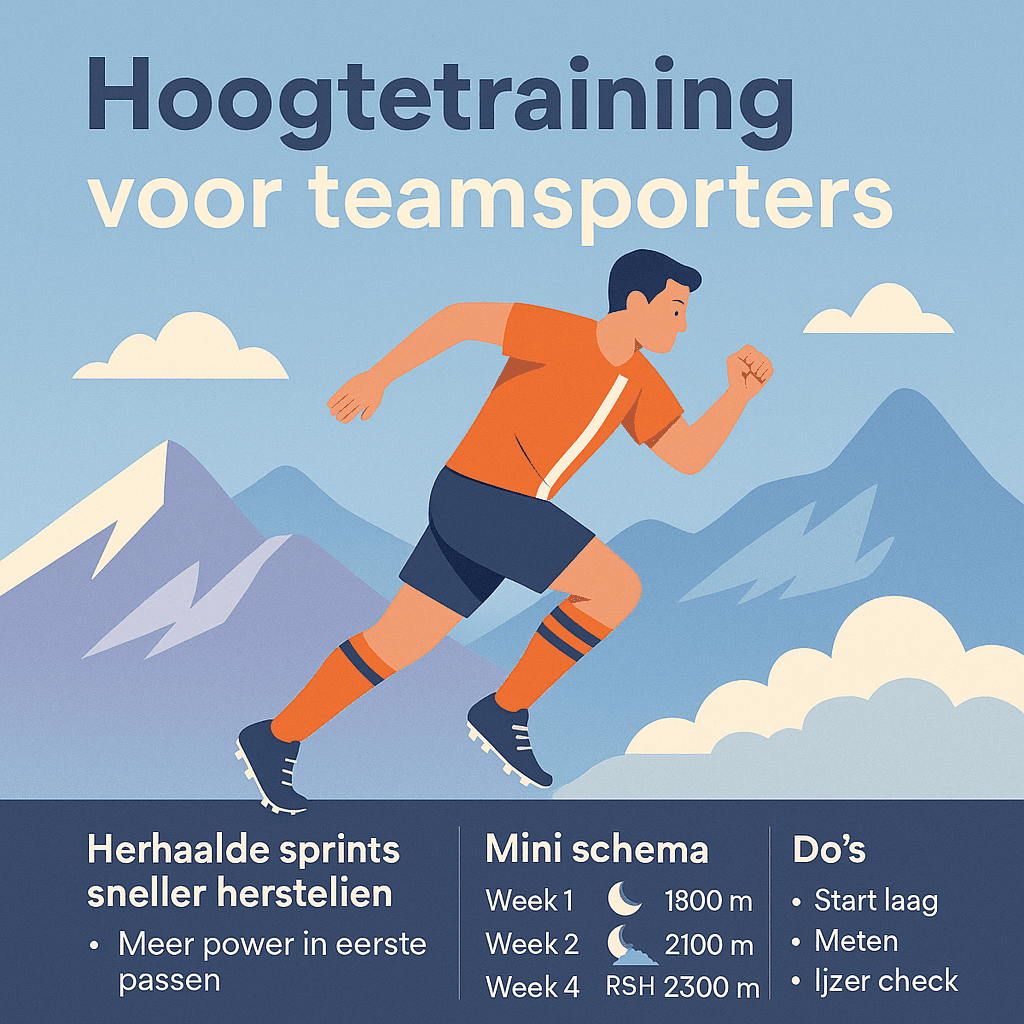
Why altitude works for team athletes
- Repeated sprint capacity: 5 to 20 sprints in a short time with minimal speed loss.
- Anaerobic power and acceleration: the first 3 to 5 passes.
- Rapid recovery between intense actions: faster heart rate recovery and smoother lactate clearance.
- Decisiveness and cognitive resilience under fatigue.
- Robust load capacity in a long and busy competition schedule.
You can target these building blocks with hypoxia via smart use of sleeping at altitude, IHE and LHTL through our rental service or specific Repeated Sprint Training in Hypoxia.
The 3 most important strategies for team athletes
1. Live High Train Low (LHTL) - sleep at altitude, train at sea level
Target: overall aerobic base, faster recovery between repetitions, higher training quality over longer cycles.
How: sleep 8 to 10 hours a night in an altitude tent or altitude chamber at 2000 to 2500 m equivalent. See also our explanation of optimal sleeping altitudes in this item and the practical comparison in sleeping in the clouds.
When: especially in pre-season or in a short boost phase without a busy competition schedule.
Plus: you train at sea level, so peak speed and technique remain intact.
Note: monitor iron status and sleep quality. Also read advantages and disadvantages of a high altitude tent.
2. Intermittent Hypoxic Exposure (IHE) - passive breathing or sitting sessions
Target: low-threshold stimulus for athletes with limited sleep time or as a stepping stone to LHTL.
How: 60 to 90 minutes per session, 3 to 5 times a week, breathing or sitting protocols at 2500 to 4000 m equivalent in intervals.
When: rehabilitation, busy periods, maintenance.
Plus: no interference with field training, individually dosable.
Note: build slowly. More on LLTH and IHT in these review articles: Frontiers review LLTH and BMC Systematic Review IHT.
3. Repeated Sprint Training in Hypoxia (RSH) - performing sprints at altitude
Target: specifically improving repeated sprint capacity without losing peak speed.
How: 5 to 10 sprints of 6 to 10 seconds with 20 to 30 seconds recovery in 1 to 2 blocks, at 2500 to 3000 m equivalent.
When: blocks of 2 to 4 weeks, once to twice a week, not within 48 hours before a competition.
Plus: very team sports specific, strong evidence for RSA win.
Literature: recent reviews and meta-analyses show benefit of RSH over normoxic sprints, especially for RSA. See Faiss 2024 review, PubMed 2024 update, Frontiers 2025 meta-analysis and the classical base in BJSM 2013.
Pre-season: sample 6-week programme
We tailor the framework below individually according to fitness and competition calendar. Consider starting to hire via our rental service To test response before investing, see also 3 purchasing tips.
Week 1 to 2 - habituation and basics
- Sleep: 6 to 8 hours at 1900 to 2100 m.
- IHE: 2 sessions per week of 60 min at 2800 m, 5 min hypoxia, 5 min normoxia.
- Field: technique, positional play, sub-maximal accelerations.
- Strength: 2 sessions full body, emphasis on technique and light RFD.
Week 3 to 4 - progression
- Sleep: 8 to 9 hours at 2200 to 2400 m.
- IHE: 3 sessions per week of 75 minutes at 3000m.
- RSH: once a week 2 blocks of 6 x 6 to 8 seconds, 25 seconds recovery.
- Field: intensity up, repeated sprints in game forms.
- Strength: 2 sessions, 1 heavy day and 1 power day.
Week 5 - peak and specificity
- Sleep: 8 to 9 hours at 2300 to 2500 m.
- RSH: 2 times short and sharp, 2 x 6 sprints.
- IHE: 2 sessions of 60 minutes at 3000 m.
- Field: match-like games, recovery monitoring tighter.
- Strength: 1 maintenance power session.
Week 6 - taper and transition
- Sleep: 7 to 8 hours at 2000 to 2200 m or taper off to 0, depending on response.
- IHE: 1 light session, optional.
- RSH: 1 incentive early week, then keep fresh.
- Field: quality over volume, speed and set plays.
- Strength: maintenance, not generating DOMS.
Target Metries: sprint top and drop off, HR recovery after 60 seconds, subjective fatigue and first-night SpO2 at new altitude steps.
In-season: two quick options
Option A - microboost 14 days
- Sleep: 7 to 8 hours at 2000 to 2200 m.
- IHE: 60 minutes twice a week at 2800m.
- RSH: once a week, not within 48 hours of a match.
Option B - maintenance 6 to 8 weeks
- Sleep: 3 to 4 nights a week at 2000m.
- IHE: 1 session per week at 3000 m.
- RSH: 1 light session every 10 days.
Team logistics without the hassle
- Compact set-up: 2 to 3 height tents for key players or per line, plus 1 to 2 generators for IHE and RSH space. Our Everest Summit 2 is known to be quiet and constant.
- Rotation scheme: prioritise players with highest load, then talents with growth potential.
- Data-driven: choose 2-3 KPIs per player and link them to the protocol.
- Sleep first: with congested fixtures, prefer IHE to new height steps.
Iron, nutrition and recovery
Altitude puts the oxygen transport chain to work harder. Give your body the building blocks and recovery to cash in on that stimulus. Consider timely blood levels, sufficient energy and protein, hydration and sleep quality. Avoid classic pitfalls such as going too high or stacking stimuli too fast. See also the 8 most common mistakes in altitude training.
Common mistakes and how to avoid them
- Too high too fast. Start 1800 to 2000 m and increase every 2 to 3 nights.
- RSH too close to matches. Keep a minimum distance of 48 hours.
- Wanting everything at once. Choose 1 main stimulus per day.
- No monitoring. Measures sprint drop off, HR recovery and subjective fitness.
- Iron forgotten. Check values regularly and adjust if necessary.
- Too little individualisation. Adjust heights and volumes per player.
Concrete protocols per game situation
Speedy outfielder or winger
- Sleep: 7 to 8 hours at 2100 to 2300 m.
- RSH: 2 x weekly 2 blocks 6 x 6 seconds, 25 seconds recovery.
- IHE: 60 minutes twice a week at 3000m on non-RSH days.
- Power: 1 power day micro dosing, 1 speed transfer.
Central midfielder
- Sleep: 8 to 9 hours at 2200 to 2400 m.
- IHE: 75 minutes 3 times a week at 2800 to 3000 m.
- RSH: 1 x per week short block, maintain field quality.
Power forward or lock in rugby
- Sleep: 8 hours at 2000 to 2200 m.
- IHE: 60 minutes twice a week at 3000m.
- RSH: once a week, focus on accelerations.
Scientific background and critical note
RSH consistently shows benefits to RSA in team settings, but remains no panacea. See RSH review 2024 and meta-analysis 2025. For IHT, results are mixed: some reviews show benefit, others are critical of additional gains over normoxic training, such as Dorelli 2025. LHTL remains a solid basic approach when properly programmed, see e.g. Bonato 2023 and practical guidance from NSCA on effect sizes and variability in response in this document.
Team implementation in 7 steps
- Goal setting: what do you want to do better in the competition in 4 to 6 weeks.
- Screening: injury status, sleep, iron value, calendar.
- Choosing strategy: LHTL, IHE, RSH or a combination.
- Pilot group start with 6 to 10 players.
- Dosage plan: nights per week, IHE minutes, RSH sessions and weekly schedule.
- Measure and adjust on 2-3 KPIs.
- Scale up what works to the rest of the selection.
Equipment and set-up
- Dream Cap For breath-controlled sessions and maintenance. Manual.
- Everest Summit 2 generator, quiet and medically specified: noise level and specs.
- Heights tent hire To test response before investing.
Summary for coaches
- Core: altitude training is more than endurance for team athletes. It supports sprint repetition, recovery and mental sharpness.
- Resources: LHTL for base and recovery, IHE for low-level incentives, RSH for race-specific sprints.
- Success factors: start low, build up, monitor 2-3 KPIs, monitor sleep and iron, plan smartly around matches.
- Timeline: 2-3 weeks can already give gains if you focus on quality and specificity.
Infographic proposal 1080 x 1080
Style: flat illustration, player in motion, mountain landscape with clouds, soft blue tones with contrasting highlights. No illustration of an altitude tent.
- Panel 1: repeated sprints faster recovery, more power in first passes, staying sharp under pressure.
- Panel 2: mini schedule week 1 to 5.
- Panel 3: do's like start low, measure and iron check.
- Panel 4: CTA 14-day microboost.
Call to action
Want a 2 to 4-week boost on repeated sprints and recovery without turning your training schedule upside down? Schedule a free 15-minute consultation with Altitude Dream. We make a short plan with concrete pitches, session duration and schedule around your matches.
Further reading


