
Buy height tent? 3 tips to take into account
Published 28 July 2016 · 10 min read
Direct response
- Buying an altitude tent makes most sense if you want to use the system more often and on a planned basis.
- If you are still unsure about comfort or tolerance, testing first is usually wiser.
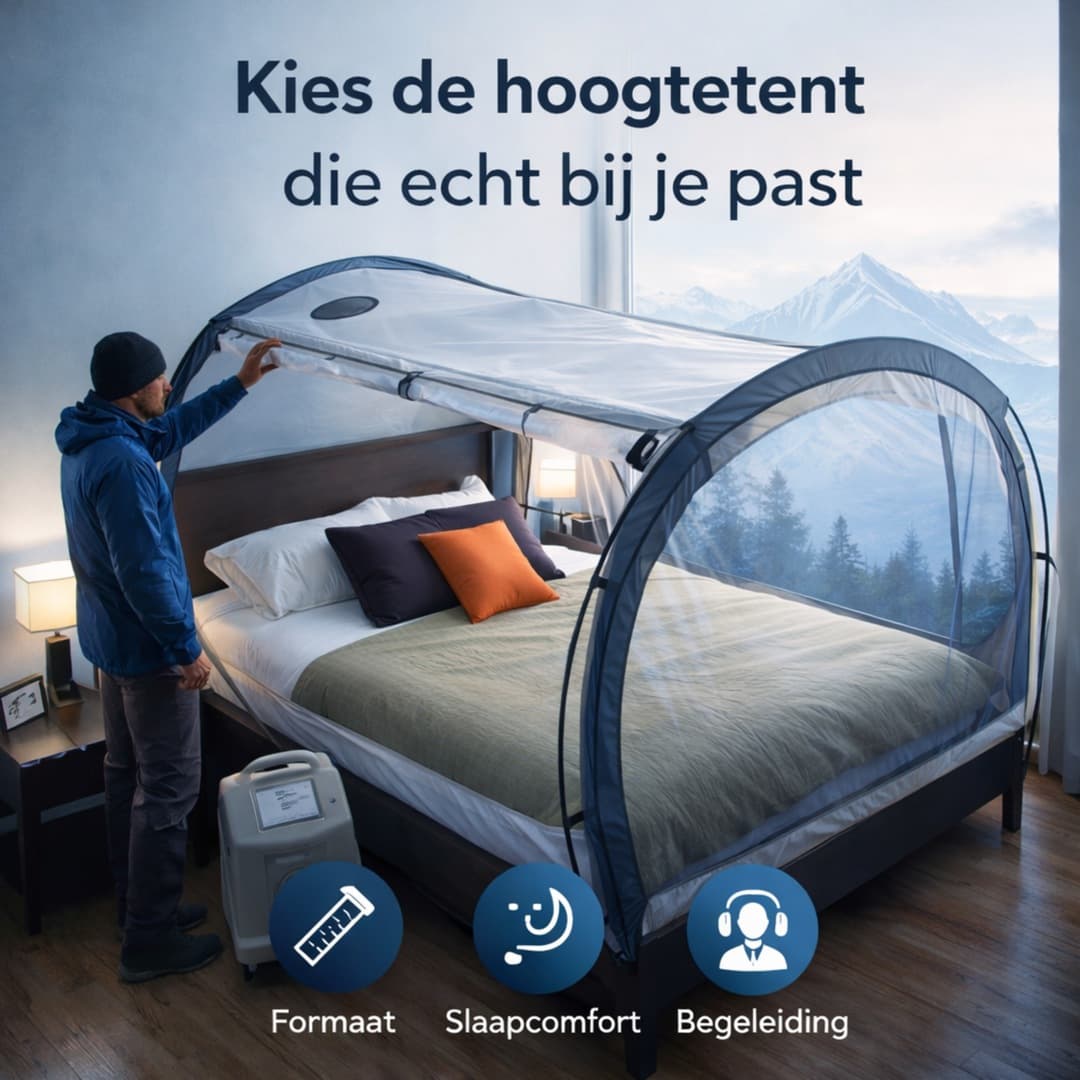
- When making your choice, pay particular attention to purpose of use, sleeping comfort, size, service and monitoring.
- The best buy is not the biggest or most expensive tent, but the system you consistently maintain.
Conclusion: Only buy when you know the system suits your body, space and purpose.
Practical hook: First assess whether you mainly need security, flexibility or maximum frequency of use.
Buying an altitude tent: start with the real goal
The first mistake when making a purchase is that people look too quickly at the product and not enough at its use. Who used a high altitude tent, does not in fact buy a tent, but a controlled training stimulus during sleep. That means comfort, routine and set-up are as important as the technique itself.
Therefore, the first question is not: which model is best? The first question is: what do you want to use the system for? For an expedition? For an altitude training trip at home? For a recurring sports goal? Or because you want the flexibility to target altitude incentives several times a year?
That distinction is important. Those with a one-off goal often benefit more from flexibility. Those who want to work with the same system for several seasons in a row are more likely to think towards buying. Those looking mainly for security, on the other hand, should look strictly at guidance, installation, support.
Buy altitude tent or rent first?
For many people, this is the key question. The answer depends less on budget than is often thought. It is mainly about duration of use, certainty of comfort and the likelihood of using the system seriously more than once. Those who don't yet know how they like sleeping in hypoxia would usually do well to first think substantively about buy or rent.
| Choice | Best for | Advantage | What you pay attention to |
|---|---|---|---|
| Rent first | First encounter, one-off project, doubts about comfort | Low risk, high flexibility, realistic test of sleep and routine | Above all, you will learn whether you and your partner really sustain the use |
| Buy later | Athletes or mountain travellers who want to work with altitude regularly | More continuity, readily available, schedulable over multiple cycles | Only smart if the system is also used outside one specific purpose |
| Buy directly | Users with clear experience, fixed goals and long-term vision | Maximum autonomy and no hassle with availability | Only sensible if format, sound, service and usage protocol are already clear |
Rent first
Best for: first encounter, one-off project, doubts about comfort.
Advantage: low risk, plenty of flexibility and a fair test of sleep and routine.
Note: Most of all, you find out whether you and your partner really keep up the use.
Buy later
Best for: Athletes or mountain travellers who want to work with altitude more often.
Advantage: more continuity and readily available for multiple cycles.
Note: this is especially smart if you use the system more broadly than one purpose.
Buy directly
Best for: Experienced users with clear routine and long-term vision.
Advantage: maximum autonomy without dependence on planning or availability.
Note: only sensible if comfort, sound, service and set-up are already clear.
⚠️ Reality check
The best buying decision often starts with the least spectacular question: will you still sleep well enough in this after ten nights? If the answer is uncertain, then testing first is more rational than immediate ownership. A high altitude tent only works if you use it consistently.
Buying an altitude tent: the three choices that really count
1. Choose the usage profile first, not the model
People often immediately compare dimensions, materials or accessories. Yet your usage profile is more important. Do you mainly want to sleep at a controlled altitude stimulus towards expedition or performance? Then the choice revolves around rest, sleep quality and persistence. In addition, do you want to be able to steer very precisely in your build-up? Then guidance also becomes important, as does knowing how to choosing the right height without going too high too fast.
A good system matches your weekly rhythm. Anyone who sleeps irregularly, travels a lot or has to adjust their bedroom frequently will have different requirements than someone who can leave a fixed setup for months on end. Therefore, the best tent is not universal. The best tent is the one that fits your practical reality.
2. Comfort and bedroom fit are not details
When buying an altitude tent, comfort is still too often underestimated. This is a shame, because it is precisely comfort that determines whether a system becomes a tool or a source of frustration. Therefore, think critically about available space, bed size, ventilation feel, getting in and out, sound experience and the impact on your partner or family.
Here, too, honesty pays off. A larger system often feels more spacious, but also requires more bedroom space and more quietness in the set-up. A more compact system fits more easily into an everyday household, but should still be comfortable enough to remain usable week after week. Those who think too lightly about this sometimes buy a good system technically, but the wrong one practically.
3. Service, support and set-up determine the real return
An altitude tent is not a standard purchase that you unpack and then forget about. You are working with a system that becomes part of a protocol. Therefore, you need to look not only at what you buy, but also at what you get afterwards. Think explanation, accessibility in case of questions, technical support and help in interpreting signals during set-up.
This is especially true in the first few weeks. This is precisely when the difference arises between people who build up calmly and those who want to go too fast. Those who know beforehand how many hours you sleep in it, how you slowly increase the height and how you assess deviations, usually gets more out of the system and experiences less unnecessary doubt.
A practical purchasing protocol in 4 steps
Those looking to buy a high altitude tent do not need to complicate the process. A good decision usually follows a simple sequence. This prevents the purchase from being driven too much by enthusiasm and too little by practicality.
Step 1. Define your real goal
Is your goal a mountain trip, a performance incentive or repeated use over several seasons? The more concrete the goal, the better you can determine whether buying makes sense.
Step 2. Test your tolerance and routine
Assess not only how the first night feels, but especially how sleep, recovery and comfort develop over several days.
Step 3. Choose on space and tranquillity
Look at bedroom fit, partner impact, entry and exit, sound and daily usability. Comfort wins over fancy specifications in the long run.
Step 4. Plan guidance and monitoring
Decide definitively only when it is clear how you are building, what data you are tracking and when you need to adjust or slow down.
This sequence seems simple, but is powerful for exactly that reason. Many mispurchases occur because steps three and four are not taken seriously until after the purchase. Only then does it become clear that the tent is just too big, that the sleeping quality deteriorates or that there is not enough grip when in doubt.
When buying a high altitude tent does make sense
When did
- You want to use the system several times a year.
- You already have experience sleeping in hypoxia or have tested it first.
- You have a fixed bedroom arrangement and plenty of space.
- You think in multi-year use rather than one short project.
- You think independent planning is important.
When not yet
- You have no idea yet how your sleep responds to the system.
- Your goal is one-off or still uncertain.
- Your bedroom is practically awkward or shared with someone who won't sleep with you.
- Above all, you are looking for a quick fix rather than a protocol.
- You want results without build-up, monitoring or adjustment.
This block may seem strict, but this is precisely where you avoid disappointment. Buying a high altitude tent makes most sense if use is likely, not just sounds desirable. Those seeking flexibility above all or still unsure about comfort need not force themselves towards ownership.
This is how you monitor this lens
The choice to buy also includes whether you are willing to monitor objectively. This need not be complicated, but consistent. Always see SpO2 as a trend and not an absolute truth. One number says little. A pattern over several mornings says much more, especially when combined with sleep and recovery.
SpO2 trend
Preferably measure in similar conditions and look at trends over several days. If the trend drops sharply while you feel worse, then building up more calmly makes sense.
Sleep quality
Record sleep-in time, nightly wake-ups and how rested you get up. Sleeping worse is often a more direct practical indicator than one isolated measurement.
Recovery
Look at morning feeling, training quality, resting heart rate or general freshness. Good use only really supports your goal if recovery remains acceptable.
Symptoms
Watch for headaches, restless nights, feeling stuffy or obvious fatigue. These are signals not to push further, but to switch back.
A practical decision rule is simple: if sleep quality and recovery deteriorate several days at a time, that is more important than an ambitious plan on paper. The best users are rarely the hardest pushers. They tend to be those who work consistently, quietly and measurably.
Common misconceptions when buying a high altitude tent
“If I buy the best system, the results will come naturally”
No. A good system increases your options, but the result depends on use, construction and persistence. A high altitude tent that is perfect in theory but fits poorly in your bedroom will remain underused.
“Bigger is automatically better”
More space can feel more pleasant, but only if the setup also remains practical. A more compact system that works smoothly on a daily basis can be more valuable in practice than a larger solution that becomes awkward or disruptive.
“Buying is always cheaper than renting”
Only if you actually use the system more often. If you find after one stretch that you don't like the sleep anyway, a theoretically favourable calculation is of little use.
🧭 In practice
In these kinds of purchases, rarely does the most impressive specification win. What wins is the combination of being able to sleep peacefully, build easily and having enough confidence to use the system again for the next purpose.
Practical home buying tips
- Measure your bedroom in advance, including walking space around the bed.
- Think about your partner too, not just your own sports goal.
- Ask not only about the system, but also about post-delivery guidance.
- Assess whether you will realistically deploy the system several times a year.
- Look at your build logic beforehand, not only after installation.
- Let comfort outweigh bravado.
Still hesitating between options?
Then calmly compare the main differences in use, comfort and practicality first. That gives more guidance than just putting specifications side by side.
Conclusion
Buying an altitude tent is especially smart if you look beyond the purchase itself. The best choice arises when purpose, comfort, space, construction and guidance are balanced. For some users, buying straight away makes sense. For others, testing first is the more rational step. Those who make that distinction clear in advance avoid regrets and increase the chances of the system actually delivering long-term value.
Is buying a high altitude tent better than renting?
Not always. Buying is especially better if you want to use the system more often and on a planned basis. When in doubt about comfort or frequency of use, renting is often smarter.
What should you pay most attention to when buying a high altitude tent?
On purpose of use, sleeping comfort, size, practical arrangement, service and how you will monitor the structure.
How do you know if a high altitude tent suits you?
You can't just tell by specifications. Above all, look at sleep quality, routine, bedroom fitness and how your body responds to multiple nights.


