High altitude tent comparison: complete buying guide to make the right choice
Published 19 February 2026 · 6 min read
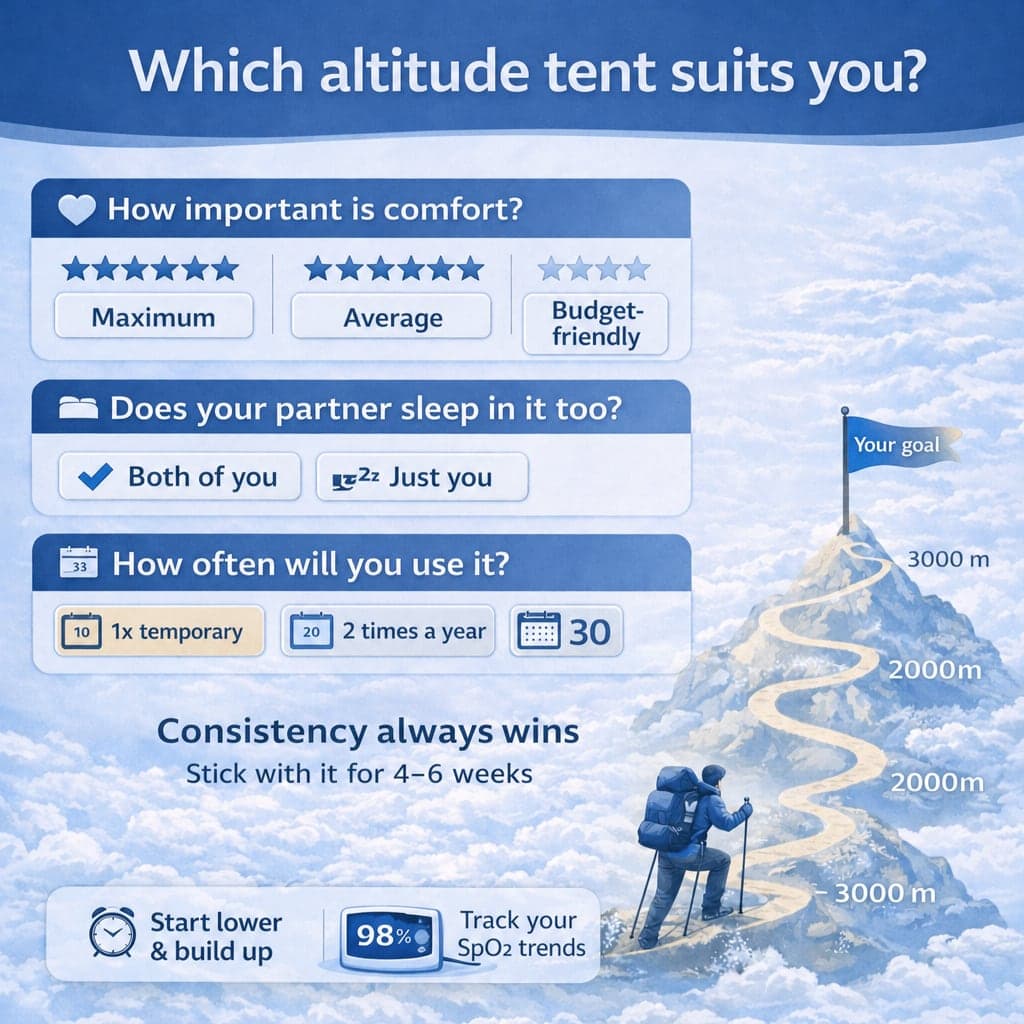
High altitude tent comparison you don't do by just looking at “the tent”. In practice, you choose a system: the right sleeping volume (Dream Cap, bed-tent or full room) AND the right altitude generator. If that match is right, it will be comfortable, stable and persistent. And that's exactly what you need for effect. In this buying guide, you get a clear decision aid, a buying matrix and objective measurement rules, based on Altitude Dream's offerings.
Internal floor: New to the topic? Start with Using high altitude tents: complete guide.
The essentials in 30 seconds
- Want maximum comfort and the most stable hypoxia in a bed-tent? Choose the Tent Generator.
- Want to sleep at altitude without the tent feel? Choose the Room Generator and create an altitude chamber.
- Do you want to start budget-friendly or does your partner not want to join you in a tent? Select Dream Cap + Cap Generator.
- Always the same foundation: sleep as an incentive, build incrementally, adjust on data.
Why high altitude tent comparison is often misunderstood
Many people mainly compare the canvas, the zips or the size. This seems logical, but it is rarely the decisive factor. In practice, three things determine whether you are going to feel the effect:
- Stability of hypoxia during the night. This is reflected in your SpO2 trend and your sleepiness.
- Comfort: noise, heat, ventilation and routine.
- Consistency: do you manage 4 to 6 weeks almost every night?
⚠️ When your sleep quality drops, your consistency drops. And without consistency, the effect usually remains limited. This is why choosing the right altitude generator to suit your sleep volume is so important.
Internal floor: Want the balance of pluses and minuses clear? Read high altitude tent advantages and disadvantages.
The 3 routes within Altitude Dream
Altitude Dream offers three distinct systems. They differ not only in price, but mainly in comfort, scale and application.
1) Room Generator: entire (sleeping) room at height
- For those who don't want a tent feel.
- Compatible with rooms up to 45 m3.
- Comfort is key: you sleep in your normal bed, in your normal space.
2) Tent Generator: topline comfort in a high-rise tent
- The most advanced, user-friendly and quietest option in the line-up.
- Designed and manufactured in the US to strict medical specifications.
- 7600 litres per hour airflow for stable hypoxia and less heat build-up.
- Compatible with all altitude tents, including large XL cubicle tent.
3) Cap Generator: budget-friendly entry with Dream Cap
- The most budget-friendly option.
- Lower airflow, therefore only suitable for small sleeping volume.
- Compatible only with the Dream Cap.
Purchasing matrix: choose your ideal high-tensile solution at a glance
This matrix helps you to high altitude tent comparison convert to a choice that suits your life. Not just your ambition.
| Situation / Purpose | Dream Cap + Cap Generator | Bed-tent + Tent Generator | Room Generator (altitude chamber) |
|---|---|---|---|
| Budget-friendly entry | ★★★★★ | ★★★☆☆ | ★☆☆☆☆ |
| Maximum sleeping comfort | ★★★☆☆ | ★★★★★ | ★★★★★ |
| Partner does not sleep with you at altitude | ★★★★★ | ★★★☆☆ | ★★☆☆☆ |
| Stable hypoxia with greater sleep volume | ★★☆☆☆ | ★★★★★ | ★★★★★ |
| Multiple blocks per year | ★★★☆☆ | ★★★★★ | ★★★★★ |
| No tent feeling desired | ★☆☆☆☆ | ★★★☆☆ | ★★★★★ |
| Quick, temporary set-up | ★★★★★ | ★★★★☆ | ★★☆☆☆ |
Interpretation in 3 sentences:
- Want to start low-key or don't want your partner to join you? Choose Dream Cap + Cap Generator.
- Want maximum peace and stability in a bed-tent? Choose Tent Generator.
- Want to sleep at altitude without the tent feeling? Choose Room Generator.
Selection guide step by step
Step 1: choose your sleep volume
This is the base. The generator should match the volume you put into hypoxia.
- Dream Cap: small personal volume, ideal if you want to train alone.
- Bed-tent: queen or king size, often the best balance between comfort and impact.
- XL cubicle tent: extra space, nice for longer blocks.
- Altitude chamber: full room, no tent feel.
Step 2: determine your comfort threshold
Comfort is not “luxury”. Comfort is consistency. Ask yourself this question: how much sleep disruption is acceptable, without suffering recovery?
- High: you want minimal disruption. Then Tent Generator or Room Generator fits.
- Average: you can get used to a tent, but you want peace and quiet. Tent Generator often fits.
- Pragmatic: you especially want to start. Dream Cap + Cap Generator makes sense.
Step 3: how often will you use it?
- 1 to 2 blocks per year: Dream Cap or bed-tent with Tent Generator.
- multiple blocks per year: comfort wins. Tent Generator or Room Generator.
Step 4: what is your performance context?
Most athletes use altitude simulation as part of LHTL: you sleep high, but train relatively low so that your training quality remains high.
Internal floor: want to understand this principle? Read sleep high, train low.
What to expect concretely per option
Dream Cap + Cap Generator
This is the most compact entry level. You train without your whole bedroom having to “come along”. This helps if your partner doesn't want to join you, or if your space is limited.
- Plus: low-threshold, quick to set up, partner-proof.
- Note: due to lower airflow, this is only appropriate for the Dream Cap and small volume.
Bed-tent + Tent Generator
This is the sweet spot for many athletes. You sleep in a spacious bed-tent, with a generator designed for comfort, peace and stability.
- Plus: Very stable hypoxia, high comfort, suitable for larger tents.
- Note: you also choose the right tent size (queen, king, XL) based on space and routine.
Room Generator (altitude chamber)
If you don't want a tent feel, this is the most elegant route. You make the room itself “high”.
- Plus: maximum comfort and routine, no tent logistics.
- Note: semi-permanent setup and matching the room size (up to 45 m3).
Checklist: how to compare without regret afterwards
- Target sharp? competition form, recovery, or preparation for altitude.
- Sleep volume chosen? Dream Cap, bed-tent or room.
- Comfort realistic? noise, heat, ventilation, partner factor.
- Capacity appropriate? Generator capacity should match volume.
- Construction plan ready? incrementally, don't start too high.
- Measurement plan ready? SpO2 trend, sleep quality, sense of recovery.
2 differentiators you don't see in every buying guide
- Airflow often determines calmness: Sufficient flow helps keep the O2 percentage stable and prevents heat build-up in larger tents.
- Consistency wins over everything: the best choice is the system you can sustain for 4 to 6 weeks without losing sleep.
Decision aid: choose in 30 seconds
- I want to start budget-friendly or my partner won't sleep with me → Dream Cap + Cap Generator.
- I want maximum rest and stable hypoxia in a bed-tent → bed-tent + Tent Generator.
- I don't want a tent feel and want my room at height → Room Generator.
In conclusion
High altitude tent comparison becomes easy if you take it back to the core: choose your sleep volume first, then choose comfort and stability, and build up incrementally with objective measurement. Then you make the process planable and achievable. And that's ultimately what performance grows on.
Do you already know which direction you want to go in? In our webshop you will find all altitude generator, altitude tents and complete packages together. Including current prices, package deals and accessories such as saturation meters and HEPA filters.
👉 See the full offer in the Altitude Dream webshop Still in doubt or have a question about which combination suits your situation? Then feel free to contact on. We are happy to think with you.