
Altitude training: the trick that isn’t really a trick
Published 29 July 2012 · 6 min read
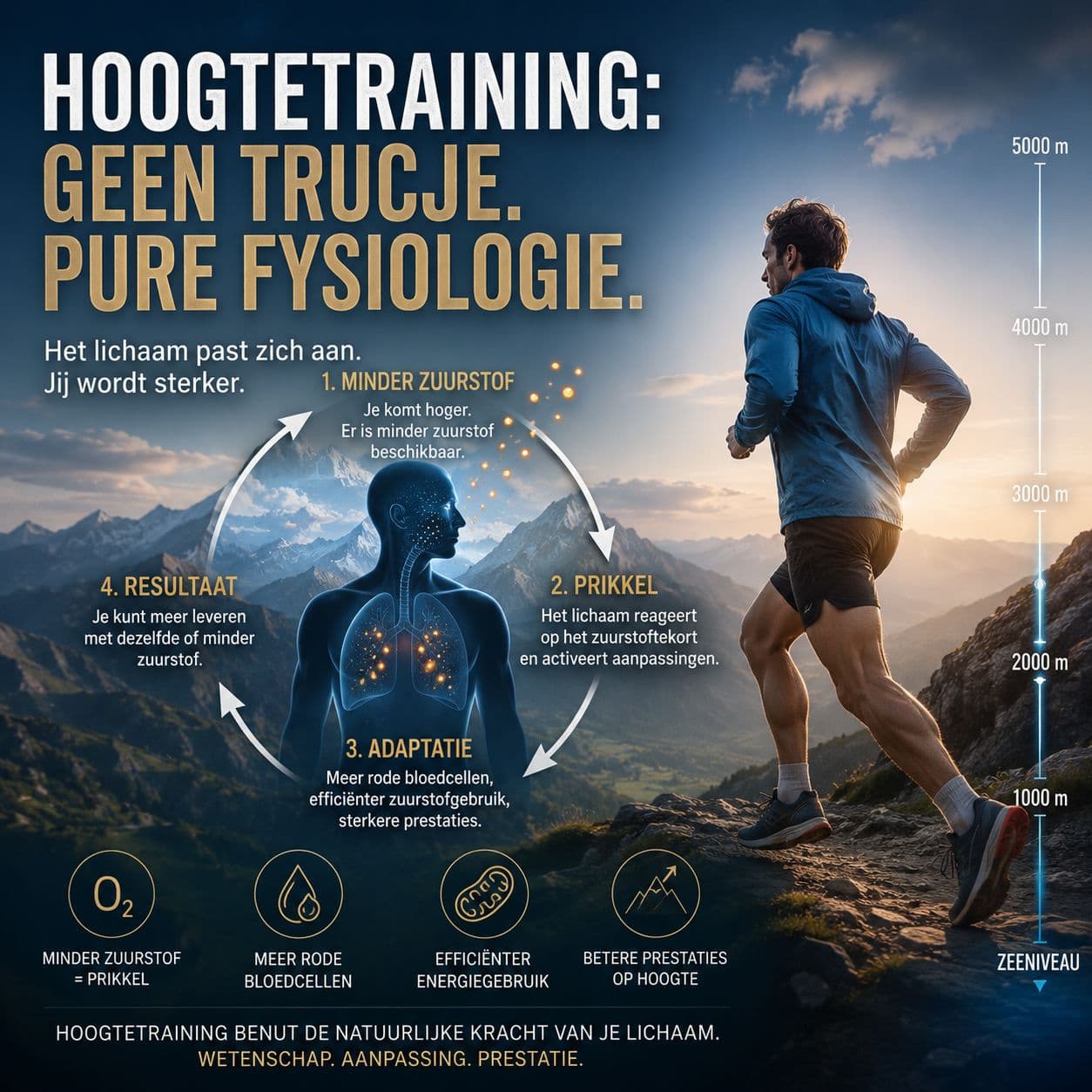
This is precisely why top athletes, mountaineers, and expedition travellers have used altitude as a training stimulus for decades. Not because it's a hack, but because the body constantly tries to adapt to conditions with less oxygen.
Short answer: Altitude training works because the body adapts to an environment with less available oxygen. This can improve oxygen transport, efficiency, and endurance, among other things.
- The body reacts to lack of oxygen
- More than just red blood cells play a role
- Effect arises from consistent exposure
- The correct dosage is more important than extreme height
Conclusion: Altitude training utilizes a natural physiological response to oxygen deficiency.
Nuance: Greater height does not automatically mean greater results.
Practical: A controlled approach often yields better results than training excessively.
Why people think altitude training is a gimmick
When something is used by Olympic champions, professional cyclists and top marathon runners, the image of a secret method quickly arises. Altitude training has therefore sometimes acquired an almost mythical reputation.
Yet there is nothing artificial about it. The body naturally possesses mechanisms to cope with less oxygen. As soon as you go higher, the air pressure drops. This makes it more difficult to absorb sufficient oxygen. The body reacts immediately.
That process is described in detail in our guide to how altitude training works.
The reaction begins within hours. Respiration changes, heart rate temporarily increases, and various hormonal processes are activated. Deeper adaptations then develop over days and weeks.
💡 Did you know?
People who live at high altitudes have often developed lifelong adaptations that help them cope with low-oxygen conditions. Altitude training utilises the same biological mechanisms.
What is really happening in your body?
Many athletes focus solely on red blood cells. They are important, but they are only one part of a much larger system.
Upon exposure to altitude, the following processes, among others, are activated:
- Increased EPO production
- Stimulation of red blood cell formation
- Improved oxygen delivery in tissues
- Muscle cell adaptations
- More efficient energy production
- Changes in ventilation and breathing
This allows the body to ultimately cope more efficiently with available oxygen.
If you want to understand more deeply why this is happening, also read how altitude training affects EPO levels.
The video that explains altitude training surprisingly well
Sometimes a short video explains a complex topic better than ten pages of theory. The video below shows in an accessible way how the body reacts when oxygen becomes less available.
Although the explanation is kept simple, the core aligns excellently with what scientists know today about acclimatisation and performance improvement through altitude.

The interesting thing is that virtually all the benefits from the video can ultimately be traced back to one central stimulus: controlled oxygen deficiency.
Higher altitude does not automatically mean better results
One of the biggest misconceptions is that higher altitudes are always better.
In reality, there is an optimal zone in which the body receives sufficient stimulation without a significant deterioration in recovery and sleep quality.
Therefore, many top athletes use the principle of sleep high, train low. They sleep at altitude, but carry out intensive training at lower altitudes.
This creates an interesting combination:
- sufficient hypoxic stimulus
- maintaining training quality
- Better recovery
- lower risk of overload
Common misconception versus reality
| Assumption | Reality |
|---|---|
| The higher the better | There is an optimal zone |
| Only red blood cells count | Multiple systems are adjusting. |
| The result appears quickly | Consistency is important |
| Everyone reacts the same | Reactions vary from person to person |
Reality There is an optimal height zone.
Reality Multiple systems adapt.
Reality Consistency determines the effect.
Reality There are large individual differences.
Who does altitude training actually work for?
Altitude training is often associated with elite sport, but that image is too limited.
In practice, we broadly see three groups of users:
- endurance athletes looking to improve performance
- mountain sportspeople wanting to acclimatise
- expedition travellers who want to reduce altitude risks
For runners, it can be interesting to read more about altitude training for runners.
For travellers heading to the Himalayas, Andes, or Kilimanjaro, it's often less about performance and more about preparation. In those situations, acclimatising at home for mountain expeditions be a valuable addition.
This is how you monitor this lens
The success of altitude training is not judged on feeling alone.
| Parameter | What are you following? | Practical significance |
|---|---|---|
| SpO2 trend | Several days | Assess adaptation |
| Sleep | Quality and duration | Restore monitor |
| Recovery | Energy and tax | Preventing overload |
| Symptoms | Headache, fatigue | Adjust if necessary |
Monitor several days.
Objective: Reviewing the adaptation.
Monitor Quality and duration.
Objective: Monitor recovery.
Monitor Energy and tax.
Objective: preventing overload.
Monitor Complaint development.
Objective: making timely adjustments.
The important thing is that SpO2 is always viewed as a trend. A single measurement says little. The development over several days provides much more information.
📊 Research shows
Successful altitude training is usually characterised by a combination of consistent exposure, adequate recovery, and a gradual increase in the hypoxic stimulus.
Rocky training is een slimme keuze wanneer u wilt verbeteren uw aerobe conditie en uithoudingsvermogen. Het kan ook nuttig zijn voor atleten die strijden in sporten waar hoogte een significante factor is, zoals bergbeklimmen, skiën en trailrunning.
Consider altitude training when:
- you are preparing for an important marathon
- you cannot practically organise an altitude training camp
- planning a trek above 3000 metres
- you are preparing an expedition towards 5000 metres or higher
- you want to acclimatise before departure
Be cautious when:
- your recovery is currently insufficient
- you have significant medical complaints without supervision
- You expect height to be a miracle cure
Curious what altitude training can do for your goals?
Whether you're training for a marathon, triathlon, or multi-day mountain trek, a well-structured programme often makes the difference between guesswork and focused preparation.
Conclusion
Altitude training is sometimes described as a gimmick. This does not do justice to what is actually happening. The body naturally possesses powerful mechanisms to adapt to low-oxygen conditions.
When the stimulus is applied in a controlled manner, both athletes and mountaineers can benefit from it.
The art isn't in going to extremes. The art lies in the right dosage, sufficient recovery, and a systematic approach.
Frequently asked questions
Does altitude training really work?
Yes. The physiological adaptations to oxygen deficiency are well-documented in scientific research.
How quickly do you notice effects?
This varies from person to person. Often, the first adjustments become visible after a few days to weeks.
Are red blood cells the main effect?
No. Breathing, muscle physiology and oxygen uptake also play an important role.
Can a height tent really replace mountains?
No. A height tent does not replace on-site acclimatisation, but it can support the process in a controlled, measurable, and planned way.


