
Altitude training for runners
Published 10 February 2026 · 9 min read
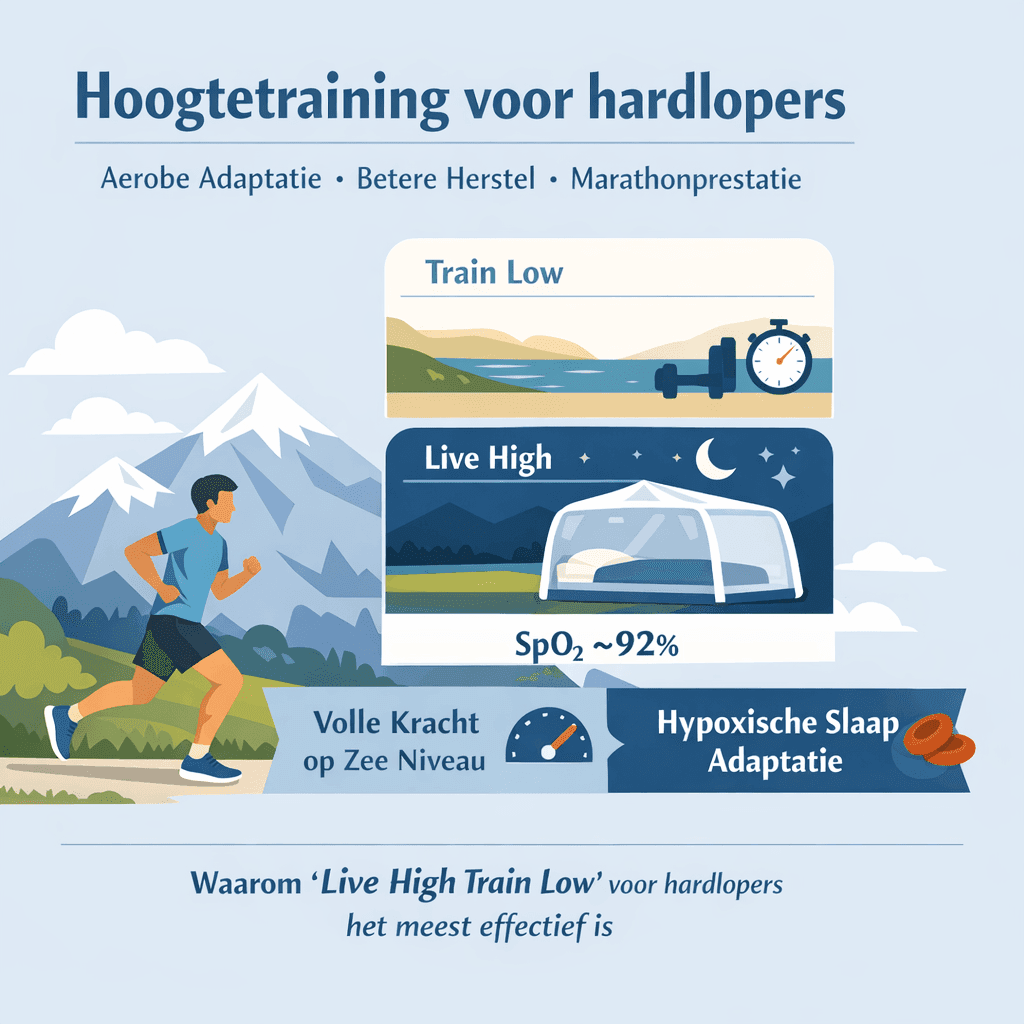
Altitude training for runners can be interesting when your running training is already consistent, but you find that progress towards longer distances stagnates. Especially in half-marathons, marathons and intensive training blocks, performance is not just about more kilometres. It is also about oxygen utilisation, recovery, running economy and how your body deals with fatigue.
The gist is simple: altitude training only works well if the stimulus matches your training phase. For runners, the sleep high, train low principle relevant. You get the altitude boost while sleeping or resting, while maintaining the quality of your running training at sea level.
Short answer
Altitude training for runners is especially useful if you use the altitude stimulus without weakening your main running training. In practice, this usually means sleeping or resting in hypoxia, training at normal intensity, and managing for recovery, sleep quality and SpO₂-trend.
The essentials in 30 seconds
Conclusion: Altitude training for runners can support aerobic capacity, oxygen utilisation and recovery, especially with a well-planned LHTL approach.
Nuance: It is not the altitude per se that determines the result, but the combination of dosage, timing, sleep quality and training retention.
Practical hook: Use altitude training as a controlled stimulus around a key training block, not as a loose shortcut just before a race.
Why altitude training is interesting for runners
Running is a sport in which small improvements make a lot of difference. Calmer breathing at marathon pace, slightly faster recovery between workouts or less decline in the final kilometres can be immediately noticeable.
That is why altitude training interesting for runners. The method addresses a fundamental limitation of endurance performance: oxygen availability and utilisation. When your body is regularly exposed to lower oxygen availability, it responds with physiological adaptations.
Those adaptations may include respiratory regulation, oxygen transport, muscle metabolism and recovery processes. For runners, this is relevant because most running performance depends on sustained aerobic efficiency.
At the same time, altitude training is not a magic performance button. If the stimulus is too heavy, sleep can deteriorate. If planning is not right, training quality can drop. And if you start too late, there is insufficient time for the body to react.
💡 Did you know?
Many runners notice the effect of altitude training not as sudden speed, but as more control. Breathing stays calmer, the pace feels more stable and tough workouts are sometimes better digested.
How altitude training for runners works physiologically
Altitude training exposes the body to hypoxia. This means less oxygen is available to the body. In the mountains, this is due to lower air pressure. In an altitude tent, this is done via normobaric hypoxia, where the oxygen percentage is reduced while the air pressure remains the same.
The body responds with several processes. The best-known reaction is an increase in erythropoietin, often abbreviated as EPO. This hormone can contribute to the production of red blood cells. Yet this is only one part of the story.
For runners, other adaptations are also important. Think more efficient oxygen delivery in the muscles, better ventilatory control, adaptations in mitochondria and possibly better running economy. It is precisely this combination that makes altitude training relevant for endurance sports.
Scientific literature on live high train low shows that prolonged, controlled exposure to altitude or simulated altitude can give a potential performance advantage in endurance athletes. See, for example, this narrative review on live high train low and research into LHTL in competitive runners.
Why live high train low is often a better fit for runners
Runners need to protect their training quality. This is especially true in tempo blocks, interval training, hill training and race-specific marathon training. When you train at real altitude, your paces and intensities often drop. This changes the training stimulus.
In live high train high, you stay at altitude and train there. The hypoxic stimulus is strong, but the load is often high. For some elites, this can work, especially with guidance and ample recovery capacity. For many recreational and aspiring runners, there is a greater risk of a drop in quality of training.
Live high train low works differently. You get the altitude stimulus during sleep or rest, but you train at normal altitude. As a result, speed, technique, stride frequency and race-specific intensity are better preserved.
Comparison for runners
Live high train high
Strong altitude stimulus, but often lower training intensity. Especially suitable with ample guidance and sufficient recovery space.
Live high train low
Elevation stimulus during rest or sleep, while key running workouts remain qualitatively strong.
The role of a high altitude tent in runners
A altitude tent use makes LHTL practical. You don't have to travel to the mountains for weeks. You can sleep at home in a controlled hypoxic environment and do your normal running training during the day.
For runners, this is a big advantage. Your training schedule remains largely intact. You don't have to compromise on paces, surface, training group or race-specific stimuli. At the same time, your body receives a recurring altitude stimulus during sleep.
An altitude tent is especially interesting when you already train consistently. The basics need to be in order. Think adequate running volume, stable sleep, good nutrition and a realistic race plan. Altitude training does not strengthen a weak base. It can, however, refine a well-constructed preparation.
🧭 In practice
For runners, altitude training usually works best when heavy running workouts are not made heavier. The altitude stimulus comes on top of the schedule, but should not structurally interfere with recovery.
Altitude training for runners heading for a marathon
Towards a marathon, the balance between load and recovery becomes increasingly important. You cannot add more kilometres indefinitely. Nor can you train harder every week. At a certain point, the gains are mainly in refinement.
Altitude training for runners can then help to provide extra stimulation to the aerobic system without necessarily making your running training harder. Especially in the four- to five-week period before an important training phase or race, this can make sense.
For marathon runners, the goal is not to force a quick impact in the last week. The aim is to give the body enough time to respond to the stimulus. Therefore, a build-up period usually works better than a short, aggressive intervention.
A practical approach is to start altitude training when the basic condition is already in place. Then gradually build up the hypoxic exposure. The most important workouts remain leading. If the quality of your long endurance run, tempo block or interval training drops structurally, the stimulus is probably too heavy.
Those training specifically for 21.1 or 42.2 kilometres can delve further into altitude training for marathon runners.
A practical altitude training protocol for runners
A good protocol starts gently. You want to build incentive, not create an extra layer of stress that undermines your training. Therefore, it is wise to start with a relatively mild altitude setting and then focus on sleep, recovery and SpO₂-trend.
Sample build-up for runners
Week 1: getting used to the stimulus
Start mild. Pay particular attention to sleep quality, morning feeling and recovery after normal workouts.
Week 2 and 3: controlled increase
Increase only if sleep, recovery and SpO₂-trend remain stable. Let heavy running training remain leading.
Week 4 and 5: stabilise
Keep the stimulus consistent. Avoid major adjustments just before important training or competitions.
For many runners, four to five weeks is a logical starting point. Shorter can sometimes make sense as acclimatisation or preparation, but gives less room for stable adaptation. Longer can be done, but does not always yield additional returns.
This is how you monitor this lens
Altitude training for runners should remain measurable. Not because every number has to be perfect, but because you want to avoid feeling alone determining planning. The key measurements are simple: SpO₂-trend, sleep quality, recovery and complaints.
SpO₂ is especially valuable as a trend. One single measurement says little. A series of measurements shows whether your body is coping better with the set altitude. For many athletes, a morning value around 92% is a useful target point, but it remains dependent on person, context and phase.
In addition, use your running data. If your heart rate is suddenly structurally higher during gentle endurance runs, your legs remain heavy and your sleep gets worse, the overall load may be too high.
Monitoring checklist
- Follow your SpO₂-trend, not just single values.
- Note whether your sleep becomes deeper, calmer or more restless.
- Check your morning mood and recovery after intense workouts.
- Watch for persistent headache, tightness of breath or abnormal fatigue.
- Reduce incentive if recovery or training quality drops for several days.
Common mistakes in altitude training for runners
The most common mistake is wanting to go too high too soon. A heavy stimulus may feel ambitious, but it is not automatically better. In runners, the goal is not maximum desaturation. The goal is a sufficiently strong stimulus that does not damage recovery and training.
A second mistake is using altitude training as a fallback. Those who start only just before a marathon have little time to build up calmly. This increases the likelihood that sleep and recovery will deteriorate.
A third mistake is to look only at performance. You cannot judge a protocol on one workout. Altitude training works through accumulation. Therefore, multiple signals are needed: sleep, recovery, heart rate, training feel and SpO₂-trend.
⚠️ Reality check
Altitude training can be a strong addition, but does not compensate for too high a training load, poor sleep or insufficient recovery. In runners, running quality should always remain protected.
When altitude training for runners fits or not
Altitude training suits especially runners who already have a stable training routine. You don't have to be elite, but your basics should be reliable. Think several running training sessions a week, a clear goal and enough attention to recovery.
It fits less well when you are just coming back from injury, sleeping poorly or do not yet have a stable training volume. In those situations, extra stress is more likely to disrupt preparation.
Decision rules
Makes sense though
You train consistently, have a clear goal and want to refine your preparation without losing running quality.
Being careful
You sleep badly, have just been injured or are struggling to cope with your current training load.
Frequently asked questions about altitude training for runners
How long should altitude training for runners last?
For many runners, four to five weeks is a practical starting point. That gives enough time to build up the stimulus gently and let the effect stabilise.
Can you keep running during altitude training?
Yes. With an LHTL approach, you continue to train normally. The altitude stimulus takes place during sleep or rest. As a result, the quality of your running training is better preserved.
Is altitude training only for marathon runners?
No. Runners training for 10 kilometres, half marathon or trail running can also benefit from a better aerobic base and recovery capacity.
Should SpO₂ be as low as possible?
No. A lower SpO₂ is not automatically better. The goal is an effective stimulus that does not interfere with sleep, recovery and training quality.
Does an altitude tent replace real acclimatisation?
No. An altitude tent is not a replacement for acclimatisation, but it makes the process controlled, measurable and planable. It can significantly reduce the risk of altitude complaints, but does not offer a 100% guarantee.
Want to target altitude training for your running goal?
Altitude Dream helps runners use altitude training practically, measurably and appropriately within their preparation. The focus is on a gentle build-up, maintaining training quality and guidance where necessary.
Conclusion: altitude training for runners works mainly with control
Altitude training for runners is most valuable when it becomes part of thoughtful preparation. Not as an isolated trick, but as a controlled stimulus alongside a good training schedule.
The best approach protects your running quality. So you don't train harder because you use altitude. You use altitude to give the body extra stimulation while the most important workouts remain upright.
This is why live high train low often suits runners well. You get the altitude boost during sleep or rest, while continuing to work on pace, technique, endurance and race-specific efficiency during the day.
Those who build up calmly, monitor objectively and make timely adjustments increase the chances of altitude training becoming a valuable addition to preparation.


