Oxygen at 8000 metres: the death zone explained
Published 6 May 2026 · 14 min read
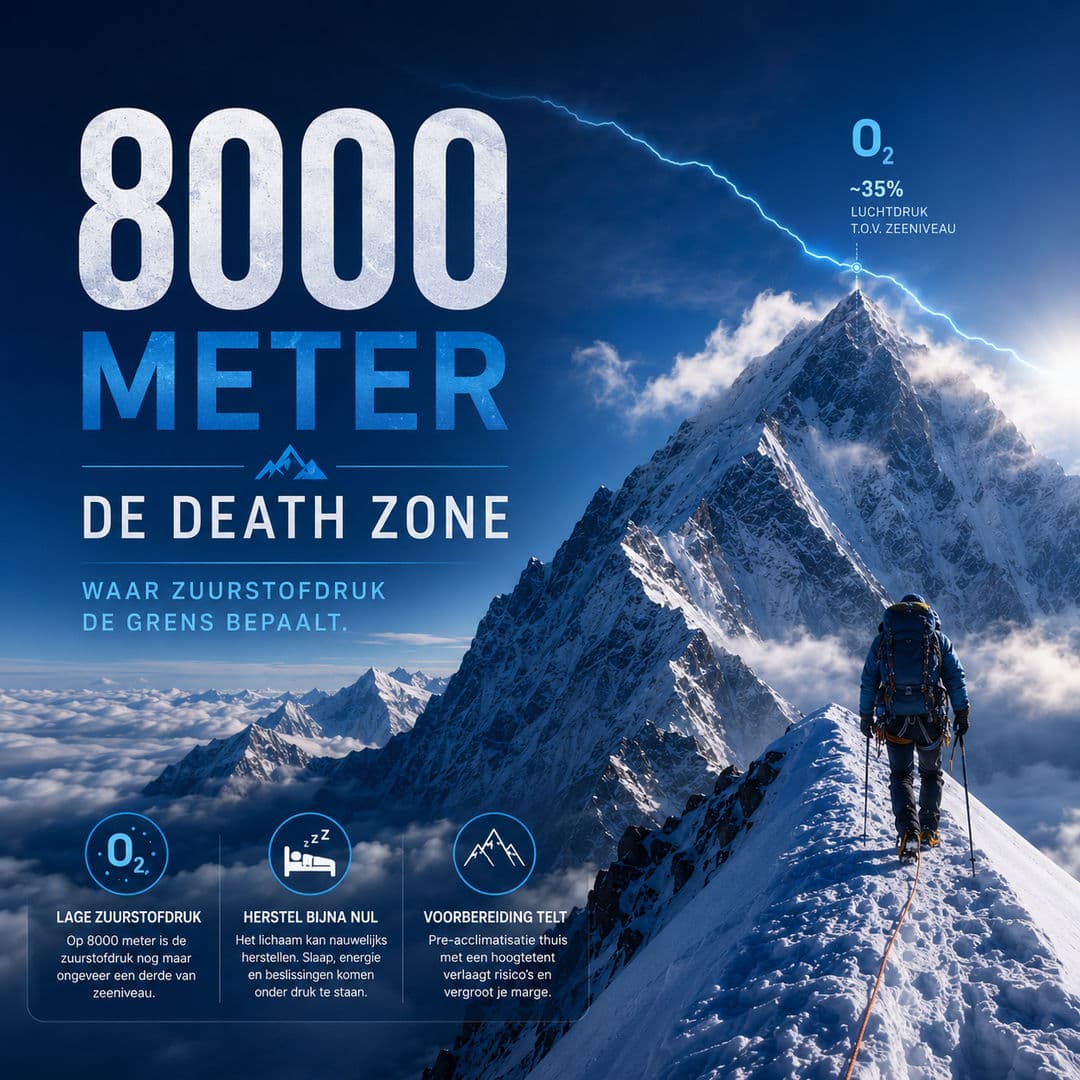
Oxygen at 8000 metres is not the same as oxygen at sea level. Although the air still contains about 21% of oxygen, the air pressure is so low that each breath provides much less usable oxygen. This is why the zone from about 8000 metres is called the death zone: the body can barely recover there, sleep becomes shallow, thinking slows down and every mistake takes on more weight.
The practical conclusion is clear. Anyone going to an 8,000-metre peak should not start acclimatising only in the mountains. Therefore, such an expedition requires a careful programme with rotations, oxygen strategy, medical preparation and sleeping in an altitude tent beforehand. This makes the preparation more controlled, measurable and planable. For those who want to understand the oxygen context first, the height to oxygen table as a basis.
Short answer: at 8000 metres, air pressure is only about a third of sea level. Consequently, the oxygen pressure drops sharply, while the oxygen percentage in the air remains almost the same. So you do not inhale less oxygen percentage, but much less oxygen pressure per breath. This is precisely what makes prolonged stays above 8000 metres extremely taxing and only justifiable with exceptional preparation.
Conclusion: the death zone is mainly a problem of low oxygen pressure, not lower oxygen percentage.
Nuance: an altitude tent does not replace true expedition acclimatisation, but it makes preparation at home much more manageable.
Practical hook: start a controlled pre-acclimatisation plan well before departure, especially for targets above 7000 to 8000 metres.
What exactly does oxygen at 8,000 metres mean?
At 8000 metres, the problem is not that the air is suddenly almost devoid of oxygen. The oxygen percentage remains around 20.9%. The real cause is in the air pressure. As you ascend, the barometric pressure drops. As a result, in the same breathing volume, there are fewer gas molecules, hence fewer oxygen molecules.
For the body, it is mainly the partial pressure of oxygen that counts. It determines how much oxygen can move from the lungs into the blood. At sea level, this pressure is high enough to almost completely saturate haemoglobin. Around 8000 metres, however, the margin becomes extremely small. Even with acclimatisation, oxygen supply therefore remains vulnerable.
This is why the death zone feels different from 4,000, 5,000 or 6,000 metres. At lower altitudes, the body can still compensate relatively well. Above 8000 metres, compensation remains possible, but not fully. Thus, breathing speeds up, the heart rate rises and the body tries to use energy more sparingly. Still, the deficit remains large.
Important insight: those who say there is “less oxygen in the air” at 8000 metres usually mean that there is less oxygen pressure available. That distinction is important because acclimatisation is mainly about coping better with low oxygen pressure.
Oxygen at 8000 metres in figures
Exact values vary due to weather, temperature and air pressure. Nevertheless, a practical range helps to understand the situation. The table below therefore does not give a medical opinion, but a physiological framework. The actual response varies from person to person and from expedition to expedition.
| Height zone | Air pressure indication | Practical oxygen context | Significance for the climber |
|---|---|---|---|
| 0 m | About 100% | Full oxygen pressure | Normal sleep, recovery and exercise possible. |
| 4000 m | About 60% | Obvious hypoxic stimulus | Acclimatisation becomes important, especially when sleeping. |
| 5500 m | About 50% | Basecamp-like load | Recovery slows and rotations become decisive. |
| 7000 m | About 40% | Very limited oxygen pressure | Any effort requires planning, rest and monitoring. |
| 8000 m | About 35% | Death zone | Long-term stay is highly stressful and recovery is very limited. |
| 8849 m | About 30 to 33% | Everest summit zone | Decision-making, speed and oxygen strategy become critical. |
Air pressure: about 100%.
Oxygen context: full oxygen pressure.
Significance: normal sleep, recovery and exercise possible.
Air pressure: about 60%.
Oxygen context: obvious hypoxic stimulus.
Significance: acclimatisation becomes important, especially when sleeping.
Air pressure: about 50%.
Oxygen context: basecamp-like load.
Significance: recovery slows and rotations become decisive.
Air pressure: about 40%.
Oxygen context: very limited oxygen pressure.
Significance: any effort requires planning, rest and monitoring.
Air pressure: about 35%.
Oxygen context: death zone.
Significance: prolonged stay is highly stressful and recovery is very limited.
Air pressure: about 30 to 33%.
Oxygen context: Everest summit zone.
Significance: decision-making, speed and oxygen strategy become critical.
These figures explain why 8000 metres is a fundamentally different environment from a classic trekking altitude. Your body is constantly working against a low oxygen supply. As a result, even moving slowly feels heavy. Even simple actions take more time, more breathing and more mental discipline.
Why is this called the death zone?
The term death zone sounds dramatic, but it has a clear physiological basis. Above about 8000 metres, oxygen pressure is so low that the body cannot recover properly. You can function there temporarily, but you hardly build up any margin. This greatly increases the chances of mistakes, exhaustion and altitude problems.
Added to this, the death zone usually coincides with other risk factors. Think extreme cold, wind, dehydration, sleep deprivation, long summit days, technical terrain and limited rescue options. So oxygen deprivation does not stand alone. It amplifies everything that is already difficult.
A well-prepared climber therefore tries to limit time above 8000 metres. The strategy is not “be strong and stay long”. Much wiser is: arrive as prepared as possible, move efficiently, decide early and descend as quickly as possible.
Death zone thinking: wrong versus wise
Wrong: seeing the death zone as a place where character and willpower allow you to stay longer.
Sensible: see the death zone as a temporary passage where preparation, speed, oxygen strategy and decision-making come together.
What happens in your body above 8,000 metres?
At extreme altitude, your physiology shifts to survival. Your breathing increases to take in more oxygen. At the same time, your heart rate increases so that oxygen is transported faster. In addition, your body distributes energy more economically. Yet your ability to retain heat, think clearly and perform physical labour decreases.
Sleep also becomes more difficult. Especially during sleep, hypoxia is often more noticeable. Many climbers breathe periodically, wake up frequently and recover poorly. This is why sleeping in an altitude tent beforehand is so relevant. You are then already using sleep at home as a controlled hypoxic stimulus well before you get to the mountains.
In addition, symptoms may arise that you should take seriously. Headaches, nausea, dizziness, shortness of breath, confusion, loss of coordination and unusual fatigue are not noise. They can fit with altitude problems. Those who want to learn to recognise those signs should take the symptoms and risks of altitude sickness know clearly in advance.
Reality check: fitness does not fully protect against altitude sickness. A strong motor helps with strain, but acclimatisation remains a separate physiological process. Ambitious climbers in particular may be at risk because they sometimes compensate for symptoms for too long.
Why pre-sleeping in an altitude tent becomes essential at 8000m goals
On an 8,000-metre expedition, sleeping in an altitude tent beforehand is no luxury extra. It is a serious preparatory layer. Not because an altitude tent replaces the mountain, but because you can already build up a controlled hypoxic stimulus at home. As a result, you don't leave completely “cold” towards the first altitude zones.
An altitude tent works with normobaric hypoxia. This means that the air pressure in the chamber remains the same, while the oxygen percentage in the inhaled air is reduced. As a result, the body experiences a hypoxic stimulus during sleep. This fits the principle of live high, train low: sleep under lower oxygen availability, while exercising and recovering normally during the day.
For 8,000-metre targets, this is important for three reasons. First, you can gradually get used to sleeping with less oxygen. Next, you can track your response objectively with SpO2, sleep quality, morning feeling and recovery. Third, you can detect problems earlier, even before you are in a remote expedition environment.
This does not make preparation risk-free. An altitude tent does not 100% guarantee against altitude sickness. Nor does it replace real acclimatisation, rotations or medical expedition supervision. It does, however, make the process controlled, measurable and planable. This can significantly reduce the risk of complaints, especially if the set-up is done carefully.
Oxygen at 8000 metres and the right pre-acclimatisation plan
An altimeter programme for an 8000-metre expedition needs to be planned broadly. In practice, this usually requires several weeks. The longer and higher the goal, the less useful a last-minute approach is. This is because the body responds to repeated stimuli, not one extreme night.
The build-up should start slowly. So you don't immediately start on a very high simulation. First see how you sleep, how your morning reading responds and how your recovery feels. After that, you can incrementally increase. The assembly diagram for the high altitude tent helps drive that progression not by feel, but by response.
Practical protocol for 8000m preparation
Phase 1: start getting used to sleeping under mild hypoxia. At this stage, maintaining sleep quality is the main goal.
Phase 2: increase only when morning feeling, SpO2 trend and recovery remain stable. This prevents the stimulus from rising too fast.
Phase 3: Build towards expeditionary altitude incentive, but don't sacrifice sleep quality structurally. Otherwise, you will lose more than you gain.
Phase 4: fine-tune the last week for departure date, travel stress, equipment planning and expedition route. Big experiments do not belong then.
For extreme heights, consistency is more important than aggression. Building up too quickly can disrupt sleep and undermine recovery. This makes the approach counterproductive. So the goal is not to sink as deep as possible in SpO2 at home. The goal is to find a useful stimulus that your body processes.
| Phase | Target | Monitoring | Adjust |
|---|---|---|---|
| Start | Getting used to sleeping in hypoxia | Morning feeling, sleep quality, SpO2 trend | Do not increase in case of poor sleep or obvious complaints. |
| Construction | Gradually more incentive | Stable trend over several nights | Increase only if the response remains calm. |
| Deepening | Expedition-specific load simulation | Recovery, resting heart rate, alertness | Downshift in case of fatigue or worse training. |
| Last week | Leaving with stable response | Sleep, energy, complaint-free feeling | No more experimental big jumps. |
Objective: Getting used to sleeping in hypoxia.
Monitoring: morning feeling, sleep quality, SpO2 trend.
Adjustment: Do not increase in case of poor sleep or obvious complaints.
Objective: gradually more incentive.
Monitoring: stable trend over several nights.
Adjustment: increase only if the response remains calm.
Objective: simulate expedition-specific loading.
Monitoring: recovery, resting heart rate, alertness.
Adjustment: downshift in case of fatigue or worse training.
Objective: leaving with stable response.
Monitoring: sleep, energy, complaint-free feeling.
Adjustment: no more experimental big jumps.
Common misconceptions about the death zone
There are many persistent misconceptions around 8000 metres. Some sound logical, but can provoke wrong choices in practice.
Misunderstandings better corrected in advance
- “I am fit, so altitude will suit me.” Fitness helps, but does not fully predict your hypoxia response.
- “A low SpO2 is always good training.” Too low or too long can actually undermine recovery and sleep quality.
- “Supplemental oxygen solves everything.” Oxygen can help, but does not replace route planning, acclimatisation or turn-around discipline.
- “Headaches are just part of it.” Headaches can be mild, but should always be assessed in context.
- “The summit is the end goal.” On 8,000-metre expeditions, descending safely is at least as important as reaching the summit.
The danger of these misconceptions is that they shift the focus from preparation to character. In the death zone, it is usually not the most optimistic climber who wins, but the best prepared climber with the best decision discipline.
This is how you monitor this lens
Objective monitoring starts at home. Especially with an altitude tent, this is valuable because you can monitor the response in a safe environment. Never use SpO2 as a loose absolute truth. Therefore, always look at the trend, in combination with sleep, recovery and complaints.
A morning measurement in the tent gives a useful signal. Yet you should not interpret that measurement in isolation. Was your sleep restless? Did you wake up often? Is your resting heart rate elevated? Do you feel head pressure, nausea or unusual fatigue? Together, these signs form the picture.
For those working with this, it is useful to know in advance what saturation in the altitude tent normal can mean. Even then, the premise remains: trends are more important than a single snapshot.
Decision rules for adjustment
Do not increase If your sleep gets noticeably worse several nights.
Stay stable if your SpO2 is lower, but sleep, recovery and morning feeling remain good.
Switch back in case of headache, tightness of breath, dizziness or noticeable recovery loss.
Get medical advice when in doubt, existing conditions or previous severe altitude complaints.
In the mountains, the same logic applies, but with less margin. Therefore, watch for loss of tempo, unusual shortness of breath, coordination, appetite, mood and clarity. The signs of oxygen deficiency should be known in the team, so that someone does not have to rely only on themselves.
Practical preparation for an 8000m expedition
A strong plan combines several layers. The altitude tent is one important layer, but not the only one. You also need a realistic expedition route, sufficient rotation days, a clear oxygen strategy, medical screening, equipment discipline and decision-making agreements.
Pre-departure checklist
- Plan several weeks of pre-acclimatisation, not just the last few days.
- Use SpO2 as a trend, along with sleep quality and recovery.
- Lay down in advance when you won't increase or just scale back.
- Discuss previous altitude complaints with a doctor or expedition doctor.
- Match altitude tent structure to travel date, route and rotation schedule.
- Train qualitatively during the day, without forcing the hypoxic sleep stimulus.
- Make team agreements on turn-around time, oxygen use and emergency scenarios.
The main difference between 6000 metres and 8000 metres preparation is the margin of error. At 6000 metres, you can sometimes still correct. Above 8000 metres, however, correcting becomes more difficult, slower and riskier. That's why most of the thinking should already be done at home.
When is an altitude tent especially relevant?
An altitude tent is especially relevant when your target altitude is high enough to seriously affect sleep, recovery and acclimatisation. For an 8000m expedition, this is clearly the case. The question then is not whether hypoxic preparation has value, but how carefully you build it up.
The altitude tent is less suitable as a last-minute emergency solution. It is also no substitute for medical supervision for risk profiles. If you have heart, lung or blood-related conditions, consult a doctor beforehand. The same applies in case of previous HAPE, HACE or severe AMS.
For healthy and well-trained expedition climbers, an altitude tent can actually be a strong preparation tool. You replicate the hypoxic stimulus at home. Then you see how your body reacts. Moreover, you can still make adjustments without expedition pressure.
Sources and medical context
For this article, we drew on generally accepted altitude medicine principles from, among others, the CDC Yellow Book guidelines on altitude sickness, the MSD Manual on AMS, HAPE and HACE, and the UIAA Medical Commission on established methods of acclimatisation.
Prepare your 8000m expedition in a controlled way
If you're heading for an 8,000-metre peak, you don't want to discover only in the mountains how your body reacts to extreme hypoxia. With an altitude tent, you make pre-acclimatisation at home measurable, plannable and better aligned with your expedition route.
Conclusion: death zone requires preparation before expedition
Oxygen at 8000 metres is all about pressure, not percentage. The air still contains about the same fraction of oxygen, but the low air pressure makes each breath much less effective. As a result, above 8000 metres, the body enters a zone where recovery barely takes place and errors feed through faster.
This is precisely why a serious 8,000-metre expedition does not start at basecamp. It starts weeks earlier, at home. Sleeping in an altitude tent beforehand makes that preparation controlled, measurable and planable. It does not reduce risks to zero, but it can significantly reduce the likelihood of altitude problems when it is part of a broader acclimatisation plan.
The death zone remains extreme. Yet there is no need to go into it unprepared. Those who understand the physiology, monitor the signals and build up the hypoxic stimulus well in advance will leave with more margin. And at 8000 metres, margin is not a detail, but an essential component of safety and success.
FAQ on oxygen at 8000 metres
Is there less oxygen in the air at 8,000 metres?
The oxygen percentage remains about the same, around 20.9%. However, due to the much lower air pressure, the oxygen pressure per breath is sharply lower. That is the real problem.
Why does the death zone start around 8000 metres?
Around 8000 metres, oxygen pressure is so low that the body can barely recover. As a result, prolonged stays become extremely stressful and risky.
Does an altitude tent help when preparing for 8,000 metres?
Yes, as part of a careful plan. An altitude tent makes pre-acclimatisation at home controlled, measurable and planable. However, it does not replace real acclimatisation on the mountain.
Should you use SpO2 at 8000 metres as a hard limit?
No. SpO2 should always be assessed as a trend. Therefore, combine the value with sleep, recovery, complaints, exercise tolerance and mental clarity.
Can you completely avoid altitude sickness with an altitude tent?
No. An altitude tent can significantly reduce the risk of complaints, but does not guarantee 100%. Route, pace, rotations, health and decisions remain decisive.