Acclimatising at home for mountain expeditions: acclimatising for 5000m with the right pace and rest days
Published 10 January 2026 · 5 min read
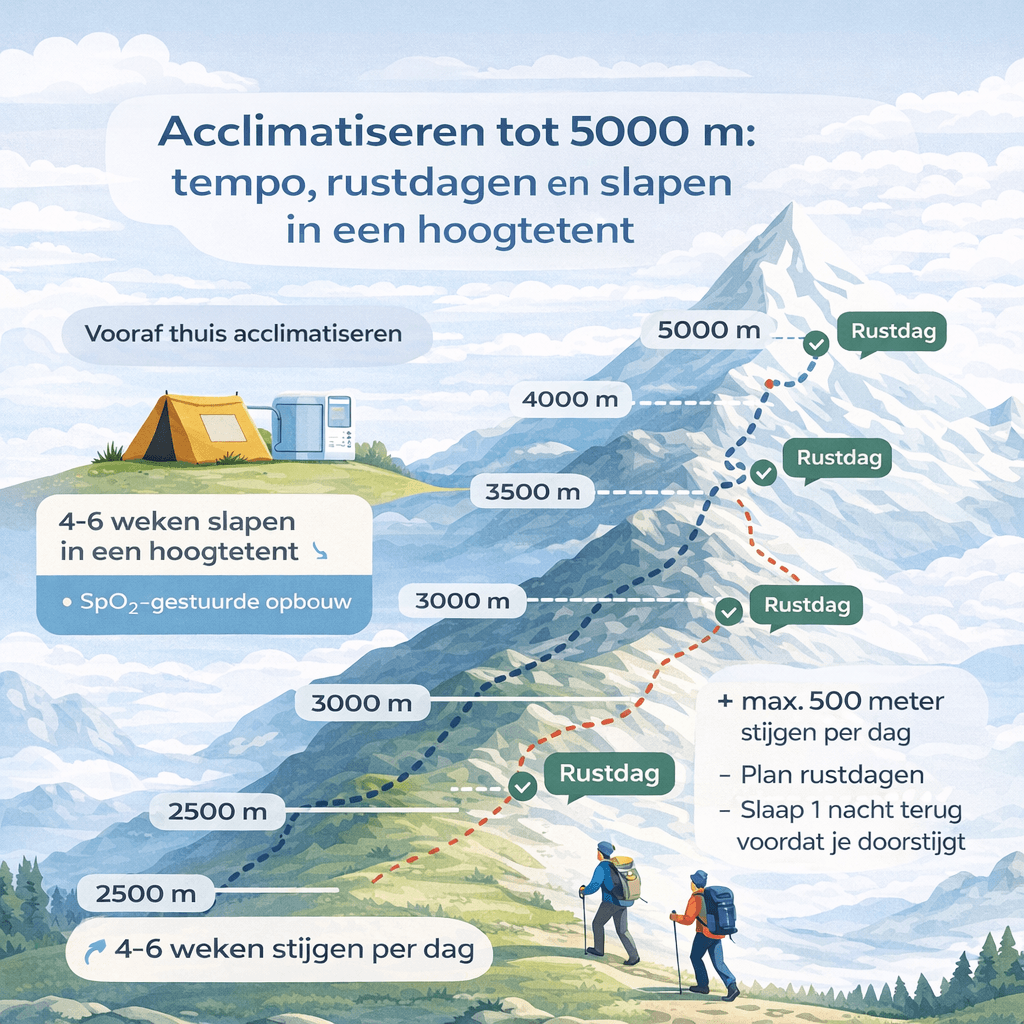
Mountain travel home acclimatisation for mountain expeditions is increasingly used by mountain hikers and expeditioners who want to prepare properly for a trek up to 5,000 metres in altitude. At Altitude Dream, by this we mean very specifically: 4 to 6 weeks sleeping in an altitude tent, where the oxygen stimulus is built up in a controlled way based on your measured oxygen saturation (SpO2). This can help you get off to a calmer start the first few days at altitude, but it does not change the basic rule: pace and rest days remain leading.
In this article you will read how home acclimatisation with an altitude tent works towards 5000 m, which physiological adaptations are central, how to use pace and rest days smartly and which pitfalls you absolutely want to avoid. The goal is not faster uphill, but controlled and responsible acclimatisation.
What does home acclimatisation mean for mountain expeditions?
Acclimatisation at home is pre-acclimatisation: you already give your body a controlled hypoxia stimulus repeatedly before departure. In practice, for mountain travellers this is usually done by to sleep in an altitude tent (LLSH: live low, sleep high), in which the oxygen percentage is reduced while air pressure remains the same (normobaric hypoxia).
The key principle is that you are not aiming for “a height”, but a physiological stimulus that matches your response. Therefore, the set altitude of the altitude generator is individually determined and built up incrementally based on measured SpO2. This helps to dose: enough stimulus for adaptation, without unnecessary recovery stress.
Acclimatising at home will never replace acclimatising on the mountain. Think of it as a head start on your first few days, not a licence to climb faster.
Why is 5000 metres a critical turning point?
Around 5000 metres, oxygen availability decreases sharply. Oxygen saturation (SpO2) drops noticeably in most people, even at rest. This is also the altitude region where complaints of acute altitude sickness (AMS) are more common, especially if the pace is too high or there are too few rest days.
Characteristic of this altitude zone:
- Faster drop in SpO2 on exertion
- Greater stress on the respiratory and cardiovascular system
- More impact of poor sleep on recovery
- Smaller difference between ‘feeling good’ and actually being physiologically burdened
This is precisely why acclimatisation towards 5000m is all about pacing, rest days and self-observation, not pushing forward.
The physiology behind acclimatising at home with an altitude tent
SpO2 as a practical guide
When acclimatising at home, it is not the “altitude setting” that is central, but your body's response. SpO2 helps to track that response more objectively. If you build up too quickly, you often see this reflected in worse sleep, higher recovery stress and an SpO2 that does not stabilise.
By gradually building up exposure, the body learns, among other things:
- breathing more efficiently at lower oxygen availability
- better management of nocturnal hypoxia (sleep in the tent)
- faster recovery from hypoxic stimuli
Adaptation without additional stress
A common mistake is “more is better”. Offering too much hypoxia too soon can lead to poorer sleep and a higher stress response. For mountain travellers, precisely sleep quality is one of the most important signals that your build-up is appropriate.
Pace and rest days: the core of acclimatising to 5,000m
Why pace is more important than ambition
Whether you acclimatise beforehand at home or not, the pace during the expedition remains decisive. A realistic starting point towards 5000m is:
- maximum 300 to 500 metres sleep altitude per day above 3000 m
- regularly apply ‘climb high, sleep low’
- deliberately planned acclimatisation days, even if you feel well
You can find in-depth information on a safe acclimation rate in what is a normal acclimation rate per 1000 metres?.
The function of rest days
Rest days are not lost days. They are times when actual acclimatisation takes place. For treks towards 5000m, rest days usually make sense:
- after every 1,000 metres of altitude gain above 3,000 m
- for persistent sleep problems or fatigue
- when complaints do not subside within 24 hours
How does acclimatising at home with an altitude tent fit into this?
Who Sleep in an altitude tent for 4 to 6 weeks and build this properly based on SpO2, can often benefit from:
- a calmer start in the acclimatisation zone (2500-5000 m)
- faster recognition of “normal” altitude sensations versus red flags
- less surprise effect on first nights at altitude
But even then, your route and pace should still be right. Acclimatising at home often makes your margin bigger, not your rules different.
Recommended duration and build-up
For mountain expeditions up to 5000 m, the following guideline applies:
- Minimum: 4 weeks sleeping in a high altitude tent
- Optimal: 5 weeks
- Maximum: 6 weeks
The build-up is gradual and tailored to individual SpO2 measurements. If you want to read through the basics and steps at your leisure, check out Acclimatising at home before a mountain expedition: here's how to do it.
For context by altitude zone, you can also use the height-to-oxygen table use and the article oxygen saturation at altitude: values and interpretation.
Common mistakes when acclimatising towards 5,000 m
- increasing the hypoxia stimulus in the altitude tent too quickly
- ignore sleep quality (poor sleep is a signal, not a detail)
- thinking that pre-acclimatisation makes rest days unnecessary
- dismissing mild, persistent complaints
- comparison with others instead of listening to one's own body
Practical tips for mountain travellers
- Make pace leading: tailor your plan to your recovery, not your ambition.
- Use SpO2 as feedback, but always interpret together with symptoms and progression.
- Plan rest and acclimatisation days in advance in your itinerary.
- Use the altitude tent consistently: sleeping in hypoxia works better than “occasionally”.
- Think of acclimatising at home as preparation, not a guarantee.
Destination guides: examples where 5000m is relevant
Many mountain travellers end up around 5000 m at routes and passes in Nepal, Tibet or on approach routes to larger peaks. Two practical levels:
- the best preparation for a trek to Kilimanjaro or Everest Base Camp
- how to avoid altitude sickness during Everest Base Camp
Experiences of other mountain travellers
Those who want to know how others experience sleeping in an altitude tent towards 5000 m can check out reviews for 5000 metres. See this as context and recognition, not proof that it works the same for everyone.
Summary and advice
Acclimatising at home for mountain expeditions up to 5000m means in practice: 4 to 6 weeks sleeping in an altitude tent, with a gentle build-up based on SpO2. That can help make the start at altitude more manageable, but the core remains: pace and rest days determine your safety and comfort.
For those who want to prepare well and fine-tune in advance what is realistic in their situation, guidance on signal construction and interpretation can make all the difference. Find more information via our rental service.