
Hematocrit and altitude training: what can you realistically expect?
Published 7 March 2026 · 4 min read
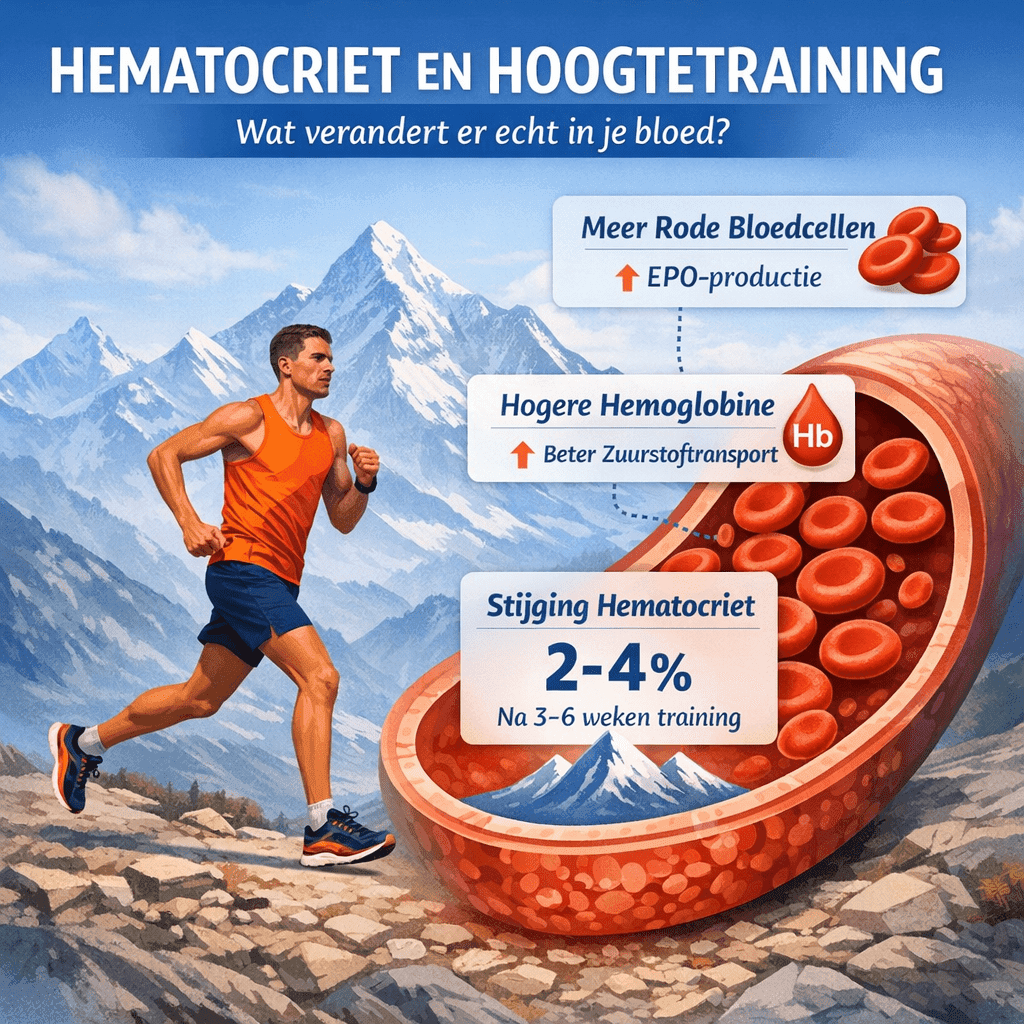
Many athletes start altitude training because they want to improve their want to increase haematocrit. That sounds logical. After all, more red blood cells means more oxygen transport and thus better performance. Yet the effect of haematocrit high often overrated.
In reality, haematocrit usually increases by only a few percentage points. This is enough to improve performance, but it is not a panacea. Moreover, haematocrit is only one part of the overall physiological effect of altitude.
In this article, you will discover:
- what exactly haematocrit is
- how altitude training affects red blood cells
- how much haematocrit can realistically rise
- Why much performance benefit also comes from other adjustments
- how to monitor these changes objectively
For a basic understanding of the entire system behind altitude training, you can also read our explanation of how altitude training works.
What is haematocrit?
Haematocrit is the percentage of your blood volume that consists of red blood cells. These cells contain haemoglobin and transport oxygen from your lungs to muscles and organs.
A higher haematocrit usually means your body can carry more oxygen. This is important for endurance athletes such as runners, cyclists and triathletes.
Average values in healthy adults:
- men: about 41 to 50 per cent
- women: about 36 to 44 per cent
In well-trained endurance athletes, values tend to be slightly higher. Yet it is not only haematocrit that determines how much oxygen eventually reaches your muscles.
Why high training can increase haematocrit
When you stay at altitude, the oxygen pressure in the air is lower. Your body responds to this with a number of adaptations designed to improve oxygen transport.
One of the main reactions is an increase in the hormone EPO (erythropoietin). This hormone stimulates the production of new red blood cells in the bone marrow.
This process involves several steps:
- lower oxygen pressure is detected by the kidneys
- the kidneys produce more EPO
- the bone marrow makes extra red blood cells
- haematocrit and haemoglobin increase gradually
If you want to understand more deeply how this mechanism works, also read our article on How altitude training increases your EPO levels.
How much does haematocrit rise with altitude training?
This is where the biggest misconception often arises. Many athletes expect big changes. In reality, the increases are usually modest.
Typical haematocrit rise
| Training duration | Average increase |
|---|---|
| 2 weeks | 0 to 1 per cent |
| 3 to 4 weeks | 1 to 3 per cent |
| 6 weeks | 2 to 4 per cent |
This seems little. Yet even a small increase in red blood cells can have a noticeable effect on VO2max and aerobic performance.
Indeed, the overall performance benefit of high training does not come from haematocrit alone.
Why haematocrit is not the whole story
Many studies show that performance sometimes improves without a clear increase in haematocrit. This is because altitude training causes multiple physiological adaptations.
Key impacts include:
- improved efficiency of mitochondria
- higher capillary density in muscles
- enhanced oxygen extraction
- increased buffer capacity
This explains why some athletes experience big performance improvements while their blood levels hardly change.
You can read an overview of these mechanisms in the physiological benefits of altitude training.
Why some athletes barely see haematocrit rise
The response to altitude training varies greatly between individuals. Some athletes respond strongly, others hardly at all.
Key factors are:
- genetic predisposition
- iron status
- training level
- duration of exposure to altitude
- sleep duration in hypoxia
For example, iron deficiency can limit red blood cell production. Therefore, nutrition during high-altitude training is crucial. Read more about this in iron and nutrition during altitude training.
Sleep high train low and haematocrit
Most modern altitude training programmes use the so-called sleep high train low principle. This involves sleeping in hypoxic conditions but training at lower altitudes.
The advantage of this is that you:
- receives sufficient hypoxic stimulus
- can continue intensive training
- prevents excessive fatigue
This principle is also used when training at home with an altitude tent. A detailed explanation can be found in sleep high train low.
Altitude tent and haematocrit
A height tent simulates height via normobaric hypoxia. The air pressure remains the same, but the oxygen percentage is reduced.
The main training stimulus occurs during sleep. During several hours of hypoxia per night, the body can start the same adaptation processes as at natural altitude.
Key principles are:
- incrementally building up height
- at least 7 to 9 hours of sleep in hypoxia
- Using SpO2 to track adaptation
An altitude tent is no substitute for acclimatisation in the mountains. However, it does make the process controlled, measurable and planable.
This is how you monitor this lens
The effects of altitude training are best monitored through multiple parameters. Measuring only haematocrit is insufficient.
1. SpO2 trend
Measure your oxygen saturation regularly during rest or sleep. The absolute value is less important than the trend over several days.
2. Sleep quality
Sleep quality is a good indicator of adaptation. When sleep deteriorates sharply, altitude may have built up too quickly.
3. Recovery feeling
Pay attention to signals such as fatigue, resting heart rate and training recovery.
Practical decision rule:
If SpO2 drops for several days in a row or sleep quality deteriorates sharply, temporarily lower the simulated altitude.
Realistic expectations for athletes
In summary, you can expect from altitude training:
- a small increase in haematocrit
- an increase in haemoglobin mass
- better oxygen utilisation
- possibly higher VO2max
The biggest gains usually come from the combination of multiple adaptations, not from a single blood value.
Conclusion
Hematocrit is an important part of the physiology behind altitude training, but it is only one piece of the puzzle.
Realistically, haematocrit usually increases by a few percentage points. This may seem small, but when combined with other adjustments, it can still produce a noticeable performance improvement.
Those who apply altitude training intelligently therefore focus not only on blood values, but on the entire adaptation process.


