High-training sleep quality: what the science really shows
Published 2 March 2026 · 3 min read
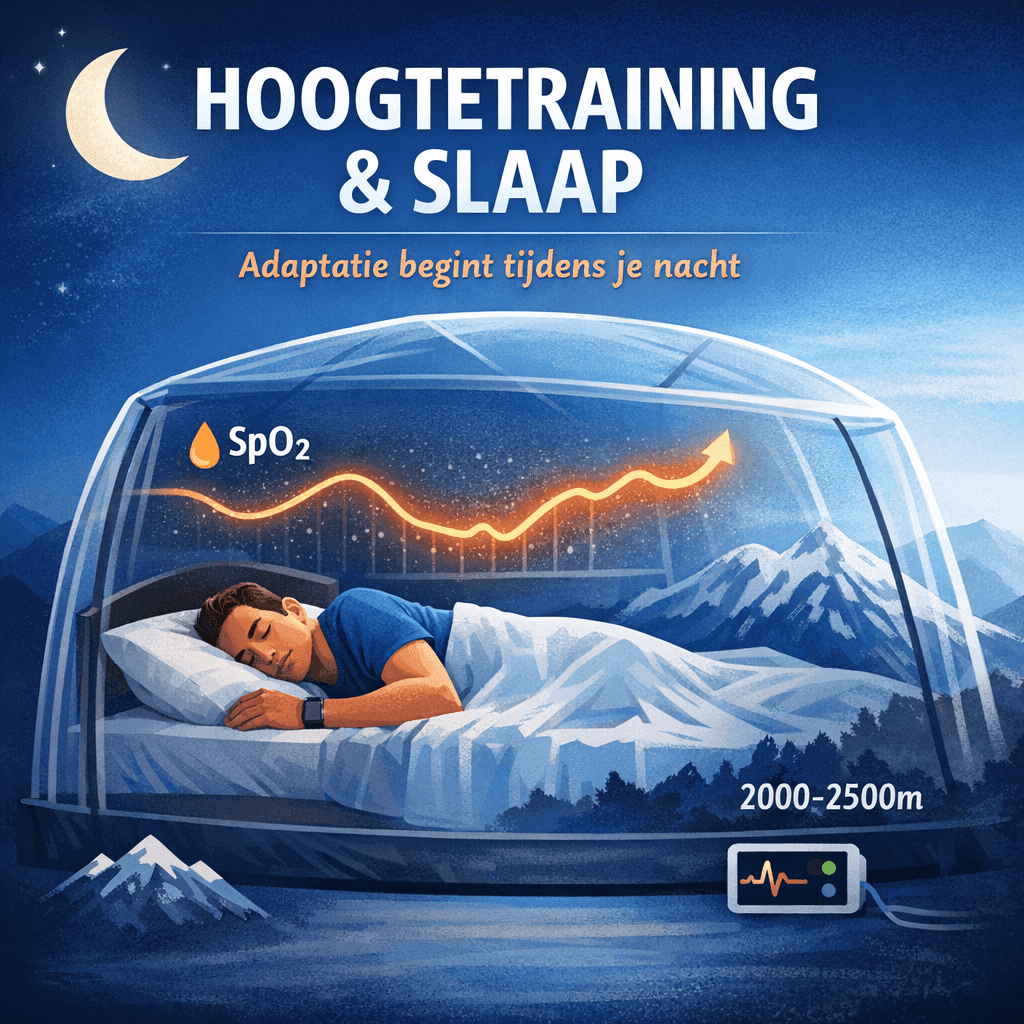
High-training sleep quality is a subject on which there are many misunderstandings. Some athletes fear worse nights, others automatically expect better adaptation. The truth is more nuanced. Scientific research shows that sleep can change temporarily during altitude training, but that this process is part of physiological adaptation. If constructed correctly, sleep can actually become a powerful adaptation stimulus.
The core insight: sleep disruption in the first few days is normal. Structurally worse sleep need not be. The difference is in dosage, accrual and monitoring.
Why altitude training can temporarily affect sleep quality
When you train or sleep in an environment with less oxygen, your body reacts immediately. In an altitude tent, this happens via normobaric hypoxia. The air pressure remains the same, but the oxygen percentage drops.
What happens next?
- Your breathing speeds up slightly
- Your heart rate rises temporarily
- Your SpO2 drops compared to sea level
This acute reaction can cause the first few nights:
- More light sleep
- Brief nocturnal awakenings
- A subjective feeling of less deep sleep
Important: this is a transitional phase. The body is looking for a new balance.
What research says about sleep during altitude training
Studies on sleeping at altitude show a consistent pattern:
- The first 3 to 7 days slight disruption
- Then partial normalisation
- Improved ventilatory response after adaptation
At a controlled sleep high train low protocol, sleep appears to be the most important adaptation stimulus. It is precisely during sleep that increased EPO production takes place. Read more about this in How high training increases your EPO levels.
The nuance: starting too high more often leads to long-term sleep disruption. Increasing too fast idem.
Why many athletes misinterpret it
A common mistake is to judge a single night as proof that altitude training does not work. That is similar to using one training session to evaluate your fitness.
What matters is the trend.
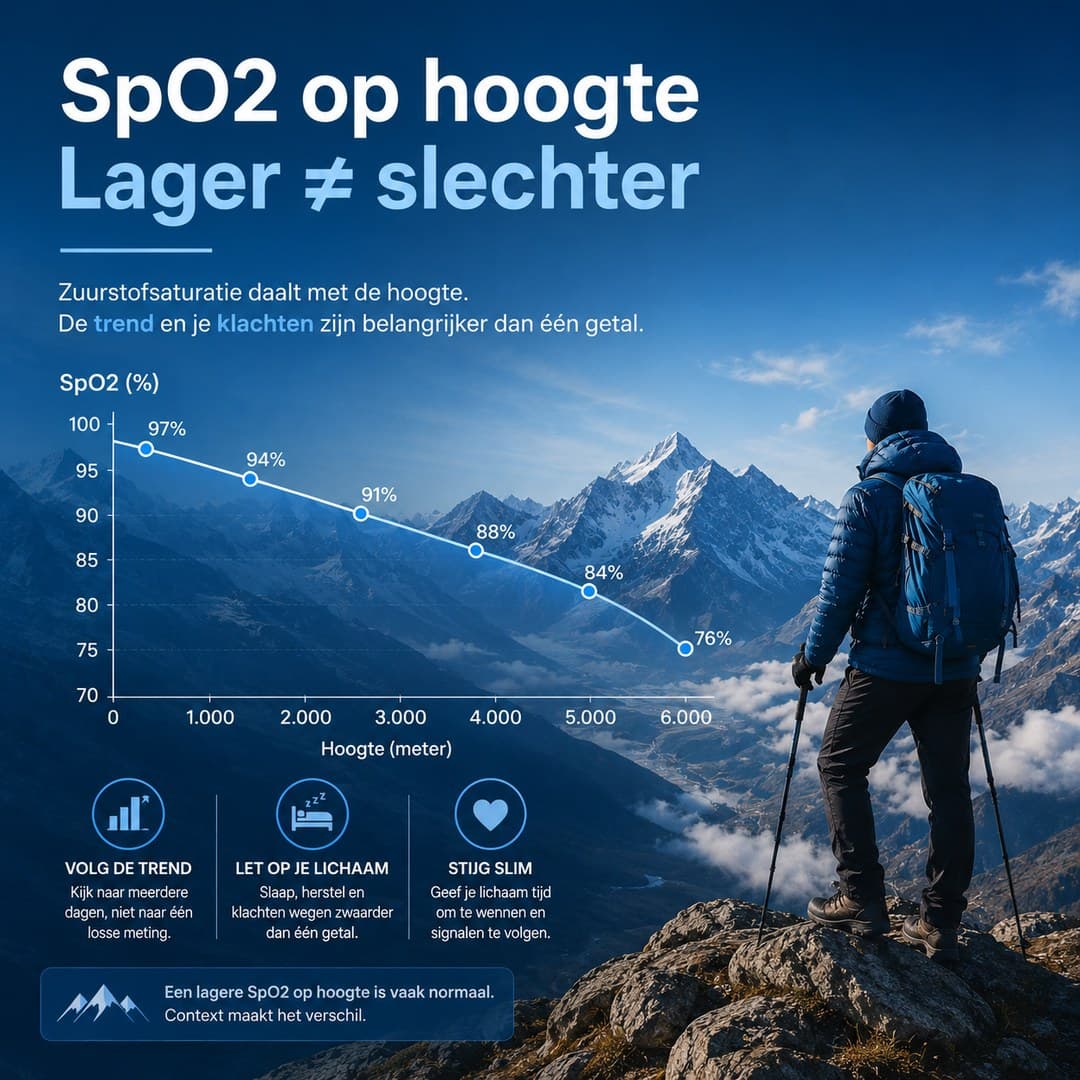
This is why we always recommend looking at oxygen saturation as a trend. More explanation can be found at oxygen saturation at altitude.
How to optimise high-training sleep quality
1. Start conservatively
Start around 2000 metres of simulation. Increase only when SpO2 remains stable.
2. Sleep as a primary stimulus
Adaptation occurs mainly during prolonged exposure. Nighttime exposure of 7 to 9 hours is more effective than short sessions during the day.
3. Increase incrementally
Increase a maximum of 200 to 300 metres per week. Forcing more often leads to sleep fragmentation.
4. Do not combine with heavy training spikes
Intensive blocks and hypoxia together increase recovery stress.
This is how you monitor this lens
Subjective sleep perception is important, but insufficient.
Use at least these three parameters:
- SpO2 trend: Measure daily under the same conditions. Look at 5- to 7-day trend. Drop of more than 3 per cent without stabilisation requires adjustment.
- Sleep quality: Use sleep tracker or subjective scale from 1 to 10.
- Recovery feeling: Morning heartburn, fatigue, headache or mild altitude complaints.
Decision rule: Does sleep quality remain markedly reduced for more than 4 nights and does SpO2 continue to fall? Lower simulation altitude temporarily.
When sleep disturbance is not normal
There are clear boundaries:
- Persistent headache
- Severe insomnia
- Symptoms appropriate for altitude sickness
When in doubt, always read altitude sickness symptoms and risks.
The bigger picture: recovery as an adaptation accelerator
Altitude training is not just about red blood cells. It is about ventilatory adaptation, mitochondrial efficiency and hormonal response.
When sleep quality stabilises, we often see:
- Better morning alertness
- More stable heart rate variability
- Improved training response
That is the moment when high-training sleep quality is no longer an opposition, but a performance lever.
For whom is extra attention to sleep crucial?
- Cyclists in peak blocks
- Triathletes in high training volumes
- Runners with limited recovery capacity
- Athletes with previous sleep problems
In these groups, guidance and SpO2-driven build-up is essential.
Conclusion
High-training sleep quality is not a black-and-white story. Temporary disruption is part of adaptation. Structural deterioration is not.
The key lies in:
- Conservative start
- Trend monitoring
- Stepwise increase
- Sleep as a central adaptation stimulus
When applied correctly, altitude training via normobaric hypoxia can significantly reduce the risk of altitude sickness on expeditions while improving athletic performance.