The impact of altitude training on your sleep quality during long-term use
Published 30 November 2025 · 6 min read
Sleeping in an altitude tent or at high altitude for long periods of time can improve your athletic performance, but it also has a noticeable effect on your sleep quality. In this article, you will discover exactly how altitude training affects your sleep, why some athletes temporarily sleep worse, and which strategies can help you wake up feeling rested. This article is part of our series on optimising altitude training for athletes and mountaineers. See also our comprehensive guides on altitude training for marathon runners and Sleep High Train Low if you wish to proceed with this.
Why sleep quality is a crucial factor in altitude training
Altitude training revolves around controlled exposure to less oxygen. This stimulus stimulates the production of red blood cells and increases your aerobic capacity. But despite the significant benefits, the physiological stress is noticeable. Especially with prolonged use, such as sleeping in an altitude tent for 3 to 6 weeks.
Many athletes experience slight disturbances in their sleep during the first few days of hypoxia. This is normal and part of the acclimatisation phase. However, it is important to monitor this closely, because recovery and sleep are just as crucial as the hypoxic stimulus itself.
How hypoxia affects your body during sleep
1. Increased respiratory drive
When there is less oxygen, your body reacts by breathing faster and deeper. This is called the hypoxic ventilatory response. During sleep, this can vary and even cause fluctuations: periods of deeper breathing are followed by slight pauses in breathing or micro-awakenings. These are usually short and harmless, but they can make sleep feel restless.
2. Melatonin production may temporarily change
Research shows that hypoxia can affect the release of melatonin. This hormone is responsible for your sleep rhythm. The change is small and often temporary, but can lead to slightly longer sleep onset times or lighter sleep during the first few days.
3. Heart rate and variability
Sleeping at altitude slightly increases your resting heart rate. This is because your body has to work harder to pump enough oxygen around. A higher heart rate can affect your sleep deeper into the night, especially for athletes who normally have a very low resting heart rate.
4. More REM suppression in the first few days
Studies show that the body sometimes generates less REM sleep during the first 2 to 4 days at altitude. REM is considered responsible for cognitive recovery. Once acclimatisation sets in, this returns to normal.
What do scientific studies say about sleep quality at altitude?
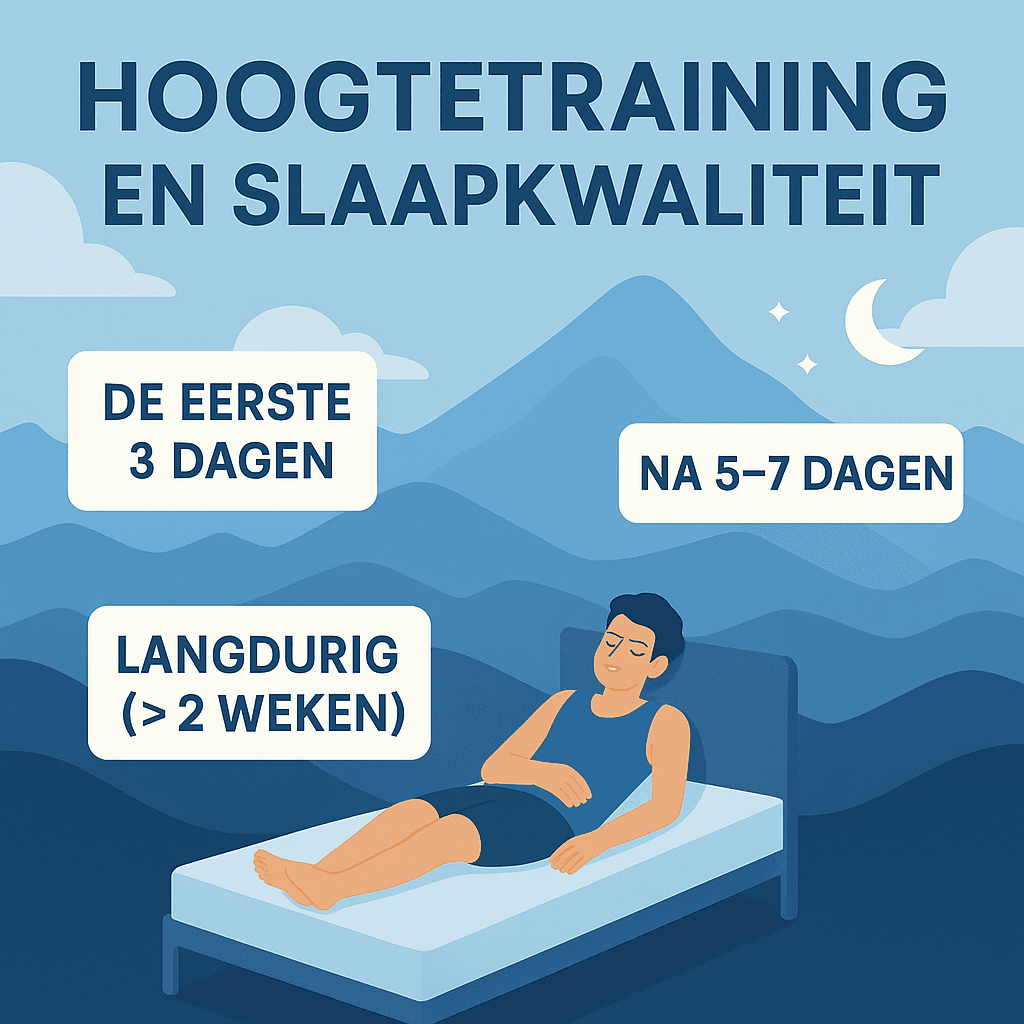
Most scientific literature is surprisingly unanimous: sleep quality declines slightly during the first few days of hypoxia, but stabilises with prolonged use. The body's own adaptation is strong and efficient. Within 5 to 7 days, most athletes notice a clear improvement.
Key findings:
- Acute hypoxia (0 to 3 days): increased respiratory variation, more micro-awakenings
- Subacute phase (3 to 7 days): breathing stabilises, heart rate gradually decreases
- Chronic phase (7 to 21+ days): sleep quality returns to baseline or even improves slightly
Long-term studies of athletes who used altitude tents for 3 to 4 weeks showed that their total sleep duration hardly changed and that the quality returned to normal conditions after the first week.
Why some athletes do experience problems with long-term use
Although most athletes acclimatise quickly, there are a few factors that can have a long-term effect on sleep:
1. Simulation height too high
If the altitude is increased too quickly, the physiological stress remains too high. This leads to restless nights, increased heart rate and sometimes even mild headaches.
2. Sleeping environment that is too warm or too stuffy
A high-altitude tent is always an enclosed space. Without proper ventilation, the temperature can rise slightly, which reduces sleep quality. Modern tents with active ventilation systems remedy this, but not all models offer the same quality.
3. Stress or competition nerves
Occasionally, poor sleep is attributed to altitude training, when in fact the cause is mental tension. This can certainly be a factor just before major events such as a marathon or triathlon.
4. Incorrect use of stimulants
Coffee, pre-workout supplements and alcohol can disrupt sleep quality much more than hypoxia itself. Consistent behaviour is essential during prolonged hypoxia training.
How can you improve your sleep during prolonged altitude training?
Here are proven strategies that help athletes and mountaineers sleep quickly and deeply during hypoxic nights.
1. Build up the height gradually
The golden rule: don't go too high too quickly. At AltitudeDream, we advise most athletes to:
- Start at 1,700 to 2,000 metres
- Increase by 200 to 300 metres every 2 to 3 days
- Maximum safe sleeping altitude: 3,000 metres for recreational athletes, 3,200 metres for well-trained athletes
2. Ensure an optimal temperature
The ideal sleeping temperature in a tent is between 17 and 19 degrees. Use light blankets and ensure adequate ventilation.
3. Use a hypoxic generator with silent operation
Modern generators are low-noise and remain below 57 decibels. This is comparable to soft background noise. Older generators can affect your sleep. Altitude Dream installs standard silent premium models that are suitable for long-term use.
4. Avoid caffeine after 2 p.m.
Athletes who consume caffeine late in the day often sleep worse than athletes who use hypoxia. This often causes confusion, but the solution is simple: limit caffeine after midday.
5. Regular hydration
Sleeping at altitude increases moisture loss through breathing. This can lead to mild dehydration and headaches, which can negatively affect your sleep. Drink plenty of water during the day and possibly an isotonic drink.
6. Utilise a sleep tracker
Wearables such as Garmin, Oura or Polar provide reliable indications of your sleep quality. This allows you to immediately see how your body responds to altitude stress and make timely adjustments.
Long-term use: what does our experience with thousands of customers show?
At AltitudeDream, we have guided thousands of athletes, climbers and expedition members since 2008. The trends are remarkably consistent:
- 80 per cent sleeps as well as normal after 5 to 7 days
- 15 per cent experiences slight sleep disturbance during the first week
- 5 per cent experiences ongoing sleep challenges due to external factors such as stress, heat, noise or excessive altitude
The good news is that almost all problems can be easily solved by adjusting the height correctly and optimising the sleeping environment. With prolonged use, such as 3 to 6 weeks, stability is the norm.
When should you intervene?
In some cases, it is advisable to (temporarily) lower the height:
- Persistent headache lasting longer than 48 hours
- Very restless sleep with no improvement
- Repeated pauses in breathing accompanied by an uncomfortable feeling
- Significant decline in training performance
This rarely indicates a serious problem, but shows that your body needs a little more time. Lower the altitude by 300 to 500 metres and build up again.
Does sleeping at high altitudes for long periods ultimately improve your sleep quality?
Interestingly, many athletes report that after several weeks of hypoxia sleep, they sleep more deeply and peacefully. This is due to:
- Improved oxygen transport capacity
- Lower resting heart rate after the adaptation period
- More efficient breathing during the night
- Higher HRV after several weeks of consecutive stimuli
Properly configured altitude training not only boosts performance, but can also indirectly have a positive effect on your sleep pattern.
Conclusion: long-term altitude training and sleep go perfectly together with the right approach.
Hypoxia training affects your sleep in the first few days due to changes in breathing and a higher heart rate. However, the body adapts quickly. With prolonged use, sleep quality stabilises and often returns to a comfortable level. By building up smartly, optimising external factors and adjusting your sleeping environment correctly, you can get the most out of your altitude training without compromising on recovery.
Would you like personal advice or would you like a rent a height tent or buy? Please feel free to contact Come in for a free consultation.